- The paper demonstrates a compiler-driven control stack achieving sub-microsecond (<700 ns) feedback in modular trapped-ion quantum experiments.
- It employs a six-stage compilation pipeline with strict control/data separation to optimize hardware synchronization and reduce memory footprint by up to 1000x.
- The design decouples host intervention from real-time feedback, enabling scalable multi-board synchronization on a distributed PXIe-class platform.
QuCtrl-BELL: Compiler-Based, Sub-Microsecond Feedback Control for Trapped-Ion Quantum Experimentation
Introduction
The complexity and scalability of trapped-ion quantum systems introduce stringent demands on classical control infrastructures. As ion chains scale and protocols require nested control structures and real-time measurement-based feedback, a fundamental systems challenge arises: balancing sub-microsecond deterministic feedback against maintainable, extensible software abstractions. The "QuCtrl-BELL: A Compiler-Driven Sub-Microsecond Feedback Control Stack for Scalable Trapped-Ion Quantum Experiments" (2605.22433) addresses this challenge through a hardware/software co-design emphasizing explicit control/data separation, modularity, and compiler-driven feedback orchestration targeting a distributed PXIe-class trapped-ion control system.
Trapped-ion experiments universally comprise highly structured sequences—cooling, state preparation, quantum gates, and fluorescence detection, typically using DDS and TTL signal channels synchronized across multiple hardware boards. Feedback protocols, especially real-time branching upon photon detection, necessitate synchronization, tight timing (<1 μs), and iteration- and parameter-sweep logic at the hardware level. The platform (QuCtrl-BELL) integrates DDS/AWG and TTL/TDC boards in a modular PXIe chassis, with a hardware Trigger Clock Manager (TCM) for star-bus coordination supporting up to 24 RF outputs and 32 digital IOs in a single chassis.
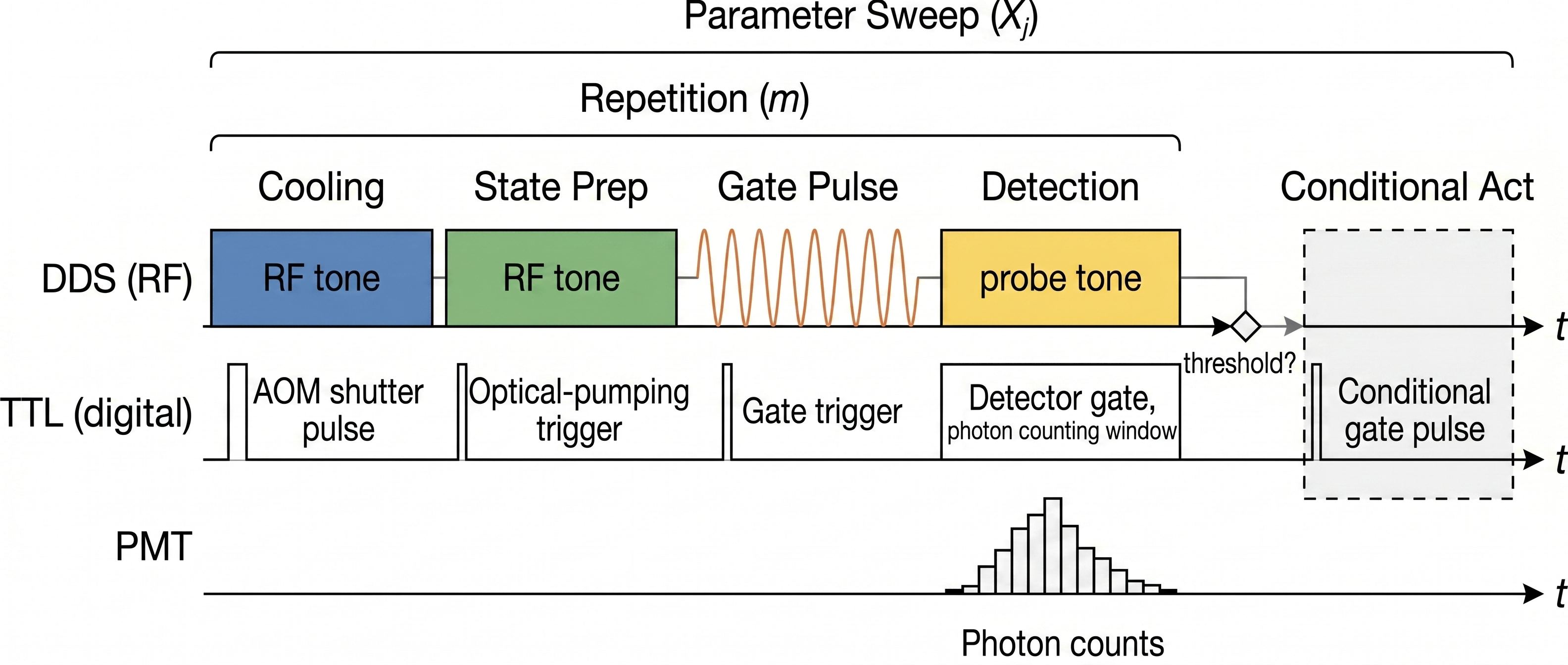
Figure 1: Trapped-ion experiment sequence: cooling, state prep, coherent gate, detection, and real-time feedback with repeated shots and outer parameter sweeps.
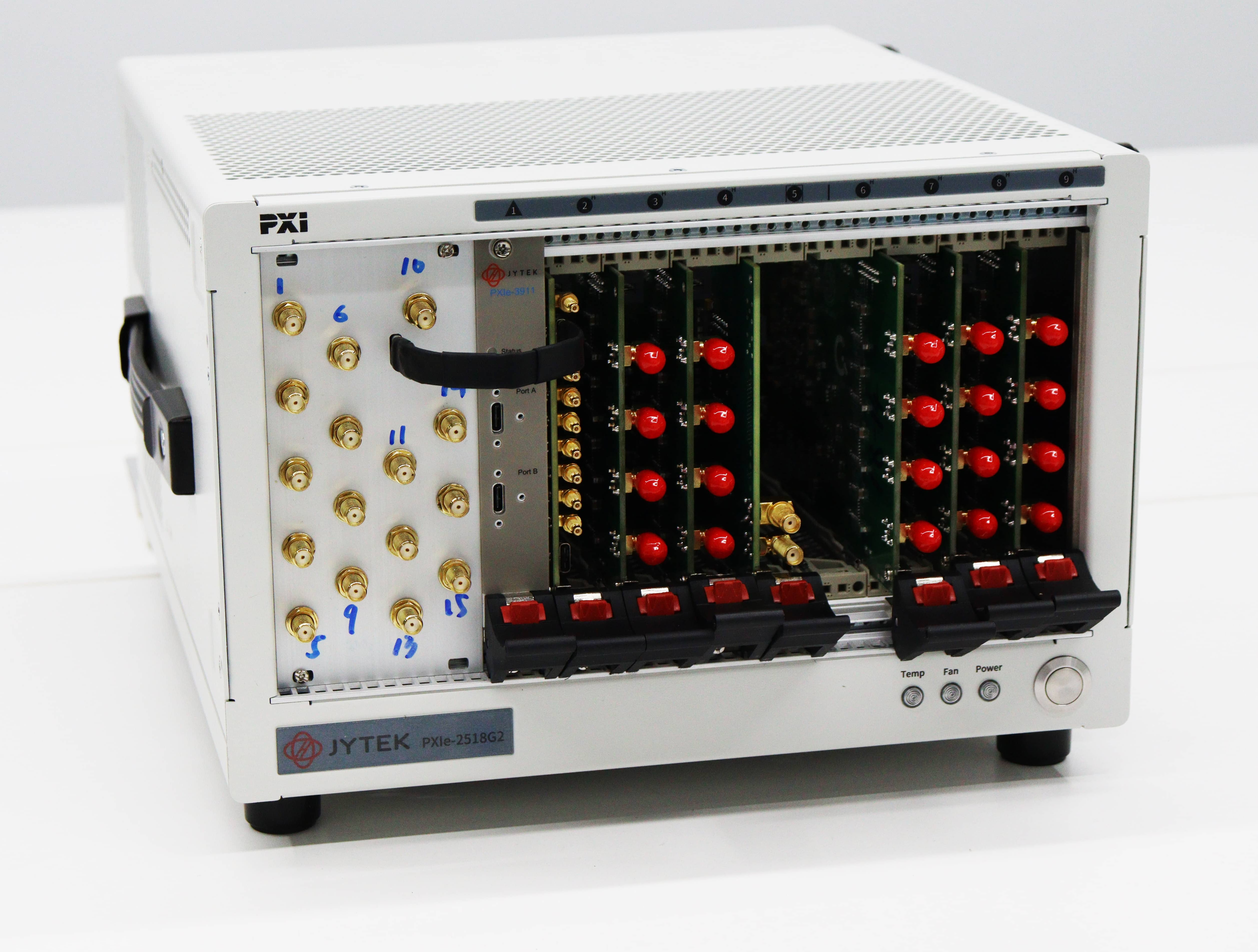
Figure 2: QuCtrl-BELL hardware stack: modular PXIe backplane and TCM-mediated star-bus broadcast for scalable multi-channel control.
Each board hosts a local RISC-V processor, executing hardware-configured step tables with deterministic 4 ns resolution. Cross-board feedback is coordinated via step alignment and TCM broadcasts, enabling the design to achieve <100 ns electronic board synchronization and overall feedback latency dominated by execution and protocol overheads rather than physical signaling.
Software Architecture and Programming Model
The core design tenet is the strict separation of control flow (looping, branching, synchronization) from hardware state management (DDS/TTL configuration), implementing three principles: real-time-first semantics (synchronization and feedback as language primitives), control/data decoupling, and inspectable multi-stage compilation. This underpins a three-tier software stack—a Python-embedded DSL (front end), a platform-agnostic compilation pipeline (middle end), and a hardware-targeted backend translator—to maintain modularity and hardware portability.
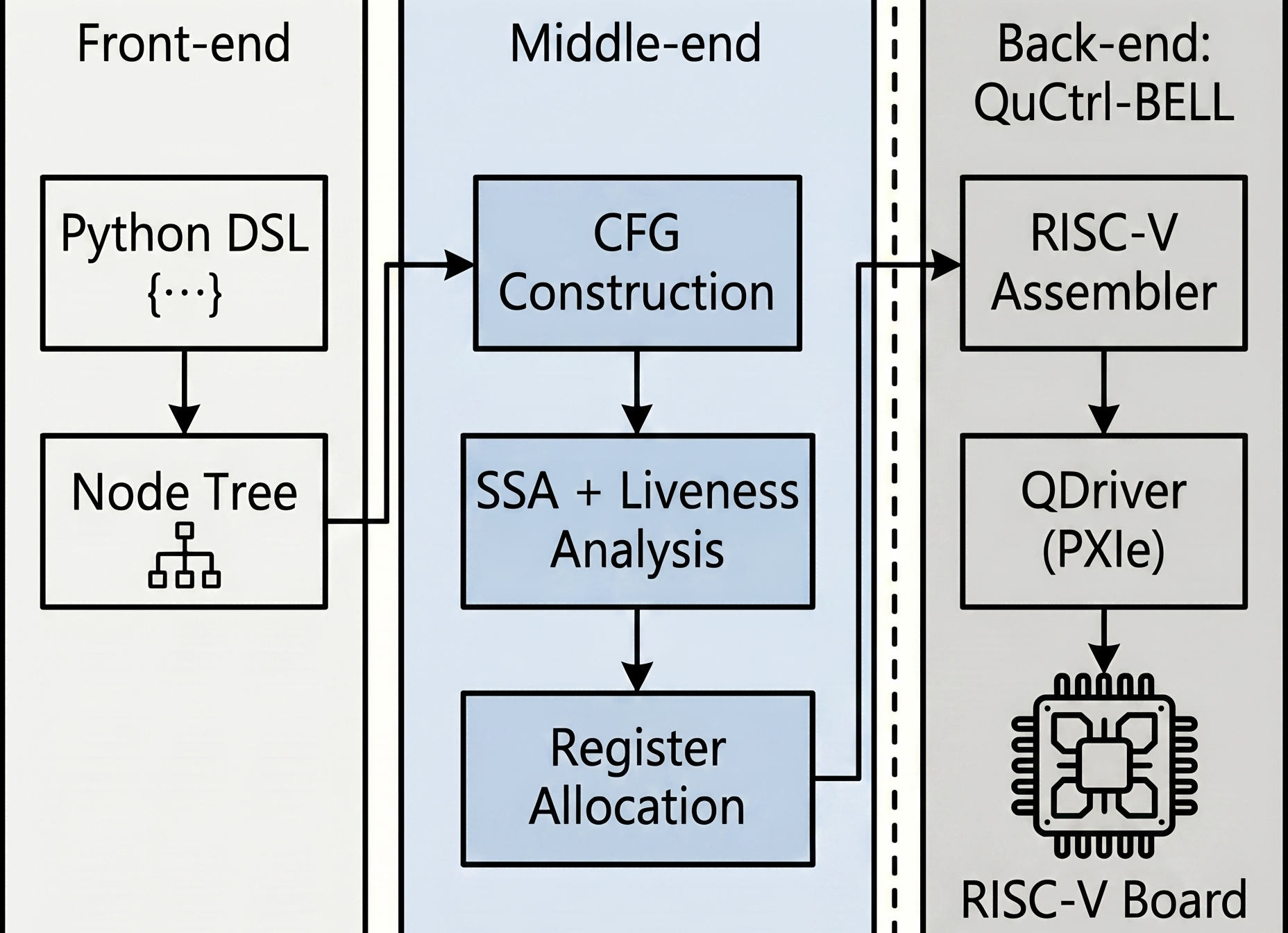
Figure 3: QuCtrl-BELL software architecture: DSL to node tree, CFG/SSA/liveness for control, hardware-parameter step tables, and board-level assembly drivers.
The DSL exposes:
- Channel-level abstraction: Devices as logical channels; States aggregate channel configs.
- Sequence-level composition: Structured blocks (loop, if, else, while) for temporal orchestration.
- Variable-level scoping: Typed, hardware-executed variables for feedback and iteration without host involvement.
A minimal feedback protocol (see Listing 1 in the paper) can be specified as a program loop incorporating real-time photon counting and conditional branching.
Compilation Pipeline
A six-stage pipeline ensures high-level Python logic translates deterministically to hardware assembly, with explicit intermediate representations: node tree, CFG, SSA, liveness, register allocation, and final assembly with step table generation.
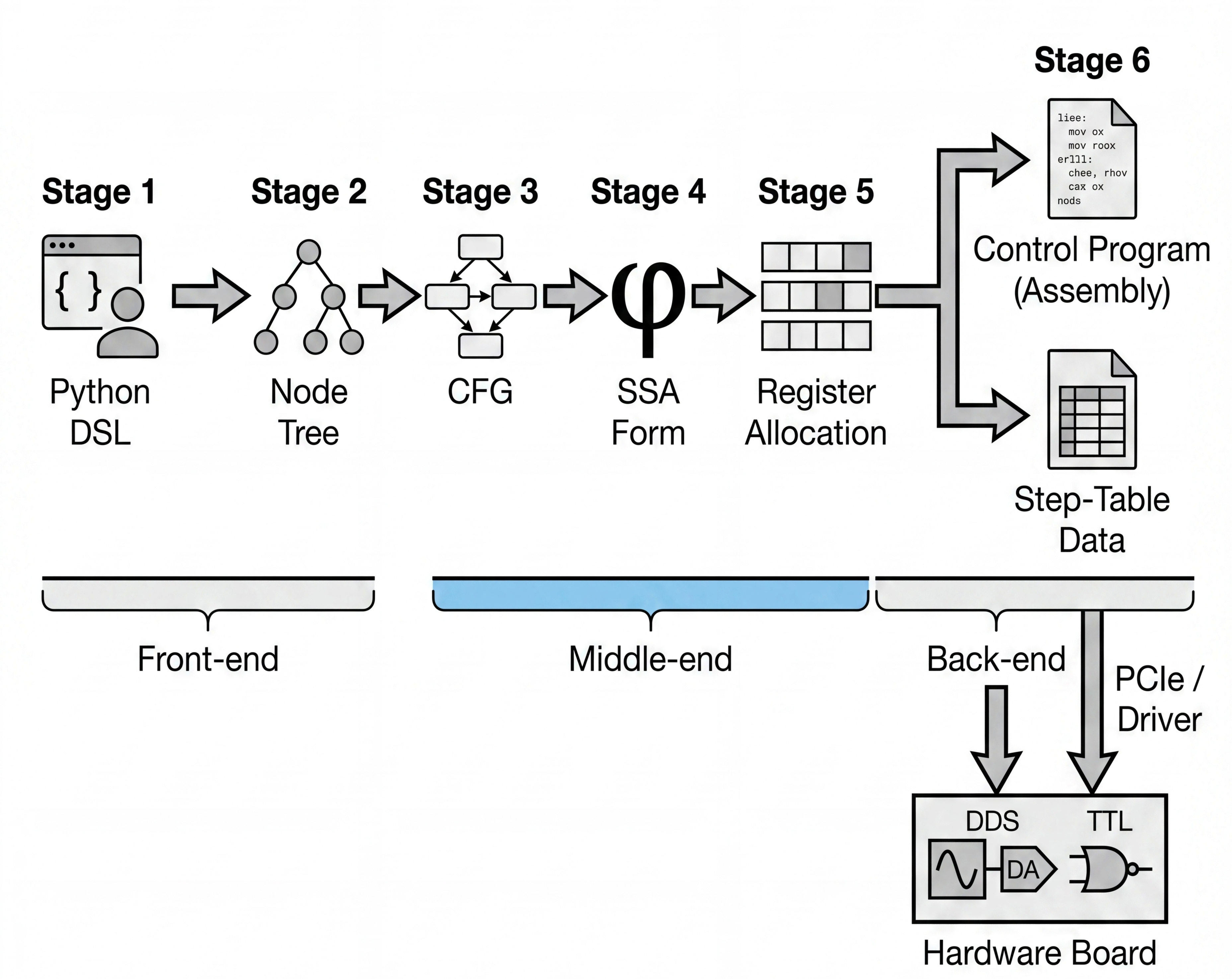
Figure 4: Multi-stage compilation: frontend (node tree, CFG), middle-end (SSA, liveness, register allocation), backend (assembly, step-table emission).
Control programs generate compact instruction streams encoding flow, synchronization, and step-indexing, while hardware state transitions reside in the step table, indexed by the programs at runtime. This design eliminates program bloat with large iteration counts or parameter sweeps and confines hardware-specific idiosyncrasies to backend encoders, promoting backend extensibility.
Real-Time Feedback and Synchronization Protocol
The timing-critical primitive read_ttl compiles to a cross-board feedback protocol: processors halt at a barrier, TTL/detector board performs event counting, broadcasts results, and all boards execute conditionally. Entirely host-decoupled, the synchronization overhead for these inter-board feedback events is consistently maintained below 700 ns.
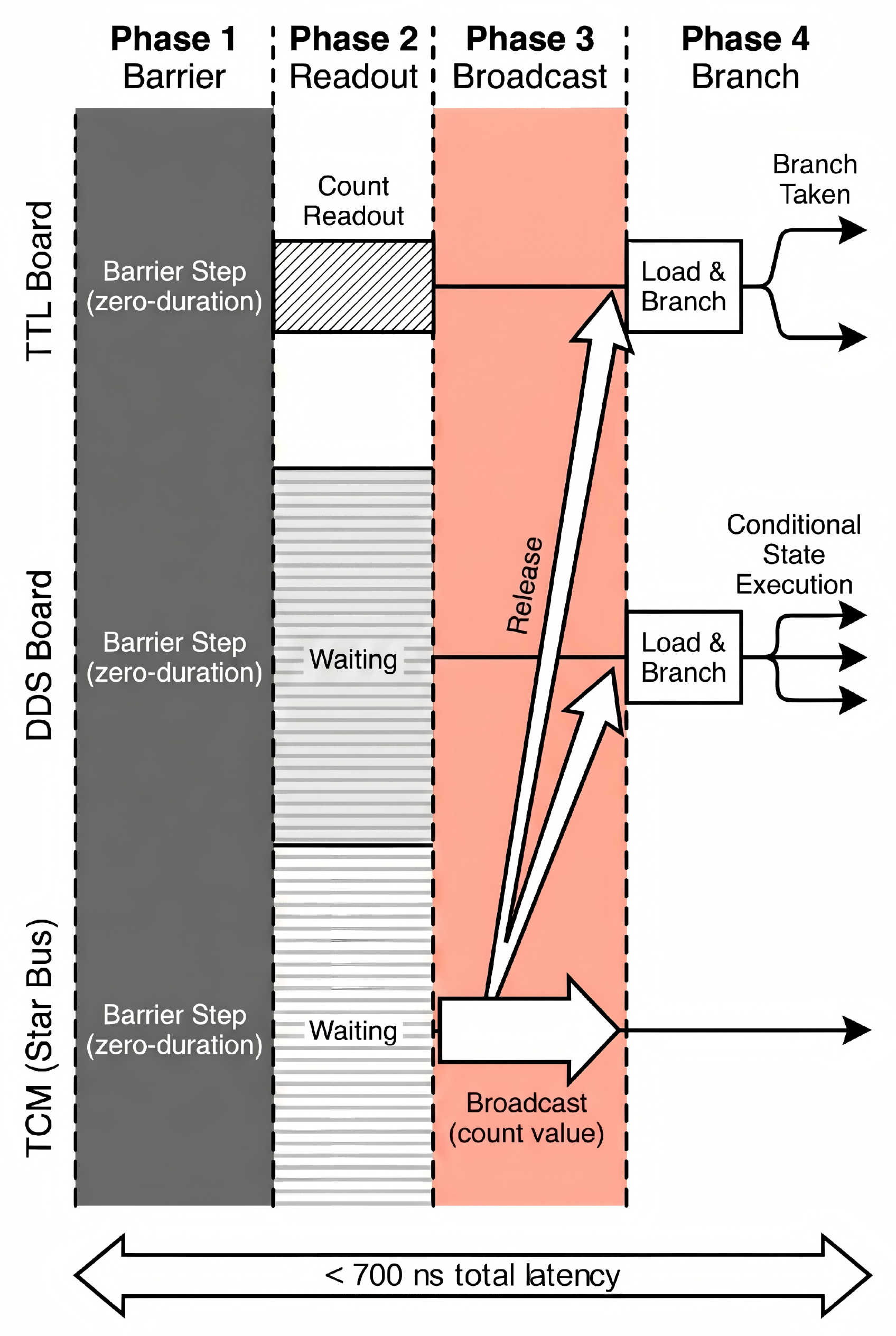
Figure 5: Cross-board four-phase read_ttl protocol: barrier, photon counting, TCM broadcast, and distributed branch resolution within 700 ns.
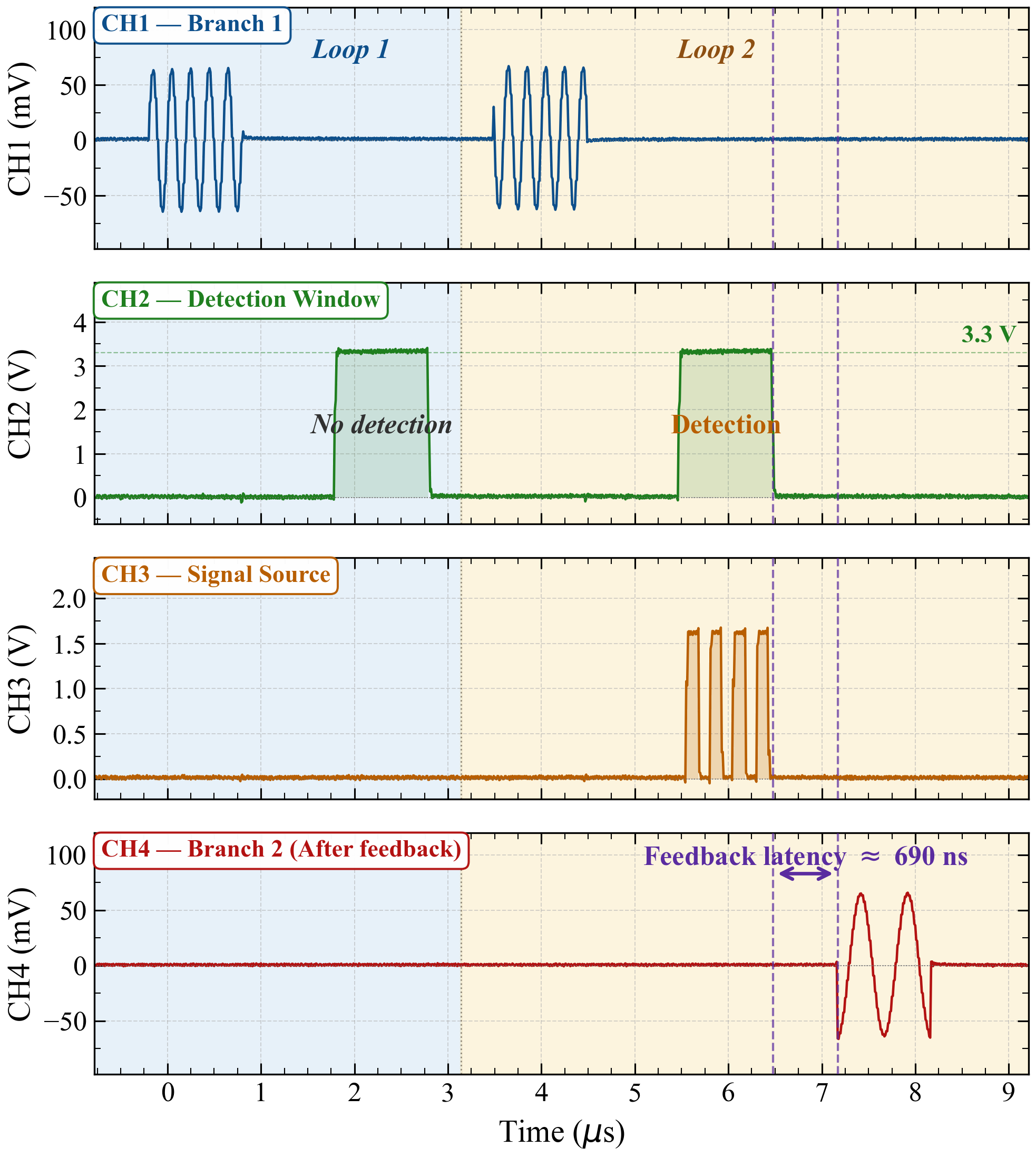
Figure 6: Oscilloscope: detection window closes and board-level feedback triggers (DDS output) after a 690 ns delay, validating sub-μs hardware response.
Empirical Evaluation
System Comparison: Relative to prior platforms (ARTIQ/Sinara, QubiC, QICK, TITAN), Bell uniquely combines a full static compiler pipeline (CFG/SSA/RA), strict control/data separation, and <700 ns feedback. Competing platforms either lack scale, require FPGA co-design, or cannot guarantee timing at comparable abstraction boundaries.
Throughput and Verification: Compilation overheads are negligible—<4 ms wall-time for complex sequences. The step-table/data compactness yields 20x–1000x reductions in sequence memory footprint versus naive static unrolling. For instance, a 1000-iteration nested loop compiles to four step-table entries under Bell rather than 4000 hardware configurations otherwise; only the step table is regenerated for parameter sweeps, not the control stream.
Determinism and Modularity: Logic verification exists at all compilation stages, and runtime determinism is hardware-validated—no host in the control loop for sub-microsecond conditional feedback. Board-level instructions remain compact (<50), and register spillage is managed by the allocator, ensuring efficient utilization of HW resources.
Implications and Future Directions
QuCtrl-BELL demonstrates that explicit compiler-based infrastructure can reconcile the demands of experiment expressivity, hardware determinism, and modular maintainability for large-scale trapped-ion quantum control. Board-level separation of control and data artifacts supports both feedback-rich and sweep-oriented protocols with minimal memory and upstream code generation overhead. The approach has direct implications for scaling multi-board/multi-node quantum experiments, reducing bandwidth pressure and enabling precise hardware timing without host intervention.
Limitations primarily concern the fixed overhead (≈700 ns) per feedback event imposed by the four-phase broadcast protocol. As workloads progress toward deeper feedback and multi-round QEC, this component could bottleneck throughput, raising the possibility of pipelined or hardware-accelerated broadcast support. The architecture is designed to be backend-portable; integration with future RFSoC or direct camera-based (IMG) feedback systems is natural given the modular separation in the stack.
Conclusion
QuCtrl-BELL realizes a compiler-driven, modular control stack for trapped-ion quantum experiments, demonstrating deterministic, sub-microsecond feedback and high-level programmability. Its architecture leverages explicit control/data separation and a multi-stage compilation process to deliver practical scalability and extensibility for modern quantum hardware, validated through deployment on a distributed PXIe-class platform. Its design outlines a roadmap for quantum control systems where real-time feedback and programmability converge without compromising performance or maintainability.