- The paper introduces a mutual information diagnostic to detect long-range nonstabilizerness in topologically encoded states.
- It rigorously demonstrates that non-integer mutual information in MES bases signifies nonstabilizer properties in the toric code.
- The study connects LRN diagnostics to modular transformations and fault-tolerant gate constraints, extending insights to non-Abelian string-net models.
Long-Range Nonstabilizerness Diagnostics in Topologically Encoded States
Introduction
This paper explores long-range nonstabilizerness (LRN) in the context of two-dimensional topologically ordered systems, focusing on encoded ground states. LRN is defined as the inability to approximate a state as a stabilizer state using shallow-depth local quantum circuits; it provides a stringent notion of quantum complexity beyond local transformations. While standard measures of nonstabilizerness are basis-dependent, spatial locality allows for the meaningful distinction between short-range and long-range nonstabilizerness. The authors leverage mutual information between spatially separated regions as a diagnostic, an approach previously shown effective in one-dimensional matrix product states [korbany2025long]. Here, they extend this to two-dimensional systems, notably the Z2 toric code (TC) and doubled Fibonacci string-net models, with an emphasis on the power and limitations of mutual information analysis in classifying LRN.
The discussion begins with a rigorous review of stabilizer states in lattice models. Stabilizer states have entanglement entropies and mutual information quantized as integers, a property related to their efficient classical simulatability. LRN is defined via the impossibility of mapping a sequence of states to stabilizer states through a polylog-depth local quantum circuit, up to vanishing trace distance in the thermodynamic limit.
Given spatial locality, LRN signals an inherent resource requirement for quantum simulation and quantum error correction that cannot be efficiently circumvented. With increasing interest in nonstabilizerness as a resource for quantum computation [sewell2022mana, oliviero2022magic], distinguishing between short- and long-range forms has practical significance for fault-tolerance in topological quantum codes.
The central technique involves computing mutual information between disconnected, non-overlapping regions that each contain a non-contractible loop on the torus. The mutual information, IA,B, is shown to be invariant under shallow circuits for topologically ordered ground states, echoing earlier results for 1D MPS. Since stabilizer states yield integer mutual information, any deviation from integer values immediately certifies LRN. The authors prove that, in the TC on the torus, this diagnostic provides both necessary and sufficient conditions for LRN for all encoded ground states.
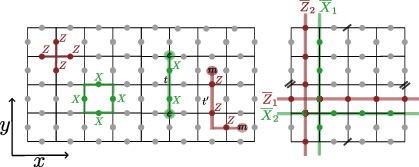
Figure 1: Vertex, plaquette, and string operators in the toric code; string operators carry anyonic excitations at endpoints and noncontractible cycles encode logical operators.

Figure 2: Three inequivalent non-contractible curves γα on the torus, illustrating regions used for mutual information analysis.
Full Classification in the Toric Code
Analysis is carried out in the TC using minimum-entropy states (MES), which are logical states with a well-defined anyon flux across a non-contractible loop. Considering all possible choices of loop and associated regions, the mutual information reduces to the classical Shannon entropy of the MES coefficients, IA,B=H({∣ψa(γ)∣2}). The authors prove that non-integer values in any MES basis imply LRN, and—crucially—that all nonstabilizer encoded states exhibit LRN detectable by this method.
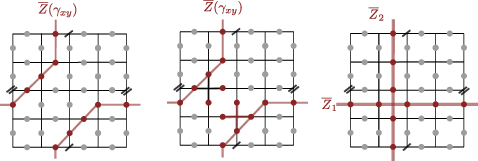
Figure 3: Support of the Wegner-Wilson-loop operator Z along a non-contractible loop; relevant for MES analysis.
The authors connect mutual information diagnostics to modular transformations of the torus, which are realized by S and T matrices from the underlying anyon theory. They demonstrate that integer mutual information in all MES bases is only possible for stabilizer states, and these modular transformations encode all the topological symmetries relevant for LRN classification.
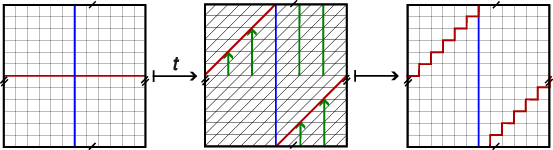
Figure 4: Lattice implementation of Dehn twist—a modular transformation—via shear transformation and local deformation.
Extension to Non-Abelian String-Net Models
The technique is extended to non-Abelian topological orders, exemplified by the doubled Fibonacci string-net model. The properties of MES and associated string operators (often non-unitary in non-Abelian cases) are analyzed analogously. It is shown that mutual information remains a certificate of LRN, but the method is no longer sufficient for a full classification: certain states with special modular properties yield integer mutual information for all regions and transformations, even though LRN is likely present.
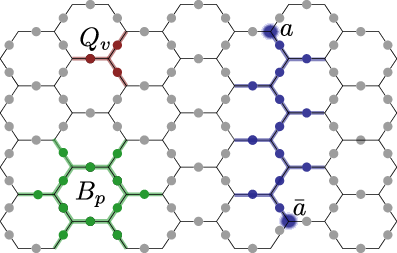
Figure 5: Schematic of string-net lattice, highlighting vertex, plaquette, and string operator supports.
Implications for Fault-Tolerant Logical Gates
An important consequence is the constraint imposed by LRN on the set of logical gates possible via shallow-depth circuits. In the TC, only Clifford gates can be implemented fault-tolerantly, and all non-Clifford gates (such as logical T) are excluded due to the presence of LRN in their encoded states. The authors generalize this classification using the invariance of mutual information, reproducing results from [beverland2016protected] without continuum assumptions and robust to asymptotic infidelity.
Outlook and Future Directions
The mutual information approach is elementary, lattice-based, and potentially extensible to more general topologies, higher spatial dimensions, and Zd stabilizer codes. However, it exhibits limitations in fully capturing LRN for certain non-Abelian phases and modular groups. Its connection to fault-tolerant gate classification, the magic hierarchy, and PEPS representations invites deeper investigations, especially in settings with boundaries, defects, or higher genus.
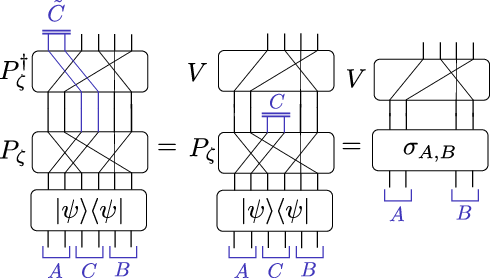
Figure 6: Tensor network derivation showing factorization and block structure of reduced density matrices in non-Abelian string-net models.
Conclusion
This work develops an information-theoretic framework for diagnosing LRN in topologically encoded quantum states, leveraging mutual information between non-contractible regions and modular transformations. The analysis yields a complete classification of LRN in the toric code, provides constraints for non-Abelian string-net models, and connects directly to the structure of fault-tolerant logical operations. These results contribute foundational understanding for quantum simulation, error correction, and topological quantum computation, opening avenues for further research in diverse topological settings and higher-dimensional codes.

