- The paper shows that modular variables provide sensitive detection of nonlocal phase information in spatially separated quantum states, even under dissipative dynamics.
- It derives time-evolution equations for both unitary and Caldeira-Leggett dynamics, revealing the distinct roles of gravitational fields and thermal noise.
- Standard measures fail to capture phase details in non-overlapping wave-packet superpositions, underscoring the need for modular observables in quantum communication and metrology.
Introduction and Theoretical Motivation
The paper "Modular Variables and the Limits of Phase Detectability in Open Quantum Systems" (2605.22293) analyzes the capacity of modular variables to serve as sensitive witnesses of nonlocal phase information in superpositions of spatially separated quantum states, with emphasis on open-system dynamics under environmental decoherence. The authors study Gaussian wave-packet superpositions subject to linear gravitational fields, examining both unitary Schrödinger evolution and dissipative Caldeira-Leggett (CL) dynamics in the high-temperature regime. Modular variables (specifically, the translation operator eip^ℓ/ℏ and its Hermitian analog cos(p^ℓ/ℏ)) are shown to access phase information inaccessible to local observables such as density or current, especially when wave-packet components lack spatial overlap.
A formal separation is established between kinematical Bell-type nonlocality and the dynamical nonlocality probed by modular variables. While Bell nonlocality emerges from multipartite entanglement, modular variables connect spatially disjoint regions already at the single-particle level. The operator eip^ℓ/ℏ is explicitly periodic in momentum and nonlocal in configuration space, making its expectation value sensitive to phases linking disparate components while remaining invariant under local momentum shifts.
Equation of Motion and Open-System Evolution
The time evolution of modular variables is derived for both the unitary and dissipative cases. Under the Schrödinger equation with a uniform gravitational potential, the translation operator evolves as
dtdetip^ℓ/ℏ=−ℏimgℓetip^ℓ/ℏ,
which results in a phase evolution proportional to mgℓt/ℏ.
For dissipative dynamics, the CL equation yields
dtdetip^ℓ/ℏ=(−ℏimgℓ−ℏ2Dℓ2)etip^ℓ/ℏ−2γiℏℓp^etip^ℓ/ℏ,
where D=2mγkBT is the diffusion coefficient. The decoherence term (−ℏ2Dℓ2) exponentially damps the modular signal, while momentum damping and gravitational effects alter the frequency and phase.
Non-Overlapping Wave-Packet Superpositions
The study focuses on superpositions of two Gaussian wave packets with negligible spatial overlap. For such states, local observables (density, current) are insensitive to the relative phase α. In contrast, the modular observable eip^L/ℏ, and its Hermitian counterpart, maintain explicit sensitivity to cos(p^ℓ/ℏ)0:
cos(p^ℓ/ℏ)1
for unitary evolution, exhibiting oscillatory phase-dependent behavior.
Numerical and analytic results demonstrate that gravitational evolution induces time-dependent phase shifts in the modular signal, while amplitude damping due to environmental noise is governed only by temperature. The modular operator's nonlocality is manifest in its insensitivity to local measurements yet sensitivity to the phase, even as dissipation suppresses signal visibility.
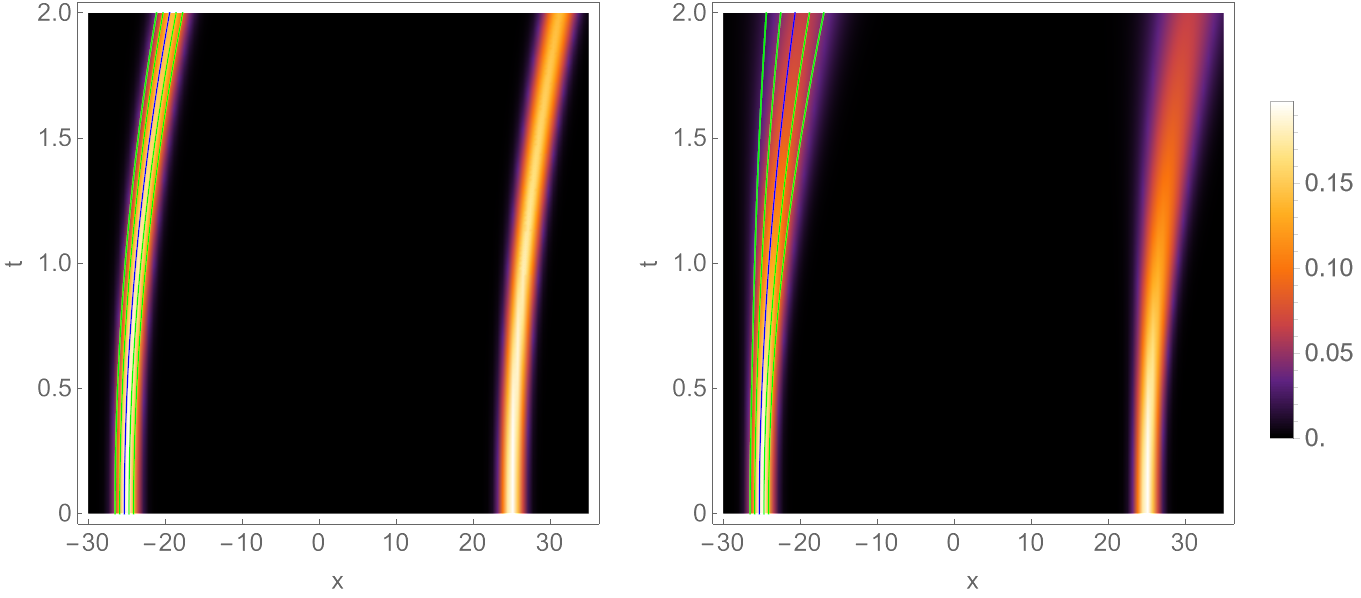
Figure 1: Probability density evolution for Schrödinger and CL dynamics; Bohmian trajectories indicate localization, wave-packet spreading, and environment-driven divergence.
Bohmian Mechanics and Local Expectation Values
Bohmian mechanics provides an interpretational framework, allowing analysis of wave-packet branching and empty waves. Local expectation values
cos(p^ℓ/ℏ)2
were computed along Bohmian trajectories to resolve the modular variable's evolution at a trajectory-specific level. The modular signal retains phase sensitivity along such trajectories, even in dissipative regimes, as illustrated numerically.
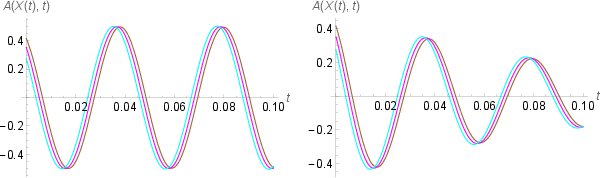
Figure 2: Local modular expectation values along Bohmian trajectories for several initial positions; comparison of Schrödinger and CL dynamics underscores robust phase-dependent oscillations.
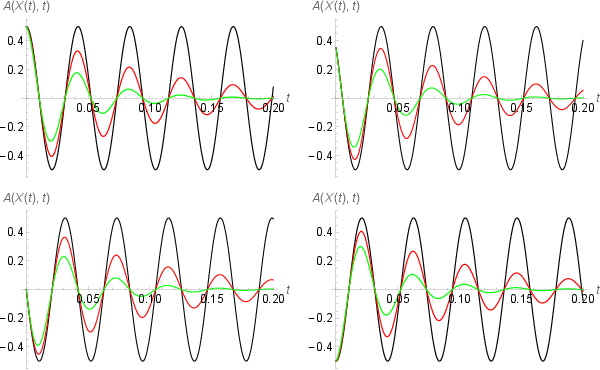
Figure 3: Trajectory-resolved modular expectation values for different cos(p^ℓ/ℏ)3, showing relative phase-induced shifts in oscillatory patterns; CL noise reduces amplitude but preserves phase shifts.
Two-Particle Systems, Common Environment, and Statistical Effects
The framework is extended to bipartite systems (distinguishable and indistinguishable particles) and their interaction with a shared environment via the double CL master equation. The modular variable's sensitivity to the phase persists for both Maxwell-Boltzmann, Bose-Einstein, and Fermi-Dirac statistics, provided the modular operator acts on the appropriate subsystem. Environment-induced correlations further modify the damping and phase evolution; however, transfer of phase sensitivity to the distant particle is found to be negligible.
Crucially, conventional measures—coherence length, cos(p^ℓ/ℏ)4-norm, entropy, entanglement witnesses based on reduced density matrices—fail to detect the relative phase in the non-overlapping regime due to their locality structure. The paper demonstrates that this is a structural property: phase-dependent cross terms lie outside the scope of local observables, even as the density matrix formally encodes them.
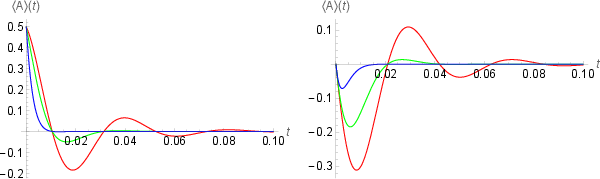
Figure 4: Modular variable expectation for the first particle in a two-particle CL system; environmental parameters control amplitude damping and phase modulation.
Strong Numerical Results and Contradictory Claims
- Amplitude Damping Exclusively Temperature-Driven: The paper shows, both analytically and numerically, that modular observable amplitude damping is governed only by the bath temperature (via cos(p^ℓ/ℏ)5), while phase evolution is influenced solely by dissipation rate (cos(p^ℓ/ℏ)6) and external potential, contradicting any claims that environmental noise randomizes phase.
- Phase Detectability Unobstructed by Open-System Decoherence: Contrary to generic expectations that open quantum systems obscure global phase information, the modular signal’s phase dependency on cos(p^ℓ/ℏ)7 remains exact until amplitude is suppressed.
- Standard Coherence/Entanglement Quantifiers Ineffective: The paper explicitly demonstrates that measures like cos(p^ℓ/ℏ)8 and linear entropy are invariant under changes in cos(p^ℓ/ℏ)9 for non-overlapping superpositions, emphasizing the necessity of modular observables for phase detection.
Implications and Future Directions
The results establish modular variables as operational probes of nonlocal quantum phase information in both isolated and open systems. This has significant implications for quantum communication, phase encoding, and foundational tests of quantum nonlocality in dissipative settings. Practically, modular observables could be employed in precision metrology, quantum error correction schemes reliant on phase-space structure, and environmental inference.
Theoretically, extension to higher-dimensional Hilbert spaces, strongly coupled environments, and non-Markovian regimes remains an open frontier. The distinction between dynamical and kinematical nonlocality captured by modular variables could inform new directions in quantum information theory and experimental design.
Conclusion
This paper rigorously demonstrates that modular variables serve as sensitive witnesses of nonlocal phase information in quantum superpositions, unaffected by the limitations of local observables, conventional coherence measures, or entanglement quantifiers—especially in open quantum systems. The modular signal’s amplitude is exclusively temperature-damped, while its phase persists with exact dependence on the superposition phase, subject only to dissipation-induced modulation. Modular variables, therefore, provide a structurally robust framework for probing quantum nonlocality, decoherence, and environment-induced phase dynamics, with broad practical and theoretical consequences in quantum information and foundations.

