- The paper demonstrates the emergence of quantum-metric driven Bloch oscillations in the absence of Berry curvature by including weak electric-field inhomogeneities.
- It employs enhanced semiclassical equations and a tilted Dirac model to quantify intrinsic and dominant extrinsic transport contributions.
- The findings reveal robust high-field saturation of quantum-metric currents, suggesting experimental suitability in engineered superlattice and flat-band systems.
Quantum-Metric Bloch Oscillations Beyond Berry Curvature
Introduction
The canonical picture of Bloch oscillations describes wavepacket motion in a periodic lattice under an external static force, manifesting as coherent oscillatory dynamics rather than sustained translation. Traditional geometric analogs rely on Berry curvature to induce anomalous velocity, enabling geometric oscillations. However, Berry-curvature effects are symmetry-restricted; specifically, for systems with PT symmetry, the Berry curvature vanishes throughout the Brillouin zone, eliminating such geometric oscillations. The paper "Quantum-metric Bloch oscillations in weakly inhomogeneous electric fields" (2605.22227) addresses whether band-geometric oscillations can persist in the absence of Berry curvature by extending the semiclassical wavepacket framework to include weak electric-field inhomogeneities, thereby isolating quantum-metric-driven effects.
Semiclassical Framework for Inhomogeneous Fields
The semiclassical equations of motion in weakly inhomogeneous fields are enriched by explicit quantum-metric terms. The quantum metric, the real part of the quantum geometric tensor, quantifies the momentum-space distance between neighboring Bloch states and contributes to real-space dynamics whenever band symmetry constrains Berry curvature to zero. The expanded equations of motion yield wavepacket velocity contributions from both the band dispersive term and the quantum metric, the latter scaling with electric-field gradients. The oscillatory component of the wavepacket motion thus includes a conventional Bloch term and a quantum-metric term, the latter persisting even when Berry curvature is absent. The amplitude of the quantum-metric oscillation is determined by the relative inhomogeneity—the ratio of field gradient to static field strength—and is bounded, mitigating vulnerability to disorder-induced decoherence.
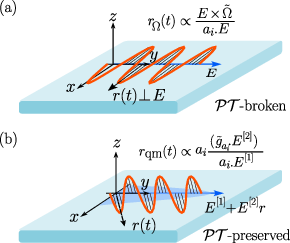
Figure 1: Schematic distinguishing Berry-curvature-driven Bloch oscillations (left, PT-broken) and quantum-metric-induced Bloch oscillations (right, inhomogeneous field, both parallel and perpendicular components present).
Transport Signatures and Field Scaling
Direct detection of quantum-metric-driven motion is experimentally challenging; thus, transport signatures are emphasized. Two distinct contributions emerge: an intrinsic current, set by the band structure and field gradient, and an extrinsic current, determined by both electric field and relaxation time in the Boltzmann regime. The paper demonstrates that the extrinsic current can dominate and exhibits finite high-field saturation when the relative inhomogeneity is fixed. This contrasts sharply with conventional Bloch transport, which exhibits negative differential conductance due to Wannier-Stark localization under strong fields.
The extrinsic quantum-metric current is nonlinear, involving both longitudinal and transverse components, and is sensitive to system symmetry and spatial variation in the applied field. The transport calculations employ relaxation-time approximation and nonequilibrium distribution functions derived from the semiclassical Boltzmann equation. In the high-field limit, quantum-metric currents saturate, providing a distinct transport signature that persists even as band-dispersive transport is suppressed.
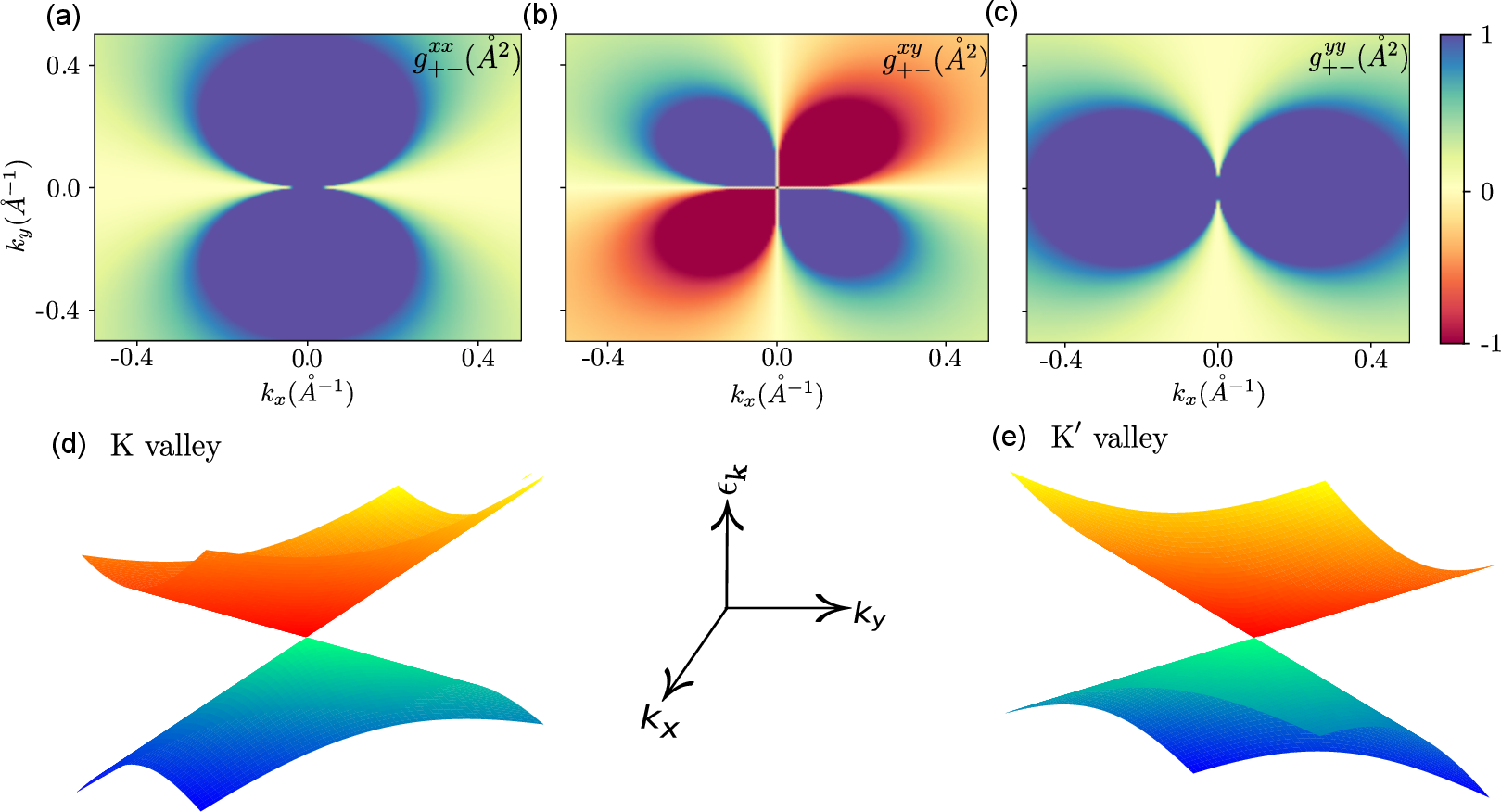
Figure 2: Panels (a)-(c) show quantum-metric tensor components (g+−xx, g+−xy, g+−yy) for a tilted Dirac model; panels (d)-(e) display the corresponding Dirac cones at K/K' valleys.
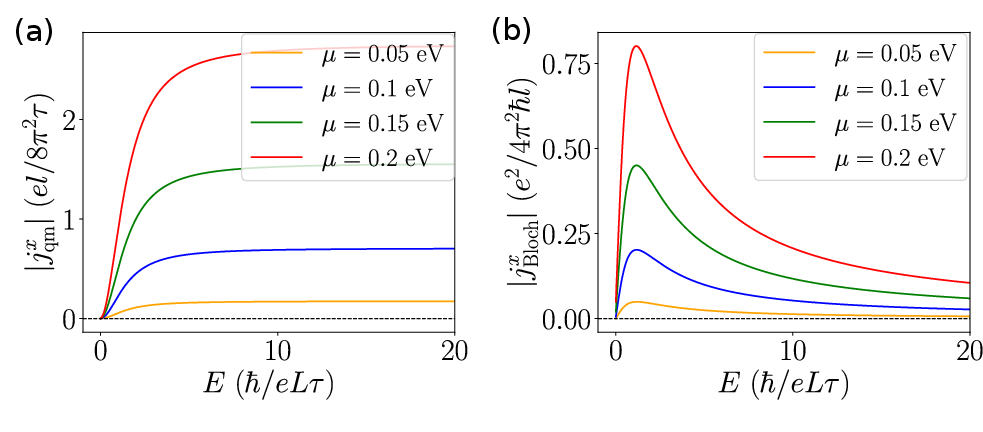
Figure 3: Magnitude of quantum-metric current jqm versus applied field for various chemical potentials μ, displaying finite saturation at high fields. Bloch current (b) shows negative differential conductance at large field.
Model Analysis: Tilted Dirac Hamiltonian
To illustrate the effect, a two-dimensional tilted Dirac model is analyzed. The model, despite vanishing Berry curvature (due to PT symmetry), possesses a finite quantum metric, thus isolating the quantum-metric-driven response. Analytical expressions for both Bloch and quantum-metric currents as functions of chemical potential and field strength are provided. Quantum-metric currents peak near charge neutrality, scaling as 1/μ2, while Bloch currents scale linearly with chemical potential. The extrinsic contribution dominates, with tilt in the Dirac cone amplifying the response.
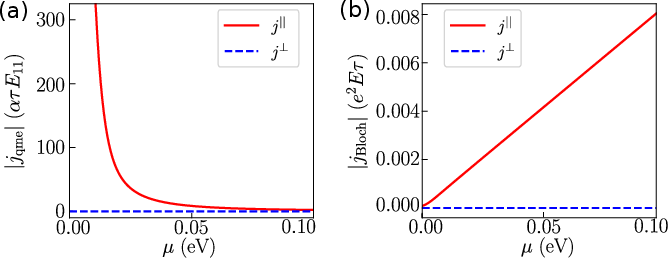
Figure 4: Longitudinal and transverse quantum-metric currents (jqme∣∣, PT0) and Bloch currents (PT1, PT2) versus chemical potential for different applied fields.
Experimental realizability focuses on large-unit-cell systems (e.g., superlattices, moiré materials) with finite band gaps and significant quantum metric. Practical parameter space estimates are given for effective lattice periods, bandwidths, gaps, relaxation times, and electric field strengths, establishing compatibility with engineered platforms.
Implications and Future Directions
This work establishes quantum-metric-driven oscillatory dynamics as an experimentally accessible probe of band geometry independent of Berry curvature. The extrinsic transport channel offers a robust signature, especially in strong-field regimes for systems with engineered inhomogeneity. From a theoretical perspective, this separates probe mechanisms of band geometry from those tied to Berry curvature, broadening the landscape for quantum geometric responses in transport.
Practically, these findings open avenues for exploiting quantum-metric effects in transport measurements within flat-band superlattices, optical lattices, or synthetic electronic platforms. Theoretical developments may focus on quantifying quantum-metric effects in higher-order band-geometric responses, exploring disorder and interaction-driven modifications, or engineering optimal platforms to maximize the quantum metric while minimizing Berry curvature contributions. Strong-field regimes and field-gradient engineering may further refine quantum-metric transport measurements.
Conclusion
Quantum-metric Bloch oscillations in weakly inhomogeneous electric fields constitute a band-geometric dynamical and transport response that persists in the absence of Berry curvature. The analysis reveals both intrinsic and dominant extrinsic contributions, with the latter capable of finite high-field saturation. The tilted Dirac model clarifies symmetry constraints and scaling behavior. Experiments in superlattice and flat-band systems with suitable gap and unit-cell size may enable direct measurement of quantum-metric-driven transport, offering a new route for probing band geometry in crystalline materials.

