- The paper provides analytical solutions for timelike geodesics around DS wormholes by decoupling equations with Mino time and explicit elliptic integrals.
- It identifies critical radial potential root configurations that dictate the ISCO, stable and unstable orbits, and the emergence of chaos via Lyapunov analysis.
- The work highlights observational implications, including distinctive gravitational waveforms and iron line signatures that can differentiate wormholes from black holes.
Analytical Solutions for Timelike Orbits Around Damour-Solodukhin Wormholes
Introduction and Context
Damour-Solodukhin (DS) wormholes represent Schwarzschild-like spacetimes with an event horizon replaced by a throat, characterized by a deformation parameter λ that sets the throat radius rth. These wormholes are minimal deviations from classical Schwarzschild metrics and retain asymptotic flatness. The analytic study of timelike geodesics in such backgrounds is pivotal for distinguishing wormholes from black holes via astrophysical and gravitational-wave observables, especially in the light of precision horizon-scale imaging and gravitational wave measurements.
Radial Potential Structure and Root Classification
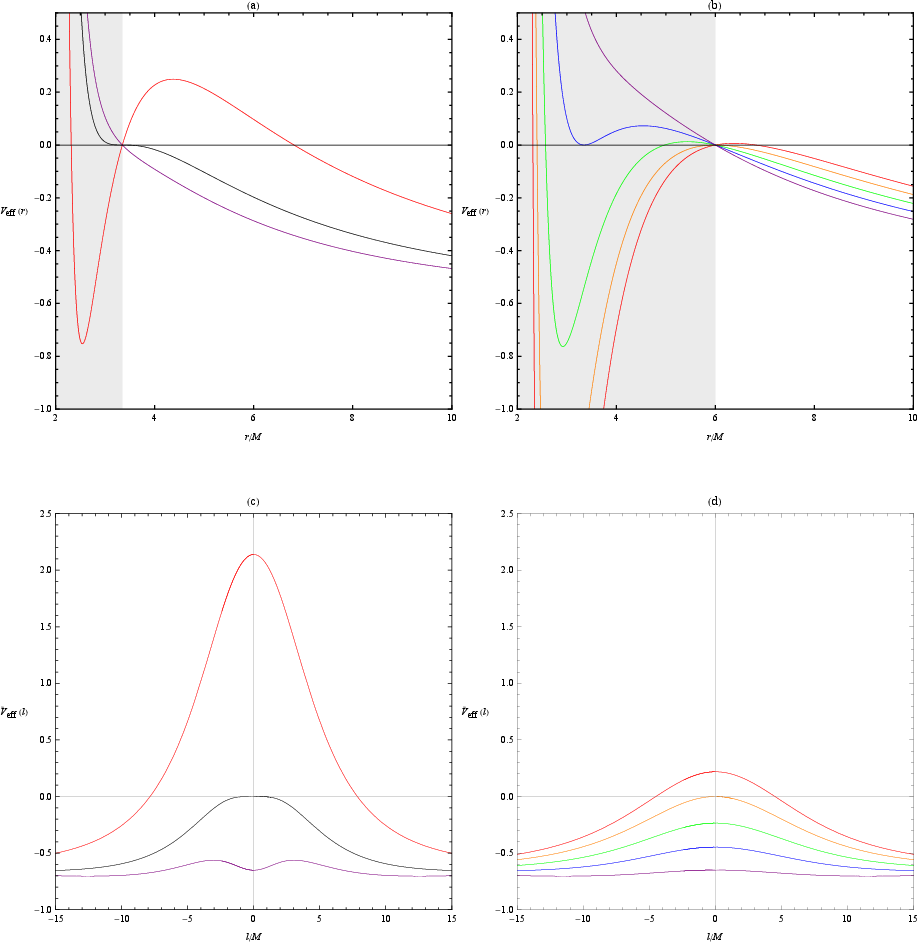
The DS wormhole spacetime introduces a quartic radial potential originating from the geodesic equations, with four roots: three associated with standard Schwarzschild-like dynamics (rm1, rm2, rm3), and a fourth fixed at the throat (rth). The interplay of these roots (double, triple, or quartic degeneracies) encodes the possibility of stable/unstable circular orbits and the innermost stable circular orbit (ISCO). Specifically, merging of the throat with other roots signals qualitative shifts in orbital dynamics and establishes regimes of observational interest, notably the ISCO coinciding with the throat in certain triple-root configurations.
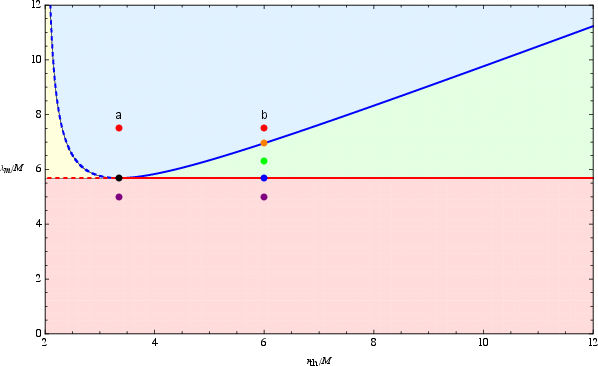
Figure 1: A diagram of the parameter space $(\lambda_{m},\,r_{\mathrm{th})$ for unbound motion, illustrating regions for simple, double, and triple root configurations and their correspondence to special orbital classes.
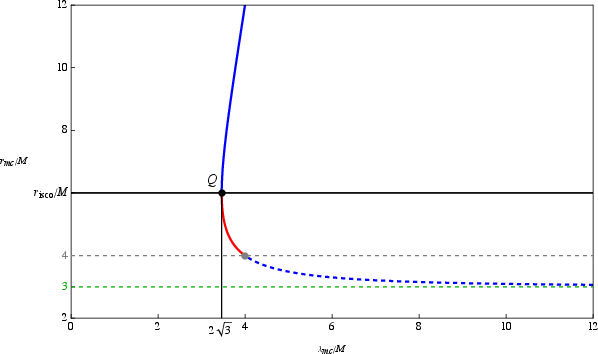
Figure 2: Parameter-space diagram showing all double-root solutions for rmc, highlighting ISCO-related triple and quartic roots.
Decoupling of geodesic equations using the Mino-time parametrization enables exact integration of orbital trajectories in terms of incomplete elliptic integrals (first, second, and third kinds). This encompasses both bound and unbound motion. The analytical framework systematically treats cases where the throat becomes a simple, double, or triple root, revealing distinctive divergent behaviors in azimuthal angle and coordinate time:
Homoclinic Orbits and Lyapunov Instability Analysis
The analytic structure supports homoclinic orbits—trajectories asymptoting to unstable circular orbits located at the throat. The Lyapunov exponent, derived as the inverse instability timescale near the unstable orbit, quantifies chaos onset and orbital sensitivity. DS wormhole configurations allow for maximum Lyapunov exponent values lower than the Schwarzschild black hole limit when rth3 is greater, e.g., for rth4, rth5 yields rth6.
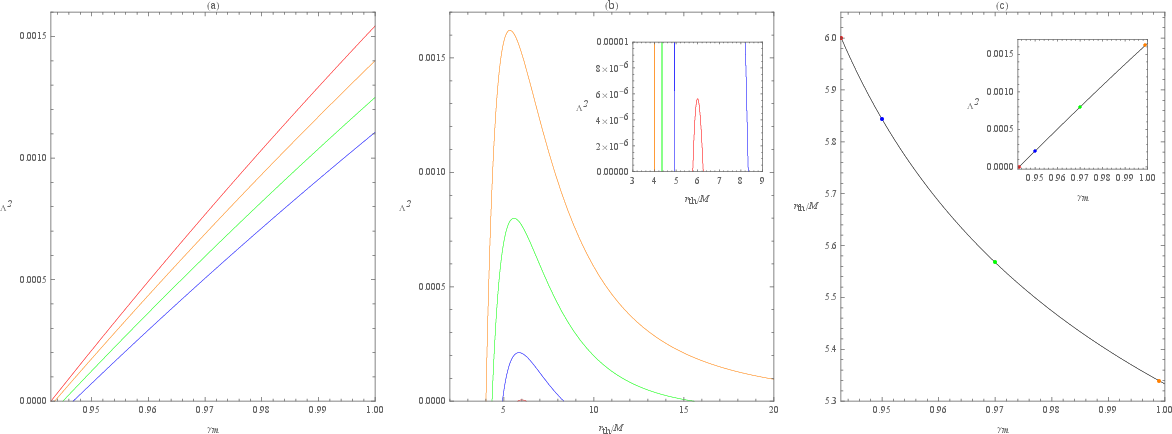
Figure 4: The Lyapunov exponent as a function of throat radius rth7 and particle energy rth8 for homoclinic orbits, showing parameter regimes of maximal instability.
Inspiral and Plunge Dynamics Through the Throat
Analytical inspiral solutions detail behavior for trajectories starting near the ISCO and plunging into the throat, subsequently oscillating between two regions. This regime is only available in wormhole spacetimes and is unattainable in classical black holes due to the presence of an event horizon. The analytic structure predicts:
Embedding Diagrams and Physical Interpretation
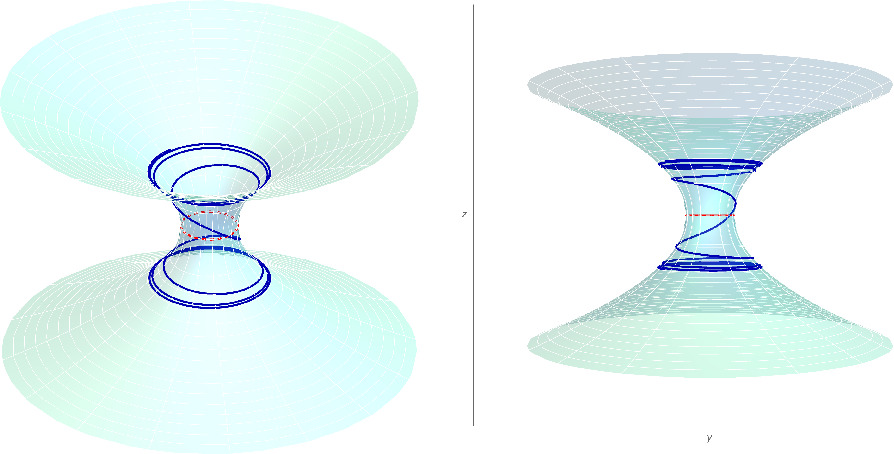
Embedding diagrams produced for specific parameter points showcase geodesic connectivity between asymptotic regions and spatial curvature induced by the throat. These visualizations solidify the topological distinction between wormholes and black holes and underline the observational ramifications for gravitational lensing, shadow imaging, and gravitational wave transients.
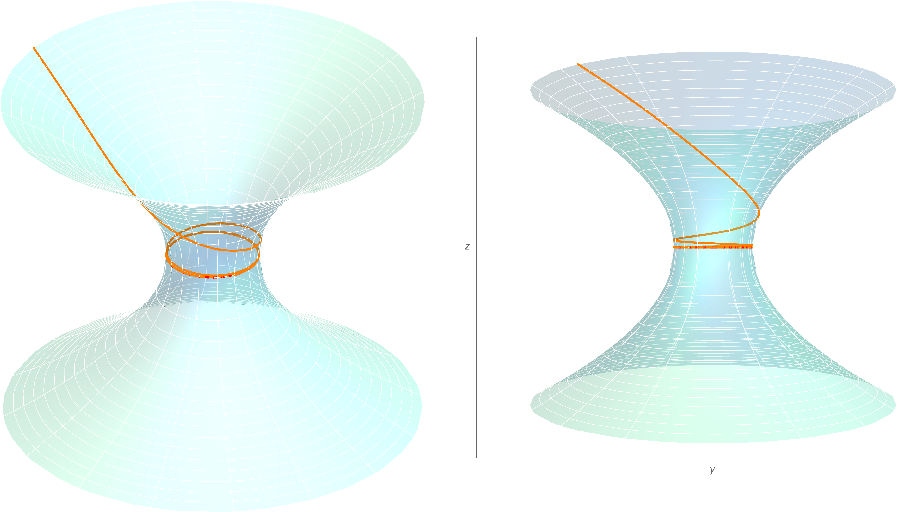
Figure 6: Embedding diagram for a particle on a trajectory towards the throat-induced unstable orbit, emphasizing spatial topology.
Implications and Prospects
The analytic results provided for DS wormhole geodesics suggest several avenues for observational discrimination:
- ISCO location and iron line signatures: The ISCO radius, modifiable by the throat and accessible via X-ray reflection spectroscopy, may distinguish wormhole from black hole environments (2605.22187).
- Gravitational waveforms: Chirp-gap-antichirp patterns from inspiral/plunge dynamics could be detectable with future facilities such as LISA, offering a unique probe of wormhole structure [malik-2026, dent-2021].
- Chaos and stability: Lyapunov exponent analysis informs the onset of chaos and the persistence of periodic or quasiperiodic motion, relevant for EMRI dynamics in wormhole backgrounds.
The analytic approach sets the stage for extensions to more general wormhole geometries, inclusion of spinning particles, and joint electromagnetic/gravitational observational strategies.
Conclusion
This work establishes a comprehensive analytic solution structure for timelike geodesics around Damour-Solodukhin wormholes, rigorously characterizing orbital classes via root degeneracy, detailing divergence and regularity regimes, and computing chaos quantifiers. The results clarify discriminants between wormhole and black hole spacetimes in strong-field astrophysics and gravitational wave astronomy, and suggest continued investigation into higher-order multipole effects, spin dynamics, and waveform modeling in exotic compact object backgrounds.