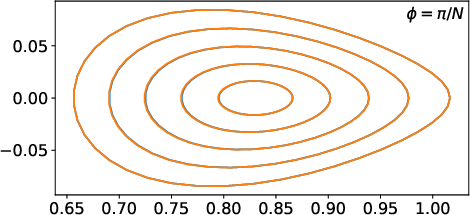
- The paper introduces a generalized flux-averaged measure of the Shafranov shift, linking plasma pressure-driven displacement with parallel current properties.
- It derives analytic scalings for QS and QI stellarators, showing that increased field periodicity and optimized geometry suppress the shift and raise beta limits.
- Numerical validations using VMEC confirm that optimized QH and QI configurations yield significantly reduced Shafranov shifts, enhancing overall plasma confinement.
On the Shafranov Shift in Stellarators
Introduction and Motivation
The Shafranov shift—the pressure-driven displacement of the magnetic axis in toroidal plasmas—establishes a fundamental equilibrium constraint for stellarators. Unlike axisymmetric devices, stellarators exhibit intrinsically three-dimensional shaping, resulting in a more complex response to plasma pressure. The Shafranov shift not only limits achievable β but also impacts confinement and fast particle retention. This work introduces a generalized, flux-averaged measure of the Shafranov shift, extending beyond traditional analyses for special geometries, and derives both explicit scalings and upper bounds for a wide range of stellarator configurations, emphasizing quasi-symmetric (QS) and quasi-isodynamic (QI) devices.
Magnetohydrodynamics, Current Structure, and Flux Surfaces
The equilibrium configuration is dictated by the MHD equation J×B=∇p, with nested flux surfaces described using Boozer coordinates (ψ,θ,φ). For stellarators where the net toroidal current vanishes, the plasma current is predominantly in the form of Pfirsch-Schlüter currents associated with pressure gradients and magnetic field inhomogeneity. Notably, the parallel (to B) current density J∥ arises to maintain divergence-free current:
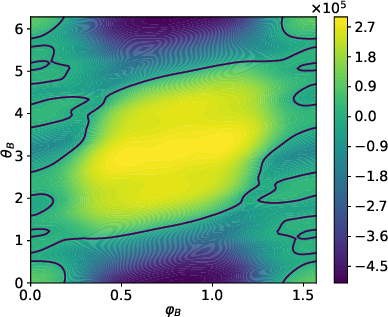
Figure 1: J∥ (A/m2) on a normalized flux surface of an elongated QI stellarator; black curves denote zero-current contours, closely tracking the symmetry directions of the configuration.
In ideal QI configurations with multiple field periods, the parallel current vanishes precisely at the toroidal locations of maximum field strength, resulting in localized reversal and minimizing deleterious effects on equilibrium and transport.
Defining and Quantifying the Shafranov Shift
A primary innovation of this work is the formulation of an average Shafranov shift,
S[χ]=X1∫PχFdV,X=∫PχdV,
where F(r) is a coordinate function reflecting the desired mode of displacement and χ is the poloidal flux. The shift J×B=∇p0 quantifies the pressure-induced flux redistribution. This average is robust across arbitrary cross-sectional shapes and field geometries and accommodates both analytic and numerical evaluation.
The perturbative analysis (via reduced MHD) establishes that J×B=∇p1 is driven by the topology and magnitude of the parallel current, directly linking the Shafranov shift to the properties of J×B=∇p2 and, consequently, to magnetic field optimization strategies. The relationship is captured by
J×B=∇p3
where J×B=∇p4 is a solution to a Poisson equation determined by the geometry, and J×B=∇p5 is the toroidal flux function.
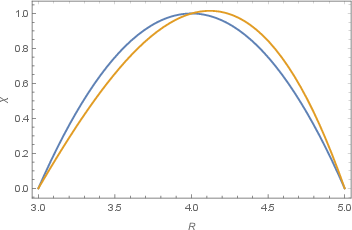
Figure 2: Schematic illustrating the outward migration of the peak poloidal flux J×B=∇p6 with finite plasma pressure, characteristic of the Shafranov shift in fixed-boundary stellarator equilibria.
Analytic Scaling: Dependence on Symmetry and Optimization
Analytic results are derived for QS and QI stellarators, demonstrating that the Shafranov shift generally decreases with increasing aspect ratio and rotational transform and is particularly minimized when the number of field periods (helical symmetry J×B=∇p7) is maximized relative to the rotational transform J×B=∇p8:
- QS Stellarators: For J×B=∇p9 and (ψ,θ,φ)0,
(ψ,θ,φ)1
leading to an equilibrium (ψ,θ,φ)2 limit scaling as
(ψ,θ,φ)3
where (ψ,θ,φ)4 is the inverse aspect ratio. Small Shafranov shifts are therefore accessible by maximizing (ψ,θ,φ)5.
- QI Stellarators: Employing an upper bound derived via the Poincaré inequality for (ψ,θ,φ)6,
(ψ,θ,φ)7
which is parametrically smaller than in classical stellarators when (ψ,θ,φ)8 is large.
Both scalings predict suppression of the Shafranov shift in configurations with high field periodicity and strong QI optimization, in stark contrast to axisymmetric or weakly shaped devices.
Numerical Validation and Configuration Comparison
VMEC-based equilibrium computations substantiate the analytic scalings across several optimized devices, including W7-X, an optimized QI (SQuID), and precise QA and QH configurations. Shafranov shifts were systematically evaluated as functions of both (ψ,θ,φ)9 (with B0 fixed) and B1 (with B2 fixed):
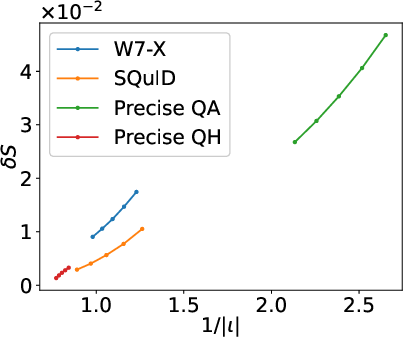
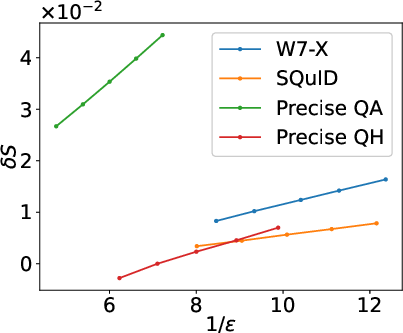
Figure 4: B3 for several devices as a function of B4 at fixed B5 (left) and as a function of B6 at fixed B7 (right); smaller shifts in QH and QI designs confirm suppression from field optimization.
Implications and Outlook
The findings critically inform both stellarator optimization theory and reactor design. Devices exploiting high field periodicity and quasi-helical or quasi-isodynamic shaping realize a practical route to increased operational J∥1 and enhanced robustness against pressure-driven equilibrium loss, while simultaneously reducing neoclassical transport and particle losses. Advanced shaping, specifically the suppression of the Pfirsch-Schlüter current via field symmetry, emerges as pivotal for next-generation stellarators. The formalism also provides generalizable upper bounds that can guide configuration space exploration without full equilibrium reconstruction.
The implications extend to operational flexibility (broader J∥2 range, reduced sensitivity to error fields) and theoretical modeling (unified equilibrium stability constraint applicable to arbitrary geometry and boundary conditions). Future research could explore the interplay of the Shafranov shift constraint with 3D coil design, energetic particle confinement, and turbulence suppression, leveraging the explicit analytic bounds and numerical benchmarks established in this work.
Conclusion
This paper provides a rigorous, geometry-agnostic framework for evaluating and minimizing the Shafranov shift in stellarators, enabling systematic comparison across device classes and highlighting the pronounced benefit of field-period and QH/QI optimization. By connecting analytic scalings, upper bounds, and benchmark equilibria, the results supply both practical and theoretical tools for next-generation stellarator design.