- The paper establishes a digital framework for quantitatively analyzing Schwarzschild imaging through calibrated metrology and ray-tracing simulations.
- It leverages four independent protocols—including shadow, Einstein ring, and lensing slope—to calibrate the mass parameter with sub-percent precision.
- The simulation rigorously validates coordinate transformations, photon ring instability, and spherical symmetry while mitigating effects like pixel quantization and aliasing.
Quantitative Imaging and Statistical Analysis of Schwarzschild Spacetime with the Black Hole Vision App
Overview and Motivation
The paper "Quantitative Black Hole Imaging Laboratory with the Black Hole Vision App: I. Schwarzschild Spacetime" (2605.21887) introduces a structured framework for quantitative analysis of Schwarzschild black hole imaging using the Black Hole Vision (BHV) smartphone application. The work addresses a critical gap in General Relativity (GR) pedagogy, bridging qualitative visualization and rigorous quantitative assessment. By leveraging the mobile platform as a calibrated optical instrument, it operationalizes a suite of metrological and statistical protocols to test the fidelity of real-time ray-tracing simulations of the Schwarzschild metric. The investigation targets both undergraduate and advanced learners with tiered laboratory exercises, providing empirical experiences closely aligned with current black hole imaging research.
Multi-Probe Mass Calibration and Consistency
Four independent protocols are utilized to triangulate the mass parameter (M) encoded in the simulated spacetime: weak-field lensing slope (Mslope), strong-field shadow boundary (Mshadow), Einstein ring (Mring), and shadow-capture width (Mvanishing). Each probe targets distinct physical regimes—linear angular deflections, critical curve geometry, capture boundary, and full field-of-view features—with precision analyses employing inverse-variance weighting, symmetry restoration, and systematic error controls.
Robust agreement is demonstrated: the shadow and Einstein ring measurements, which leverage precise geometric boundaries, converge to M∼1.9418 mm with <0.1% deviation. The evaluation explicitly notes that this agreement reflects the application's internal geometric consistency rather than independent physical validation.
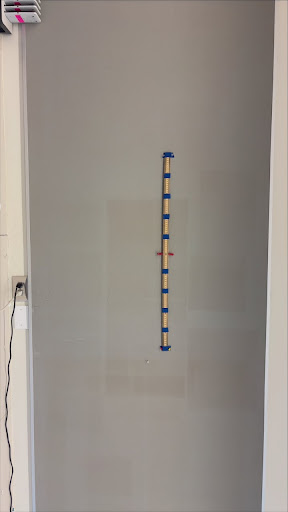
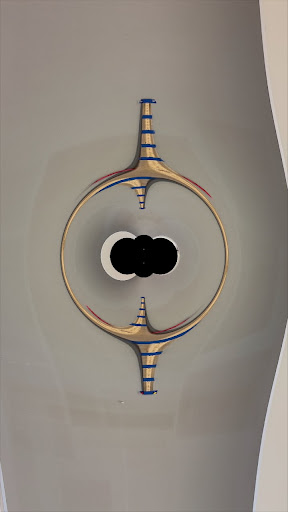

Figure 1: Experimental apparatus for Schwarzschild imaging analysis, showing the calibration meter stick, simulated lensing features, and full field-of-view shadow and ring geometry.
This methodological synthesis provides a practical lesson in statistical metrology, enabling learners to distinguish genuine metric signatures from rendering noise (pixel quantization, aliasing). The approach models real astrophysical parameter extraction workflows used in Event Horizon Telescope (EHT) analyses, replicating the interplay of measurement precision across disparate observational regimes.
The paper analytically derives the lensing Jacobian for Schwarzschild spacetime, mapping anisotropic transformations in the observer's image plane. The vertical stretch (μv) and radial compression (μh) effects are calculated via angular potential integrals, formalizing the pixel-level image deformation rooted in geodesic dynamics. Singularities at the equator are regularized by finite pixel integration, and the predicted magnification factors (μA) in strong-field regions demonstrate quantitative agreement with rendered images (Mslope0, Mslope1 error).
The analysis reveals that these numerical implementations faithfully capture the theoretical balance of divergent stretch and compression, confirming that the BHV ray-tracing pipeline correctly handles coordinate singularities and anisotropic metric gradients.
Global Coordinate Stability: Integral Arclength Invariance
Through discrete arc-length summation along lensed and unlensed trajectories, the investigation verifies the global numerical stability of coordinate projection. The comparability of lensed and unlensed arc lengths (Mslope2 deviation) indicates the simulation's ability to regularize non-linear metric transformations, anchoring the experimental coordinate grid to the theoretical manifold. This serves as evidence of the fidelity of the engine's sampling protocol and its handling of discrete projection effects.
Photon Ring Instability and Lyapunov Scaling
Photon-ring subimages, governed by exponential demagnification (Mslope3 with Mslope4 in the half-orbit parametrization), are quantitatively analyzed via echo ratios extracted from pixel-level measurements. Adjusting for internal scaling (Mslope5), the experimental Lyapunov exponent matches theoretical expectations within Mslope6 of the predicted value (Mslope7).
The matched-pairs t-analysis establishes that the rendered demagnification hierarchy is statistically consistent with the GR scaling law for photon ring instabilities, providing a robust pedagogical demonstration of orbital instability properties in strong-field gravity.
Numerical Symmetry and No-Hair Theorem Validation
The fidelity of Schwarzschild spherical symmetry is probed by extracting the shadow boundary with automated sub-pixel edge detection, statistical runs tests, skewness analysis, and confidence intervals. The axial ratio (Mslope8) and high Mslope9-values across all spatial and distributional tests demonstrate sub-pixel adherence to rotational symmetry, as required by the No-Hair theorem and Birkhoff's theorem.
The suite of statistical diagnostics—spanning Shapiro-Wilk, Levene, and circular runs tests—provides objective benchmarks for algorithmic bias, confirming that deviations from ideal circularity are dominated by stochastic instrumental artifacts rather than systematic rendering errors.
2D Grid Probes and Advanced Imaging Diagnostics
Leveraging 2D grid environments, the BHV app enables visualization of global manifold effects, demonstrating the transformation of rectilinear meshes into concentric Einstein rings and radial spokes. This qualitative landscape showcases the repeated imaging of the celestial sphere, parity-inverted rings, and caustic structures—features analogous to observational challenges in EHT and the forthcoming Black Hole Explorer (BHEX) mission.

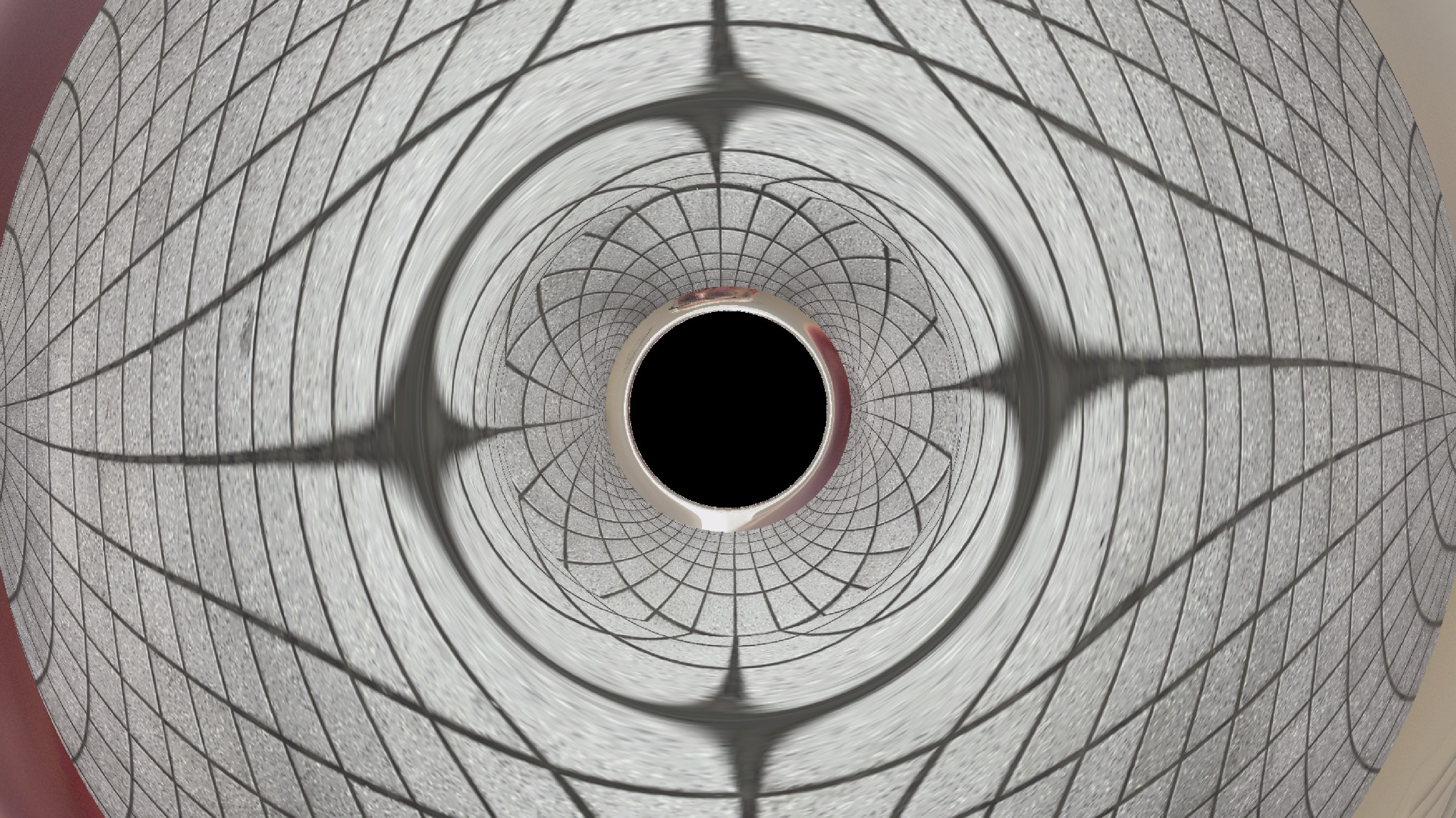
Figure 2: Transformation of unlensed rectilinear grid (top) into Schwarzschild-lensed polar ring structure (bottom), demonstrating geometric distortion and photon ring hierarchy.
For advanced students, the platform facilitates investigations of parity inversion, caustic formation, and instrumental sampling artifacts, anchoring theoretical concepts to the practical challenges of horizon-scale black hole imaging.
Systematic Sensitivity: Instrumental Limits and Error Quantification
The study rigorously analyzes the sensitivity of the simulated environment to experimental misalignments—specifically minor tripod tilts (Mshadow0)—and sampling limits. Side-selection protocols are justified by observed amplification of shearing in high-gradient regions, confirming the necessity of careful data selection and error controls. The projection geometry (gnomonic transformation) is dissected to differentiate metric deformation from background non-Euclidean artifacts.
Instrumental noise such as Cartesian grid aliasing is characterized and neutralized via diagonal intersection protocols. The practical implications for real black hole imaging experiments are emphasized: sampling limits and pixel quantization are the dominant sources of uncertainty near the critical curve.
Conclusions
This work establishes the BHV app as a robust digital platform for quantitative GR education, operationalizing statistical metrology, coordinate transformation analysis, and symmetry diagnostics at the pixel level. The simulation engine demonstrates statistical consistency with theoretical Schwarzschild targets in mass calibration, lensing transformations, photon ring instability, and symmetry, with all deviations attributable to instrumental or rendering artifacts rather than algorithmic bias.
Pedagogically, this framework moves beyond traditional analytical derivations, empowering students to engage directly with empirical image analysis and numerical stability protocols. The modular laboratory structure enables scaling from introductory exercises to advanced research-level investigations, bridging the gap between textbook GR and the data-centric workflows inherent to black hole imaging missions such as EHT and BHEX.
Future directions include extending the quantitative probe to rotating Kerr spacetimes, investigating parity-breaking and frame-dragging signatures, and refining the app's capabilities for research-driven exploration of horizon-scale phenomena. This methodology lays the foundation for integrating real-time quantitative imaging within the broader landscape of relativistic astrophysics and numerical relativity.

