- The paper integrates equilibrium propagation with Hamiltonian inference in diffusive Fitzhugh-Nagumo networks, enabling effective local credit assignment.
- It derives symmetric input-output Jacobians for activator variables at steady state despite the underlying skew-gradient dynamics.
- Empirical results on deep FHN networks achieve a 2.8% test error using EqProp, supporting its application in biologically plausible neuromorphic learning.
Equilibrium Propagation and Hamiltonian Inference in Diffusive Fitzhugh-Nagumo Networks
Introduction and Problem Setting
The paper "Equilibrium Propagation and Hamiltonian Inference in the Diffusive Fitzhugh-Nagumo Model" (2605.21568) presents a novel and unified framework integrating Equilibrium Propagation (EqProp) and Hamiltonian inference for spatially extended Fitzhugh-Nagumo (FHN) neural networks. The FHN model, a canonical excitable system in mathematical neuroscience, exhibits activator-inhibitor dynamics with nonlinear dissipation, gain, and energy storage. This structural complexity renders it highly expressive but previously resistant to direct application of self-adjoint learning algorithms such as EqProp and Hamiltonian Echo Backpropagation (HEB).
The discussion is motivated by challenges in biologically plausible credit assignment in deep architectures. Standard backpropagation, though effective for error minimization, is nonlocal and thus lacks plausibility in neuromorphic models. EqProp and related local gradient propagation methods, originally studied in energy-based models (EBMs), exploit self-adjointness for efficient local learning. The paper’s primary contribution is generalizing these frameworks to nonlinear, skew-gradient systems and explicitly demonstrating a Hamiltonian formulation for stationary solutions in deep Fitzhugh-Nagumo networks.
Theoretical Framework: Skew-Gradient Structure and Self-Adjointness
The FHN model inhabits the class of skew-gradient systems, characterized by partitioned variables where some evolve along gradients of an energy function (activator) and others along negative gradients (inhibitor). While conventional EBMs/gradient systems guarantee symmetric Jacobians, FHN-like neuron models do not. However, the authors prove that, at steady state, the linear response of the activator variables to input current perturbations is self-adjoint; thus, EqProp applies to stationary solutions. This crucial observation allows for local credit assignment based only on activity differences, preserving the low-variance advantages of EqProp over perturbative approaches and bypassing the need for an explicit backward computational graph.
Key derivations show that for stationary FHN networks with undirected diffusive coupling (represented through Laplacian operators derived from graph topology), the steady-state input-output Jacobian for activators remains symmetric. As a consequence, gradient estimation required for synaptic updates maintains locality and symmetry, enabling biologically plausible learning dynamics in a broader class of models than previously recognized.
Fitzhugh-Nagumo Networks as Deep Residual Architectures
The paper advances the field by constructing deep, multilayer networks of diffusively coupled FHN units, which operate analogously to residual networks. By organizing multiple 1D spatial intervals (path graphs) in parallel and coupling layers, the network supports both recurrent and deep architectures.
The analysis exploits the electrical circuit analogy, wherein nodes correspond to neuron variables, tunnel diode nonlinearities realize membrane mechanisms, and resistive coupling creates lateral interactions. This provides not only a mechanistic understanding but also delivers tractable algebraic forms for Laplacian operators and nonlinearities in discrete graphs.
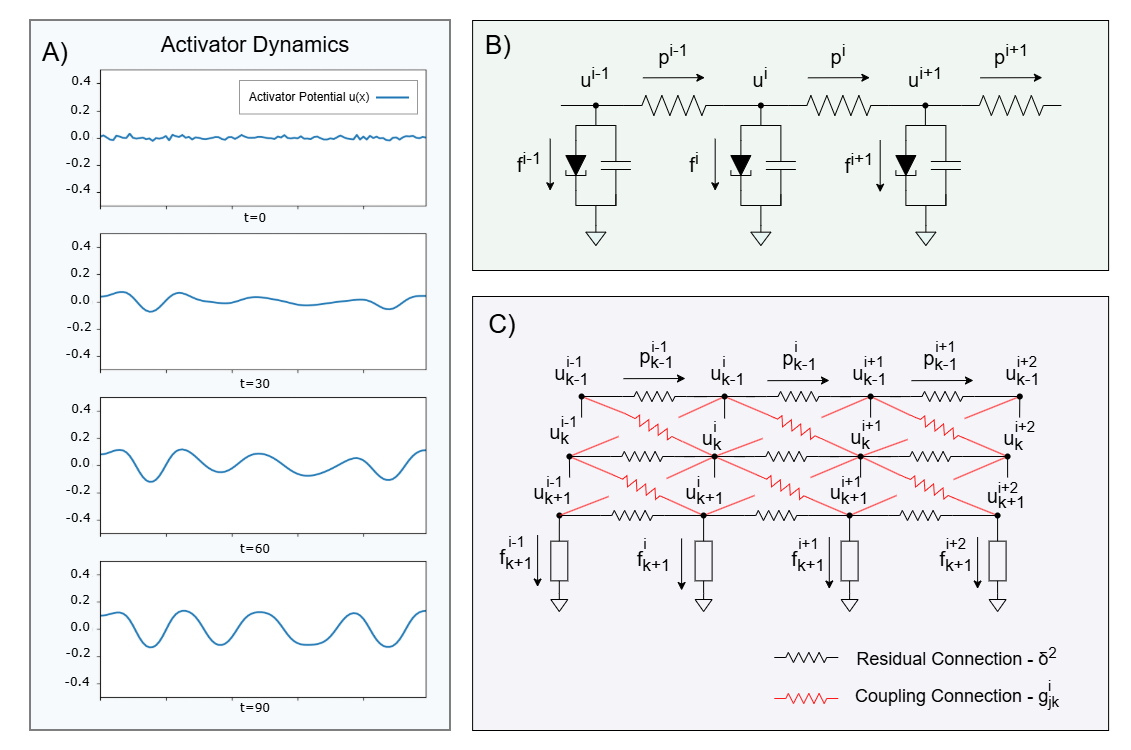
Figure 1: A) Temporal evolution towards a 1D Turing pattern in the FHN model; B) Discrete spatial path-graph topology for FHN neurons; C) Multi-path, layer-coupled architecture forming a deep residual FHN network.
Moving beyond local energy gradients, the work demonstrates that stationary FHN networks—when discretized in space—admit a Hamiltonian description, wherein the spatial coordinate plays the role analogous to time in dynamical systems. The Hamiltonian, constructed for both activator and inhibitor dynamics, enables reduction of the inference process to a strictly feedforward, layer-wise recurrence, circumventing the need for lengthy iterative convergence typical in EBMs.
The recursive formulation provides, for each layer, explicit update rules involving activator values, “momentum” variables (representing spatial differences), nonlinear feedback, and graph coupling terms:
ui+1=ui+pi
pi+1=MiNipi+Mifi+1−MiOiui+1
The structure admits analogies to second-order conservative systems and supports direct, non-iterative inference given suitable initialization (boundary plus “momentum” conditions). The authors also generalize this insight to deep EBMs: provided invertible interlayer weight matrices, EBMs allow exact steady-state computation via similar recurrences, bridging the Lagrangian (two-point boundary value) and Hamiltonian (initial-value) formulations.
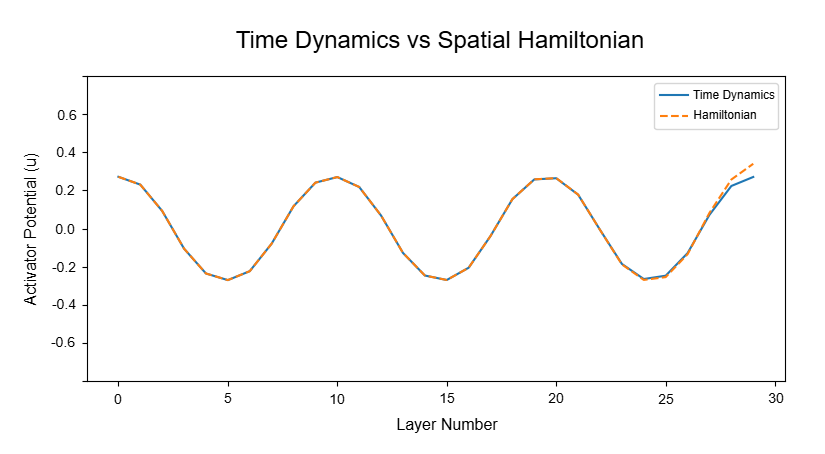
Figure 2: Comparison of time-dynamics convergence vs. Hamiltonian spatial layer-wise integration for deep FHN networks. The two approaches yield equivalent activator trajectories up to integration depth limits.
Empirical Results: Equilibrium Propagation on Deep FHN Networks
The authors validate their theoretical constructs by training deep FHN networks with five hidden layers on the MNIST dataset using EqProp. The networks are initialized in regimes supporting Turing pattern formation, leveraging carefully tuned nonlinear and coupling parameters. Importantly, the model achieves a test error rate of 2.8%±0.2, which substantiates the feasibility of large-scale biological plausible learning in skew-gradient, dynamical neural architectures.
Observations include transient loss spikes—likely attributable to deviations from steady-state regimes during training—highlighting the importance of parameter and initialization selection in maintaining stable dynamics. The authors suggest further research on constraints or normalization schemes to mitigate runaway gain accumulation in deep dynamical systems.
Implications, Limitations, and Future Directions
This work confirms that equilibrium propagation algorithms—originally thought to require strict gradient (symmetric) structure—generalize to a broad class of biophysical networks exhibiting skew-gradient (mini-max) dynamics. The Hamiltonian formulation not only yields practical algorithmic benefits (layer-wise, feedforward steady-state computation) but also enforces local conservation laws rooted in network topology (e.g., Kirchhoff-like current balancing).
From a practical standpoint, these results decrease the computational burden of inference in EBMs/FHN networks and provide algorithmic templates directly compatible with hardware implementations spanning neuromorphic and analog platforms. Theoretical implications extend to the understanding of pattern formation, spatial bifurcations, and biological architectures naturally employing activator-inhibitor interactions. The work signals that tools from Hamiltonian and variational analysis are directly portable to the design and training of new classes of deep energy-based and dynamical neural networks.
Concerning limitations, while the Hamiltonian feedforward inference works up to a finite depth before instability under discrete integration, the analysis suggests that architectural modifications—such as normalization or advanced integration schemes—may extend stable inference regions. Future developments include systematic methods for setting boundary conditions in Hamiltonian inference, application to spiking or multi-timescale neurons, and rigorous analysis of non-stationary (time-dependent) learning in skew-gradient systems.
Conclusion
The paper establishes a robust theoretical and experimental foundation demonstrating that equilibrium propagation and Hamiltonian algorithms for credit assignment extend well beyond conventional energy-based models. By providing an explicit bridge between energy minimization and Hamiltonian spatial dynamics for the Fitzhugh-Nagumo class, the authors enable efficient, biologically plausible deep learning in nonlinear dynamical networks. The results are expected to catalyze further exploration of deep biophysical neural architectures and integration of physical principles into AI inference and learning paradigms.

