- The paper demonstrates that Apple’s DifferentialPrivacy framework fails to meet its privacy guarantees due to floating-point vulnerabilities and misconfigured parameters.
- The audit applies reverse engineering and dynamic analysis to reveal empirical epsilon values far exceeding intended levels, undermining DP claims.
- The study highlights practical risks from plaintext analytics logs and server misconfigurations that enable reconstruction of sensitive user data.
Auditing Apple's DifferentialPrivacy.framework: Implementation Bugs, Misconfigurations, and Practical Risks
Introduction and Context
This paper conducts an exhaustive, implementation-level audit of Apple's DifferentialPrivacy.framework across macOS Sonoma 14.2 and Sequoia 15.6 (2605.21378). The DifferentialPrivacy.framework is the core client-side analytics system in all recent Apple devices, claimed to provide strong user privacy via local differential privacy (LDP), state-of-the-art privatization mechanisms (Laplace, Gaussian, Count Median Sketch, Hadamard methods, RAPPOR), and secure aggregation protocols (Prio, Prio++, PINE). The absence of open sourcing these methods has previously inhibited independent verification of Apple’s privacy claims, raising longstanding concerns about trust, implementation soundness, and the practical realization of privacy guarantees.
Methodology
The analysis utilizes reverse engineering to extract Objective-C runtime headers from system binaries, dynamic linking to actively instrument Apple's native DP mechanisms, and construction of specialized auditing and decoding tools to evaluate both the DP framework's privacy properties and its vulnerability to practical attacks. The methodology exceeds prior art by validating empirical privacy guarantees using membership inference attacks, decoder construction for leakage quantification, and by auditing the real outputs of deployed mechanisms as shipped on production Apple OS releases.
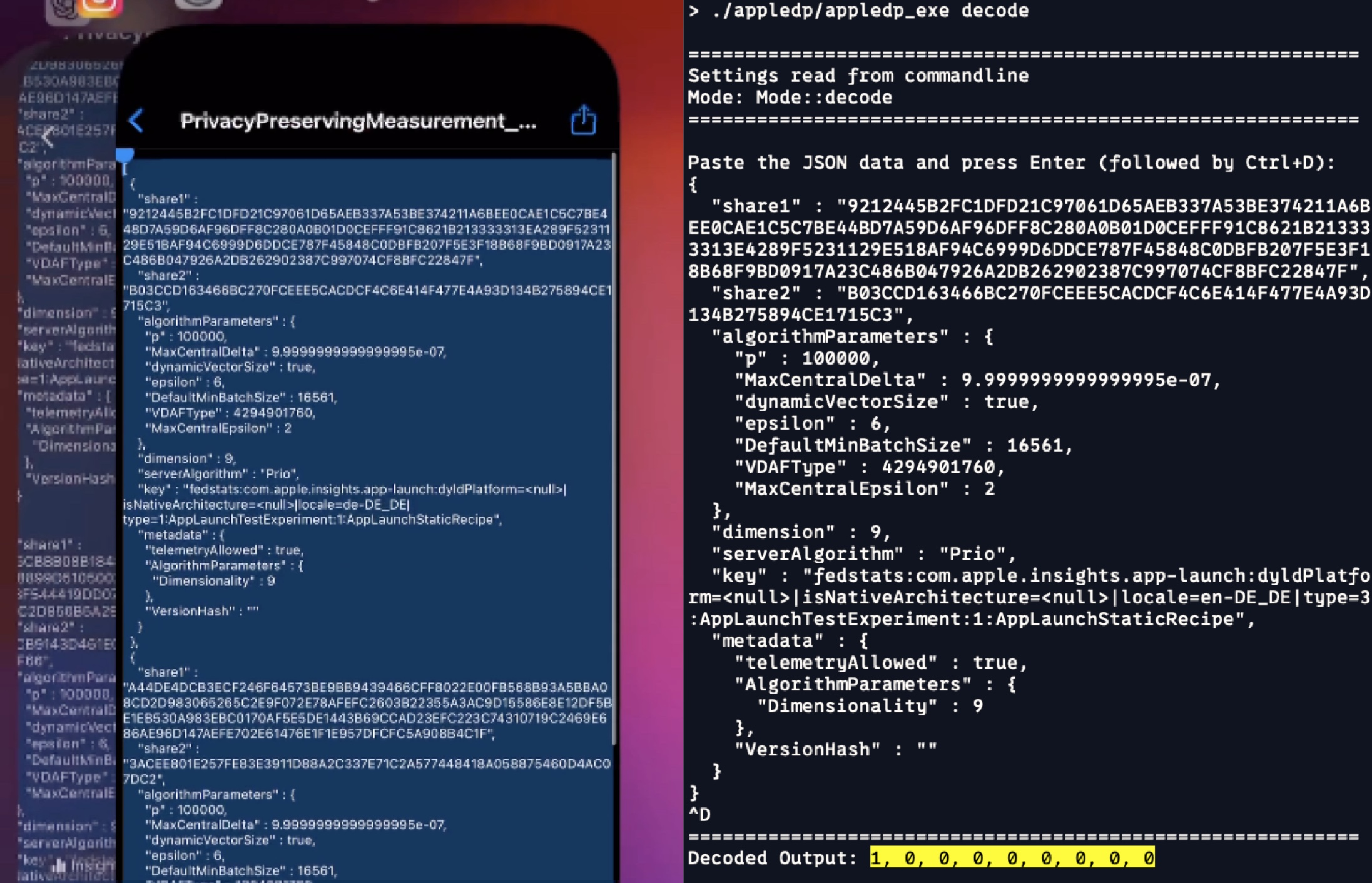
Figure 1: Decoding analytics data from our test iPhone device. The logs reveal unencrypted share1' andshare2' fields (representing the secret shares [Y]1 and [Y]2) of the differentially private measurement Y uploaded to Apple's servers. These plaintext logs allow direct decoding of Y, as shown on the right. Furthermore, the logs indicate the original OHE of X had a dimensionality of 9, privatized with ϵ=6, leading to a 97.80% chance that the decoded Y equals the original X.
Implementation Vulnerabilities and Practical Risks
Floating-Point Vulnerabilities in Noise Generation
All privatization algorithms in the Apple DP framework that rely on continuous noise distributions (Laplace, Gaussian) are susceptible to well-known floating-point attacks. These vulnerabilities originate in the design of their Laplace and Gaussian PRNGs, which apply inverse transform sampling and Marsaglia polar methods using IEEE 754 double-precision arithmetic. As established by Mironov et al., such floating-point artifacts produce infeasible output regions, resulting in outputs that can, in principle, be mapped to only one (or a very small subset of) possible user inputs. Membership inference attacks performed by the auditors in this work empirically demonstrate that the effective ϵ of these mechanisms is far higher than configured, completely undermining differential privacy and invalidating associated zero-knowledge (ZK) claims.
Secure Aggregation and Misconfiguration
Analysis of Apple's implementation of Prio and its internal variants (Prio++, PINE) reveals systemic architectural and configuration weaknesses:
- Server Collusion Assumption Break: Despite using secret sharing, both shares are uploaded to endpoints under Apple's sole control, violating the core trust assumption of multi-server MPC and SecAgg.
- LDP Disabled by Default: Many protocols, including those used for sensitive analytics, are configured with no DP at all, leaving the raw or nearly raw data reconstructable by any party with pre-aggregation log access.
- Incorrect Parameterization and Interpretation: In several protocols, privacy budgets are defined using the deletion adjacency model but interpreted and presented as if for replacement adjacency, resulting in at least a factor of two overstatement of privacy and effective ϵ≫1.
Plaintext Analytics Log Leaks
Empirical demonstration shows that device-side analytics logs in iOS and macOS include unencrypted, directly decodable secret shares for the main DP mechanisms. These can be trivially combined to reconstruct the original privatized values and, in many cases, the original input with near certainty—even for high-cardinality properties (e.g., visited web domains, keyboard emojis). Public leaks of such logs have been documented on GitHub, Pastebin, and social media, confirming the external exploitability of these weaknesses.
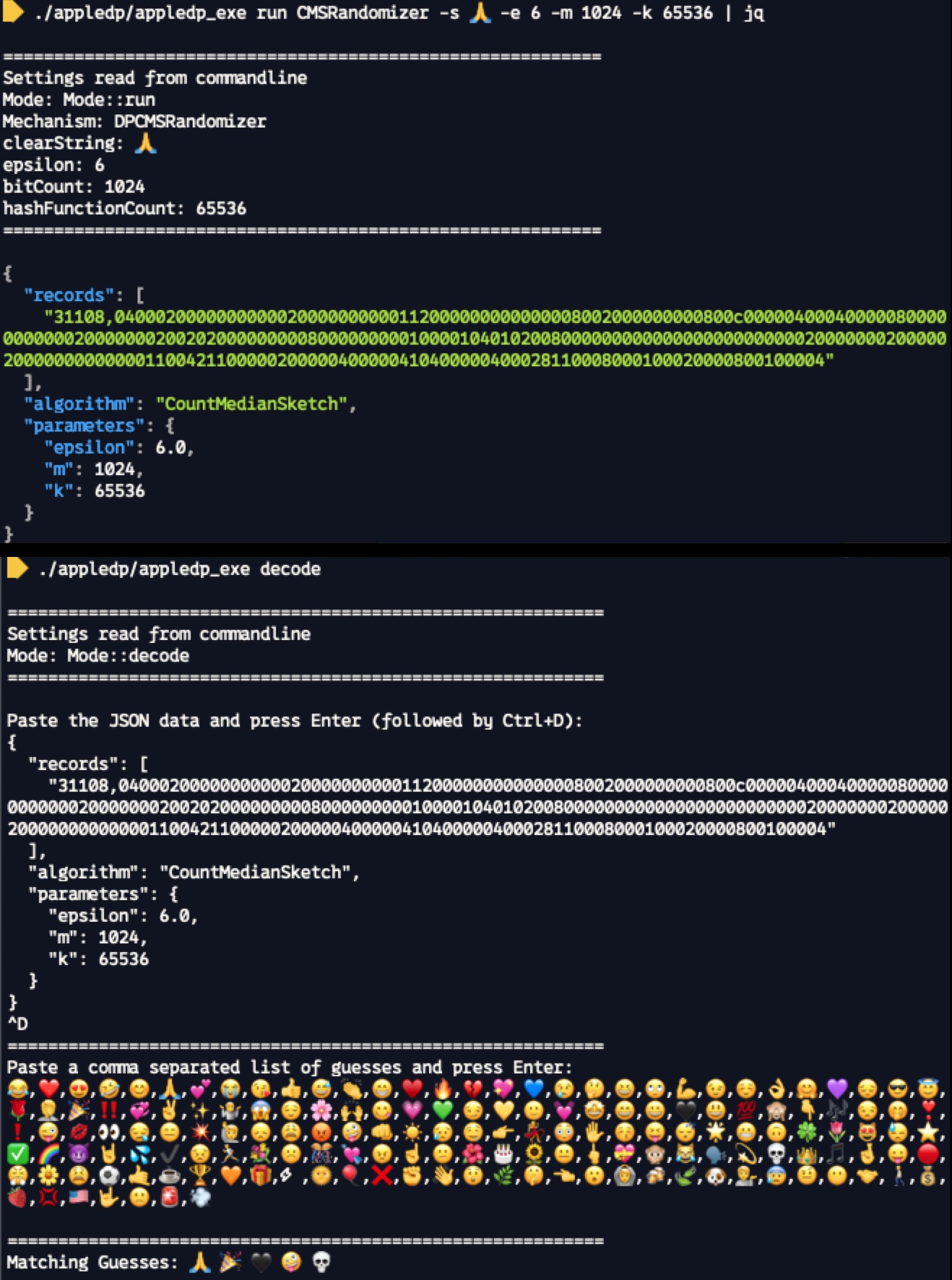
Figure 2: Illustration of our decoder for Apple's Count Median Sketch ([Y]20), demonstrating decryption of sensitive data from leaked logs using published configuration parameters.
Empirical Auditing and Results
Differential Privacy Auditing
Empirical audits deploy state-of-the-art testing, leveraging membership inference and Bayes-optimal hypothesis testing to establish lower bounds on the actual privacy parameters of each mechanism. Numerical results highlight:
- Laplace Mechanism (NumberRandomizer): False-negatives on infeasibility tests yield an empirical lower bound of [Y]21 (target [Y]22), confirming severe DP failure.
- Gaussian Mechanism (Prio++/PINE variants): An attack using 1,000 sample pairs achieves over 85% inference accuracy; empirical [Y]23 versus a claimed [Y]24-DP.
- Prio Protocol: With [Y]25, decoded outputs typically differ from the true input in at most 30 bits (for [Y]26), with over 87% probability of exact reconstruction.
- Count Median Sketch / Hadamard: For [Y]27, the mechanism can often uniquely determine the input from the observed output when the candidate set is restricted (as per the property being measured).
Across all mechanisms, audit results are strongly at odds with the figures officially communicated by Apple, with privacy violation rates and DP parameter underestimation correlating directly with floating-point flaws and misconfiguration. Many membership inference attacks against these mechanisms achieve >80–90% success probability, even at moderate privacy budgets.
Implications for Privacy, Security, and Distributed Analytics
The findings substantiate that implementation subtleties—specifically, floating-point PRNG vulnerabilities and misapplication of SecAgg—enable both Apple and any third-party adversary with log access to reconstruct sensitive user information from analytics records, presenting a practical and non-theoretical privacy risk across more than two billion devices. These exposures are not obscure: configurations and exploits pertain to health (vaccination status), location, browser history, device usage patterns, and more. Moreover, absence of public review and third-party verification for the DP mechanisms exacerbates the problem of trust.
The analysis concludes that the utility/accuracy trade-offs have been heavily skewed toward business use-cases (population-level analytics) at the direct expense of individual privacy. Large-scale DP applications in industry will need to reassess the trust models underpinning client-to-server analytics, the actual parameters used for "privacy," and the dangers of floating-point and logging errors—especially if user consent is predicated on claims of mathematically robust privacy.
Recommendations and Future Directions
The paper proposes specific remedial steps for Apple and similar vendors:
- Immediate migration to integer-based, cryptographically secure discrete noise mechanisms (Discrete Laplace, Discrete Gaussian) and open, formally analyzed PRNG libraries.
- Separation of SecAgg servers into cryptographically independent, publicly auditable entities.
- Enforcement of LDP (with low [Y]28) for all analytics data, including any metadata or diagnostics.
- Default encryption of all pre-aggregation logs and aggressive minimization of exposure windows for user-exportable analytics.
- Public release of DP mechanism specifications, configuration files, and server-side code for independent audit and reproducibility.
These steps are not solely relevant for Apple’s ecosystem, but serve as concrete guidance for all deployers of local DP and secure analytics frameworks. The audit framework and decoder tooling provided can be generalized for studies of other closed-source or large-scale analytics systems.
Conclusion
This paper establishes clear, empirical evidence that Apple’s real-world deployment of differential privacy is undermined by implementation flaws, misconfigurations, and systemic architectural choices that allow both Apple and adversaries to extract sensitive user data. The technical origins of the privacy failures—a combination of floating-point inaccuracies, misparameterization, and trust-model violations—are well understood but persist in major production deployments. The recommended countermeasures are standard in privacy engineering but are not currently adopted.
Without public review, open-source releases, and alignment of implementation with formal privacy analyses, differential privacy's intended protections in consumer analytics are not realized in practice. Future directions are clear: enforce cryptographically sound implementations, lower privacy budgets, open all mechanism details, and eliminate plaintext diagnostics exports. This is essential for rebuilding trust in privacy technologies and ensuring user consent is meaningful and informed.