- The paper extends HDMFT to incorporate structural cut-offs and degree correlations using a maximum entropy framework.
- It employs generalized Lotka-Volterra dynamics and self-consistent equations to reliably predict survival rates and stability across diverse networks.
- Empirical validations demonstrate that accounting for hidden degrees markedly improves prediction accuracy over naive mean-field models.
Dynamical Mean-Field Theory for Ultra Small-World, Highly Heterogeneous Networks
Introduction
The study investigates the behavior of complex dynamical systems on ultra small-world networks characterized by extreme degree heterogeneity, focusing particularly on settings where empirical network structures diverge strongly from the simplifying assumptions of independent or weakly heterogeneous connectivities. The central theoretical advance is the extension of Heterogeneous Dynamical Mean-Field Theory (HDMFT) to account for strong degree correlations and structural cut-offs, which are inherent in networks with broad (power-law) degree distributions but are neglected in existing mean-field approaches. The authors analyze these phenomena using the generalized Lotka-Volterra (GLV) framework as a model system, deriving new self-consistent equations that incorporate nontrivial assortativity and validating their theory across both synthetic and empirical networks.
Structural Cut-Offs and Degree Correlations
The formulation begins by noting that real heterogeneous networks (e.g., ecological, social, economic) exhibit degree distributions often close to power-law, with exponents α as low as $0.07$–$1.78$. Such extreme heterogeneity induces structural cut-offs: any node cannot exceed N connections in a network with N nodes, enforcing negative degree-degree correlations (disassortativity) even in the absence of explicit architectural biases.
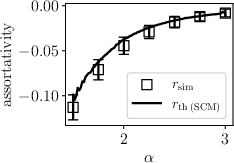
Figure 1: Forced negative assortativity emerges in highly heterogeneous networks with power-law degree exponents, even when constructed without explicit assortative constraints.
This disassortativity is quantitatively demonstrated, and the statistical models that do not account for structural cut-offs (e.g., Chung-Lu random graphs, where pij∝kikj) fail to capture the non-zero assortativity observed in large-scale simulations. The authors resolve this by mapping observed degrees to a "hidden degree" variable within a maximum entropy network ensemble. The connection probability between nodes is then modeled as PSCM(k~,m~)=k~m~+CNk~m~, with k~ the hidden degree and CN proportional to total edges, thus capturing the emergent degree correlations and cut-off effects.
HDMFT for Dynamical Systems with Strong Heterogeneity
The main technical contribution is to generalize HDMFT for networks with arbitrary, potentially extreme, degree heterogeneity and intrinsic degree correlations. The GLV dynamics takes the form S˙i(t)=Si(t)(1−Si(t)−j∑AijβijSj(t)), where $0.07$0 encodes network structure and $0.07$1 the interaction strength (with specified disorder statistics).
For such setups, the effective stochastic dynamics for species of degree $0.07$2 is: $0.07$3
with the mean-field inputs $0.07$4 and noise correlations $0.07$5 given by self-consistent integrals over the degree distribution and the correlated connection probability $0.07$6. Crucially, the mapping between observed and hidden degrees—required to specify $0.07$7—is computed analytically or numerically for arbitrary degree distributions.
Numerical Results: Survival and Stability
The theoretical framework is validated by comparison with large-scale numerical simulations of GLV systems on both power-law synthetic networks and empirical networks (food webs, communication, metabolic graphs). A key observable is the survival rate of species as a function of nodal connectance.
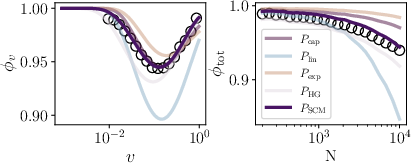
Figure 2: Theoretical survival rates match simulations only when the hidden-observed degree mapping and correlated $0.07$8 are used; naive bilinear approximations break down for large heterogeneity.
The results show that using the traditional bilinear edge probability $0.07$9—as in prior HDMFT studies—substantially mispredicts survival probabilities and system stability in the strongly heterogeneous regime, sometimes even yielding unphysical probabilities $1.78$0. In contrast, using the derived $1.78$1 (or its analytic forms based on hypergeometric functions) provides accurate predictions for the full range of parameters.
Empirical validations further demonstrate the predictive capacity of the formalism.
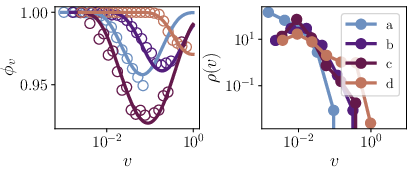
Figure 3: Survival probability as a function of connectance across real-world networks is quantitatively predicted by the new HDMFT with degree correlations accounted for.
Phase Boundaries and System Size Effects
The analysis further characterizes the impact of degree correlations on the stability boundary of the system. For a given disorder strength $1.78$2 and degree exponent $1.78$3, there exists a critical system size $1.78$4 beyond which all stable networks necessarily possess nodes with connectivity on the order of the system size. As $1.78$5 decreases, this effect becomes pronounced, implying that mean-field approximations neglecting degree correlations become increasingly inaccurate for large, highly heterogeneous systems.
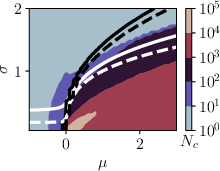
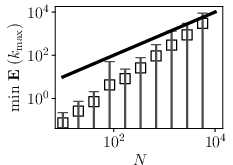
Figure 4: The critical system size $1.78$6 for stability and the expected maximum degree $1.78$7 highlight when degree correlations cannot be neglected; theory with correlations (solid lines) diverges from naive mean-field (dashed).
Practical and Theoretical Implications
The approach enables precise quantitative predictions for dynamics and stability on real, heterogeneous networks without requiring bespoke network models or detailed measurement of correlations. The results indicate that degree correlations, even when emergent purely from structural cut-offs, can increase both survival rates and systemic stability, paralleling the effect of negative correlations in interaction strengths. This finding directly challenges the conventional wisdom that highly heterogeneous, disassortative networks are more fragile; instead, the structural cut-off-induced correlations provide a stabilizing mechanism that must be reckoned with in theoretical ecology, epidemiology, and other networked dynamical systems.
Potential extensions include analysis of positively assortative, directed, or bipartite networks and scrutiny of higher-order structural effects, all of which may demand further generalization of the mean-field machinery developed herein.
Computational Aspects
The numerical implementation computes the hidden degree distributions and order parameters using efficient iterative binning methods, making it tractable to analyze empirical networks with thousands of nodes. Convergence of theoretical results with as few as $1.78$8 bins is observed, ensuring practical usability for a wide range of real network datasets.
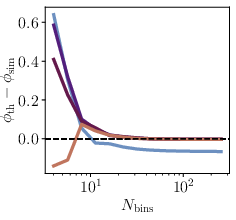
Figure 5: Rapid convergence of theoretical predictions as a function of the number of degree bins used in the hidden degree calculation.
Conclusion
By introducing a maximum entropy-based edge probability framework and constructing self-consistent HDMFT for ultra small-world networks, this work provides a robust methodology for analyzing dynamical systems with strong structural heterogeneity. The results demonstrate the necessity of accounting for inherent degree correlations in real networks, revealing that such correlations can stabilize dynamics and enhance species survival, a conclusion with far-reaching implications for the modeling and management of complex systems across diverse scientific domains.

