- The paper presents a contrastive self-supervised convolutional autoencoder that robustly detects core-collapse supernova gravitational waves by enforcing noise invariance in the latent space.
- It achieves high detection efficiency with AUCs up to 0.9951 on out-of-distribution CCSNe signals, outperforming both standard autoencoders and supervised CNNs.
- The approach minimizes template dependence and enhances glitch rejection via channel coherence, offering a modular framework for robust astrophysical transient detection.
Contrastive Self-Supervised Convolutional Autoencoder for Core-Collapse Supernova Gravitational-Wave Detection
Introduction
The detection of gravitational waves (GWs) from core-collapse supernovae (CCSNe) is of high astrophysical significance, but presents formidable challenges due to the stochastic, weak, and waveform-diverse signal morphology intrinsic to these events. The canonical approaches, spanning unmodeled burst searches to supervised deep neural network classifiers, are either susceptible to reduced sensitivity in the low-SNR regime or suffer from limited generalization to unseen waveform morphologies. This paper introduces a contrastive self-supervised convolutional autoencoder (CS-CAE) framework, aiming to address template dependence and robustness deficiencies in CCSNe GW searches, particularly for applications with next-generation detectors like the Einstein Telescope (ET) (2605.21310).
Methodology
The CS-CAE architecture fuses a convolutional autoencoder (CAE), a latent space regularizer, and an InfoNCE-style contrastive projection head. Training leverages paired noisy realizations of the same GW signal: for each sample, independent noise realizations are added to the same underlying CCSNe waveform, presenting positive pairs that must be embedded in proximal regions of latent space. This mechanism enforces invariance of the learned representation to detector noise, enhancing generalization across signal morphologies and noise artifacts. Additionally, a noise-center latent regularizer ensures pure-noise samples are mapped centrally in the latent space, further improving discriminability. The detection statistic combines the latent distance from the noise center and the reconstruction error, enabling anomaly-driven unsupervised detection without explicit class labels.
The authors benchmarked CS-CAE against a fully supervised convolutional neural network (CNN) and a standard CAE baseline. Training and evaluation data draw from simulated ET-like noise conditions, with signal injections based on both phenomenological CCSNe waveforms and independent catalogs of numerical simulations, thereby probing both in-distribution and cross-distribution performance.
The ROC analysis on in-distribution data demonstrates that CS-CAE bridges the gap between conventional CAEs and fully supervised CNNs, achieving an AUC of 0.9759 compared to the CNN's 0.9838. Notably, on the numerical CCSNe waveform test set—where waveform morphology diverges from the training distribution—CS-CAE achieves an AUC of 0.9951, surpassing both the supervised CNN (0.9926) and the standard CAE (0.9787). This inversion of performance hierarchy confirms that the contrastive self-supervised objective enhances transferability to out-of-distribution signals, a key requirement in CCSNe GW astronomy.
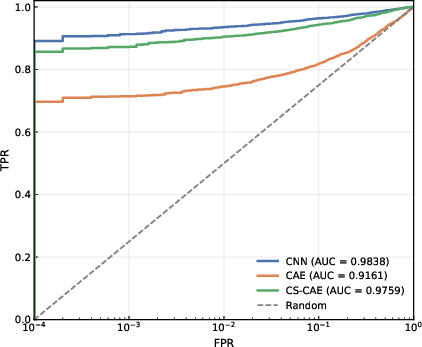
Figure 2: ROC curves for in-distribution simulated test set; CS-CAE closely approaches supervised CNN performance, exceeding CAE baseline sensitivity.
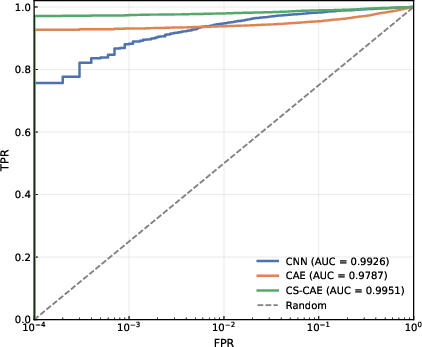
Figure 1: ROC curves on numerical CCSNe waveform test set; CS-CAE outperforms both supervised and unsupervised baselines in cross-simulation generalization.
Distance-Dependent Sensitivity and Low-FPR Regime
The detection efficiency as a function of source distance reveals that CS-CAE retains the highest efficiency in the low-SNR transitional regime. The 50% detection-efficiency horizon is approximately 120kpc—a strong result for template-agnostic detection under ET sensitivity. Fixed-distance ROC curves reinforce these findings: at 100kpc and above, CS-CAE attains superior true-positive rates, particularly in the strict low-false-positive-rate domain relevant for operational observatory thresholds.
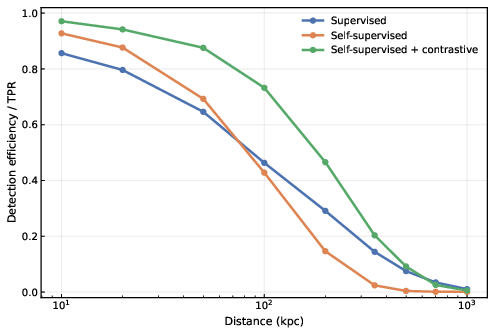
Figure 3: Detection efficiency versus source distance, with CS-CAE maintaining the highest efficiency across the physically relevant range.
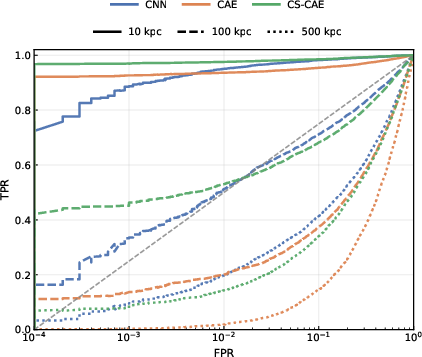
Figure 4: ROC curves at representative source distances (10kpc, 100kpc, 500kpc); CS-CAE's advantage is most pronounced in the low-FPR region crucial for astrophysical searches.
Statistical and Representation Analysis
Analysis of detection-statistic distributions indicates that CS-CAE achieves cleaner signal/noise separability than the CAE, mirrored in the increased shift of signal injections away from the noise population. Latent space visualizations using UMAP elucidate that CS-CAE forms compact and distinct clusters for genuine CCSNe signals, while single-channel glitches injected during robustness assessment are cleanly isolated—implying channel-coherence as a discriminating feature.
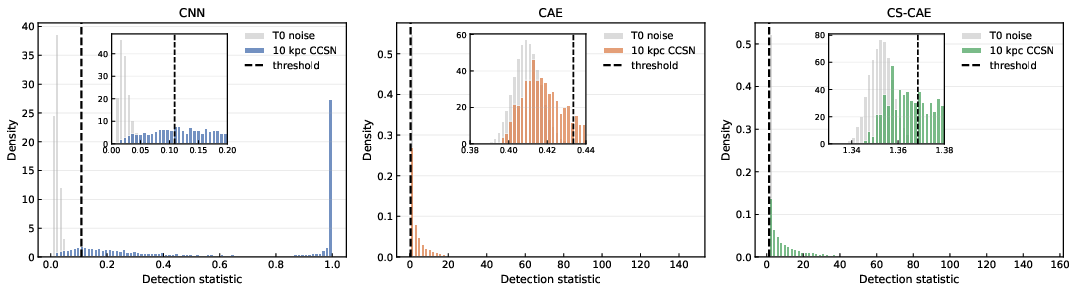
Figure 5: Detection-statistic distributions for each model; CS-CAE signals are more cleanly separated from the noise background compared to the standard CAE.
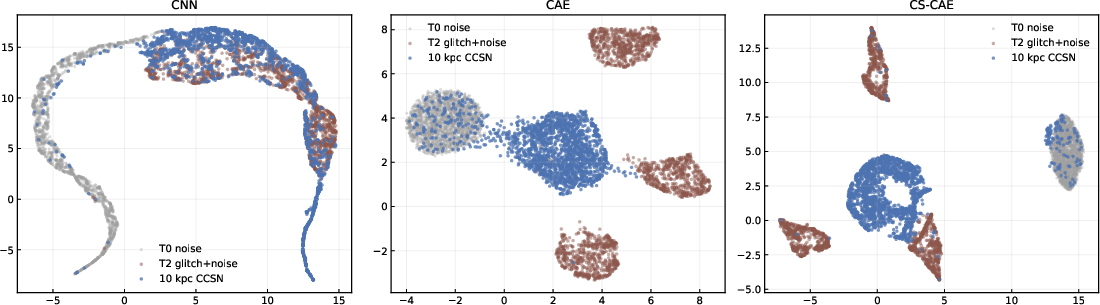
Figure 6: UMAP projections of learned representations; CS-CAE produces compact, distinct signal and glitch clusters, reflecting increased robustness.
The channel-wise response further characterizes the physical basis for glitch rejection: CS-CAE reconstruction errors spike in a localized channel for noise artifacts but display coherence across all channels for true CCSNe signals, supporting an actionable criterion for post-processing vetoes.
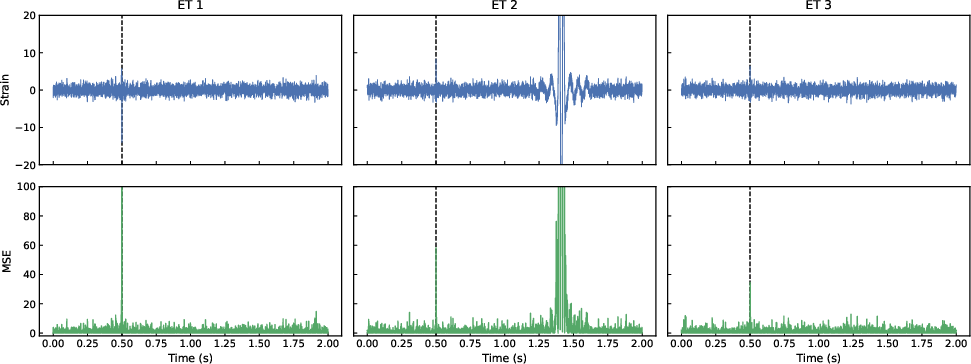
Figure 7: Channel-wise MSE reconstruction for glitches vs. CCSNe; single-channel excess in glitches contrasts with multi-channel coherence of astrophysical signals.
Theoretical and Practical Implications
The contrastive self-supervised paradigm, as implemented in CS-CAE, addresses two critical pain points: sensitivity to realistic, morphologically diverse GW bursts, and robustness to single-channel instrumental artifacts and detector noise. By eschewing dependence on supervised labels and simulated template banks, CS-CAE aligns more closely with the physical uncertainties inherent to CCSNe GW production. The approach is modular and amenable to further improvements, such as integration of explicit channel-coherence constraints, domain adaptation, and deployment with RNN or Transformer-based encoders for longer signal contexts.
The results substantially reinforce the argument for self-supervised representation learning as a path forward in robust, generalizable GW astrophysics. The framework is also extensible to other classes of unmodeled or weak-signal transient detection in complex noise environments.
Conclusion
The CS-CAE model achieves strong numerical performance in both matched and cross-simulation scenarios. The bold claim—empirically substantiated—is that CS-CAE attains generalization properties not manifested in either fully supervised or standard unsupervised autoencoding frameworks, yielding improved detection efficiency and robustness under operational constraints. The implications extend beyond CCSNe GW detection, underscoring the value of contrastive self-supervision in learning physically meaningful and robust representations for rare, stochastic transients in high-dimensional time series. Future directions include adaptation to additional detector configurations, integration with model-based Bayesian inference, and extension to multimessenger contexts and other astrophysical transients.

