- The paper presents a coherent feedback cooling protocol that significantly reduces the room-temperature phonon occupation via re-injected optical fields.
- It employs optimized feedback delay, displacement operations, and dual orthogonally polarized modes to overcome sideband-unresolved limitations.
- Experimental results show a reduction from ~444 to ~166 phonon occupation, with projections suggesting a pathway toward quantum ground-state cooling.
Coherent Feedback Cooling of Ultracoherent Phononic-Crystal Membranes at Room Temperature
Motivation and Background
Laser cooling of macroscopic mechanical resonators into the quantum regime is foundational for advancing quantum optomechanics, precision measurement, and sensing applications. Conventional cavity dynamical backaction cooling (DBC) is broadly effective but fundamentally limited in the sideband-unresolved regime, particularly when the cavity linewidth κ exceeds the mechanical resonance frequency Ωm. In this regime, measurement-based feedback cooling can suppress thermal fluctuations but inevitably incurs quantum state collapse and backaction noise due to measurement. Coherent feedback cooling (CFC) circumvents these constraints by re-injecting the optical probe field—after controlled delay and displacement—without intermediate measurement, preserving quantum coherence and avoiding the electronic bandwidth limitations inherent to conventional feedback.
The experimental challenge is to reach quantum ground-state cooling for macroscopic resonators at room temperature—a goal hindered by the necessity of cryogenic precooling in most prior platforms. Recent advances in density phononic crystal engineering have produced ultracoherent membranes with exceptional Q factors and Qf products, enabling new regimes for quantum control.
Conceptual Framework and Theoretical Model
The CFC protocol operates by coupling a mechanical mode to two orthogonally polarized optical cavity modes. The probe field, after optomechanical interaction, is rotated in polarization and displaced with a strong auxiliary beam, converting phase quadrature information into amplitude quadrature. The displaced field, delayed via fiber, is re-injected to the cavity, applying a feedback force proportional to the mechanical momentum and enhancing damping. The corresponding phase-space evolution reduces the thermal occupation of the mechanical mode (Figure 1).
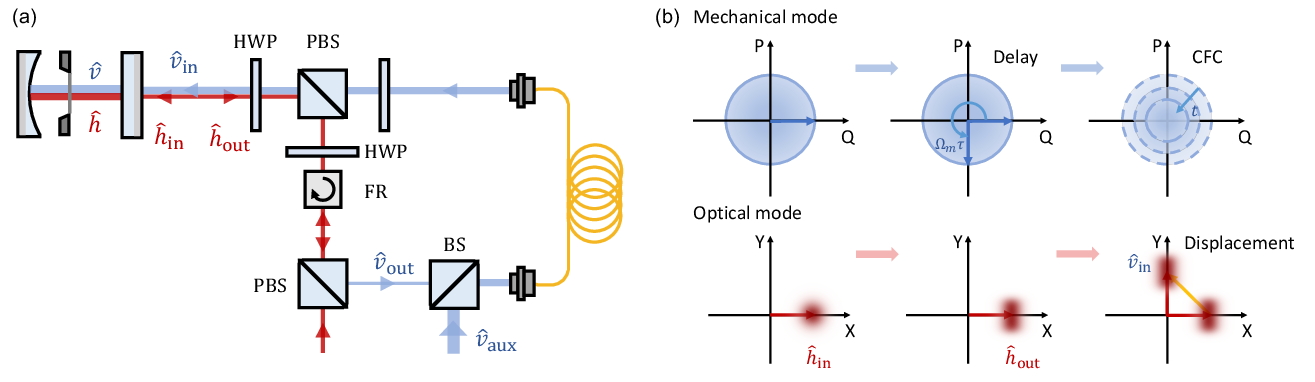
Figure 1: Conceptual scheme of CFC, showing the probe injection, polarization rotation, displacement operation, delayed re-injection, and consequent shrinkage of the mechanical uncertainty in phase space.
The theoretical model departs from the fast-cavity approximation, incorporating finite cavity bandwidth and experimentally relevant frequency fluctuations, and linearizes the system's quantum Langevin equations. Output quadratures, displacement angles γ, and feedback delay τ are optimized for cooling performance. The susceptibility function χcf(ω) and power spectral densities are derived analytically, accounting for loss channels and classical technical noise sources.
The platform is a Fabry-Pérot cavity containing a membrane engineered with a density phononic crystal structure (Figure 2), achieving Q∼1.1×10⁸ and Qf∼1.3×10¹⁴ at Ωm/2π=1.14 MHz. The cavity linewidth Ωm0 MHz places the system in the near-sideband-resolved regime, while birefringence-induced mode splitting introduces additional optical loss. The overall feedback loop efficiency is Ωm1.
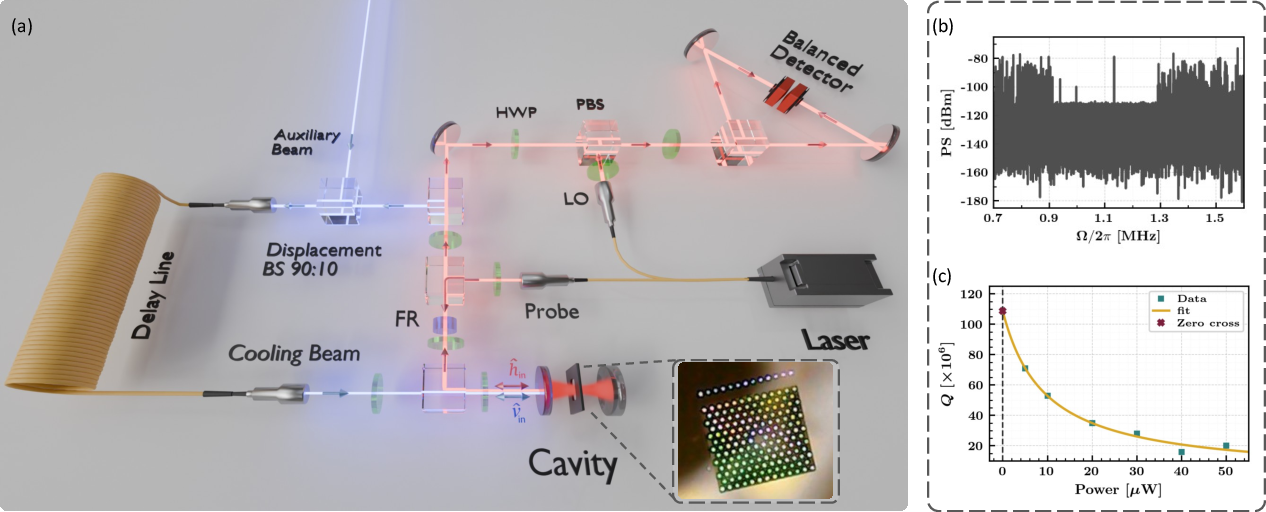
Figure 2: Experimental setup for the CFC scheme and membrane structure. Probe beam is injected, reflected, rotated, displaced, delayed, and re-injected. Inset shows SiΩm2NΩm3 phononic-crystal membrane.
Mechanical ringdown measurements confirm the intrinsic Ωm4 factor. Balancing probe and cooling beam powers and optimizing detuning enables strong DBC. Coherent feedback is implemented via fiber delay and displacement on an asymmetric beam splitter; homodyne detection and avalanche photodetection further characterize the system.
Numerical Optimization and Parameter Dependence
Numerical calculations show the dependence of optimal CFC performance on cavity linewidth and feedback parameters. As Ωm5 decreases (approaching the sideband-resolved regime), the optimal feedback delay shifts from Ωm6 (fast-cavity limit) towards Ωm7, and displacement angle Ωm8 approaches Ωm9 (Figure 3).
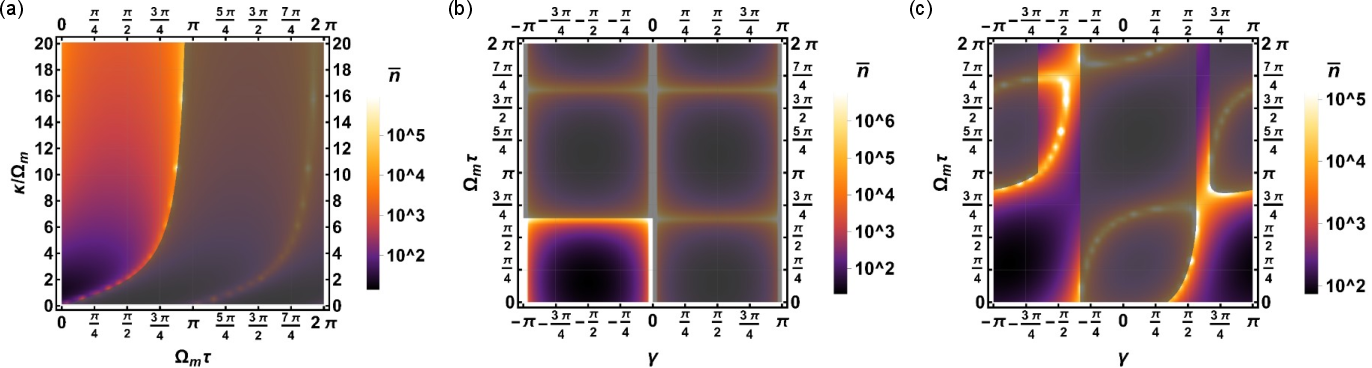
Figure 3: Simulated phonon occupation Q0 as function of feedback delay Q1 and cavity linewidth Q2, and as function of Q3 and displacement angle Q4.
Robustness of cooling performance is evident in wide parameter neighborhoods around the optimum, and cavity detuning further alters the optimal displacement angle due to quadrature mixing in the output field.
Measured phase-quadrature power spectral densities under various regimes—probe only, DBC, and CFC—demonstrate progressive suppression of thermal occupation. DBC alone achieves Q5, with technical noise contributing to the residual occupation. Full CFC, at optimized delay and displacement, reduces the phonon occupation to Q6. Variation of displacement angle shows a clear minimum in Q7 near Q8, matching theoretical predictions (Figure 4).
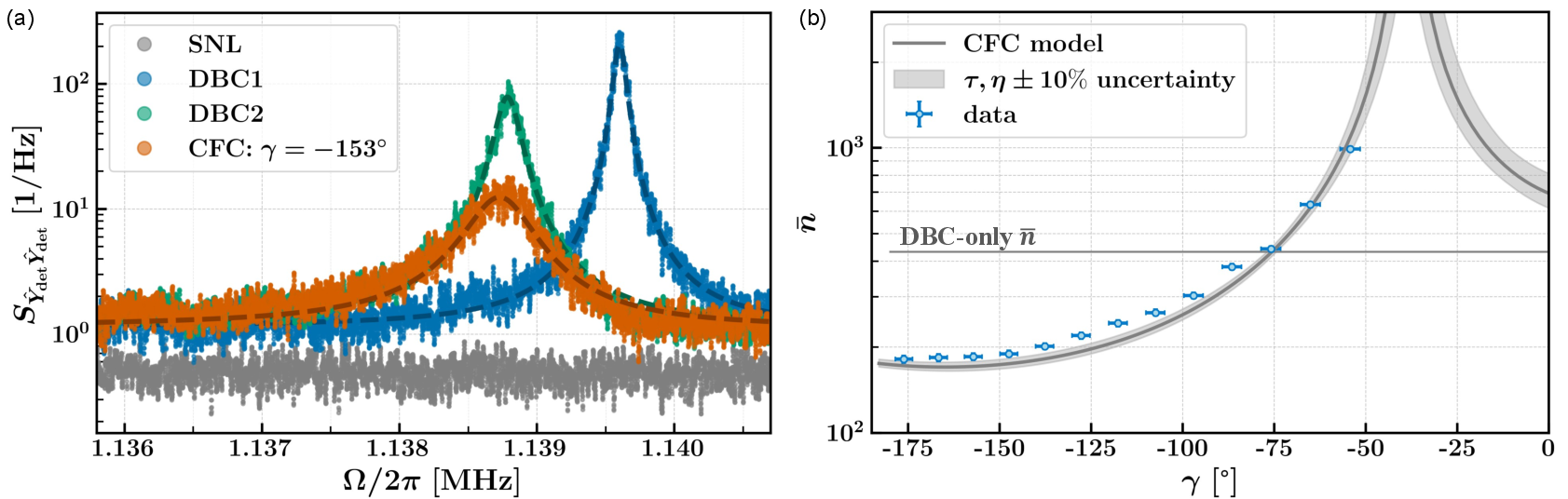
Figure 4: Experimental phase-quadrature PSDs for probe only, DBC, and CFC, and phonon occupation as function of displacement angle Q9.
Scanning probe detuning and feedback delay confirms that CFC surpasses DBC cooling limits at fixed power and detuning. The lowest achieved phonon occupation is Qf0, corresponding to an effective temperature of 9.1 mK, with a cooling factor of Qf1 at room temperature (Figure 5).
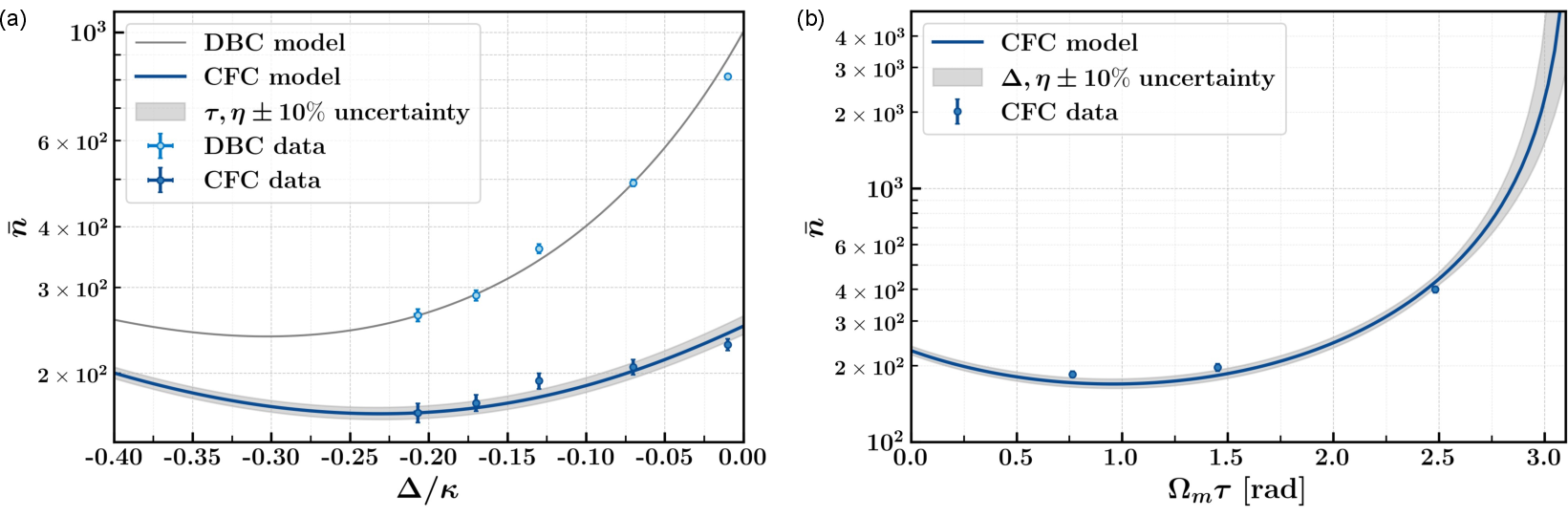
Figure 5: Phonon occupation as a function of probe detuning Qf2 and feedback delay Qf3, showing superior CFC cooling against DBC baseline.
Technical Noise and Projections for Improvement
A salient feature of the modeling is explicit incorporation of classical technical noise—cavity-frequency fluctuations and laser phase/amplitude noise—which become limiting in the strong feedback regime. Current CFC results (Qf4) exceed the ideal quantum limit (Qf5) largely due to such noise, further quantified in simulations.
Projections with realistic device improvements, e.g., tenfold enhancement of Qf6 and suppression of cavity frequency noise, indicate possible reduction to Qf7 (CFC) and approach to Qf8 in the quantum-noise-limited case, delineating a pathway to room-temperature ground-state cooling (Figure 6).
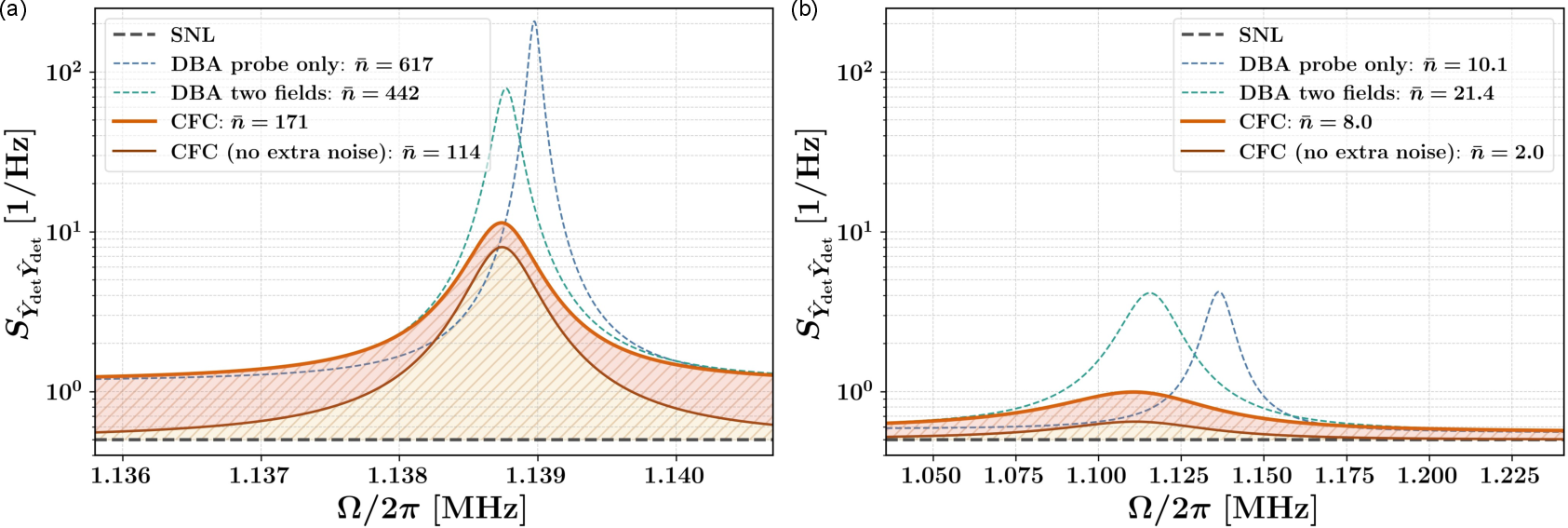
Figure 6: Simulated detected spectra showing performance gaps between current, improved, and quantum-noise-limited CFC conditions.
Implications and Future Directions
This work establishes that coherent feedback cooling is a viable, effective approach for cooling ultracoherent macroscopic resonators at room temperature, providing a synergy with DBC enabled by near-sideband-resolved cavities. The findings indicate a practical route for eliminating cryogenic requirements, broadening applicability for quantum sensing and control. The theoretical framework, validated against experiment, is adaptable for system-level design in noisy, non-ideal cavities.
Near-term developments should focus on increasing optomechanical coupling (e.g., via membrane engineering), further suppressing technical noise (phononic-bandgap engineering of mirrors, improved laser stabilization), and minimizing feedback loop losses. Extension to multimode resonators and integration with quantum networks are logical directions.
Conclusion
Coherent feedback cooling of an ultracoherent phononic crystal membrane at room temperature is experimentally implemented and theoretically characterized beyond fast-cavity idealizations. Combining CFC with strong DBC achieves a minimum room-temperature phonon occupation of Qf9, with clear pathways to ground-state cooling via technical upgrades. The results reinforce coherent optical feedback as a practical control tool for quantum optomechanical applications, and the developed modeling framework provides a robust basis for future protocol optimization and experimental design.