- The paper determines TeV-scale masses for n=2 and n=3 electroweak vortex rings using high-precision numerical solutions.
- The methodology leverages an axially symmetric ansatz and solves nonlinear coupled PDEs on a compactified, nonuniform grid with convergence metrics of 10⁻¹⁴ to 10⁻¹³.
- The results unveil detailed field structures, including a neutral Ampère’s law and pinch dynamics, providing experimental thresholds and theoretical insights into electroweak stability.
First Mass Determination of Electroweak Vortex Rings in the Standard Model
Introduction
The paper "First mass determination of electroweak vortex rings in the Standard Model" (2605.20791) presents the first high-precision mass computations of axially symmetric electroweak vortex rings within the Standard Model, quantifies their internal structure, and analyzes their stabilization and stress mechanisms. Focusing on n=2 and n=3 configurations, the study yields explicit mass values and reveals dynamical phenomena absent in purely topological monopole-antimonopole or SU(2) systems. The analysis is executed in the physically relevant parameter space, incorporating the experimentally determined Higgs sector and Weinberg angle.
Model Framework and Numerical Construction
The authors employ the bosonic sector of the Weinberg-Salam Lagrangian, using an axially symmetric ansatz compatible with vortex ring topology for the Higgs doublet and SU(2)/U(1) gauge fields. The configuration is specified by the ϕ-winding number n, with n=2,3 allowing for smooth, regular solutions, unlike the numerically elusive n=1 heavy string-like case.
The nonlinear system of coupled PDEs is solved with stringent precision on a compactified, nonuniform grid. Boundary conditions are set to ensure the fields interpolate smoothly from the region of restored symmetry (H=0 at the ring core) to vacuum values at infinity. The authors leverage highly convergent initial guesses from SU(2) YMH vortex rings, translated to physical electroweak sector parameters. Convergence metrics for physical solutions remain in the 10−14−10−13 range.
Geometric and Energetic Properties
The vortex ring geometry is primarily controlled by mass-mediated repulsive interactions: Higgs-mediated (short-range, β-dependent) and Z-boson (n=30-dependent). The Higgs modulus surface profiles, displayed in Figure 1, demonstrate sharper transitions and more localized cores in the electroweak case compared to pure SU(2) systems. This is a direct result of the enhanced mass scales and multi-boson couplings, leading to pronounced numerical stiffness.
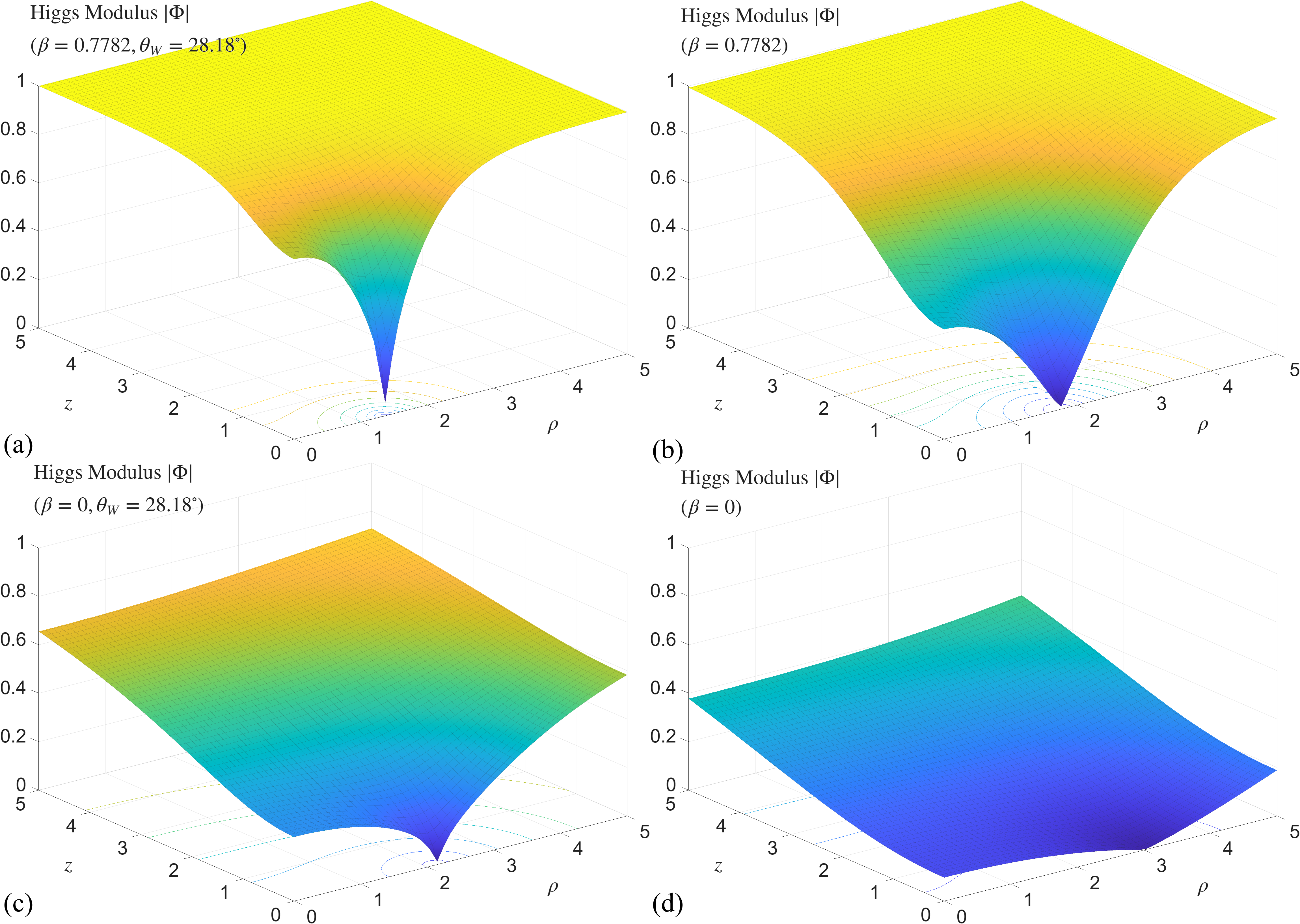
Figure 1: 3D Higgs modulus surface plots for (a,c) electroweak and (b,d) SU(2) YMH vortex ring solutions at various n=31; with physical n=32.
The geometric radius n=33 and total dimensionless energy n=34 exhibit complex, non-monotonic dependence on both n=35 and n=36. For physical parameters (n=37, n=38), the physical masses for n=39 and ϕ0 rings are computed as
ϕ1
These values provide the first Standard Model-based predictions for such nontrivial topological objects, setting the collider energy thresholds required for their possible production.
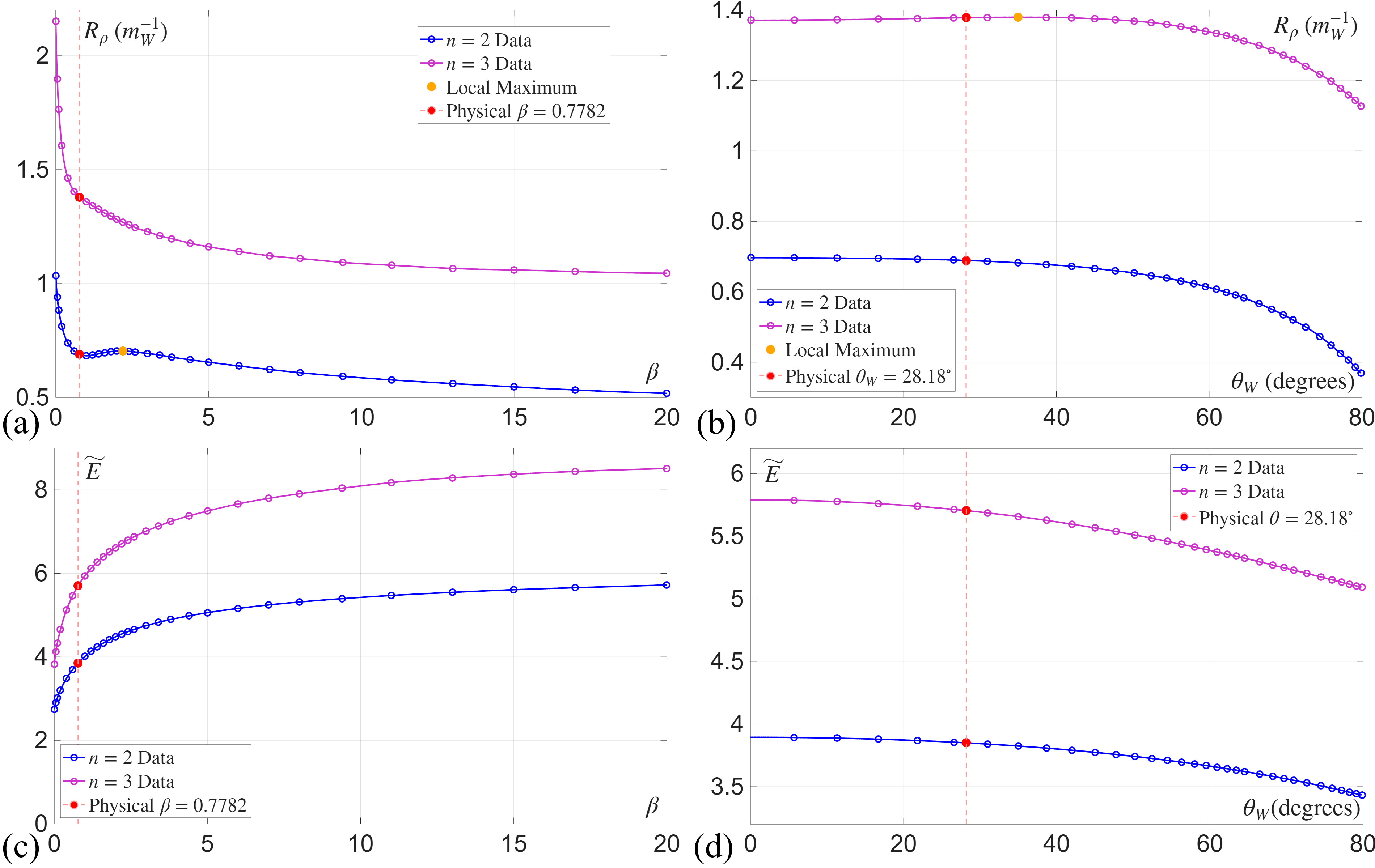
Figure 2: Dependence of electroweak vortex ring radius ϕ2 and total energy ϕ3 on ϕ4 and ϕ5 for ϕ6.
Field Structure and Neutral Circuital Law
Within the vortex configuration, the electromagnetic and ϕ7-boson field lines form concentric closed loops in the meridian plane, as shown in Figure 3. The ϕ8-boson field is confined due to its mass, in contrast to the unbounded photon field.
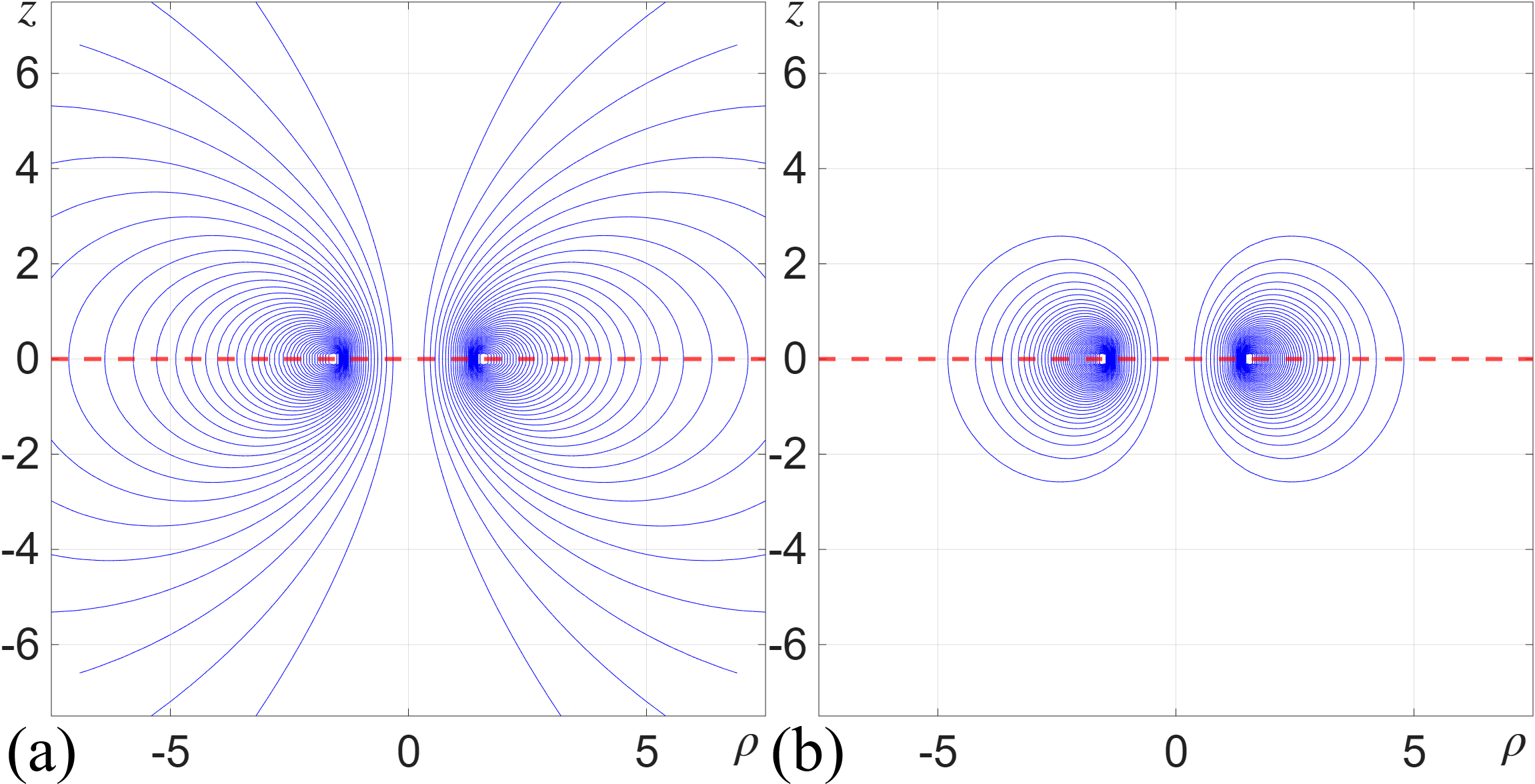
Figure 3: Field lines of (a) the electromagnetic and (b) Z-boson fields for ϕ9, n0, n1.
A key result is the identification of a neutral Ampère’s law: the spatial configuration and analytic expressions for the n2-current confirm that an azimuthal neutral current n3 circulates, sourcing the n4-field analogously to how an electric current sources a magnetic field. This double-loop structure, illustrated in Figure 4, features outer and inner counter-circulating rings. The n5-boson current is more complex, forming a double-torus with a helical breathing mode, reminiscent of Hopfion structures.
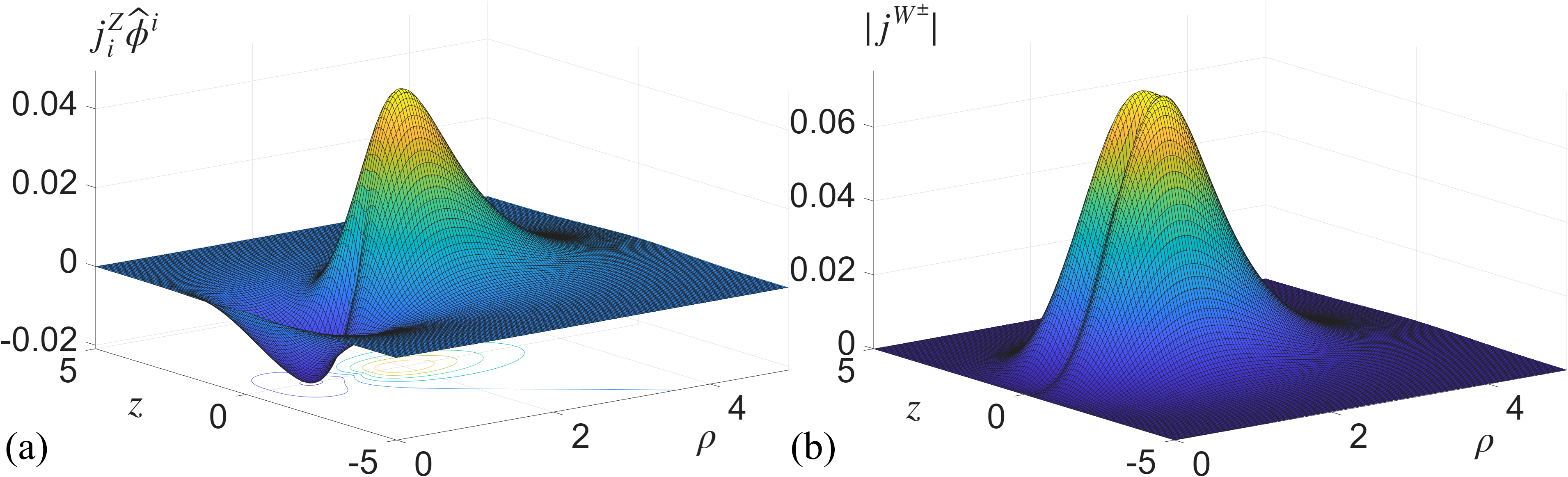
Figure 4: (a) Azimuthal neutral current n6 (double loop) and (b) modulus of n7-boson current n8 (double torus) for the n9 ring.
Stress Analysis and Pinch Dynamics
The authors perform an in-depth investigation of integrated and spatially resolved stress-energy tensor components (n=2,30, n=2,31) to probe mechanical stability and the interplay of repulsive and attractive contributions. Oscillatory behavior as a function of model parameters signals intricate modulations of stability and a subtle competition between bosonic repulsions and current-induced pinching forces.
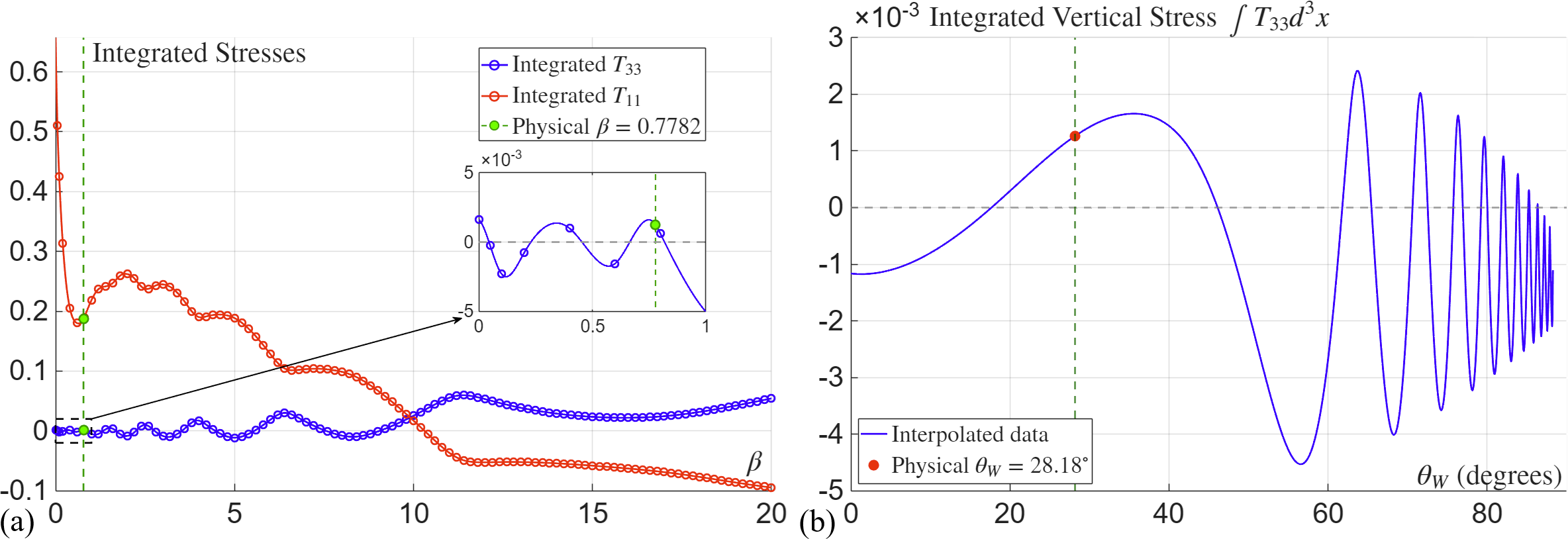
Figure 5: Integrated horizontal (n=2,32) and vertical (n=2,33) stresses for n=2,34 rings as functions of n=2,35 and n=2,36.
At the ring core, pronounced spikes in the local stress (Figure 6) are observed, consistent with a neutral Bennett pinch effect—an attractive self-constriction generated by the neutral current and n=2,37-field. These features persist under grid refinement, indicating physical sharp gradients rather than numerical pathology. The results establish a mechanical analogy between neutral weak pinching and familiar electromagnetic pinch effects in plasmas.
Figure 6: Local spatial distribution of stress tensor components n=2,38 for the n=2,39 vortex ring, showing sharp spikes at the ring core.
Implications and Theoretical Outlook
The robust determination of TeV-scale masses for electroweak vortex rings within the Standard Model provides explicit experimental targets for future high-energy colliders. The detailed current and field structure uncovers a neutral circuital law extending Ampère’s law to weak interactions, raising the possibility of a broader set of “Maxwell-type” equations for the n=10 sector. The stress tensor oscillations and neutral pinch dynamics suggest an inherent instability, consistent with these objects’ interpretation as saddle-point, sphaleron-like solutions with half-integer baryon number—potentially relevant for baryogenesis during the electroweak epoch.
The analogy with topological configurations in multi-component superfluids and superconductors opens pathways for cross-disciplinary exploration of non-topological electroweak objects and their analogues. Refinement of the stress decomposition using Abelian projections may further quantify the direct contribution of the n=11-boson to the neutral pinch, offering deeper analytical transparency.
Conclusion
This work establishes electroweak vortex rings as well-defined, regular, unstable solutions with precisely computable masses in the Standard Model. The results decisively demonstrate the role of bosonic repulsions and neutral pinch effects in their stabilization, elucidate the internal topological and dynamical structure, and provide mass thresholds guiding collider searches. The implications span both experimental high-energy physics and theoretical insights into nontrivial Standard Model vacuum structures and their cosmological relevance.