- The paper establishes a coherent off-critical extension of bosonic closed string field theory by introducing special punctures that absorb BRST anomalies.
- It develops a modified geometric and algebraic framework using mixed moduli spaces and descent operators to restore gauge invariance and BV structure.
- Numerical analyses and low-point vertex computations confirm the framework's consistency with linear-dilaton backgrounds and conformal perturbation theory.
Closed String Field Theory in Noncritical Dimensions: An Authoritative Synthesis
Introduction and Motivation
The paper "Closed String Field Theory in 25.99 Dimensions" (2605.20324) refines and systematizes the off-critical extension of bosonic closed string field theory (CSFT) previously introduced by Zwiebach. Traditionally, the structure of CSFT relies on the worldsheet being a critical conformal field theory (CFT), with BRST invariance governing gauge structure and moduli space integration. Upon leaving the conformal locus—e.g., by changing the central charge—the BRST charge loses conservation and nilpotency, raising nontrivial issues for the construction of gauge-invariant actions and quantization.
The work at hand builds a coherent genus-zero formalism that incorporates such off-critical backgrounds, reconciling the failures of BRST symmetry in a geometrically transparent and computationally tractable framework. This is achieved by extending the theory's geometric and algebraic ingredients, introducing special punctures labeled by a fixed Grassmann-odd state F encoding the BRST anomaly, and deriving modified moduli spaces and recursion relations for string vertices.
Geometric and Algebraic Structure of Off-Critical CSFT
A direct generalization of Witten’s and Zwiebach’s (critical) formulation is obstructed by loss of conformal invariance: the BRST operator QB becomes contour-dependent and non-nilpotent. To control the resulting gauge anomaly, the construction distinguishes between:
- Ordinary punctures: Carrying dynamical string field Ψ, as in critical CSFT.
- Special punctures: Carrying a fixed state F that absorbs the nonconservation and non-nilpotency of QB.
This formalism is geometrically encoded in bundles P0,n+mω over moduli spaces M0,n+m, whose points correspond to punctured spheres equipped with a Hermitian metric and specific local coordinates. Ordinary punctures have standard local coordinates; special punctures use metric-adapted coordinates fixed by the Weyl frame (Bergman–Zwiebach normalization).
The anomaly state F is accompanied by local descendants F[1],F[2] capturing the explicit failure of QB to square to zero and its nontrivial contour dependence. The descent algebra, together with a metric-dependent descent operator QB0, organizes all required corrections.
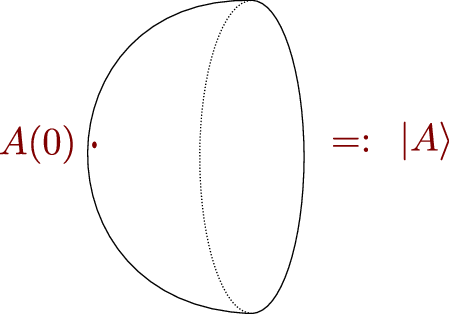
Figure 1: A local worldsheet insertion QB1 prepares a state QB2 upon specification of local metric data and a Weyl frame at the puncture.
The resulting mixed moduli spaces QB3—chains in QB4—feature dimension QB5, with the additional QB6 real dimensions corresponding to the metric dependence at special punctures. These spaces admit a natural extension of the BV geometry underpinning the master equation and vertices even off the conformal locus.
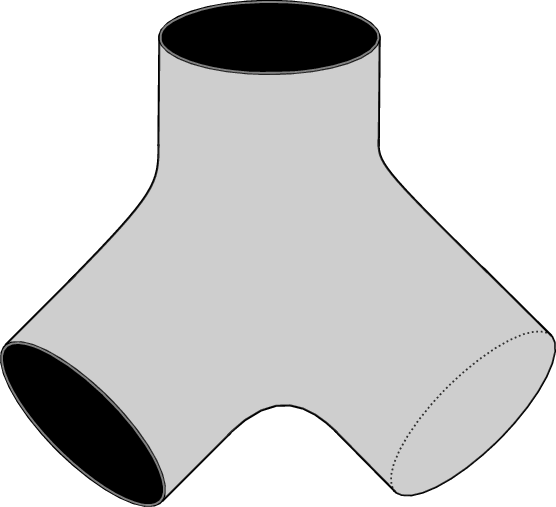
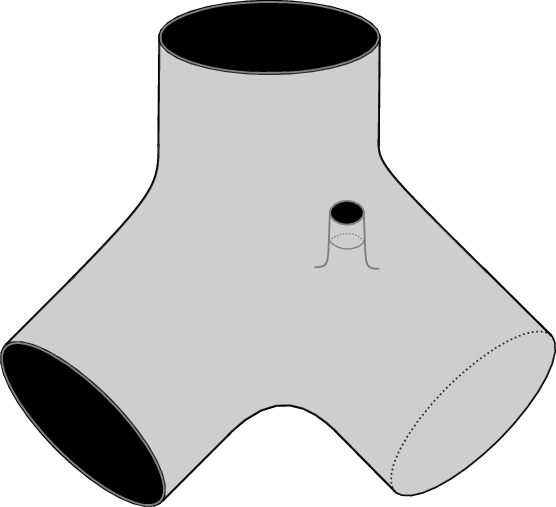
Figure 2: Three-string vertex with Weyl-framed ordinary punctures. The local geometric data at each puncture ensures the correct identification for state preparation and sewing operations.
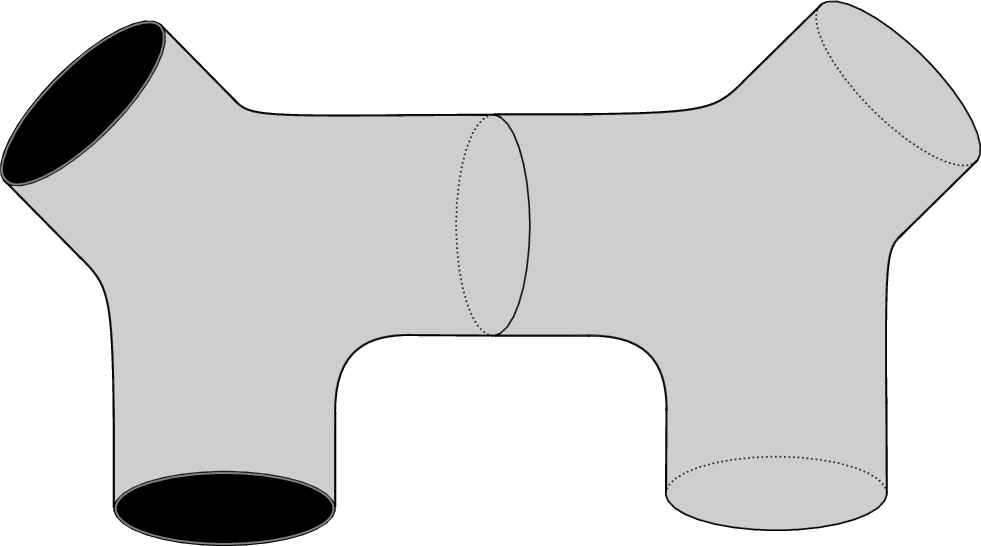
Figure 3: Twist-sewn three-point vertices with their Weyl frame, representing the degeneration limits and boundary data necessary for higher-point vertices such as the four-string vertex.
Modified BRST and BV Structure
The breakdown of BRST nilpotency manifests as a correction in the form:
QB7
and
QB8
where the integrands are supported on regions between BRST contours or their boundaries, and QB9, Ψ0 are descendants reflecting the anomaly.
This defect is geometrically encoded as asymmetric insertions of Ψ1 at special punctures. The total failure of the standard BRST descent is then compensated by a precisely controlled set of bulk and boundary terms in moduli integration—a process that is naturally recursive and governed by geometric operations Ψ2 and Ψ3 acting on chains in mixed moduli space.
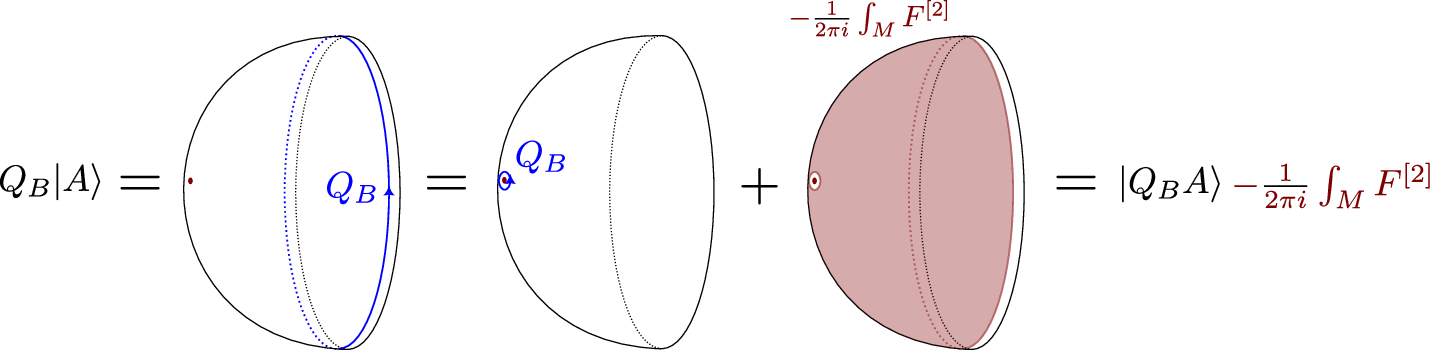
Figure 4: Two modes of BRST action away from the conformal locus: either directly on a local insertion, or as a contour encircling a state-preparation region. The difference is captured by an integrated Ψ4 insertion over the intervening region.

Figure 5: When a BRST contour is shrunk, the off-critical correction leaves an integrated Ψ5 insertion over the complement of the local-coordinate disks, comprising the bulk anomaly.
The modified vertices and multilinear forms are specified as: Ψ6
with integration over the chain Ψ7. The bracket operations involving these forms satisfy recursion relations reflecting the off-critical defect, replacing exact BRST closure of the chain boundary by balanced contributions from bulk anomalies and special-puncture vertices.
Background Independence and Interpolation Spaces
One of the notable accomplishments of the construction is the extension of Sen-Zwiebach’s proof of local background independence to first order in off-shell deformations. This is carried out by representing infinitesimal background changes via ghost-number-two local insertions Ψ8 and their descendants, with BRST variation controlled by the same machinery as the off-critical defect.
A key technical assertion is that the action of background deformations in string field space can be generated by mixed moduli chains with one insertion of Ψ9 and F0 insertions of F1, preserving the BV bracket and symplectic form up to first order in the deformation. These interpolation spaces dovetail exactly with Zwiebach’s extended moduli spaces, ensuring that formal gauge invariance and physical equivalence of backgrounds are robustly maintained even off the conformal locus.

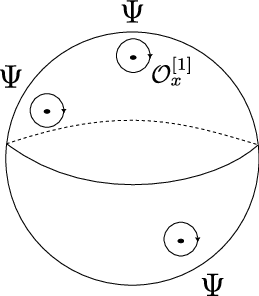
Figure 6: The asymmetric insertion of the local worldsheet field F2 defining the deformed vertex for background-independence differentials in field space.
To concretize this formalism, the authors analyze a matter CFT with F3, the simplest case of a non-critical string background. Here, the special state F4 becomes the "antighost dilaton"—the zero-momentum, pure-ghost state implementing the dilaton theorem. Its descendants F5 are computed explicitly using the local geometry and descent operator F6, and the anomaly is shown to encode the Weyl noninvariance through curvature insertion.
The analysis is further refined by considering linear dilaton backgrounds (parameterized by slope F7) and their relation to the central charge shift. The theory reproduces the well-known bookkeeping relation: F8
(see section 5.3), and demonstrates, via low-point vertex computations, how the formalism naturally accommodates the emergence of exactly marginal deformations and their obstructions.
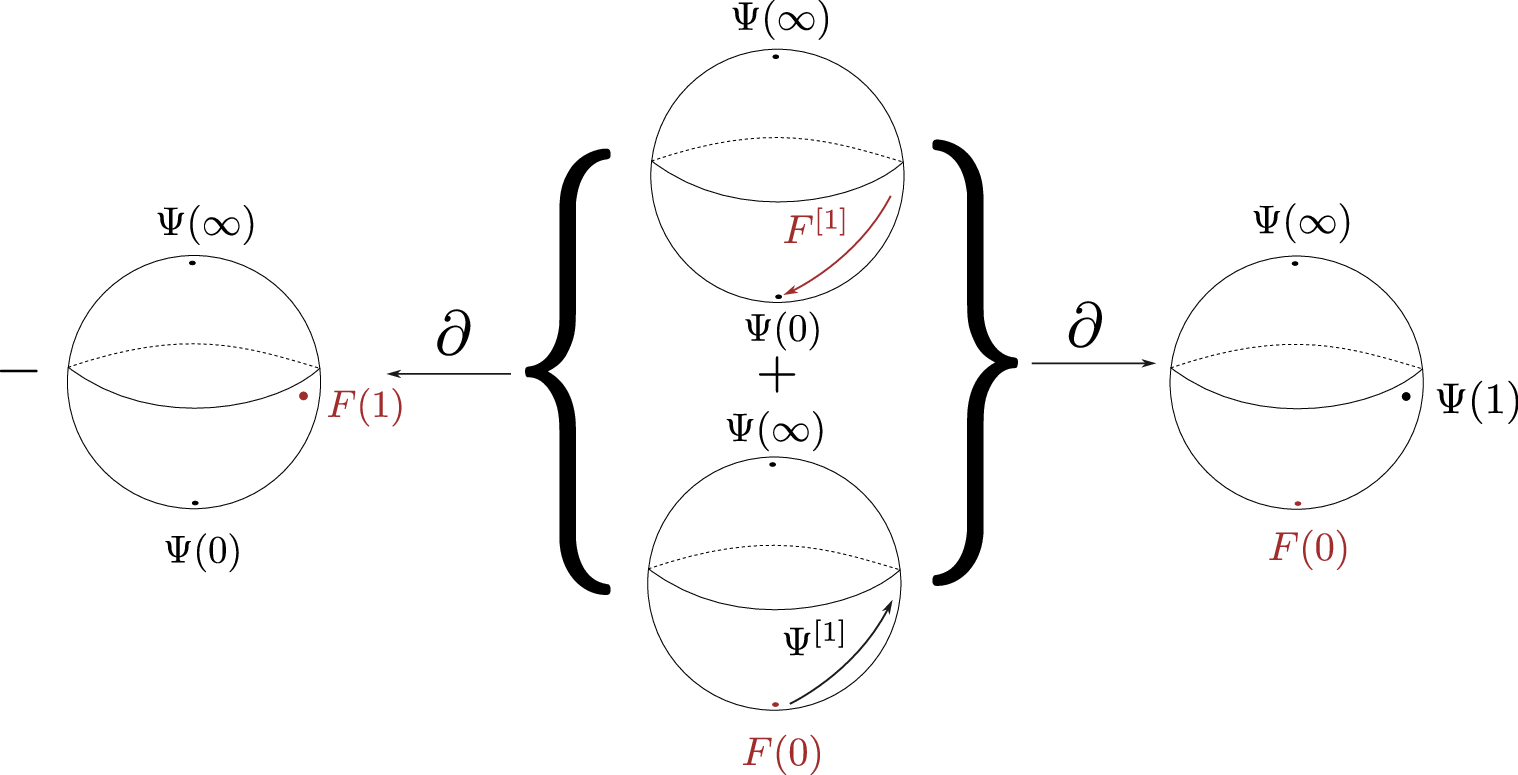
Figure 7: A component of the lowest-dimensional mixed interpolation space F9, facilitating explicit evaluation of quadratic corrections and their algebraic significance.
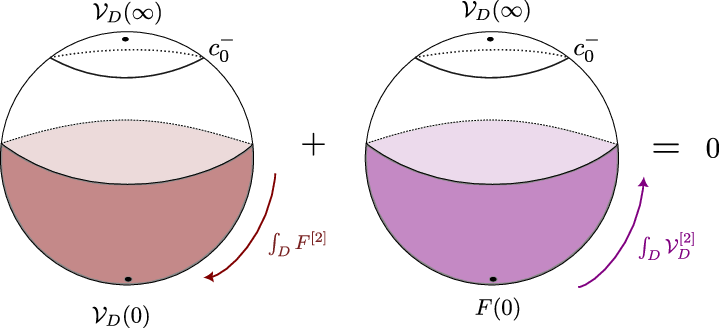
Figure 8: The first step in the low-point organization of QB0 in the linear-dilaton sector, interpolating along QB1. This is used to evaluate matching between kinetic and mixed-vertex corrections.
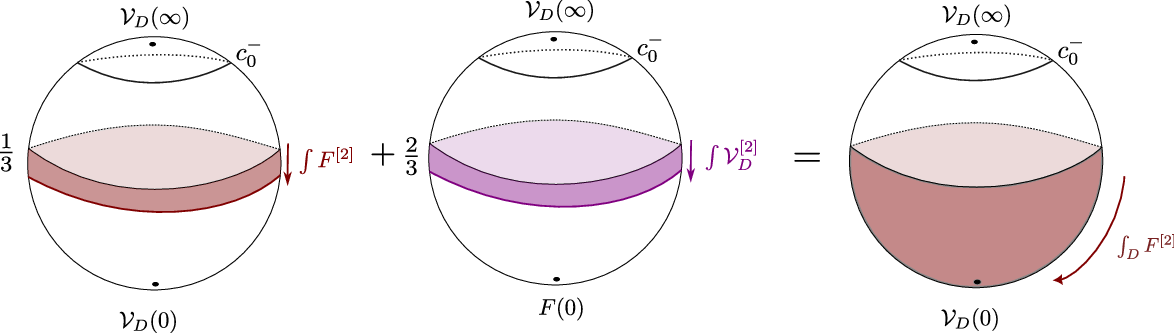
Figure 9: The second step in the low-point organization, transporting the insertion in moduli space and enabling explicit descent computations for quadratic terms.
Numerical Results and Algebraic Claims
- The chain-level recursion relations for mixed vertices QB2 are shown to close and admit unique (up to boundaries) solutions, utilizing explicit contractibility properties of the fiber bundle structure.
- For conformal matter with central charge defect, the off-critical anomaly is precisely encoded by the antighost dilaton and its Weyl- and contour-descended companions, in direct agreement with explicit BRST and curvature computations.
- The formalism holistically accounts for first-order deformations away from criticality—including both local moduli and trace anomalies—without introducing uncontrolled ambiguities or loss of gauge invariance.
- The prescribed mixed vertices accurately diagnose the absence of linearized flat-space solutions in subcritical backgrounds and yield the correct bookkeeping for linear-dilaton solutions, precisely matching expectations from conformal perturbation theory.
Theoretical and Practical Implications
This off-critical extension of CSFT coherently organizes all "defect" data arising from violations of conformal invariance into a controlled geometric and algebraic system. It provides a computationally practical and conceptually robust framework for:
- Background independence: The formalism accurately extends background-independence proofs and action equivalence to the tangent directions of the enlarged theory space, capturing first-order off-shell effects and suggesting extensions to higher orders.
- Conformal perturbation theory: The systematization of mixed vertices and anomalies provides new, renormalization-compatible tools for organizing conformal perturbations, especially in the presence of nearly-marginal or noncompact directions.
- Sigma model and effective action frameworks: The explicit geometric underpinning of the formalism makes it naturally compatible with recent advances in off-shell effective actions for string theory, especially in the context of spacetime diffeomorphism and field redefinition ambiguities.
Open Directions
- Generalization to higher-genus surfaces and open/closed topologies is open, as is the extension of the interpolation-space logic to those settings.
- All-orders background independence, while plausible, currently lacks a full proof due to the necessity of controlling contact terms and the analytic structure of descendant insertions at higher orders.
- Relation to manifestly background-independent and Kontsevich–Segal–inspired frameworks, as well as effective actions for nonconformal worldsheet CFTs, remains an active research avenue.
Conclusion
The formulation presented in (2605.20324) establishes a refined and systematic off-critical extension of closed string field theory, capable of absorbing anomalies from broken BRST symmetry into the geometry of moduli spaces and special punctures. Through a blend of explicit computation and geometric reasoning, the paper clarifies and sharpens the status of background independence, BV structure, and conformal perturbation theory beyond the critical locus. The framework not only confirms longstanding physical expectations but also provides fertile ground for further developments in off-shell string theory and field-theoretic treatments of noncritical backgrounds.