Induced transitions in non-Hermitian spin-boson models with time-dependent boundaries
Published 19 May 2026 in quant-ph and math-ph | (2605.20019v1)
Abstract: We study a time-dependent non-Hermitian extension of the Schütte-Da~Providência spin-boson Hamiltonian with complex couplings. A time-dependent Dyson map containing a squeezing transformation maps the model, in an admissible bounded regime, to a Hermitian Hamiltonian with real instantaneous energy spectrum. The squeezing contribution generates a dilatation term allowing the Hermitian partner to be interpreted as a fixed-domain representation of a system with moving boundaries. While the fixed-boundary Hermitian model conserves $Q=N-S_0$ and forbids transitions between sectors differing by two bosonic quanta, the boundary motion opens such channels. For closed boundary protocols with constant background parameters the first-order integrated transition amplitude vanishes, reflecting the unitary nature of constant squeezing. Nontrivial transition control arises when the non-Hermitian parameter varies during the boundary motion, changing the dressed basis and allowing boundary-induced transitions to be suppressed or enhanced by coherent interference.
The paper demonstrates that the time-dependent Dyson map preserves a real energy spectrum within bounded parameter regimes.
It employs a geometric squeezing transformation that mimics moving boundaries, inducing quantum transitions that can be dynamically controlled.
Perturbative analysis reveals vanishing first-order corrections, with second-order shifts governing the transition amplitudes.
Dynamical Boundary-Induced Transitions in Non-Hermitian Spin-Boson Models
Introduction and Model Construction
The paper investigates a time-dependent non-Hermitian extension of the Schütte-Da Providência spin-boson Hamiltonian featuring complex couplings. The model generalizes prior work by introducing explicit time-dependence and non-Hermiticity in couplings. The dynamics are mapped via a time-dependent Dyson transformation comprising bosonic squeezing, bosonic number scaling, and spin-sector scaling. Within a bounded regime, the Dyson map ensures Hermiticity of the transformed Hamiltonian, thus maintaining real instantaneous energy spectra and supporting a quasi-Hermitian (PT-symmetric) framework.
A salient feature is the geometric interpretation of the squeezing transformation. Its time derivative yields a dilatation term in the transformed Hamiltonian, establishing an equivalence with Hermitian systems where boundaries move. Thus, the fixed-domain Hermitian representation of the model encapsulates the physics of boundary motion.
where κ(t),γ(t),δ(t)∈C. The transformed Hamiltonian h(t) is Hermitian provided the parameters satisfy explicit conditions linking complex couplings to real observables. The squeezing parameter κ(t) induces a dilatation term proportional to κ˙(t), precisely the generator describing inertial effects from moving boundaries when mapped to a fixed reference interval.
The boundedness of the Dyson map critically restricts parameter space, ensuring both the map and its inverse are bounded only if ℜγ(t)=0. Consequently, only specific parameter regimes admit a physically consistent similarity transformation.
Energy Operator: Spectrum and Perturbative Corrections
The physical energy observable, distinct from the Hamiltonian generating time evolution, is defined as
H(t)=η−1(t)h(t)η(t)=H(t)+iη−1(t)η˙(t),
incorporating additional terms from the time-dependence of the Dyson map. The model's instantaneous spectrum is explored across three regimes:
Non-Squeezing (κ(t)=0): The operator Q=N−S0 is conserved, and the Hilbert space decomposes into two-dimensional sectors. Closed-form expressions for instantaneous eigenvalues exist; all are real under admissible parameter choices.
Constant Squeezing (κ˙=0): The model remains solvable via a unitary transformation; spectral properties mirror the non-squeezing case.
Genuine Time-Dependency (κ(t),γ(t),δ(t)∈C0): The dilatation term (from squeezing) breaks the κ(t),γ(t),δ(t)∈C1 symmetry, coupling sectors whose boson numbers differ by two. Perturbative analysis reveals vanishing first-order corrections to energy levels; non-trivial spectral shifts arise only at second order.
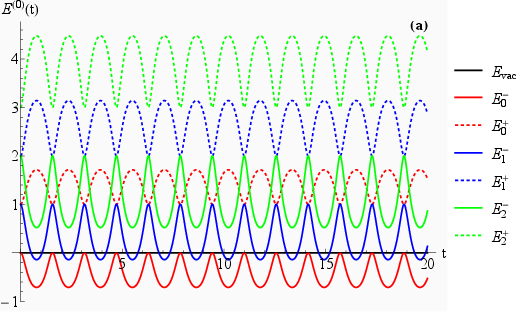
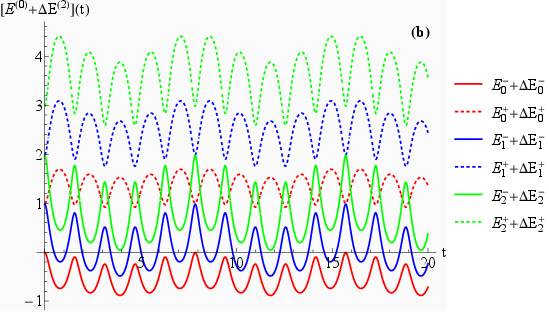
Figure 1: Instantaneous energies (a) and perturbatively corrected instantaneous energies (b) for time-varying parameters, showing real spectra unaffected by exceptional points.
Panel (a) in Figure 1 demonstrates persistently real instantaneous energies under time-dependent parameters, confirming the robustness of the quasi-Hermitian regime. Panel (b) reflects perturbative corrections due to boundary motion, which, while shifting levels, do not violate Hermiticity or open exceptional points.
Boundary-Induced Transitions and Dynamical Control
Boundary motion, encoded through the squeezing-induced dilatation term, explicitly breaks the conservation of κ(t),γ(t),δ(t)∈C2. The operator κ(t),γ(t),δ(t)∈C3 and κ(t),γ(t),δ(t)∈C4 couple sectors with boson numbers differing by two, thus inducing transitions forbidden in the static boundary case. The transition amplitudes are calculated perturbatively, showing:
Closed Boundary, Constant Parameters: The integrated first-order transition amplitude vanishes for a closed protocol, reflecting that constant squeezing is a unitary transformation.
Time-Dependent Non-Hermiticity: If the non-Hermitian parameter (e.g., κ(t),γ(t),δ(t)∈C5) varies during boundary motion, the dressed basis evolves in time. The accumulated transition probability can be suppressed or enhanced via coherent interference, providing a mechanism for controlling boundary-induced transitions dynamically.
A quench-type protocol further quantifies this control: tuning the duration and phase of the non-Hermitian pulse to satisfy a phase-matching condition can suppress transitions entirely. Periodically modulated boundary motion and non-Hermitian parameters result in sideband-controlled transitions, producing phase-matching enhancement or suppression that can be engineered.
Theoretical and Practical Implications
This construction offers a general approach to studying dynamical transitions in time-dependent non-Hermitian systems with moving boundaries. The real energy spectrum persists throughout the admissible parameter regime, demonstrating that non-Hermitian deformations need not induce exceptional points—a sharp contrast to models where non-Hermiticity controls spectral singularities. Instead, the non-Hermitian deformation in this setup operates as a dynamical control parameter for boundary-induced transitions, without modifying the energy spectrum.
The practical implication is the capacity to selectively enable or disable transition channels in quantum spin-boson systems by modulating both boundary motion and the non-Hermitian metric. Theoretically, this framework extends the landscape of non-Hermitian quantum dynamics, elucidating how geometry (via squeezing and boundary motion) and metric deformation jointly influence observable dynamics, enriching applications in quantum control, cavity QED, and open quantum systems where boundaries are dynamic or where effective non-Hermitian descriptions are relevant.
Conclusion
The paper establishes a robust quasi-Hermitian framework for time-dependent non-Hermitian spin-boson models with moving boundaries. The squeezing component in the Dyson map confers geometric significance, mapping the non-Hermitian model to a Hermitian system with time-dependent boundaries. In the bounded regime, the energy spectrum is always real, and level crossings are ordinary Hermitian degeneracies. The key result is the dynamical opening of transition channels due to boundary motion, with transition amplitudes precisely controlled by the temporal modulation of non-Hermiticity. This work offers an effective paradigm for controlled quantum transitions and deepens understanding of the interplay between non-Hermitian dynamics, boundary conditions, and geometric transformations in spin-boson systems.
“Emergent Mind helps me see which AI papers have caught fire online.”
Philip
Creator, AI Explained on YouTube
Sign up for free to explore the frontiers of research
Discover trending papers, chat with arXiv, and track the latest research shaping the future of science and technology.Discover trending papers, chat with arXiv, and more.