- The paper introduces an in situ optimization approach using locally linear approximations to control nonlinear multimode fiber amplifiers, achieving high beam purity at kilowatt power levels.
- It employs a robust experimental platform with a Yb-doped multimode fiber and phase-only SLM, enabling versatile generation of beams such as Gaussian, OAM, and Bessel profiles.
- The framework overcomes conventional beam shaping limitations by bypassing model-based constraints and ensuring real-time, programmable output of structured light.
Reconfigurable High-Power Structured Light via Nonlinear Beam Shaping in Multimode Fiber Amplifiers
Introduction
The paper "Reconfigurable generation of high-power structured light via nonlinear beam shaping" (2605.19996) introduces and validates an experimental and algorithmic framework for generating arbitrary high-power structured light fields directly from a highly-multimode fiber (MMF) amplifier. This work specifically addresses challenges in coherent control of output vector fields in nonlinear, high-dimensional laser amplifiers, where the governing input-output relations are subject to complex (linear and nonlinear) multimode dynamics, gain saturation, and thermo-optic nonlinearity.
Conventional approaches for producing high-power structured light are constrained by the limited power handling of beam-shaping components or are restricted to fiber/amplifier architectures that preclude strong modal interactions. The methodology presented achieves output beam programmability and high beam purity at kilowatt-class power levels—surpassing the previous limitations of mode selectivity and power scalability. The framework involves a robust in situ optimization algorithm based on local linear approximations to the nonlinear transmission operator (local TM), operating completely model-free and independent of any prior knowledge of the amplifier's dynamical equations.
System Architecture and Physical Regime
The experimental platform comprises a Yb-doped MMF amplifier supporting Nfib=80 spatial modes per polarization, pumped by a multiplexed LD array and seeded by a preamplified, single-frequency source at λ=1064 nm. Full spatial and polarization control at the input is performed via a phase-only SLM, enabling arbitrary complex field synthesis in both polarizations via dual-order beam shaping and recombination.
The MMF amplifier is operated at up to Pout=538 W limited by the onset of SBS, with both near-field (NF) and far-field (FF) resolved characterizations for two orthogonal polarizations. The amplifier exhibits strong modal mixing, polarization scrambling, and both dissipative and nonlinear gain dynamics, rendering the input-output relations highly nontrivial.
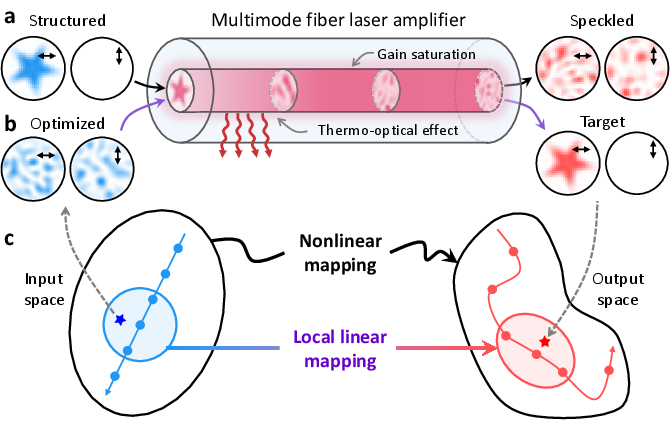
Figure 1: Schematic of the MMF amplifier generation scheme, illustrating structured beam evolution, nonlinear input-output mapping, and the local TM control framework.
A major impediment to direct structured output is the severe distortion and depolarization of the seed's spatial and polarization structures after traversing the complex MMF amplifier, as the input light is subject to both linear intermodal and nonlinear interactions (Fig. 1).
Nonlinear Beam Shaping via Local Transmission Matrix
The core contribution is the development and demonstration of an in situ local TM-based optimization strategy. While the full system TM only approximates the global (generally nonlinear) input-output mapping, the authors show that within a sufficiently small local domain of the high-dimensional complex input space, a linearized TM can accurately estimate the gradient of the system's response and thus enable efficient, robust gradient-based optimization.
The practical protocol consists of:
- Global TM Estimation: Initial acquisition of a global, empirical TM by sampling random complex input wavefronts and measuring corresponding output fields.
- Gradient-Guided Descent: Use of the global TM as a linear surrogate for the highly nonlinear input-output landscape, allowing initial navigation toward the target output beam.
- Iterative Local Linearization: Upon reaching a stagnation point, a contracted local domain is defined around the current best input, and a new (local) TM is experimentally determined in situ. Gradient-based optimization using this refined local TM proceeds, recursively focusing on smaller domains and converging efficiently even in the presence of high nonlinearity.
- Output Validation: At each stage, the achieved output is benchmarked against desired figures of merit: the beam quality factor M2, polarization extinction ratio (PER), and field overlap with the target.
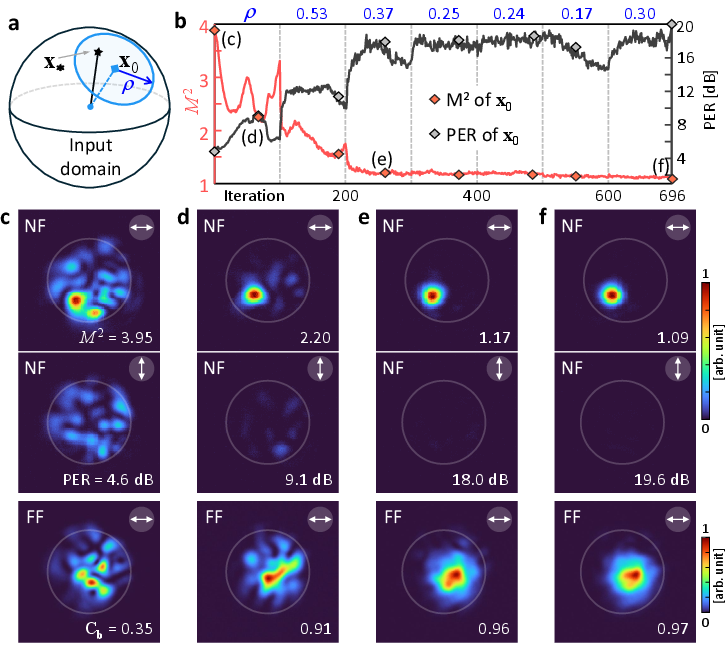
Figure 2: Convergence of beam shaping for a Gaussian target at 538 W showing major improvement in M2 and PER across global and local TM stages as the optimizer approaches the solution.
Numerical simulations (Fig. 5) confirm the monotonic increase in fidelity of the local TM approximation as the domain size contracts, supporting the assumption of locally linear system behavior.
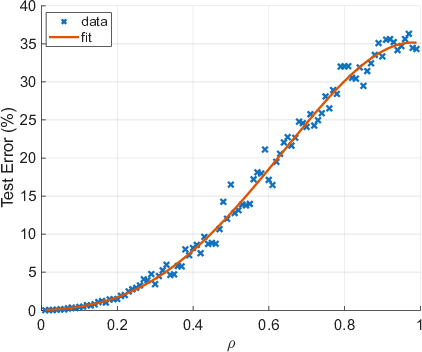
Figure 3: Test error of local TM predictions as a function of domain size parameter ρ, confirming contraction yields better local linearization.
High-Power Structured Beam Generation
Experimental results display direct generation of diverse high-power structured beams:
- Gaussian beams: Output beam with M2=1.09 and PER = 19.6 dB at 538 W, indicating near-diffraction-limited, high-purity polarization.
- Multifocal patterns: Parallel spot arrays with deterministic phase relations for parallel processing applications.
- Shaped welding beams: Centrally weighted spots with controlled sidelobes, advantageous for thermal management in welding and additive manufacturing.
- OAM (Orbital Angular Momentum) states: Beams with l=±1,2 directly generated, with precise azimuthal phase structure and specified polarization states.
- Radially polarized and vector beams: Structured polarization states enabling access to tight focusing and advanced nonlinear interactions.
- Bessel beams: Beams with axially extended focus, beneficial for volumetric processing and optical guiding.
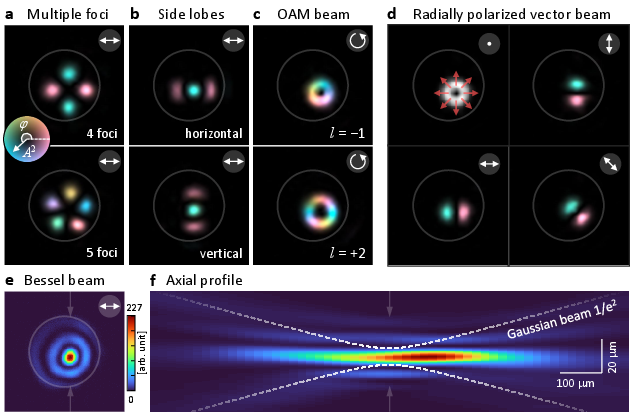
Figure 4: Example structured beams at 538 W: multifocal, customized sidelobe, OAM, vector (radial), and Bessel profiles.
Any desired structured mode complying with the MMF modal content and amplifier stability restrictions can be produced, and the framework permits on-demand, real-time programmable steering between target profiles.
Practical and Theoretical Implications
This approach directly addresses the long-standing barrier posed by high-dimensional, nonlinear amplifier dynamics in high-power optics. The methodology:
- Enables robust control without analytic models or training data—critical for highly nonlinear amplifier systems with unknown or untractable physics.
- Surpasses the limitations of traditional genetic, swarm, or data-driven (neural network) schemes which are known to stagnate, especially in rare or out-of-distribution target cases and under noisy conditions.
- Provides a scalable and generalizable protocol compatible with larger-core fiber amplifiers and platforms with higher mode counts, supporting prospective operation at multi-kW and beyond.
The implications span high-field physics, materials processing, high-bandwidth free-space and underwater optical communication (enabling OAM and mode-multiplexed channels), advanced trapping/manipulation, and programmable coherent wave control in high-power environments.
The local TM linearization paradigm is conceptually applicable to other nonlinear, high-dimensional physical systems, and can be hybridized with deep learning for fast inference (where input-output datasets from controlled experiments can supplement rare or arbitrary target training).
Outlook and AI Relevance
The demonstrated framework provides a reference implementation for experimental control over complex, nonlinear systems where neither global analytic models nor large data-driven regressors are available or reliable. The recursive local linearization approach offers a pathway for high-precision, robust manipulation in quantum optics, nonlinear wave physics, programmable photonic information processing, and emerging AI-driven laboratory automation, especially for training and operating physical neural networks or differentiable photonic circuits.
Extensions to AI include automated exploration of high-dimensional nonlinear response surfaces, active learning with adaptive experimental allocation, and efficient feedback-based optimization in closed-loop physical systems.
Conclusion
The paper establishes a robust and practically viable protocol for the reconfigurable, high-fidelity generation of arbitrary high-power structured light fields via nonlinear beam shaping in MMF amplifiers. By leveraging empirical, recursively contracted local linearizations, the method circumvents the need for analytical control models or exhaustive training, enabling real-time, on-demand structured light at unprecedented power levels. This generalizable framework is poised to impact high-power photonics, complex-system control, and hybrid physical-AI experimentation across numerous frontier domains.