- The paper demonstrates that redshift-based distances can reliably map peculiar velocities in the ZOA with only modest deviations in most velocity bins.
- It employs a sample of 282 HI-detected galaxies, advanced photometric corrections, and Malmquist bias adjustments to enhance distance accuracy.
- The findings confirm the dynamical influence of large-scale structures like the Great Attractor, supporting ΛCDM predictions and scalable cosmic flow analysis.
Assessing Peculiar Velocities and Large-Scale Structure at Low Galactic Latitude
Introduction
The Zone of Avoidance (ZOA), obscured by the Milky Way's disk, has historically limited efforts to construct a comprehensive cosmography of the local universe, particularly in delineating large-scale structures such as the Laniakea Supercluster. This paper investigates the peculiar velocity field within the ZOA using an expanded sample of H I-detected galaxies, leveraging recent advances in 21 cm radio surveys (notably MeerKAT) and infrared photometric observations. The objective is to test whether redshift-based distances can reliably reconstruct large-scale structure in the ZOA or if substantial peculiar velocities necessitate a more sophisticated dynamical approach.
Data Acquisition and Sample Selection
The study draws its sample from the recent deep, systematic H I surveys of the ZOA (e.g., MeerKAT SMGPS) and incorporates complementary photometry from both bespoke infrared follow-up (e.g., VISTA Hemisphere Survey) and archival 2MASS datasets. This joint sample includes 282 H I-selected galaxies with Ks-band photometry and cosmic microwave background (CMB) frame velocities, with additional cross-validation against CosmicFlows4 and other high-latitude datasets to probe consistency in distance measurements.
The challenge of dense stellar foregrounds in Ks-band images was addressed using advanced star subtraction algorithms, improving the reliability of total galaxy magnitudes in crowded ZOA fields. Galaxies exhibiting significant positional uncertainty or excessive extinction were conservatively excluded to uphold photometric and kinematic integrity.
Calibration and Analysis via the Tully-Fisher Relation
The Tully-Fisher relation (TFR), employing inclination-corrected 21 cm velocity widths and extinction-corrected Ks-band magnitudes, was calibrated for the sample, facilitating redshift-independent distance estimates. This is crucial for detecting bulk flows and assessing the impact of peculiar velocities. The TFR for the ZOA galaxies reveals an RMS scatter of 0.95 mag, with photometric errors contributing 0.70 mag, consistent with anticipated uncertainties for such fields.
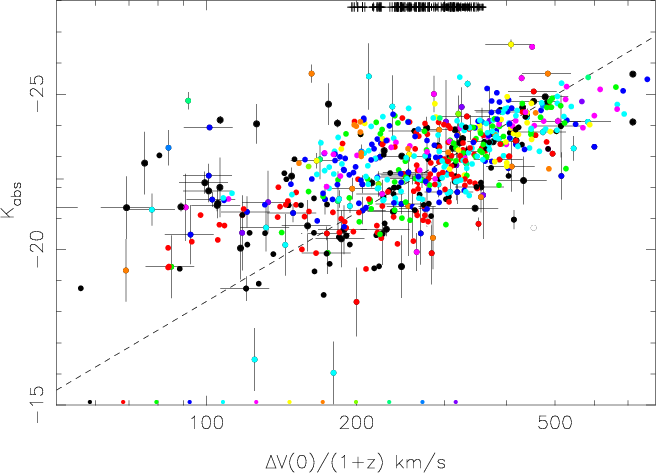
Figure 1: Tully-Fisher relation for ZOA galaxies, color-coded by distance, with the dashed line indicating the reference from Masters et al. (2014); markers along the upper axis map the longitude distribution between 200∘ and 360∘.
Comparison with CosmicFlows4 distances for a common subset shows agreement within ±10% in the derived distances, validating both the photometric and velocity width measurements, as well as the adopted inclination/width corrections.
Velocity Field Results
A Malmquist bias correction (1.38σ2) accounts for selection effects and photometric scatter, with the impact on systematic distance bias quantified across velocity bins. Only the velocity bin at approximately $4000$ km/s exhibits a statistically significant distance modulus residual, corresponding to a mean peculiar velocity of 800±300 km/s, spatially concentrated at Galactic longitudes between 300∘ and Ks0. In all other velocity bins up to Ks1 km/s, no significant trend in distance residuals is observed.
The robustness of the derived velocity fields with respect to both extinction and positional uncertainties confirms the viability of H I- (and IR-) selected ZOA samples for peculiar velocity mapping in these obscured regions.
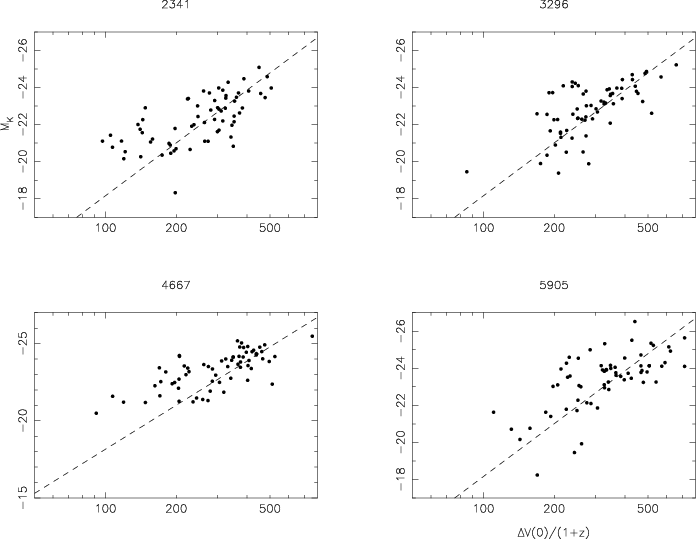
Figure 2: TFRs divided by redshift quartiles, revealing the consistency of the relation across depth slices; median redshifts are indicated.
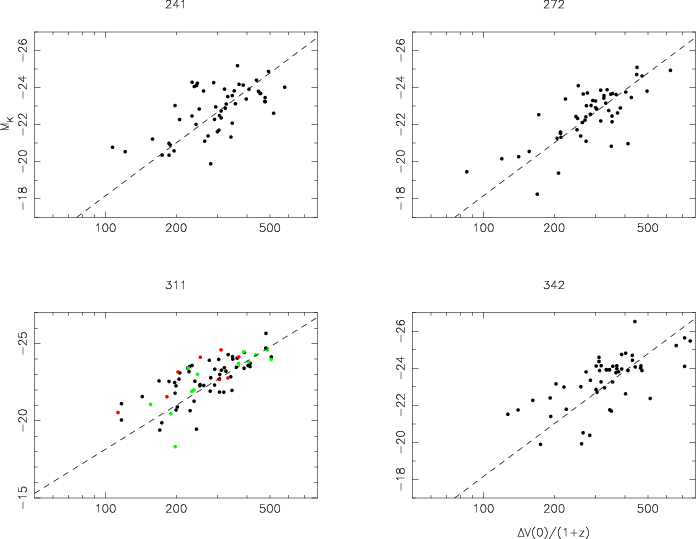
Figure 3: TFRs split by longitude quartiles, with color segregation highlighting Malmquist bias and deviant luminosity populations.
Discussion and Implications
The data substantiate the existence and dynamical significance of large-scale structures behind the Galactic plane, such as the Great Attractor/Laniakea, Vela, and Norma superclusters. The analysis supports the assertion that the observed fractional peculiar velocities in the Great Attractor region of the ZOA are modest: Ks2.
This enables reliable tomographic reconstructions of local structures using copious redshift data alone, rather than requiring redshift-independent distances for every galaxy. The findings reinforce the approach taken in ongoing reconstructions (Hollinger et al. 2026), where redshifts are used even for galaxies undetected in the infrared, resulting in large homogeneous samples amenable to cosmic flow analysis.
Furthermore, the inferred upper limits on ZOA peculiar velocities directly inform ongoing debate regarding the magnitude of local bulk flows and their consistency (or lack thereof) with Ks3CDM structure formation. The data place constraints on the mass and extent of hypothesized structures such as Quipu, which could, at Ks4 Mpc, drive significant peculiar velocities (on the order of Ks5 km/s at Ks6 Mpc).
Future Prospects
Future cosmographic efforts will benefit from the methodology validated here. Massive spectroscopic surveys such as DESI have already measured Ks7 peculiar velocities from millions of galaxy redshifts, and the ZOA approach outlined in this work demonstrates a scalable framework for incorporating previously inaccessible regions into all-sky velocity field analyses.
The ultimate goal remains the reconciliation of observed bulk flows (e.g., the cosmic microwave dipole) with Ks8CDM predictions. The ability to robustly map large-scale structure in the ZOA is essential for resolving this tension and for constraining possible physics beyond the standard cosmological model, including models with non-constant Ks9 or exotic dark matter scenarios.
Conclusion
The analysis presented demonstrates that redshift-based reconstruction of the ZOA is now feasible, with measured fractional peculiar velocities (Ks0) consistent with the existence of known superclusters beyond the plane. The approach removes the principal barrier to mapping the full sky density and velocity field, setting the stage for next-generation cosmographical and cosmological studies that will critically test the concordance model and its alternatives.