- The paper examines 5D f(T,T_G) gravity, showing that the torsional Gauss-Bonnet term induces significant deformations such as brane splitting.
- It employs a domain wall warp factor and scalar field with a kink structure to derive thick-brane solutions that modify energy density profiles.
- Fermion localization is achieved via a Yukawa coupling, leading to a normalizable left-chiral zero mode and an altered massive KK spectrum.
Thick Branes and Fermion Localization in Five-Dimensional f(T,TG) Gravity
Introduction
This paper systematically investigates thick brane configurations and spin-1/2 fermion localization within the framework of five-dimensional f(T,TG) gravity, a torsion-based modification of general relativity that incorporates the teleparallel equivalent of the Gauss-Bonnet invariant, TG. Distinct from four-dimensional teleparallel gravity, TG in five dimensions is not a topological term but contributes dynamically to the field equations. The authors focus on the minimally extended model f(T,TG)=−T+αTG, highlighting the physical effects engendered by this torsional Gauss-Bonnet sector.
Key results include the demonstration that the TG term generates significant deformations in the brane structure, such as brane splitting, and radically modifies the fermion localization landscape, especially the chirality and massive Kaluza-Klein (KK) spectrum. The implications for higher-dimensional braneworld phenomenology and torsion-based gravity models are examined in detail.
Thick-Brane Solutions in f(T,TG) Gravity
The study begins by formulating the five-dimensional f(T,TG) gravity action and specializing to a warped spacetime supported by a canonical scalar field that drives the brane structure. The torsion scalar T and the torsional Gauss-Bonnet term TG are computed explicitly for the given metric and f\"unfbein ansatz. The minimally extended action f(T,TG)0 introduces higher-derivative corrections through f(T,TG)1, which cannot be mapped to pure f(T,TG)2 or curvature-based Gauss-Bonnet brane models.
Numerical analysis of the field equations under a domain wall-like warp factor reveals a pronounced f(T,TG)3-dependence. Specifically, increasing f(T,TG)4 leads to marked deformations of the gravitational Lagrangian density profile near the brane core due to the torsion-based corrections. This is illustrated by the behavior of f(T,TG)5 as a function of the extra-dimensional coordinate f(T,TG)6:
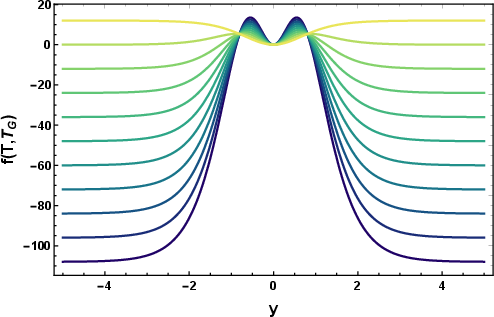

Figure 1: Behavior of the gravitational function f(T,TG)7 versus the extra dimension f(T,TG)8 for various f(T,TG)9; larger TG0 introduces sharper deformations near the brane core.
The scalar field configuration TG1 retains a kink structure typical of domain-wall branes but with a steepness and transition width that are sensitive to TG2. The associated scalar potential TG3 deepens and narrows for negative TG4, underlying an enhanced confinement mechanism:
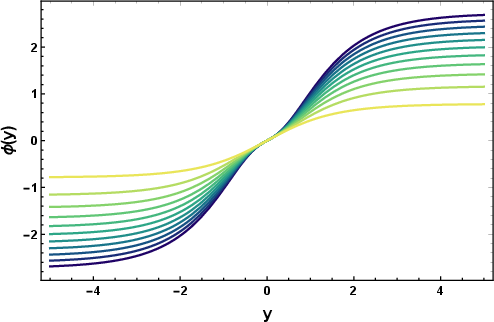
Figure 2: Scalar field (left) and potential TG5 (right) profiles for varying TG6, displaying increased steepness and depth due to TG7 contributions.
Pressure and energy density are likewise strongly affected. Notably, for specific TG8, the energy density transitions from a single-peak to a double-peak structure, which is a hallmark of brane splitting — an internal structure not generally present in standard TG9 or GR-based models:
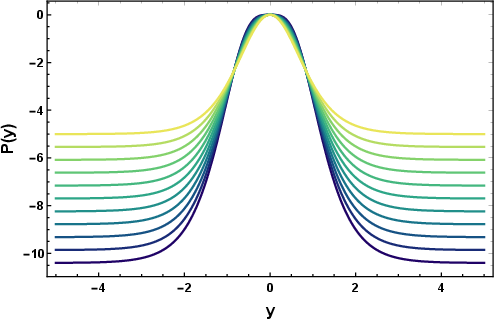
Figure 3: Pressure TG0 (left) and energy density TG1 (right) display a transition from single- to double-peak profiles as TG2 increases, revealing brane splitting.
Fermion Localization and KK Spectrum
Addressing matter localization, the paper introduces a Yukawa coupling between the bulk scalar and a five-dimensional Dirac fermion field. Chiral decomposition and KK mode analysis reveal that, for both TG3 and TG4 Yukawa coupling exponents, only one chirality (left-handed mode) is localized on the brane, consistent with supersymmetric quantum mechanics arguments about the positivity and structure of the corresponding Schrödinger-like Hamiltonians.
The left-chiral zero mode is normalizable and exponentially localized, supported by a volcano-type effective potential. The right-chiral counterpart, by contrast, is always delocalized:
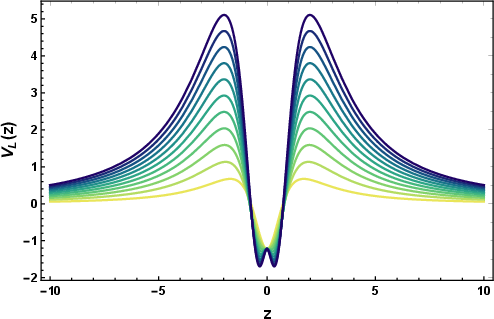
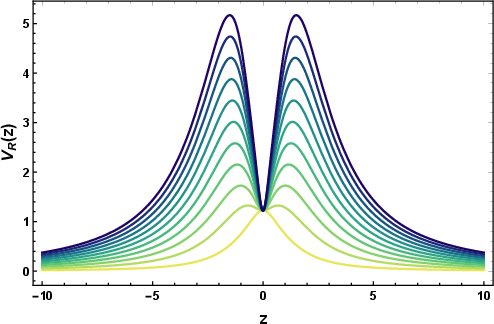
Figure 4: Left: Volcano-type potential TG5 supporting a localized left-handed zero mode; Right: Positive-definite TG6 forbids right-handed zero mode localization (for TG7).
For TG8, the localization becomes even more pronounced, with deeper and narrower potentials favoring stronger localization:
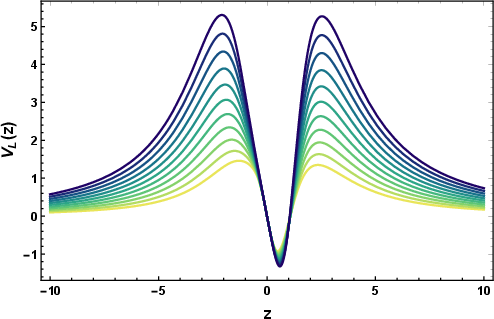
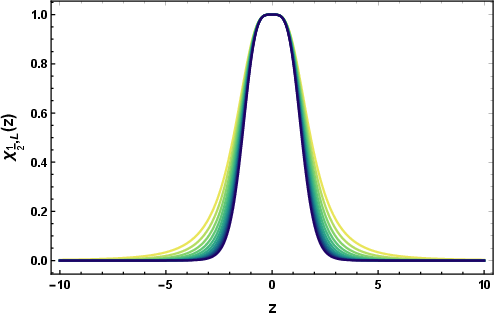

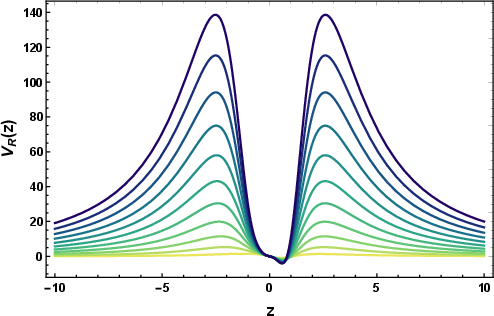
Figure 5: Enhanced well depth and left-chiral localization (left), further suppression of right-handed zero mode (right) for TG9.
Massive KK Modes and Resonant States
The massive KK spectrum is intricately controlled by both the Yukawa coupling and the torsional Gauss-Bonnet parameter f(T,TG)=−T+αTG0. The presence of f(T,TG)=−T+αTG1 substantially modulates the amplitude and phase of KK modes near the brane, with larger f(T,TG)=−T+αTG2 intensifying oscillatory features and localization probability density.
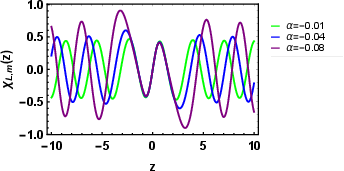
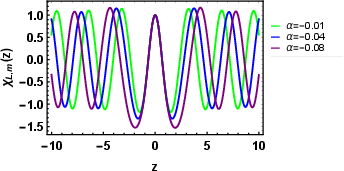
Figure 6: Massive KK modes for f(T,TG)=−T+αTG3, showing enhanced oscillatory amplitude near the brane core for increasing f(T,TG)=−T+αTG4.
For larger Yukawa exponent (f(T,TG)=−T+αTG5), mode amplitude near the brane is even further enhanced, and the sensitivity to f(T,TG)=−T+αTG6 becomes more pronounced:
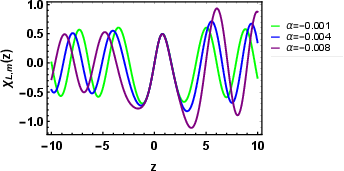
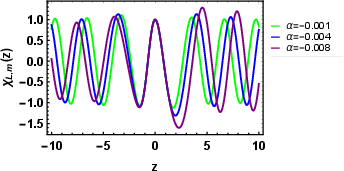
Figure 7: Increased oscillation amplitudes and coupling sensitivity of massive modes for f(T,TG)=−T+αTG7.
An analysis of the relative probability function f(T,TG)=−T+αTG8 exposes quasi-localized resonant states — sharp peaks at specific masses — whose structure and distribution are highly dependent on both f(T,TG)=−T+αTG9 and TG0:
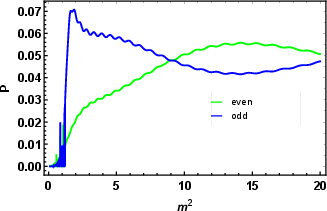
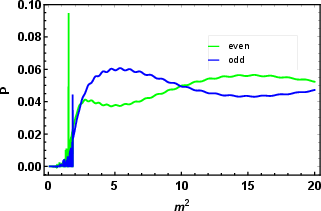
Figure 8: Peaks in the relative probability TG1 signify resonant KK states; peak structure broadens with larger TG2 or TG3.
Physical Implications and Theoretical Perspectives
The teleparallel Gauss-Bonnet sector uniquely modulates all aspects of the brane and matter localization landscape. The key physical implications established are:
- Emergence of brane splitting/internal structure: The dynamic role of TG4 results in nontrivial multi-peak energy profiles, a property absent in four-dimensional or strictly TG5 models.
- Chiral fermion localization: Only a single fermion chirality becomes normalizable, a requirement for phenomenologically viable brane-world models.
- Control of massive/resonant spectra: The parameters TG6 and TG7 provide independent levers for engineering the distribution, intensity, and quasi-localization of massive KK modes and resonant states.
- Sensitive dependence on torsion-based corrections: Results are highly nonperturbative with respect to the TG8 term, even for the simplest linear extension considered.
The framework underscores the necessity to examine torsion-based extensions as independent and phenomenologically rich alternatives to curvature-based Gauss-Bonnet or Lovelock extensions. The modes and resonance structure elucidated here could have observable signatures in corrections to Newtonian gravity, collider phenomenology, or cosmological scenarios involving extra dimensions.
Conclusion
This study establishes that five-dimensional TG9 gravity, even in its minimal form, realizes a diverse and technically intricate brane landscape with marked phenomenological features: geometrical deformations, brane splitting, and a hierarchically structured fermionic spectrum with chiral selection and resonances. The torsional Gauss-Bonnet sector is shown to be central in controlling these effects, thereby positioning torsion-based higher-order modifications as essential in the exploration of higher-dimensional theories and realistic braneworld scenarios.
Future directions include the investigation of more general f(T,TG)0 forms, vector and tensor perturbations, and detailed phenomenological and cosmological modeling, including potential observational signatures of the induced modifications to matter localization and KK spectra.