- The paper introduces a sufficient statistic and dynamic programming framework to address LQG aggregative games with delayed discrete observations.
- It explicitly constructs Nash equilibrium strategies via coupled Riccati recursions and quantifies the cost penalty induced by observation delays.
- Numerical experiments validate that increased sampling periods and delays degrade performance, with penalties diminishing as population size grows.
Continuous Aggregative LQG Games with Delayed Discrete Observations: An Expert Analysis
Introduction and Motivation
This paper introduces and rigorously analyzes a class of continuous-time, finite-population aggregative games governed by linear-quadratic-Gaussian (LQG) dynamics, in which agents access empirical mean state information only at discrete time instances and with a fixed delay. Unlike the standard perfect-information mean field game (MFG) paradigm, this work addresses a more realistic information structure motivated by networked systems where global state sharing is impractical or subject to communication constraints and delays. This modeling abstraction is particularly compelling for analyzing coordination in large networks with sparse, intermittent communication—settings relevant to many control, economics, and engineering domains.
Agents' scalar state dynamics evolve continuously according to
dxi(t)=(axi(t)+bui(t))dt+σdwi(t),
with individualized control ui and independent Wiener noise. Costs are aggregative: each agent seeks to minimize a quadratic objective penalizing deviation from a scaled population mean and control effort over a finite horizon:
Ji=E[∫0Tq(xi(t)−ΓxˉN(t))2+rui2(t)dt+h(xi(T)−ΓxˉN(T))2],
where xˉN(t) is the empirical mean of all states.
A key departure from existing LQG mean field literature is in the observation protocol: agents have continuous access to their state but observe the global mean only at discrete sampling times, and each observation is received with a full period delay. This defines a piecewise deterministic, partially observed game, departing sharply from classic full-information or open-loop, symmetry-exploiting approaches.
Sufficient Statistic and Dynamic Programming Decomposition
The primary technical insight is the introduction of a virtual measurement, a sufficient statistic that recursively summarizes all available population mean information up to each sampling instant. By imposing symmetry-preserving agent policies—agents suppress local private information when predicting the empirical mean—interval-wise deterministic (Markovian) predictors become viable. This construction elegantly circumvents the otherwise intractable infinite regress of beliefs endemic to games of incomplete information.
Dynamic programming (DP) equations are constructed at two levels: (1) embedded continuous-time HJB equations solved on each inter-sampling interval, in which the predictor is considered a deterministic exogenous signal, and (2) a discrete DP propagating value function boundary conditions and virtual measurement updates at each sampling epoch.
Key results are the explicit backward Riccati recursion and the forward predictor evolution, which jointly yield the Nash equilibrium controls and close the consistency loop imposed by the population mean feedback structure.
Explicit Nash Equilibrium Characterization
A strong result of the analysis is the existence and explicit construction of Markov Nash equilibria in the finite-agent regime, parameterized by the solution of coupled Riccati equations and predictor dynamics.
The Nash equilibrium strategy for each agent takes the affine form
uk∗(t)=−rb(p(t)xk(t)+α(t)xˉ^j−1N(t)),
where p(t) and α(t) solve interval-specific Riccati equations and xˉ^j−1N(t) is the recursively updated delayed mean predictor.
Assumptions are clearly laid out, with sufficient conditions on system parameters to preclude Riccati finite-escape singularities and guarantee the well-posedness of the Nash strategies.
A salient theoretical contribution is the closed-form quantification of the cost penalty incurred by delayed discrete observations compared to both (a) continuous observation and (b) discrete observation without delay. This is shown to decompose into an additive term involving only the variance of the mean state prediction error and is proportional to O(1/N) due to the averaging of independent noise—thus, the mean field (large-N) regime naturally recovers the certainty equivalence property.
The performance loss is articulated as
ui0
with all terms explicitly constructed through the DP solution. Empirical results indicate that costs strictly increase with both the sampling period ui1 and the observation delay, confirming the adverse impact of degraded information on equilibrium efficiency.
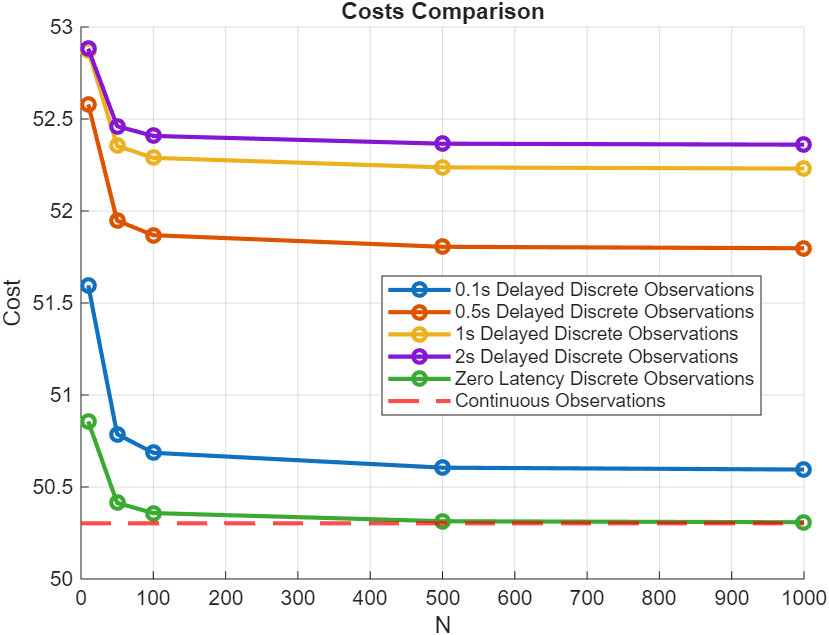
Figure 1: Aggregate cost comparison under continuous, discrete, and delayed-discrete observation regimes as functions of sampling interval and population size.
Numerical Experiments
Simulation results validate the theoretical framework, highlighting several important findings:
- For moderate ui2, delayed discrete observations yield the highest cost, with discrete (no-delay) and continuous-observation regimes exhibiting strictly better performance, converging as ui3 increases.
- The penalty associated with increasing the sampling period is monotonic and saturates gently, confirming theoretical expectations.
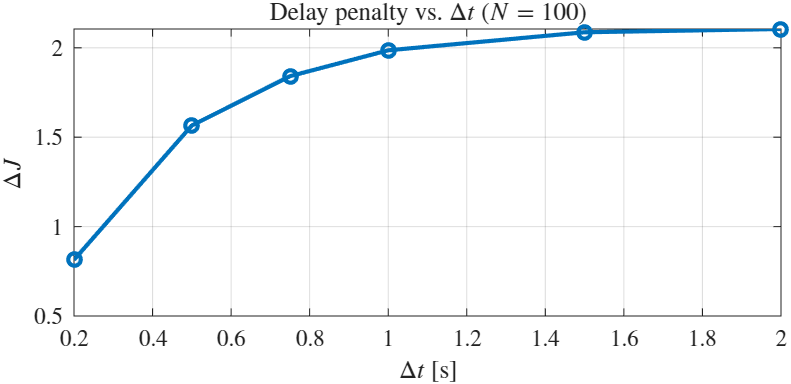
Figure 2: Delay penalty ui4 as a function of the sampling period ui5 for large ui6, exhibiting monotone and saturating growth.
- The time evolution of the population mean and its delayed predictor illustrates the nature of the induced tracking error; larger sampling periods result in slower and more error-prone predictor corrections.
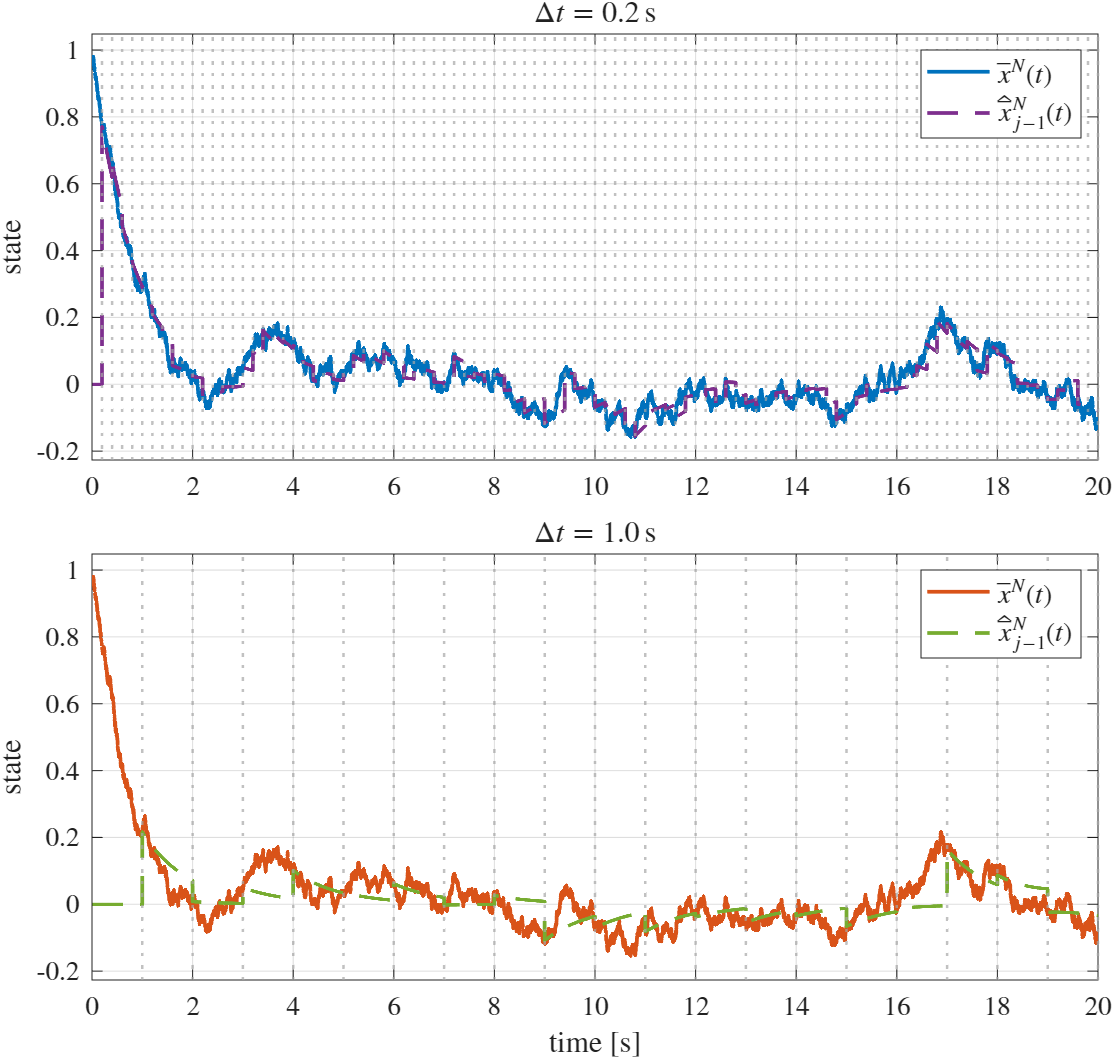
Figure 3: Comparison of empirical mean (solid) and delayed predictor (dashed) over time for different sampling periods; band widening and tracking latency increase with ui7.
Implications and Extensions
From a systems-theoretic perspective, this work closes a significant gap in the rigorous analysis of LQG mean field-type games under realistic information constraints. The methodology—combining piecewise DP, explicit sufficient statistics, and intervalwise Riccati and predictor recursions—provides an analytical foothold for a broad class of distributed control problems with communication delay, quantization, or consensus-driven state sharing.
The results offer a direct analytical basis for understanding and mitigating the efficiency loss in large-scale networked control systems where global state sharing is intermittent or delayed. Moreover, the explicit Nash equilibrium characterization with finite ui8 (without asymptotic approximation) establishes a theoretical bridge to practical finite-population deployments.
The multidimensional (vector state) extension is straightforward at the DP level but entails additional technical complications regarding the convexity and boundedness of matrix Riccati equations; sufficient conditions have been detailed for the scalar case.
Anticipated future directions include:
- Systematic analysis of consensus-based mean field learning protocols and their delay-induced performance loss.
- Extending ui9-Nash quantification to infinite-population limits under delayed/discrete observation regimes.
- Integrating time-varying graphs or stochastic communication models for agent observation structure.
Conclusion
This paper rigorously characterizes Nash equilibrium strategies in finite-population, continuous-time LQG aggregative games with delayed discrete empirical mean observations. By introducing a sufficient statistic-based predictor, the authors develop explicit DP-based solutions and provide a closed-form quantification of information-structure-induced performance loss. Numerical experiments corroborate the theoretical analysis, verifying the increase in equilibrium cost with observation delay and demonstrating asymptotic recovery of the continuous-information optimum with increasing population size. The framework sets a foundation for further investigation into delayed information structures in distributed control, learning, and networked mean field games.

