- The paper introduces an advanced mmfBm framework that integrates classical noise with quantum Brownian motion to model decoherence.
- Simulation results reveal non-exponential, stretched-exponential coherence decay and temperature-dependent noise scaling.
- The framework establishes practical guidelines for gate optimization by linking qubit coherence performance to dynamic noise parameters.
Non-Stationary Decoherence in Superconducting Qubits via Memory Multi-Fractional Brownian Motion and Time-Dependent Quantum Brownian Motion
Introduction
This paper (2605.18914) formulates an advanced stochastic model for decoherence in superconducting charge qubits, integrating both classical and quantum perspectives through a unified framework based on memory multi-fractional Brownian motion (mmfBm). The classical sector leverages a time-dependent Hurst exponent H(t) and adaptive kernel K(t,s) to realistically capture low-frequency 1/fβ noise and dynamically evolving long-range temporal correlations. The quantum extension employs a time-dependent Caldeira–Leggett environment, aligning the spectral properties of the bath with the mmfBm noise structure. Simulation results highlight the inadequacy of stationary or Markovian noise assumptions, and the derived scaling relations prescribe optimized gate times, coherence decay envelopes, and temperature-driven crossovers.
Classical Modeling: mmfBm and Noise Characterization
The paper introduces mmfBm as the classical noise process governing qubit energy fluctuations, moving beyond stationary fractional Brownian motion by incorporating a slowly varying local Hurst exponent H(t) and adaptive memory kernels. This construction enables the explicit modeling of non-stationary and long-memory environmental correlations, as observed in contemporary superconducting devices.
Sample trajectories confirm the extracted Hurst exponent Hext quantitatively matches the imposed profile, and the variance scaling follows Var[M(t)]∝t2H(t), validating the covariance structure. Fourier analysis reveals the PSD exponent β=2H−1, though numerical estimation of β from finite-time simulations exhibits partial alignment due to limitations in local stationarity and frequency resolution.
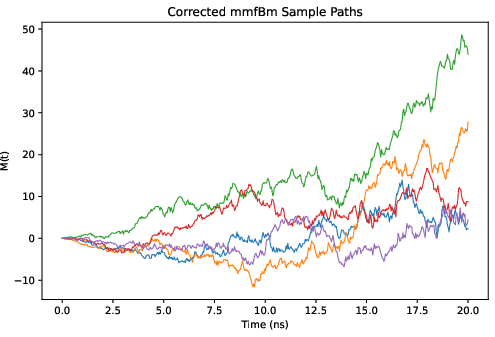
Figure 1: Classical mmfBm characterization: sample trajectories, time-dependent Hurst exponent, variance scaling, and power spectral density. The extracted Hurst exponent agrees with the imposed profile, while the PSD exponent shows partial agreement with the expected 1/fβ scaling.
The framework robustly reproduces non-exponential coherence decay, indicating that the presence of time-dependent memory is crucial for accurate stochastic modeling of realistic charge qubit environments.
Quantum Brownian Motion Extension: Microscopic Embedding
To bridge stochastic phenomenology with open quantum system dynamics, the classical mmfBm noise process is embedded into a time-dependent Caldeira–Leggett quantum bath characterized by spectral density J(ω;t)∝ω2H(t)−1. Analytical derivation via the Feynman–Vernon influence functional validates microscopic consistency, and the time-local Lindblad equation emerges under the Born–Markov and adiabatic approximations.
Coherence dynamics are simulated by filter-function theory and master equation solvers. The results reveal stretched-exponential Ramsey and echo decay envelopes, with a temperature-dependent crossover from quantum vacuum fluctuations to thermal noise.
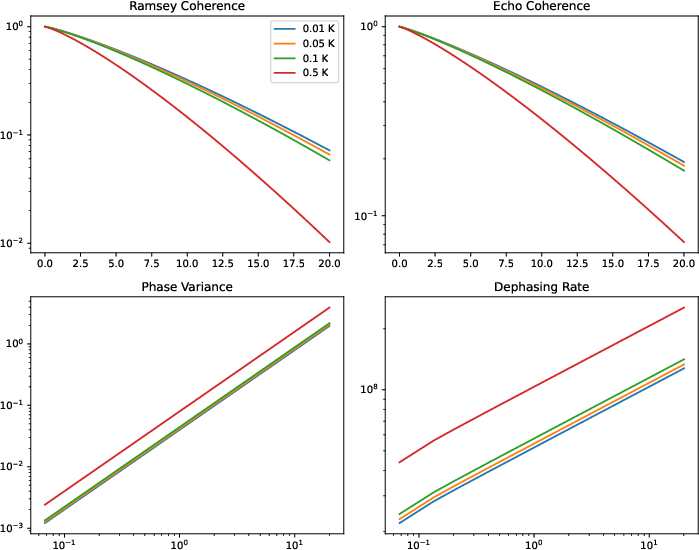
Figure 2: Quantum coherence dynamics under mmfBm-induced dephasing. Ramsey and echo signals exhibit stretched-exponential decay with strong temperature dependence. The extracted phase variance and dephasing rate confirm non-Markovian scaling behavior.
At K(t,s)0, zero-point quantum fluctuations dominate, while for K(t,s)1, thermal activation drives enhanced dephasing rates. The phase variance and dephasing rate scale as K(t,s)2 and K(t,s)3, respectively, establishing direct links between experimentally measurable coherence envelopes and the underlying noise parameters.
Gate Optimization and Practical Implications
The interplay between relaxation and dephasing is analyzed to prescribe optimal gate times for error minimization. The derived gate error expression,
K(t,s)4
reveals an explicit minimum determined by the competition between K(t,s)5 decay and mmfBm-induced non-Markovian dephasing.
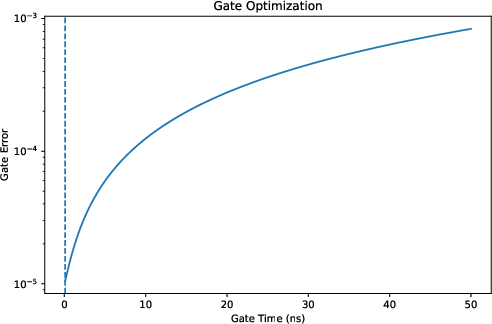
Figure 3: Gate-error optimization. The total error arises from the competition between relaxation-induced decay and mmfBm-driven dephasing. An optimal gate time emerges at the minimum of the combined error curve.
This framework guides the design of noise-resilient qubit operations by addressing non-stationary environments and provides experimentally testable scaling relations for Ramsey/echo spectroscopy and noise parameter extraction.
Machine Learning and Spectral Estimation
Attempts to use convolutional neural networks for inference of time-dependent Hurst exponents from coherence curves reveal that global pooling architectures fail to represent non-stationary temporal variability. Superior inference will require sequential models such as Transformers, larger datasets, and physics-informed constraints. The discrepancy between simulated and theoretical PSD exponents underscores the necessity for improved spectral estimation and longer simulation trajectories.
Limitations and Future Directions
The framework exposes several methodological and physical challenges. Non-stationary spectral estimation suffers from finite-time and local-stationarity bias; higher-fidelity spectral techniques (wavelet or multitaper) are recommended. The Born–Markov approximation neglects strong-coupling and non-Gaussian effects that may be significant in the millikelvin regime. The phenomenological bath, while consistent with observed noise, does not address microscopic origins (TLS or defect spins), and connecting mmfBm parameters to material-specific models remains an open problem.
Future work should incorporate exact non-Markovian solvers (HEOM), integrate concurrent charge and flux noise, characterize leakage into higher transmon levels, and develop adaptive quantum control protocols using real-time estimation of K(t,s)6. Experimentally, stretched-exponential decay and gate optimization can be validated in current superconducting hardware.
Conclusion
The paper establishes a rigorous theoretical foundation for modeling non-stationary decoherence in superconducting qubits through a memory multi-fractional Brownian motion framework and its quantum extension. Strong numerical and analytical evidence supports the necessity of time-dependent, long-memory stochastic models for accurate characterization of qubit noise and decoherence. The results have broad practical implications for quantum device engineering, parameter extraction protocols, and optimal qubit control in noisy environments. Continued development of this framework, combined with advanced spectral and machine-learning inference, may elucidate fundamental limits in quantum hardware performance and inform the design of resilient next-generation superconducting qubit architectures.