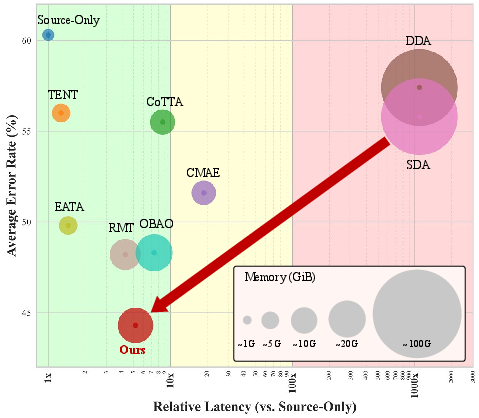
- The paper proposes a forward-facilitation paradigm that dynamically updates a synthetic knowledge base to enable real-time, robust continual test-time adaptation.
- It employs a multi-level bridging mechanism using FFT-based style injection, channel-wise feature alignment, and supervised contrastive learning to reduce error rates.
- Empirical results on ImageNetC and CIFAR benchmarks show significant efficiency gains and superior adaptability over existing backward-alignment methods.
Forward-Facilitation Continual Test-Time Adaptation via Dynamic Style Bridging
Continual Test-Time Adaptation (CTTA) addresses the degradation in model performance due to dynamic, evolving distribution shifts post-deployment, without access to source data or labels. Prevailing approaches operate under a backward-alignment paradigm, aligning target data to static supervision surrogates extracted from the original domain or to synthetic anchors. This results in unreliable guidance under continual shift as supervision signals become outdated and noisy, increasing susceptibility to catastrophic forgetting.
This work introduces a fundamentally different forward-facilitation paradigm. Rather than constraining adaptation via static surrogates, it dynamically co-evolves a compact synthetic knowledge base representing each class, injecting current target styles into these proxies in real time. This yields continually updated, high-fidelity supervision tightly coupled to instantaneous data distributions.
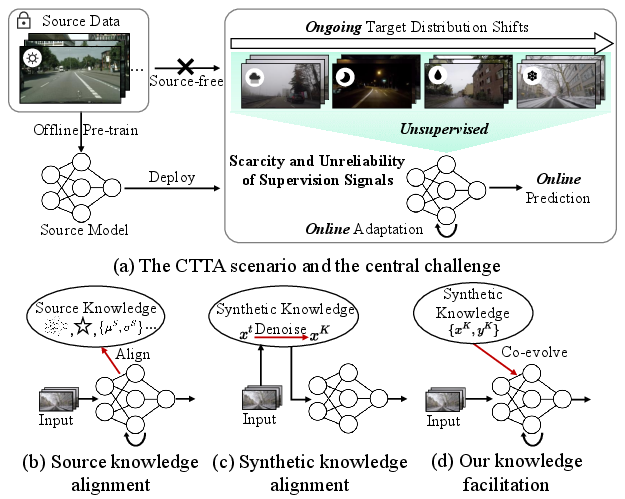
Figure 1: The central challenge of CTTA, limitations of backward alignment, and conceptual depiction of forward-facilitation via co-evolving synthetic proxies.
Framework Design and Methodological Contributions
The proposed solution is instantiated as a pipeline comprising two principal components: an offline synthetic knowledge base construction and an online multi-level bridging mechanism. Class prototypes are synthesized using advanced generative diffusion models (e.g., Stable Diffusion), employing descriptive prompts to ensure semantic purity and computational efficiency.
During CTTA, each incoming batch triggers dynamic style adaptation of the knowledge base at three granularities:
- Input level: Fast Fourier Transform-based amplitude spectrum replacement injects visual style from target images into synthetic exemplars, preserving phase information for content fidelity.
- Feature statistics level: Channel-wise alignment of mean and variance (akin to AdaIN) bridges neuron-level style statistics, ensuring consistent feature distributions across domains.
- Semantic representation level: Supervised contrastive learning reduces intra-class domain gap by clustering stylized synthetic and target representations via cosine similarity.
The transformed proxies are then employed as on-demand supervision for cross-entropy loss with explicit class labels.
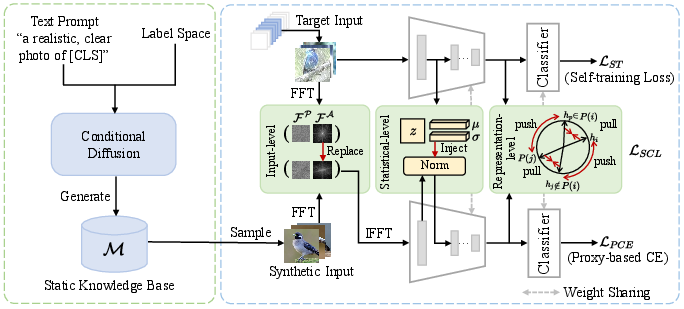
Figure 2: Multi-level bridging mechanism dynamically transforms the static synthetic knowledge with the evolving test-time data stream to reliably guide adaptation.
Empirical Evaluation and Numerical Results
Comprehensive evaluations are conducted over standard CTTA benchmarks: ImageNet-to-ImageNetC, CIFAR100-to-CIFAR100C, and CIFAR10-to-CIFAR10C, each with 15 corruption domains at maximal severity and fully online adaptation. The method is compared to diverse SOTA baselines, including single-model, teacher-student, and generative diffusion-driven approaches.
Strong numerical outcomes are reported:
Ablation studies confirm synergistic contributions from each bridging level, with even a single synthetic exemplar per class being sufficient for robust adaptation. The framework is robust to generator choice (BigGAN, Stable Diffusion 1.5/3.0) and maintains low error variance across stochastic runs.
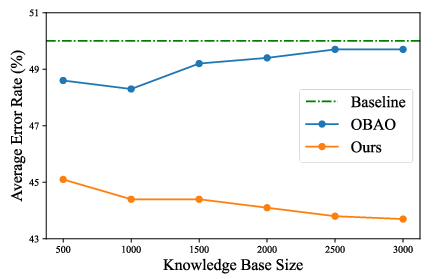
Figure 4: Ablation on knowledge base size reveals low sensitivity—minimal synthetic samples suffice for stable adaptation.
Qualitative Analysis and Visualizations
Visualization of GradCAM activation maps across noise corruption domains demonstrates that the proposed method consistently yields higher attention on salient objects compared to both source model and SDA, confirming improved domain-agnostic feature discrimination.
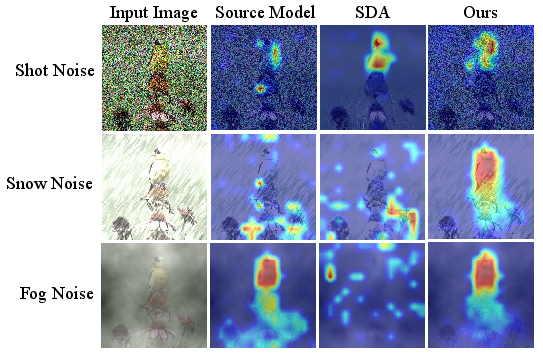
Figure 5: Grad CAM maps for shot, snow, and fog show strong and consistent foreground activation with dynamic style bridging.
Synthetic images generated for the knowledge base reveal high semantic purity, with cleaner backgrounds and more salient objects, but also generative biases such as texture repetition. The necessity of the dynamic bridging mechanism is underscored: static use of synthetic data risks entrenching model biases, whereas style injection enables bridging the diversity gap.
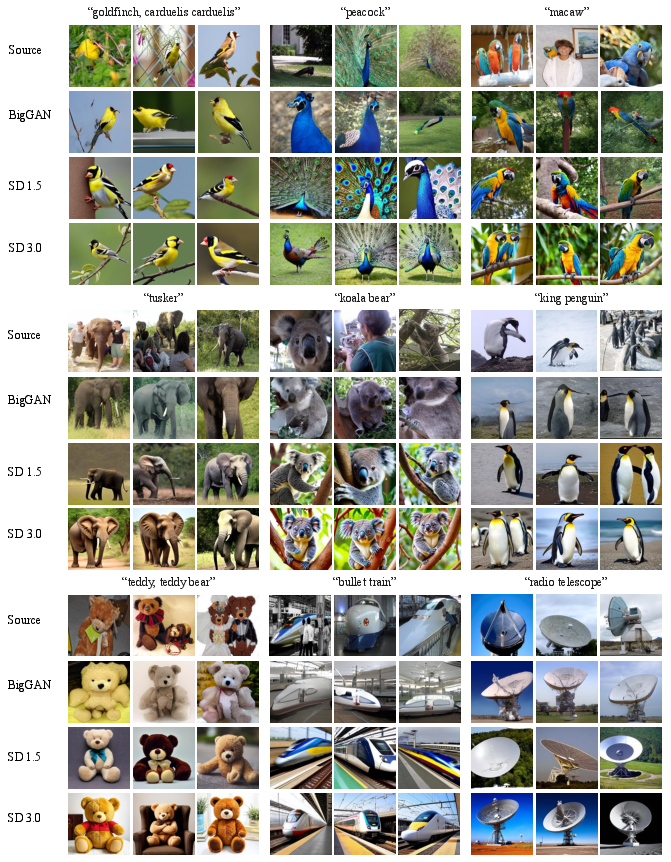
Figure 6: Comparison of source-domain and synthetic images from different generators demonstrates semantic purity and generative bias—justifying dynamic style bridging.
Implications, Limitations, and Future Directions
The forward-facilitation paradigm constitutes a shift from rigid constraint to continual co-evolution, transforming static prior knowledge into a dynamic asset for adaptation. Practically, it enables robust deployment under unpredictable distribution shifts, reducing catastrophic forgetting and error accumulation. The compact synthetic knowledge base and efficient bridging are well-suited for real-time applications, unlike generator-in-the-loop diffusion-based baselines.
The paper highlights bold claims of universality and robustness: the method retains efficacy across generator choices, self-training objectives, challenging batch sizes, and mixed domain shifts. This suggests strong generalizability and positions the framework as a foundational approach for future CTTA research.
Theoretically, the paradigm opens opportunities for extending dynamic style bridging to vision-LLMs, structured outputs (e.g., segmentation), and integrating more advanced semantic control over generative proxies.
Conclusion
This work redefines supervision in CTTA by introducing dynamic style bridging of synthetic knowledge bases, supporting a forward-facilitation paradigm. Empirical results demonstrate superior adaptation performance, resource efficiency, and domain robustness. The approach delivers stable, context-aware supervision, advancing both practical deployment and theoretical understanding of continual adaptation under non-stationary conditions (2605.18608).