- The paper demonstrates that if a two-qubit state allows a party to achieve a pure conditional state via projective measurement, it is necessarily EPR-steerable in both directions.
- Using quantum steering ellipsoids, the analysis shows that a QSE tangent to the Bloch sphere at even one point guarantees two-way EPR steering.
- The results establish a link between steering, measurement incompatibility, and Bell nonlocality, providing clear operational criteria for device-independent protocols.
One Pure Steered State Implies Einstein-Podolsky-Rosen Steering
Introduction
The paper "One pure steered state implies Einstein-Podolsky-Rosen steering" (2605.18243) addresses a core open problem in quantum information theory concerning the identification of sufficient criteria for Einstein-Podolsky-Rosen (EPR) steering in bipartite two-qubit systems. The work demonstrates that if a two-qubit entangled state allows one party, via local projective measurement, to steer the other's qubit to a pure state with nonzero probability (i.e., the steered ensemble contains at least one pure conditional state), the state is necessarily EPR-steerable in both directions. This result is characterized through the geometry of quantum steering ellipsoids (QSEs), establishing that a QSE tangent to the Bloch sphere at a single point suffices to guarantee steering. The implications span fundamental characterizations of nonlocal quantum correlations, device-independent protocols, and the operational links between steering, measurement incompatibility, and Bell nonlocality.
Background and Problem Statement
EPR steering, as formalized by Wiseman et al., refers to the impossibility of describing the conditional states one party (Bob) receives, after arbitrary local measurements by another party (Alice), with a local-hidden-state (LHS) model [Wiseman2007]. The challenge is that entanglement and Bell nonlocality do not provide necessary and sufficient conditions for steering, due to its inherent asymmetry and the lack of general analytical steerability criteria except for specific state families.
Detecting EPR steering is highly nontrivial, particularly for arbitrary two-qubit mixed states, in part because projective measurements in all directions must be considered. Existing approaches involve steering inequalities, semidefinite programming (SDP), numerical optimization, and, more recently, machine learning techniques. However, there exist entangled states where even advanced numerical methods fail to decide steerability, often linked to the presence of pure steered states in the conditional assemblage.
A QSE offers a geometric visualization: for any two-qubit ρAB, the set of Bloch vectors corresponding to Bob’s post-measurement states under Alice’s projective measurements forms an ellipsoid (QSE) within Bob’s Bloch sphere. Pure steered states correspond to points where the QSE is tangent to the Bloch sphere.
Main Results
Sufficient Condition: One Pure Steered State Guarantees EPR Steering
The primary result is the formal proof that the existence of at least one pure steered state in the conditional assemblage of Bob (i.e., a single QSE–Bloch sphere tangency point) suffices for EPR steering from Alice to Bob, irrespective of other state properties. Crucially, via a geometrical–algebraic analysis, the authors show that any attempt to build an LHS model—finite or infinite—for such a scenario incurs a contradiction: a polyhedral (finite LHS) or convex (infinite) decomposition cannot cover the ellipsoid when it is tangent to the sphere (Figure 1).
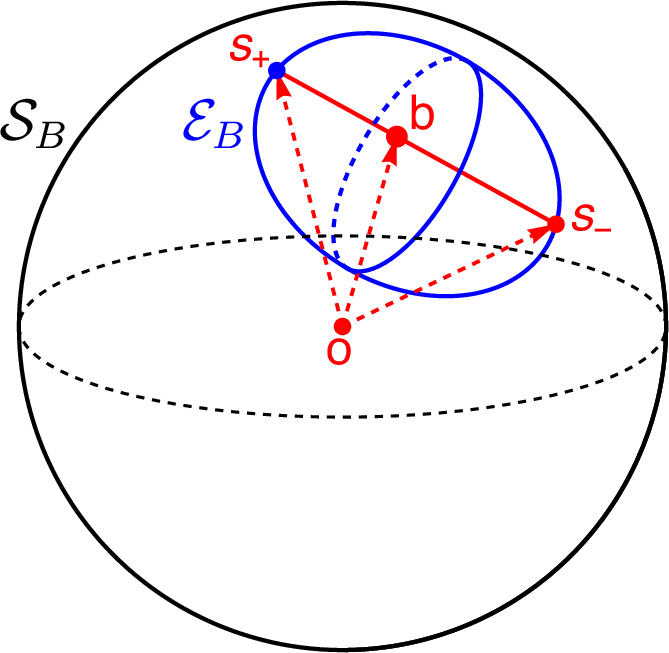
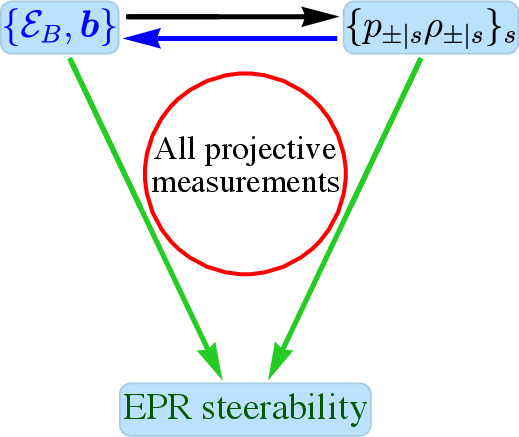
Figure 1: One-to-one correspondence between the pair {EB,b} and the assemblage obtained from projective measurements; QSE surface points correspond to steered states, with tangency indicating a pure conditional.
This result is underpinned by the constructive contradiction: as a projective measurement outcome approaches the pure conditional state, the associated region of the LHS ensemble shrinks to null measure, but the requirement for LHS simulation demands a nonzero weight—a mutual inconsistency (see Figure 2).
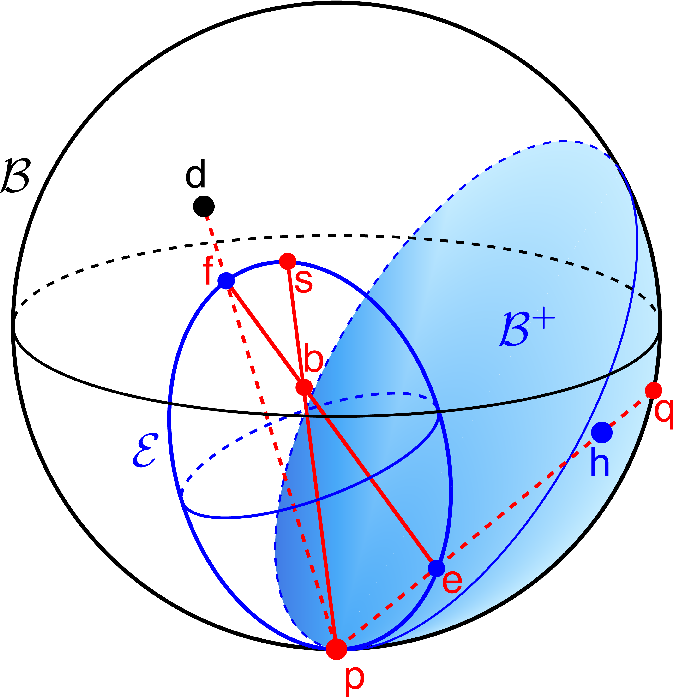
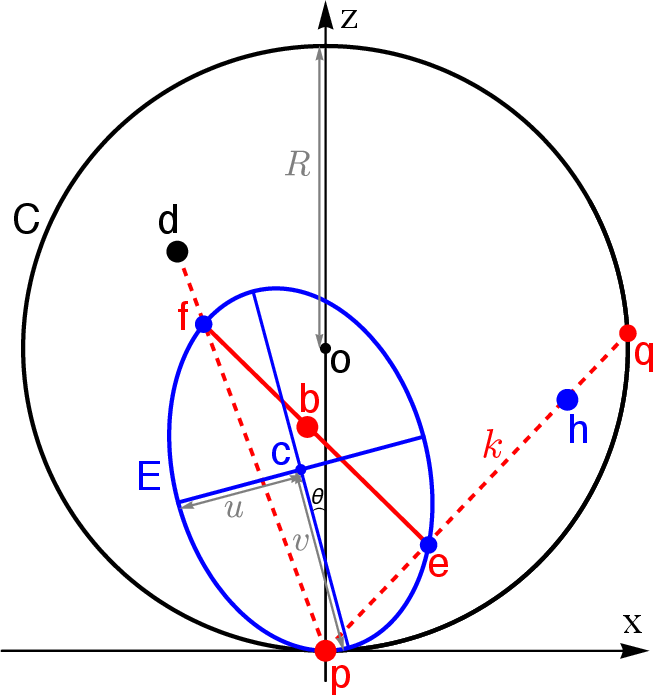
Figure 2: Illustration of Alice's response function in LHS models; the necessity of including a pure LHS state leads to coverage and normalization contradictions for the assemblage.
The proof extends rigorously to the regime where the QSE is tangent at two points, establishing that two tangency points similarly guarantee EPR steering.
Two-way EPR Steering and QSE Correspondence
The analysis further demonstrates that for all two-qubit entangled states, the number of QSE–Bloch sphere tangency points is necessarily equal for both subsystems and must be in the set {0,1,2,∞}—a result derived via explicit algebraic and geometric arguments. This leads directly to the corollary: if one party can steer the other qubit to at least one pure state, the opposite is true, i.e., the state is two-way EPR steerable.
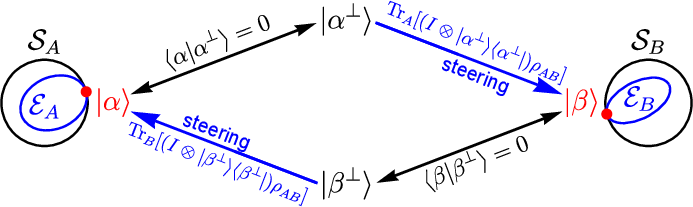
Figure 3: The one-to-one correspondence between Alice's pure steered state ∣α⟩ and Bob's pure steered state ∣β⟩.
This phenomenon is a geometric equivalent of Gisin’s theorem in the steering scenario and imposes a strict link between pure output states under projective measurements and operational nonlocality.
Exemplary State Families and QSE Visualization
The paper presents explicit families of two-qubit mixed states, including X-states and asymmetric mixtures, which admit exactly one pure steered state on one or both subsystems, corroborating the theoretical predictions via QSE visualizations (Figures 6–13). These examples are essential as they go beyond known analytically tractable classes and showcase the sharp distinction between QSE volume and tangent points as steering criteria.
Numerical Results and Contradictory Claims
A key claim, directly supported by rigorous construction, is that for two-qubit states, a single pure steered state suffices for two-way EPR steering—contradicting earlier intuition from entanglement or Bell nonlocality, where one-way scenarios or strict conditions abound. The authors further show that known numerical and SDP-based methods for steering detection can fail for states with such QSE geometries. Explicit constructions demonstrate that states not detectable numerically can be certified as steerable if their QSE is tangent at a single point, thus strengthening and expanding the operational boundary of EPR nonlocality.
Implications and Connections
Measurement Incompatibility
Via the steering–measurement incompatibility correspondence [Uola2015], the results provide a new sufficient condition: if the measurement assemblage (POVMs) mapped from a state assemblage contains at least one pure effect, the measurements are incompatible.
Bell Nonlocality and Gisin’s Theorem
The findings establish a strong form of the Gisin theorem for EPR steering: every entangled two-qubit state allowing a single pure steered state must be EPR-steerable, and if two pure steered states exist, the state is both EPR-steerable and necessarily Bell nonlocal (if the states are obtained via the same projective measurement). This refines the known hierarchy of quantum correlations and opens the possibility of further unification of nonlocality results under geometric and conditional-state frameworks.
Device-Independent and Quantum Cryptographic Protocols
Practically, the results provide a simple geometrical criterion—tangency of the QSE—for certifying two-way steering in one-sided device-independent quantum tasks. This criterion applies universally across all two-qubit entangled states, thus broadening the operational scenarios where security proofs can be constructed purely from measurement statistics.
Future Directions
The constructive nature of the proofs and the broad geometric criteria invite generalization to higher-dimensional systems (qudits), multipartite entanglement, and generalized measurement scenarios. There are open questions regarding the sufficiency of two QSE tangency points for Bell nonlocality in full generality, and on whether similar geometric–algebraic correspondences hold for all forms of measurement incompatibility. Extending the correspondence to positive operator-valued measures (POVMs), continuous-variable systems, and linking QSE geometry to quantitative steering measures remain intriguing avenues.
Conclusion
This work rigorously establishes that, for two-qubit entangled systems, the existence of a single pure steered state—i.e., a single QSE–Bloch sphere tangency point—guarantees two-way EPR steering. The result is geometrically transparent and operationally immediately applicable, providing a new, widely applicable sufficient criterion. It directly resolves cases where current numerical schemes are uninformative, offers a constructive paradigm for state classification, and lays groundwork for future unification and generalization within quantum nonlocality and measurement theory (2605.18243).

