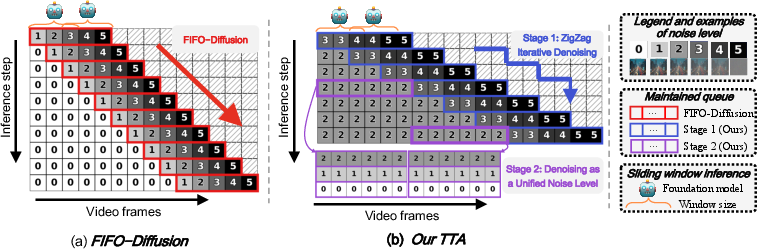
- The paper introduces MIGA, addressing content drift by employing a Two-Stage Training-Inference Alignment to bridge noise-level mismatches during inference.
- It presents a Dual Consistency Enhancement that enforces temporal coherence via self-reflection and long-range frame guidance, significantly reducing visual artifacts.
- Empirical results on VBench and NarrLV benchmarks demonstrate state-of-the-art performance with smooth, artifact-free long video generation at constant memory usage.
Enhancing Train-Free Infinite-Frame Generation for Consistent Long Videos: An Expert Essay
Introduction and Motivation
The paper "Enhancing Train-Free Infinite-Frame Generation for Consistent Long Videos" (2605.18233) addresses fundamental challenges in text-to-video generation, focusing specifically on the extension of generation length for foundation models in a train-free, memory-constant manner. Historically, diffusion-based video generators produce short, fixed-length clips, with train-free length extension strategies such as FreeNoise, FreePCA, and FreeLong facing prohibitive memory scaling as video lengths increase. The frame-level autoregressive paradigm, epitomized by FIFO-Diffusion, overcomes the memory constraint but introduces significant training-inference mismatch and struggles with maintaining long-range temporal consistency.
This work introduces MIGA, an infinite-frame generation framework that incorporates two novel algorithmic advancements: a Two-Stage Training-Inference Alignment (TTA) mechanism for bridging the noise-level span mismatch during inference, and a Dual Consistency Enhancement (DCE) suite—comprised of self-reflection and long-range guidance—to explicitly promote temporal coherence. The paper validates MIGA's efficacy on VBench and NarrLV, establishing new benchmarks in consistency and narrative expressiveness using both classic (VideoCrafter2) and state-of-the-art (Wan2.1) foundation models.
Framework Design: Algorithmic Innovations
Two-Stage Training-Inference Alignment (TTA)
Existing autoregressive generation frameworks, typified by FIFO-Diffusion, naively feed multi-noise-level latents to models trained exclusively with uniform noise-level inputs, inducing misalignment that propagates content drift and visual artifacts through long sequences.
The TTA mechanism divides inference into a zigzag denoising stage and a unified denoising stage:
Ablation analyses demonstrate that this two-stage scheme offers 2.03% overall score improvement over baseline FIFO-Diffusion, with gains saturating as zigzag width is increased.
Dual Consistency Enhancement (DCE)
Temporal consistency, essential for perceptual coherence and semantic alignment in long videos, remains inadequately addressed in prior train-free autoregressive methods. MIGA introduces two orthogonal enhancements:
- Self-Reflection: Early high-noise frames are subject to adaptive consistency evaluation using latent-space similarity metrics, obviating the need for external evaluators or decoding overhead. Correlation analyses reveal strong alignment between high-noise and clean-latent consistency scores, enabling early corrective search triggered when anomaly drops exceed a tunable threshold.
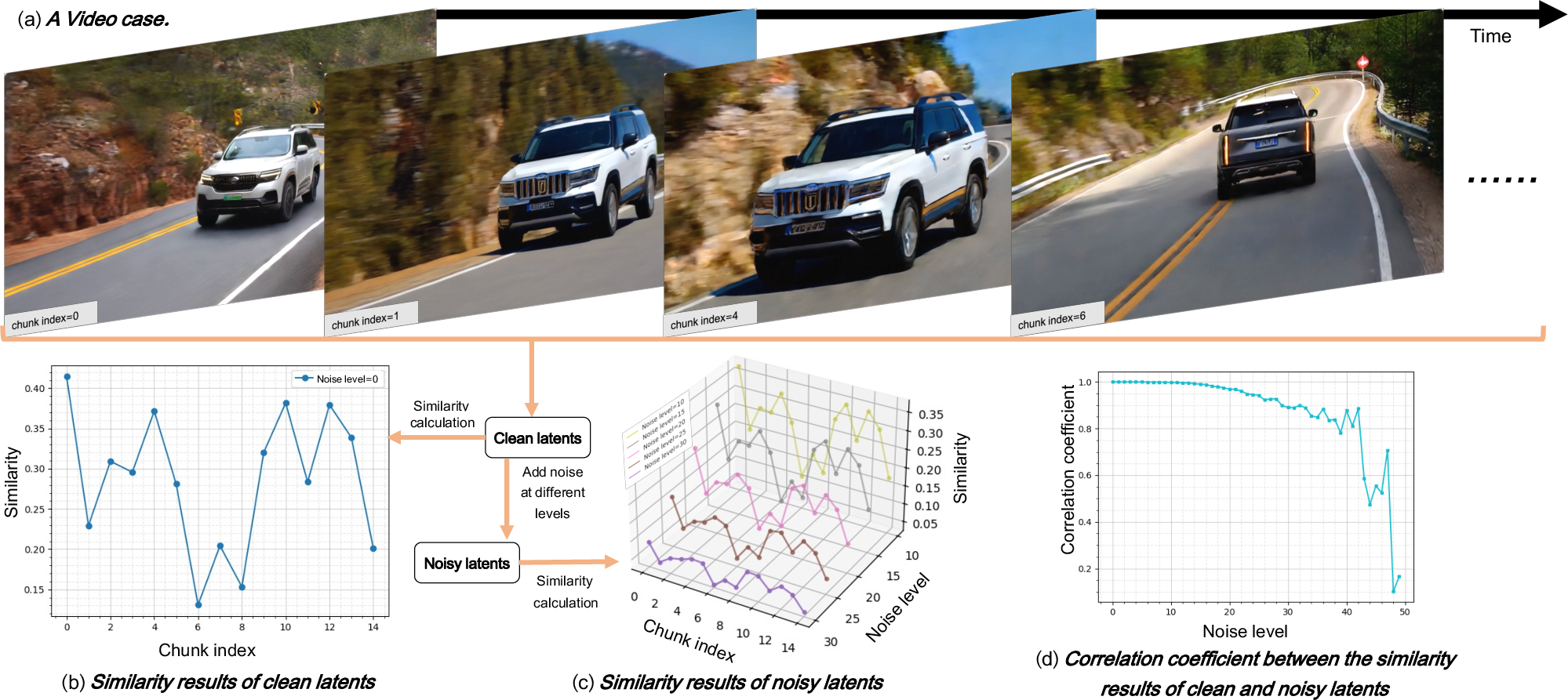
Figure 2: Self-reflection mechanism identifies and corrects consistency anomalies by analyzing latent similarity and correlation.
- Long-Range Frame Guidance: Sparse sampling of low-noise, temporally distant latents guides local denoising, enforcing global coherence beyond short-range window interactions. Implementation via sliding-window inference is memory efficient and empirically yields substantial improvements in overall consistency metrics, with best results achieved at a guidance frame count (mguid) of 6.
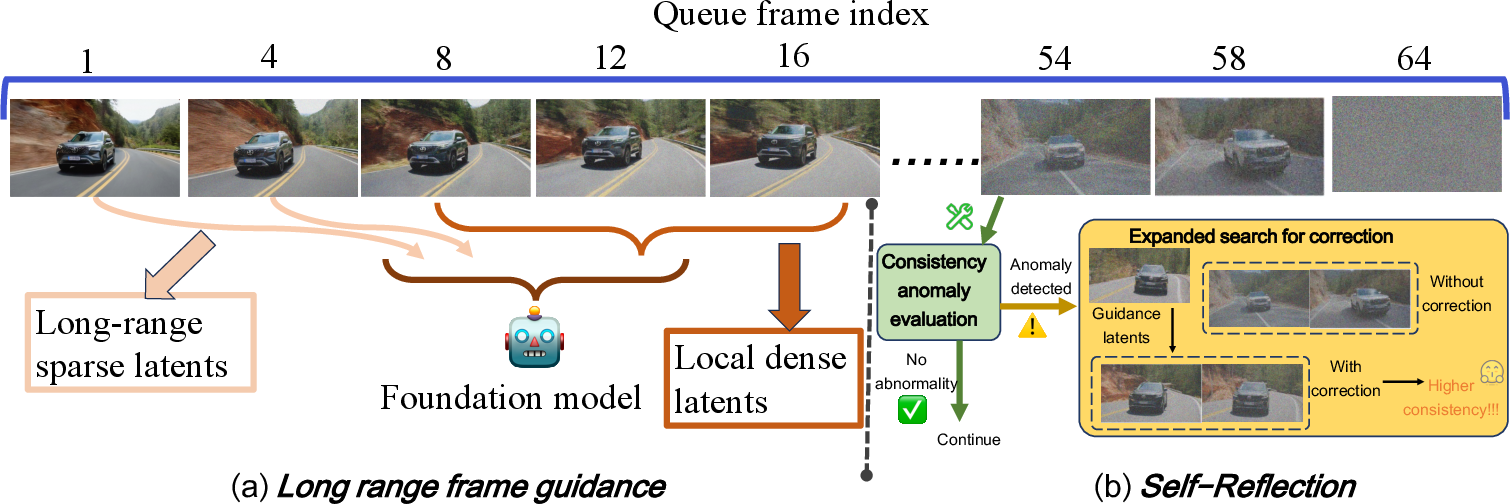
Figure 3: DCE integrates self-reflection and long-range guidance to enforce temporal consistency via both local correction and global feature propagation.
Empirical Results and Validation
Comprehensive experiments are conducted with VideoCrafter2- and Wan2.1-based MIGA instantiations. Evaluation against VBench and NarrLV, alongside both memory-scaling (FreePCA, FreeLong) and frame-autoregressive (FIFO-Diffusion, ScalingNoise) baselines, demonstrates dominant performance:
- VBench (128/161 frames):
- VideoCrafter2-based MIGA achieves 97.66% (S.C.), 96.99% (B.C.), 98.60% (M.S.), 98.03% (T.F.), and 97.82% (O.S.), outperforming FreeLong and FIFO-Diffusion across all dimensions.
- Wan2.1-based MIGA attains 96.46% (S.C.) and 98.85% (M.S.), replacing content drift and flicker with smooth transitions.
- NarrLV (narrative expressiveness):
- MIGA yields up to 4.7% gain in subject consistency and 2.0% in background consistency over FIFO-Diffusion.
- For TNA=4, Wan2.1-based MIGA records 75.05% (scene attributes), 72.31% (target attributes), and 62.90% (target actions), denoting stable content propagation under complex narrative constraints.
Qualitative outputs include videos exceeding 1,000 frames, exhibiting both prompt alignment and semantic stability.
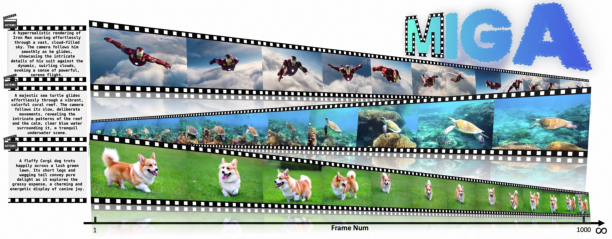
Figure 4: MIGA achieves temporally consistent, infinite-frame generation, surpassing foundation model frame limits for coherent long video outputs.
Ablation and Mechanism Analysis
Ablation studies rigorously dissect mechanism contributions:
- TTA: Stage 1 alone eliminates major content anomalies, while Stage 2 addresses noise, with optimal zigzag width and unified steps yielding maximal scores.
- DCE: Self-reflection’s threshold δadju controls tradeoff between search frequency and correction rate. Long-range guidance efficiency is validated by near-negligible memory and latency overhead.
Memory profiling confirms constant memory usage over increasing frame counts (Figure in Appendix), ensuring true infinite-frame scalability.
Architectural Generalizability and Limitations
MIGA’s autoregressive principles migrate with minimal adaptation to foundation models supporting frame-level noise and text conditioning via cross-attention (VideoCrafter2, Wan2.1). Attempted adaptation to MMDiT-based architectures (CogVideoX) fails, producing semantic drift, due to joint noise-text interaction limitations.

Figure 5: Migration of frame-level autoregressive generation to MMDiT architectures results in degraded performance due to conditioning incompatibilities.
Limitations persist in maintaining causal or physically plausible trajectories through lengthy sequences; occasional hallucination or content reversal may arise when temporal dependencies are violated.

Figure 6: An instance illustrating model limitations, where semantic hallucination disrupts consistency after prolonged generation.
Practical and Theoretical Implications
MIGA provides a scalable solution for train-free long video generation, unlocking practical applications in simulation, entertainment, and creative industries without incurring model retraining costs or hardware upgrades. Theoretically, its noise-alignment methodology and latent-space correction may be transplanted to other autoregressive domains, bridging training-inference gaps and enforcing consistency in generative systems.
Future work may augment text conditioning with auxiliary signals (e.g., physics or world knowledge), leveraging foundation model architecture improvements for even more robust causal reasoning over extended temporal horizons.
Conclusion
This work establishes MIGA as a robust, train-free solution for infinite-frame, temporally consistent video generation. By introducing a principled alignment mechanism and novel consistency enhancements, it achieves state-of-the-art quantitative and qualitative results while preserving memory efficiency. The framework’s practical scalability and theoretical generalizability make it a compelling foundation for future developments in AI-driven long video generation.