- The paper introduces a centralized repository that curates 103 hypergraph datasets, extending network analysis beyond traditional dyadic interactions.
- The paper details robust data formatting and multi-tier metadata integration, including JSON and Python-native formats for enhanced computational efficiency.
- The paper emphasizes reproducible benchmarking and practical improvements in network science, supporting research on hypergraph models and AI applications.
Hypergraphx-data: Centralized Resource for Higher-order Network Datasets
Motivation and Contributions
The current paradigm in network science is predominantly focused on pairwise (dyadic) interactions, as reflected in canonical dataset repositories like SNAP and Netzschleuder. However, a multitude of real-world systems exhibit intrinsic higher-order, many-body interactions that dyadic models inadequately capture. The "Hypergraphx-data" repository directly addresses this limitation by providing a curated, standardized, and version-controlled collection of empirical hypergraph datasets spanning diverse domains including social, ecological, biological, and financial systems (2605.18166). The repository's construction encompasses not only generalized hypergraph data (weighted, directed, temporal, multiplex), but also comprehensive metadata and open data formats explicitly designed for interoperability and computational efficiency.
Dataset Spectrum and Domain Coverage
Hypergraphx-data assembles 103 datasets representing both artificial and natural systems with complex relational structures. Social systems are well-represented, e.g., face-to-face interactions in schools and conferences, co-authorship, online discussion groups, and voting records. In technology and finance, the repository contains email communication hypergraphs and Bitcoin transaction networks. Ecological and biological domains are covered via animal proximity, gene-disease, drug association, and metabolic reaction datasets.
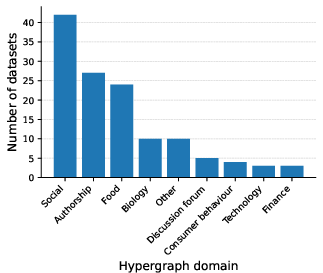
Figure 1: Distribution of datasets by application domain in the collection. Bars are sorted in descending order of frequency. We show only domains with at least three datasets.
Figure 1 illustrates that social and biological domains dominate the dataset corpus, aligning with well-established evidence of higher-order processes in those settings. The inclusion of domains such as finance and ecology extends existing repositories’ coverage, supporting comparative multi-domain studies.
The repository supports a rich taxonomy of hypergraph structures. Datasets include undirected, directed, weighted, temporal, and multiplex hypergraphs. Directed hypergraphs encode asymmetric groupwise relationships, critical, for example, in biochemical pathways or transaction flows. Temporal datasets enable dynamic process modeling and are relevant for time-resolved contact networks. Multiplex representations allow layered analysis for heterogeneous edge types.
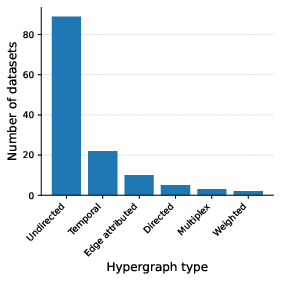
Figure 2: Distribution of datasets by hypergraph type in the collection. Bars are sorted in descending order of frequency.
Importantly, the dataset schema enforces metadata at multiple scales: system-level (global descriptors), node-level (attributes such as demographic or biochemical class), and hyperedge-level (interaction labels, timestamps, weights). This multi-tiered annotation fosters contextualized structural analysis and downstream benchmarking for algorithms leveraging additional covariates.
Hypergraphx-data provides each dataset in dual formats: a JSON schema for human-readability and cross-platform usage, and a binarized, Python-native format that is 1.5× more compact and 5× faster to load in practical computational settings. The integration with the Hypergraphx (HGX) library and Hypergraph Interchange Format (HIF) ensures compatibility with other leading libraries such as XGI, HyperNetX, and SimpleHypergraphs, encouraging method transfer and benchmarking across software ecosystems.
Dataset provenance is maintained through embedding original sources, citations, licensing, and reconstructive scripts, promoting reproducibility and transparency. Notably, the repository introduces semantic versioning and hash-based integrity checks for all datasets, providing immutability and traceability of versions. This is crucial for reproducible experiments and the establishment of robust benchmarking protocols.
Repository Website and Usability
The repository’s web interface is organized for accessibility and dataset exploration. Users can browse datasets via powerful search and filtering tools—by domain, scale (number of nodes/hyperedges), or structural features—directly from the home page.
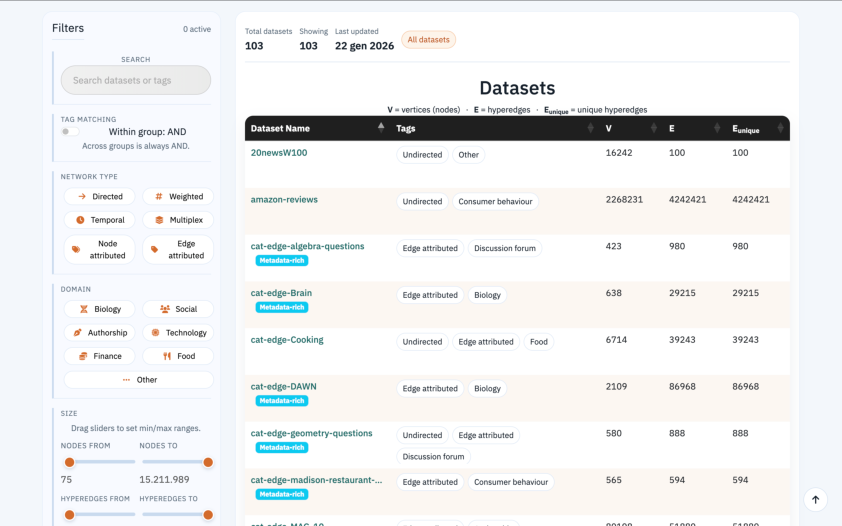
Figure 3: Home page of the repository website, showcasing its interface and key features for navigating and accessing datasets.
Each dataset’s detail page displays summary statistics, interactive visualizations, version history, citation information, and direct download links, optimizing for both exploration and reproducible academic workflows.
Implications, Limitations, and Future Directions
Hypergraphx-data fills a notable gap in empirical higher-order data accessibility, facilitating systematic benchmarking of models and algorithms in higher-order network science. By centralizing datasets across domains and supporting advanced formats and metadata, it lays the groundwork for rigorous reproducibility, fair model evaluation, and improved cross-study comparisons.
Practically, the repository’s structure enables research into areas such as hypergraph community detection [contisciani2022inference], motif mining [lotito2024exact], dimension reduction [kirkley2025structural], influence maximization [genetti2024influence], and shortest path computation [nortier2025higher] using real-world data. The explicit versioning and integrity management addresses a longstanding challenge in maintaining scientific benchmarks. The repository advocates for further development in standardized interchange formats (e.g., HIF), robust binary formats, and richer statistics, as well as eventual interactive visualization tools.
Theoretically, wide-scale empirical availability may enable the network science and machine learning communities to validate higher-order generative models, study the impact of non-dyadic structures on dynamical processes, and better leverage hypergraph representations in neural models for AI tasks. Standardized datasets may accelerate progress on understanding the statistical mechanics and computational phenomenology unique to higher-order interactions.
Conclusion
Hypergraphx-data constitutes a substantial resource for advancing research at the intersection of network science, data-driven modeling, and AI, by making accessible a diverse, high-fidelity, and well-documented collection of hypergraph datasets. Its architecture supports reproducibility, method development, and fair benchmarking, and is extensible to further domains and data types. This resource is poised to become an anchor for empirical research in higher-order network analysis, with downstream impact for both theoretical developments and applied machine learning in complex systems.