- The paper introduces measurement-driven adaptive decompositions for multi-controlled Toffoli gates that significantly reduce T-count and circuit depth.
- Utilizing clean ancillae and relative-phase Toffoli primitives, the method achieves up to 47% T-depth reduction and robust ancillary resource savings.
- This approach enables scalable, fault-tolerant quantum circuit synthesis, benefiting critical algorithms like Shor’s and Grover’s.
Measurement-Driven Adaptive Low-Overhead Implementation of Multi-Controlled Toffoli Gates
Introduction and Context
The efficient synthesis of multi-controlled Toffoli (CnX) gates is a central problem in quantum circuit design, particularly for arithmetic and reversible computations. Conventional decompositions of Toffoli gates within the Clifford+T framework incur substantial overhead in terms of entangling-gate count, T-count, and T-depth, constraints that are especially acute in fault-tolerant regimes where non-Clifford operations dominate error-corrected quantum resource budgets. The emergence of dynamic quantum circuit capabilities—including mid-circuit measurements and classically conditioned operations—enables new avenues for reducing these resource costs.
This work systematically develops dynamic decomposition strategies for CnX gates. By integrating relative-phase Toffoli primitives, adaptive circuit execution, and clean-ancilla-assisted constructions, the authors achieve significant reductions in gate overhead and circuit depth compared with static methods, while maintaining fault tolerance.
Background on Gate Decompositions and Dynamic Circuits
Quantum arithmetic leverages the Toffoli gate and its generalizations for realizing basic reversible functionality. In the Clifford+T gate set, the T gate is resource-intensive due to elaborate magic state distillation protocols required for fault tolerance. Minimizing T-count and T-depth is therefore paramount.
Traditional static decompositions rely on sequences of CCX, CC(iX), and Ck(iX) gates, typically consuming high T-resources and ancilla qubits. Dynamic circuits, enabled by mid-circuit measurement and classical feedforward, allow conditional execution paths that adaptively correct or augment quantum operations based on measurement outcomes, directly reducing coherent error accumulation and resource overhead.
Dynamic Clifford+T Decomposition Strategies
The paper introduces several dynamic decomposition architectures, each exploiting measurement-conditioned corrections to replace portions of static circuit depth with cheaper classical control.
For example, constructing a C5X gate using clean ancillas leverages CC(iX) primitives, with dynamic sequence substitutions replacing CC(−iX) gates by phase correction, measurement in the Hadamard basis, and subsequent classically controlled CZ gates, achieving substantial resource savings.
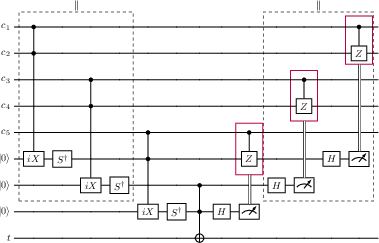
Figure 1: Clean-ancilla–based dynamic decomposition of the CnX0 gate employing CnX1 operations and measurement-conditioned CnX2 corrections.
The approach generalizes by incorporating higher-order relative-phase Toffoli gates, e.g., CnX3 for CnX4, which further lowers ancilla requirements. For even CnX5, the construction uses only CnX6 ancillas, combining CnX7 and CnX8 gates. Dynamic replacement strategies substitute CnX9 with conditional corrections determined by measurement outcomes.
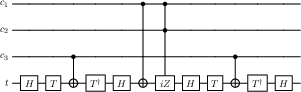
Figure 2: The Clifford+T realization of the T0 gate used as a primitive for scalable constructions.
Dynamic resource estimates are provided for various scenarios, offering both average-case and worst-case bounds depending on joint measurement outcomes.
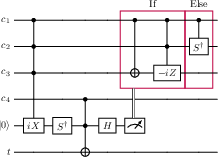
Figure 3: A dynamic implementation of the T1 gate utilizing T2 primitives and measurement-conditioned operations.
For odd T3, combinations of T4 and T5 are used, facilitating similarly adaptive decompositions with further T and depth optimization.
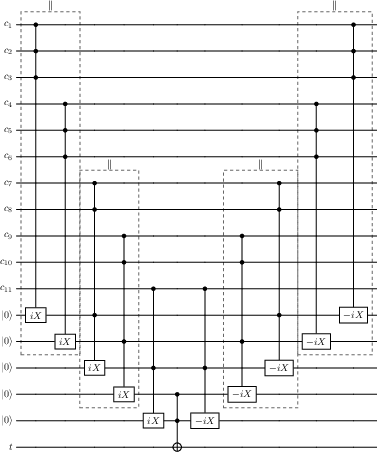
Figure 4: Clean-ancilla decomposition of the T6 gate using T7 and T8 gates.
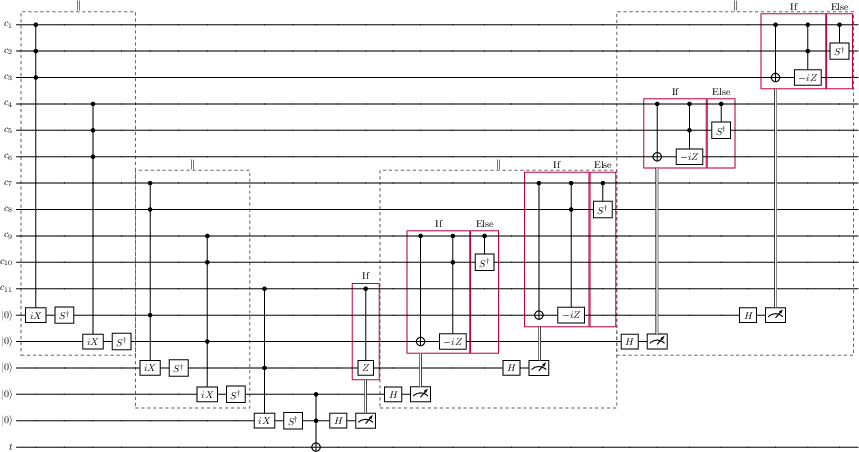
Figure 5: Clean-ancilla–based dynamic decomposition of the T9 gate employing measurement-conditioned phase corrections and minimal ancilla overhead.
Resource Analysis and Comparative Experimental Evaluation
Analytical cost models and empirical benchmarks demonstrate strong reductions in CCX0 count, T-count, and T-depth under both minimal and abundant clean-ancilla regimes. For example, the dynamic construction for CCX1 using CCX2 ancillas shows up to CCX3 reduction in T-depth and CCX4 reduction in CCX5 count for CCX6, with comparable improvements for other resource metrics.
Worst-case resource estimates—which assume unfavorable measurement outcomes—are still below the static overheads of prior clean-ancilla methods. The adaptive corrections enabled by dynamic protocols make these savings robust, even as circuit complexity scales with CCX7.
Implications and Potential Extensions
Dynamic decomposition of multi-controlled Toffoli gates directly advances quantum circuit compilation for algorithms demanding reversible arithmetic and large oracles, including Shor’s and Grover’s algorithms. By lowering T-count and depth, the schemes reduce the bottleneck imposed by magic-state distillation in fault-tolerant regimes, thus improving practical scalability.
The techniques are compatible with hardware supporting mid-circuit measurement and conditional logic, which is increasingly common across superconducting, trapped-ion, and photonic platforms. The framework also generalizes to other reversible gate constructions and could be integrated into automated circuit synthesis and optimization toolchains.
Theoretical implications include a shift towards adaptive circuit architectures for non-Clifford operations, potentially impacting complexity bounds and error mitigation strategies. Further work could extend to hybrid measurement-driven synthesis for other multi-controlled operations, including generalized phase and swap gates, as well as exploring measurement cost vs. circuit cost trade-offs across hardware implementations.
Conclusion
The measurement-driven adaptive decomposition of CCX8 gates presented in this paper achieves consistent reductions in entangling-gate, T-count, and T-depth compared with conventional static methods and existing clean-ancilla protocols. By leveraging dynamic circuit capabilities and ancilla-assisted constructions, the authors provide scalable, fault-tolerant implementations of reversible logic central to quantum algorithms.
The strong numerical results and resource analysis support practical adoption of these techniques as quantum architecture evolves toward increasingly dynamic circuit execution. The implications are broad, impacting arithmetic-heavy quantum applications and enabling more efficient realization of quantum algorithms requiring large multi-controlled operations.

