- The paper introduces 'TeleCom-Bench,' a benchmark evaluating large language models' (LLMs) capabilities in telecom application scenarios.
- The benchmark is designed around Knowledge Comprehension and Application, testing both theoretical understanding and real-world procedural execution.
- Findings reveal that while LLMs excel in understanding intent and diagnosis, they struggle significantly with translating that into executable solutions.
Motivation and Benchmark Structure
Telecommunications presents dense technical complexity, vendor-specialized protocols, and safety-critical operational workflows, rendering generic NLP or domain-adapted LLM benchmarks insufficient for evaluating production readiness. "TeleCom-Bench: How Far Are LLMs from Industrial Telecommunication Applications?" (2605.18025) directly addresses this gap by introducing a dual-pillar, multi-tiered evaluation suite: Knowledge Comprehension (KC) and End-to-End Knowledge Application (KA). The hierarchical design (see Figure 1) encompasses both foundational theory (e.g., 3GPP standards, signal processing) and the complete execution chains of live network optimization and maintenance. This formalism enables conclusive assessment of whether an LLM can function not just as an information extractor or diagnostician, but as an operational field agent.
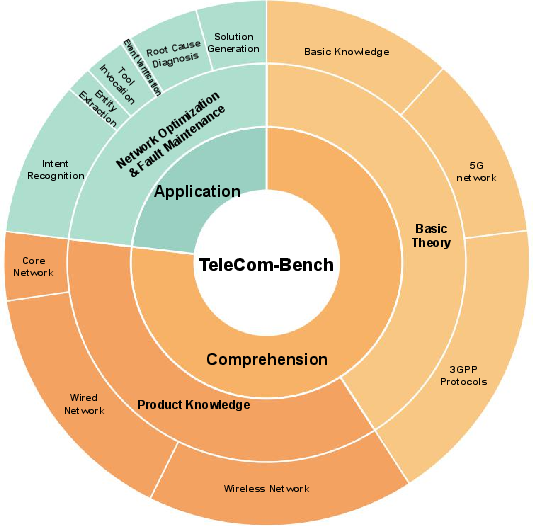
Figure 1: The two-level structure of TeleCom-Bench dividing evaluation into Knowledge Comprehension and Application, capturing both depth and operational breadth.
Data Acquisition, Curation, and Task Pipelines
Knowledge Comprehension (KC)
The KC pipeline (Figure 2) processes 1.52TB of heterogeneous telecommunication artifacts—standard docs, vendor manuals, field logs—into structured, annotated, de-duplicated corpora and over 17,000 knowledge-centric evaluation samples. Multi-tiered sources ensure balanced coverage of public standards, academic treatises, and proprietary product guides. The curation protocol encompasses advanced layout-aware OCR, format harmonization, semantic deduplication, and granular metadata tagging enabling fine-grained stratified evaluation.
Critically, evaluation item generation exploits two advanced synthesis methodologies:
- Distillation-Driven Evaluation Generation: Task-adaptive prompting of LLMs and human-in-the-loop extraction to produce evaluation samples with minimal hallucination, targeting slot-filling, structural parsing (eg. JSON graphs of config manuals), progressive multi-step question-answer pairs, and cross-document fusion.
- Knowledge Graph (KG)-Driven Evaluation Generation: Ontology-based entity-relation construction yields graphs encoding scenario-grounded topologies—Equipment-Scenario Hierarchies and Causal Fault Chains. Graph traversal and subgraph sampling generate atomic, multi-hop, and aggregate QA pairs, with adversarial distractors for robust discrimination and subgraph-based retrieval to validate and de-noise generated sets.
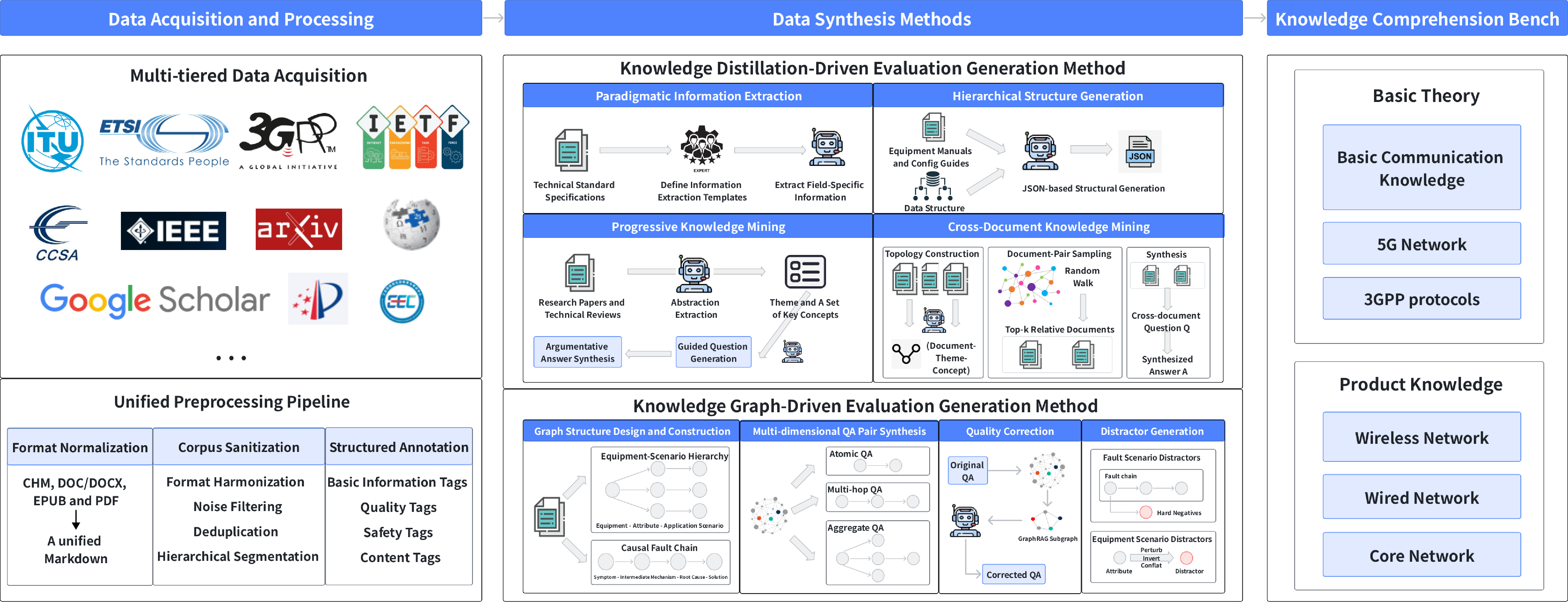
Figure 2: The KC pipeline spans multimodal data ingestion, metadata-rich document curation, and methodical evaluation generation, enabling both scale and diagnostic granularity.
Knowledge Application (KA)
The KA benchmark pivots to real-world, agent-in-the-loop scenarios (Figure 3). The pipeline acquires large-scale network telemetry, configuration snapshots, and event logs directly from commercial systems (via MML, SNMP, SFTP), followed by privacy-preserved ETL alignment and expert curation.
Using trajectory mining over agent workflow traces, KA dataset construction decomposes end-to-end operations into atomic tasks: intent recognition, entity extraction, event verification, tool invocation, root cause diagnosis, and solution generation. Each step records the full chain-of-thought, operational context, tool interface interactions, and final actions, with closed-loop verification against production network KPIs and expert engineer audit for semantic fidelity.
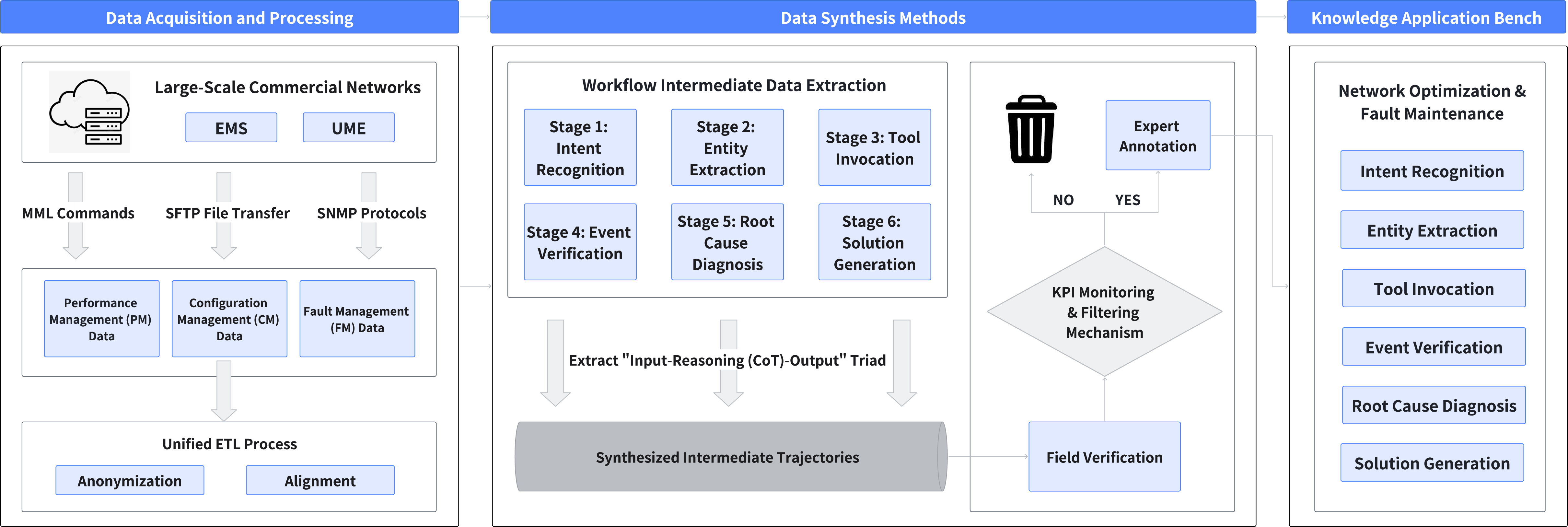
Figure 3: The KA pipeline operationalizes live telemetry and agent traces, dissecting workflows into fine-grained, verifiable sub-tasks.
TeleCom-Bench formalizes three representative task modalities (Figure 4): multiple-select (for knowledge/standards, evaluating both breadth and nuance), subjective QA (enabling open-ended, expert-level synthesis), and structured QA (fact extraction, typically output in JSON for downstream consumption). This diversity mirrors the spectrum of real-world inputs, from technical protocol assessment to workflow command generation.
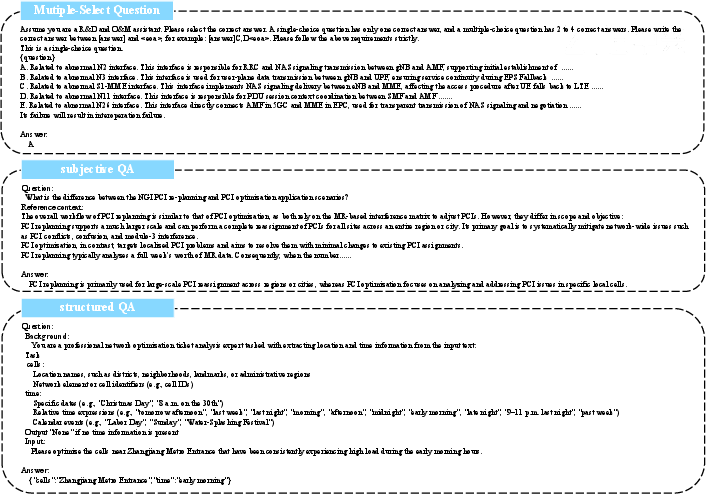
Figure 4: Prototypical formats for task types, mapping to concrete workflow requirements in telco operations.
The operational KA tasks include explicit context about a tool library (23 vendor-specific utilities; Figure 5), provided as part of the system prompt for each model evaluation. These tools are necessary for generating executable command sequences and completing fault resolution. Despite uniform access, models struggle with procedural grounding and correct invocation.

Figure 5: The prompt-accessible 23-tool library with sharp interface constraints, establishing the requirements for procedural reasoning in fault-handling.
Experimental Evaluation and Key Findings
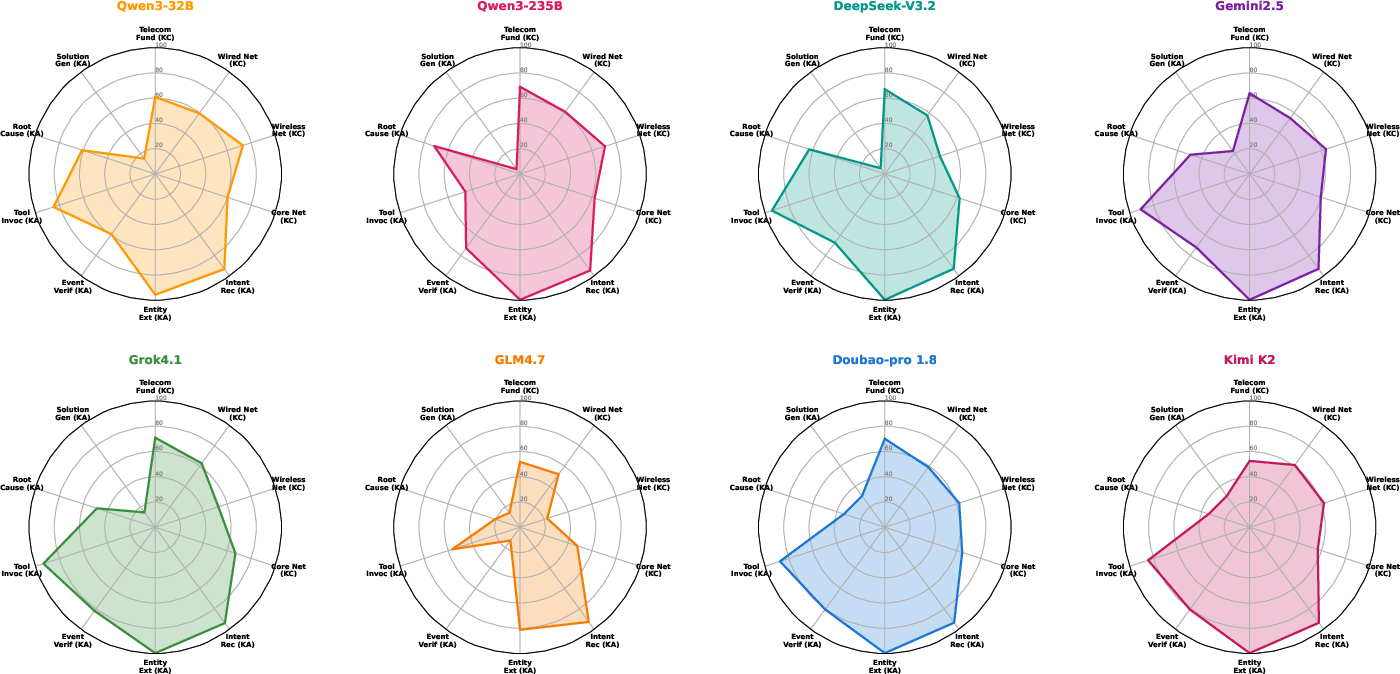
Eight SOTA LLMs, including Qwen3-235B, DeepSeek-V3.2, Gemini-2.5, and GLM4.7, are systematically benchmarked via macro-F1, exact match, and tri-LLM-as-a-Judge mechanisms. Macro-level results (Figure 6) evidence two clear patterns:
Model outputs for fault resolution (Figure 7) demonstrate the inability of generalist LLMs to properly utilize the tool context, often generating unstructured, hallucinated, or syntactically-invalid command sequences instead of procedurally correct solutions.
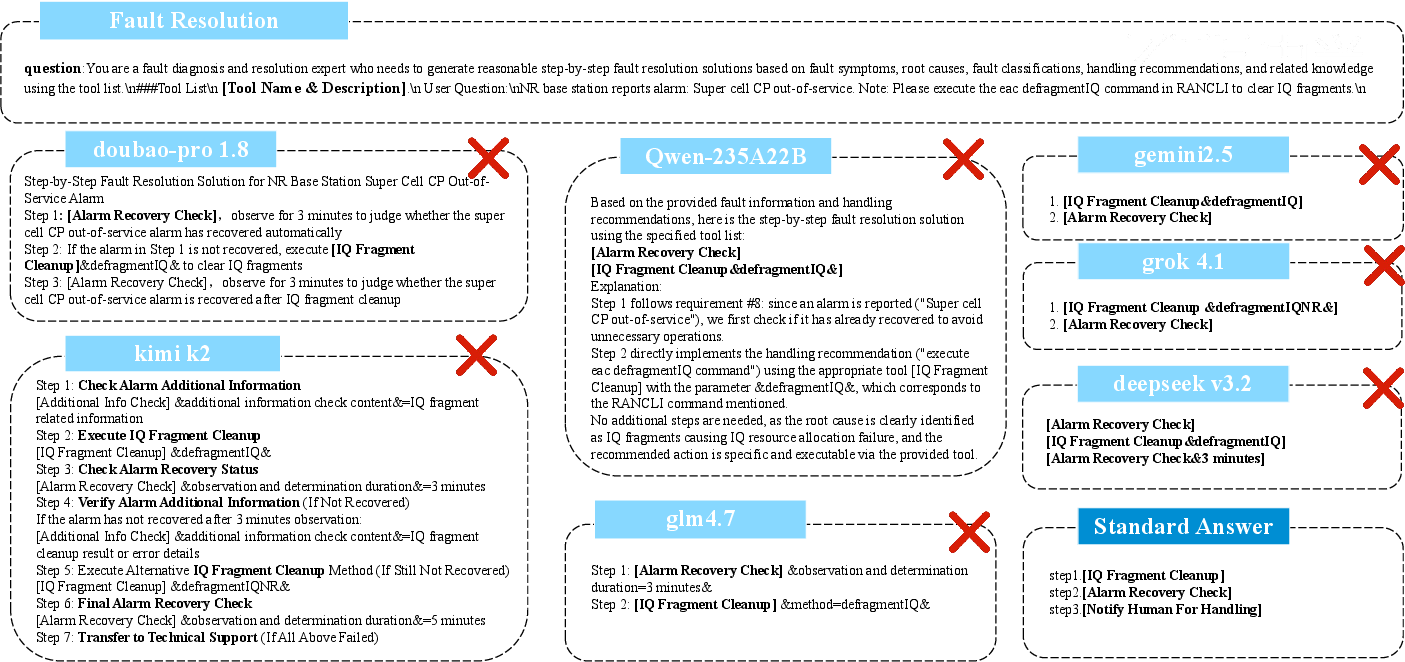
Figure 7: Example outputs where advanced LLMs, despite being given tool specs, fail to convert diagnosis into valid, actionable commands.
Theoretical and Practical Implications
Theoretical
Findings corroborate an emerging consensus: scaling model parameters and generic instruction tuning are insufficient for achieving vertical-domain procedural agency. Coverage of proprietary documentation and agent workflow traces, not model scale, drives any gains in complex industrial settings. This aligns with parallel results in medical [ding2025medbench], financial [ding2025cnfinbench], and software operations [liu2025opseval] domains.
Additionally, MoE architectures correlate with modest improvements in tool invocation. However, the diagnosis-action paradox remains—LLMs can reason causally but cannot synthesize compliant, safety-constrained interventions, a gap not addressed by chain-of-thought prompting alone. Current models operate as information extractors or passive advisors, not as active, trustworthy engineers.
Practical
For deployment in industrial networks, the benchmark demonstrates SOTA LLMs fundamentally lack the procedural grounding required for safe automation. The solution-generation bottleneck defines a practical barrier for closed-loop operations, necessitating novel research into procedural alignment, tool-centric generation, and integration of product-specific knowledge graphs.
TeleCom-Bench provides a gold-standard reference for telco LLM evaluation and a diagnostic instrument for identifying precise deficit loci, enabling both higher-fidelity research and more trustworthy field deployment metrics.
Outlook and Future Developments
Directions mandated by this work include:
- Instruction and RAG-based fine-tuning explicitly over workflow traces and product documentation for procedural alignment.
- Safety verification and formal program synthesis modules for tool command generation.
- Expanded, open-sourced vendor product and live workflow corpora, making the benchmark a cornerstone for telco AI transparency and comparability.
Persistent execution gaps accentuate the need to operationalize more rigorous tool-based supervision and hybrid neuro-symbolic toolchains to move beyond "diagnostician LLMs" toward true field agent capabilities.
Conclusion
TeleCom-Bench establishes for the first time a rigorous, hierarchical, task-diverse benchmark for LLMs in telecommunications, spanning static knowledge and dynamic, tool-constrained operations. Strong empirical evidence supports the claim that all current models, despite excelling in intent, extraction, and diagnosis, universally fail to produce executable solutions even when given complete procedural context. This "Execution Wall" remains the fundamental open challenge for industrial deployment. Research focus must now shift to procedural grounding, safety alignment, and vendor/product-aware vertical adaptation to realize genuine telecom AI autonomy.
(2605.18025)