- The paper shows that the coupling phase φ governs the existence and number of bound states in the continuum (BICs) within giant-atom configurations.
- It details how phase modulation induces distinct atomic dynamics, including persistent population trapping and phase-insensitive Rabi-like oscillations.
- The study reveals that tuning φ enhances atomic entanglement and provides robust control for engineered quantum state storage and dissipative processes.
Phase-Controlled Bound States in the Continuum and Dynamics in Giant-Atom Waveguide QED
Introduction and Physical Motivation
This work studies the impact of direct coupling phase on bound states in the continuum (BICs) and quantum dynamics in systems of “giant atoms” coupled to a coupled-resonator waveguide (CRW). The key novelty is the explicit inclusion and modulation of the phase ϕ associated with direct coherent coupling between two giant atoms—each nonlocally connected to the waveguide, creating a braided, multi-point attachment geometry. Previous literature primarily examined BIC formation as an interference effect in atom–waveguide systems, but the role of direct atom–atom coupling phase remained unaddressed. The study demonstrates that the phase ϕ serves as a flexible control parameter for engineering the number and spatial profiles of BICs in the composite system, with major implications for atomic entanglement, fractional population trapping, and dissipation engineering in waveguide QED platforms.
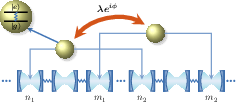
Figure 1: Schematic diagram of two braided giant atoms coupled to a coupled-resonator waveguide (CRW) highlighting the nonlocal, multi-point waveguide coupling and direct atom–atom connection.
The configuration (Figure 1) realizes both mediated (via the waveguide) and direct coherent interactions between two-level systems, where geometric and phase degrees of freedom induce interference phenomena not possible in standard small-atom models.
Theoretical Framework and Hamiltonian
The system consists of two two-level giant atoms, each coupled to a CRW at two separate, spatially distinct resonators. Direct coupling of strength λ and phase ϕ connects the atoms. The total Hamiltonian H=Ha+Hc+HI is constructed as follows:
- Ha describes the atomic transitions and direct inter-atomic coupling, with a phase factor eiϕ.
- Hc models a standard tight-binding CRW.
- HI implements nonlocal coupling between each atom and its respective two lattice sites on the CRW.
Transformation to momentum space allows analytic tractability. Within the single-excitation sector, excitation amplitudes for each atom (α1, ϕ0) and each photonic mode (ϕ1) evolve according to coupled equations. By eliminating photonic degrees of freedom under the Markov approximation, effective non-Hermitian dynamics for the atomic amplitudes is obtained:
ϕ2
where the matrix ϕ3 encodes both dissipative (waveguide) and coherent (direct coupling) interactions, with entries explicitly dependent on ϕ4. The imaginary parts of ϕ5’s eigenvalues determine loss rates: zero corresponds to a BIC, negative indicates decay.
Analysis of the full parameter space reveals several key findings:
- The coupling phase ϕ6 governs the number of BICs supported for a given geometric configuration. For instance, with ϕ7 (giant atom “size”) and ϕ8 (separation), the system supports a single BIC only when ϕ9 (λ0), and none otherwise. For λ1, λ2, two phase-insensitive BICs always exist. For λ3, λ4, BICs are altogether absent.
- Atomic population dynamics exhibits clear fingerprints of BIC presence and number. With a BIC, initial atomic excitation is partially trapped indefinitely, while both atoms acquire equal, nonzero steady-state populations. Without BICs, both atoms eventually relax to ground, with transients set by λ5. With two BICs, persistent, phase-insensitive Rabi-like excitation exchange emerges.
- Strong claim: The phase λ6—an otherwise unitary transformation in closed atomic systems—has operational significance in open, nonlocal light–matter interfaces and enables dynamical regimes (population trapping, Rabi oscillations, complete dissipation) not accessible in conventional small-atom QED.
Spatial and Quantum State Structure of BICs
The study further characterizes the spatial and internal structure of phase-modulated BICs:
- For one-BIC cases, the photonic excitation is primarily localized between the left and right pairs of coupling points, with amplitude pattern modulated by λ7. The atomic state exhibits variable entanglement: for λ8, partial population is in the ground state (λ9); for ϕ0, the atomic state approaches a nearly maximally entangled Bell state (ϕ1).
- For two-BIC scenarios, each BIC demonstrates distinct localization and atomic state character. One BIC confines photons like the single-BIC case, with high atomic concurrence (ϕ2); the other is localized between different spatial features of the setup and features reduced entanglement (ϕ3).
These findings highlight how the phase degree of freedom enables versatile engineering of quantum state storage, retrieval, and entanglement in giant-atom waveguide QED systems.
Experimental Relevance and Outlook
Parameter estimates place the predicted effects (dynamical timescales, coherence thresholds) comfortably within the capabilities of current state-of-the-art superconducting circuit QED platforms, utilizing transmon qubits coupled to resonator chains. The theoretical framework unifies direct coupling, geometric, and phase-dependent control of interference effects, and extends quantum state engineering through dissipationless and robust bound states.
Implications:
- Quantum Networks: Controlled BICs support nonlocal storage and robust entanglement, important for distributed quantum protocols.
- Open Quantum Systems: Phase-tuning enables dynamical protection or dissipation of quantum information, advancing quantum error correction schemes through engineered decoherence-free subspaces.
- Device Architecture: The interplay of geometry and phase in atom-waveguide composites suggests new design modalities for quantum memory, routers, and switches with in situ tunability.
Future work could explore the many-body regime (networks of more than two giant atoms), integration with chiral or topological waveguide structures, and time-dependent phase modulation for dynamical quantum control.
Conclusion
Phase control in directly coupled giant atoms coupled to waveguides offers a versatile mechanism to engineer the number and character of BICs, their spatial localization, and atomic entanglement. This provides a comprehensive toolbox for the manipulation of interference, dissipation, and coherent dynamics in hybrid quantum platforms, with direct applications to quantum network and device engineering. The explicit consideration of coupling phase as a tunable resource fundamentally enriches the operational landscape in waveguide QED.