- The paper demonstrates that anomalous Kerr quasinormal mode behavior near algebraically special frequencies arises from pole skipping and avoided crossings.
- It uses the MST formalism to track QNM poles and Matsubara zeros in the Green's function, linking spectral anomalies to horizon thermodynamics.
- Resonant excitation is shown to amplify mode detection, offering actionable insights for gravitational wave spectroscopy and non-Hermitian spectral theory.
Pole Skipping, Avoided Crossing, and Resonant Excitation in Kerr Quasinormal Modes Near Algebraically Special Frequencies
Introduction
This study investigates long-standing anomalies in the spectrum of Kerr black hole quasinormal modes (QNMs) near algebraically special (AS) frequencies. These anomalies include bifurcation, apparent disappearance of modes, and the lack of a smooth connection to the Schwarzschild QNM spectrum. By systematically tracking both QNM poles and Matsubara-mode (MM) zeros of Green-function building blocks across different Riemann sheets, it is shown that these phenomena are manifestations of pole skipping and avoided crossing accompanied by resonant excitation. The results unify several threads in gravitational wave physics, non-Hermitian spectral theory, and quantum statistical physics, providing new physical interpretations of features in black-hole spectroscopy.
Algebraically Special Frequencies and the Anatomy of the Anomaly
Algebraically special frequencies are discrete, purely imaginary frequencies specific to gravitational perturbations, corresponding to total-transmission modes (TTMs) in black-hole scattering. Near these frequencies, the Kerr QNM spectrum for given angular multipoles, such as (l,m)=(2,2), exhibits anomalous bifurcation and discontinuity, with branches seeming to appear or vanish as the spin parameter a/M crosses zero (Figure 1).
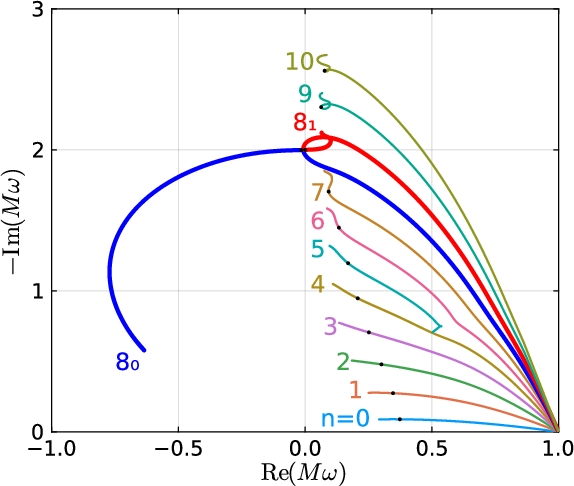
Figure 1: Prograde Kerr QNM frequencies for (s,l,m)=(−2,2,2) over −1<a/M<1. The black dot marks the Schwarzschild limit a/M=0.
These features are deeply connected to the analytic structure of the Green's function for the Teukolsky equation, specifically the behavior of the incident amplitude AinT. Using the Mano–Suzuki–Takasugi (MST) formalism, the full Riemann-surface structure of 1/AinT reveals the configuration of QNM poles and MM zeros (Figure 2). The placement of the branch cut in the spectral plane and its crossing by the QNM trajectories are essential for a complete description.
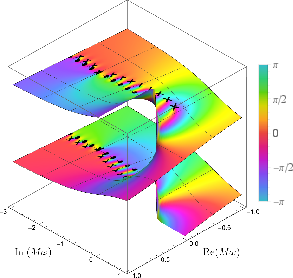
Figure 2: Riemann-surface structure of the Schwarzschild Green's function, visualized by the phase of 1/AinT with QNM poles (crosses) and Matsubara zeros (dots).
In the neighborhood of AS frequencies, modes do not bifurcate in a conventional sense. Instead, apparent bifurcation arises from avoided crossings between QNMs across Riemann sheets (Figure 3). This avoided crossing is a direct interaction, not a degeneration of a single mode, and is accompanied by substantial amplification of the QNM excitation factors.
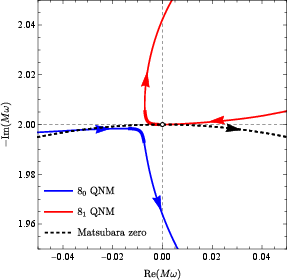
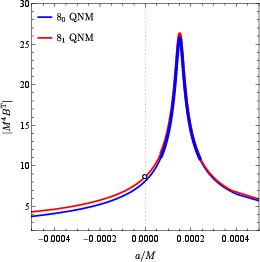
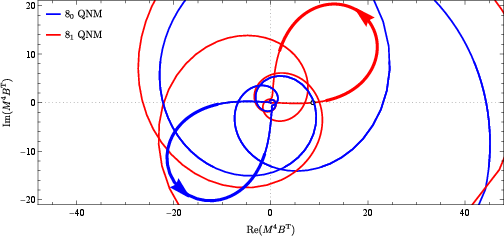
Figure 3: Near-AS QNM and MM frequencies (upper left), magnitudes of excitation factors (upper right), and their trajectories in the complex plane (lower). Solid curves: QNM poles; dashed: Matsubara zeros; white circle: pole-skipping point.
Pole Skipping and Mode Disappearance
A critical insight of this work is that the apparent disappearance of certain QNMs as a→0 and their frequency approaches AS values is the result of pole skipping. Specifically, the QNM pole coincides with a Matsubara zero of 1/AinT, resulting in a complete cancellation at the level of the Green-function building block. This pole-zero collision makes the QNM "invisible" according to the standard incident-amplitude criterion, although it may persist under alternative definitions (see the detailed analytic criteria in the Supplemental Material).
Pole skipping is intrinsically linked to the thermal nature of the black hole horizon, as the MM frequencies are set by the Hawking temperature and the horizon chemical potential (see Eq. (Matsubara) in the main text). The coincidence of QNM and MM trajectories near AS frequencies thus imprints thermodynamic information onto the analytic structure of the perturbation spectrum.
Excitation Factors and Resonant Enhancement
Resonant excitation is observed at the avoided crossing between QNMs near AS frequencies. The excitation factors, which determine the amplitude with which each mode appears in the gravitational wave strain, exhibit pronounced enhancement and characteristic lemniscate patterns in the complex plane during the interaction (Figures 3 and 5). However, physical waveforms remain finite due to compensating factors in the complete Green’s function (discussed with reference to Figure 4 in the appendix).
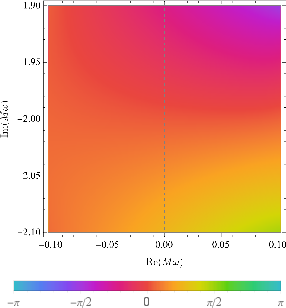
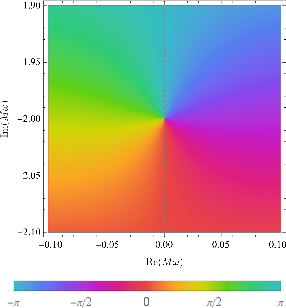
Figure 4: Phase of a/M0 (left) and a/M1 (right) for a/M2 at a/M3; divergence in excitation factors is canceled in physical observables.
Extension to Higher Multipoles and Gravitational Specificity
The phenomena of pole skipping, avoided crossing, and resonant excitation are not restricted to a/M4. Analysis of higher multipoles demonstrates similar intertwined behavior at corresponding AS frequencies, with the severity of the avoided crossing diminishing for higher a/M5 (see Figure 5).
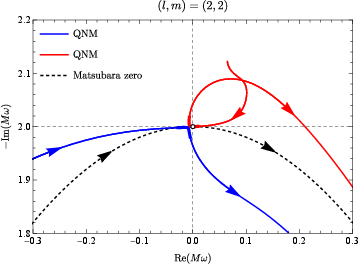
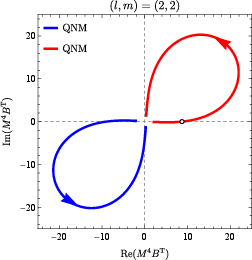
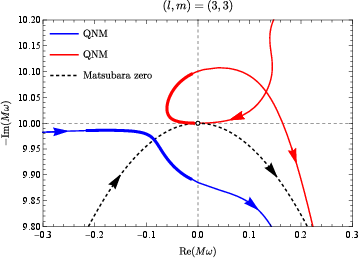
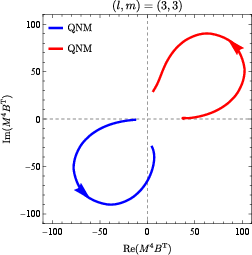
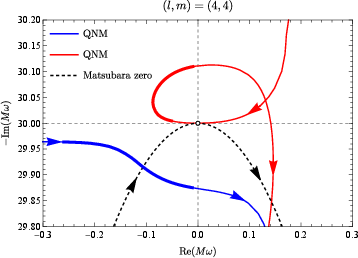
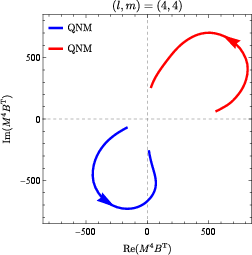
Figure 5: QNM poles (solid), Matsubara zeros (dashed), and excitation factors for a/M6, a/M7, and a/M8. White circles mark pole-skipping points, thick curves: resonant-excitation regions.
Importantly, these features occur only for gravitational perturbations; scalar and electromagnetic perturbations do not exhibit analogous AS pole-skipping points (Figure 6). This underscores the genuinely gravitational origin of the anomaly, linked to the specific structure of the Teukolsky equation and the underlying geometry.
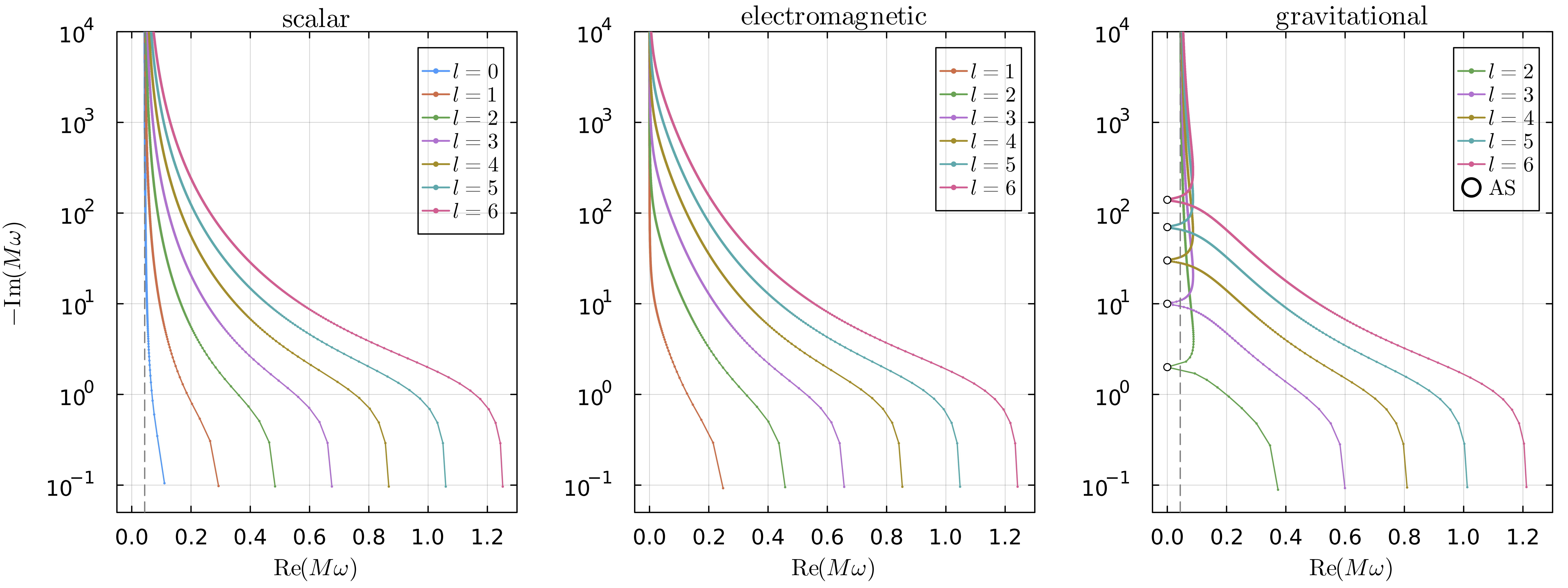
Figure 6: Schwarzschild QNM spectra for scalar, electromagnetic, and gravitational perturbations, highlighting AS pole-skipping points exclusive to gravity.
Theoretical and Practical Implications
The findings have both theoretical and observational implications:
- Non-Hermitian spectral theory: The analysis places black-hole QNM dynamics within the framework of resonant non-Hermitian systems, wherein poles and zeros move, interact, and exchange detectability across Riemann sheets as system parameters (here, black hole spin) are varied.
- Black-hole spectroscopy and gravitational-wave astronomy: Since Riemann sheet structure and pole-zero dynamics determine which modes are physically observable, accurate theoretical modeling must account for both poles and zeros in the analytic structure—not just visible pole trajectories.
- Horizon thermodynamics: The presence of Matsubara zeros at MM frequencies rooted in the Hawking temperature suggests that QNM spectra inherently encode information about black-hole horizon thermality.
- General spectral analysis: The pole-skipping mechanism and its consequences may have analogs in other open quantum systems, hydrodynamics, and statistical physics.
Future research may further elucidate the role of Green-function zeros in determining observables, extend analytic continuation techniques in black hole spacetimes, and explore connections with quantum chaos in gravity.
Conclusion
Through analytic continuation and Riemann-sheet tracking of both QNM poles and Matsubara zeros, this work comprehensively resolves the decades-old puzzle concerning anomalous QNM features near algebraically special frequencies in Kerr black holes. Bifurcation translates to avoided crossing, disappearance to pole skipping, and both are intimately associated with resonant excitation phenomena. These behaviors are universal for gravitational (but not scalar or electromagnetic) perturbations, confirming their geometric and gravitational origin. The results establish pole-zero analysis as an essential tool in black-hole spectroscopy and reveal deep connections between gravitational wave physics, horizon thermodynamics, and non-Hermitian resonance theory.
References:
"Pole Skipping, Avoided Crossing, and Resonant Excitation in Kerr Quasinormal Modes near Algebraically Special Frequencies" (2605.17840)