- The paper introduces a fully optical neural network architecture utilizing transient quantum dynamics to implement synaptic weighting, temporal integration, and nonlinear activation.
- It employs a novel waveguide QED system with a giant-cavity module and TLS-driven activation, achieving competitive accuracies of 97.60% on MNIST and 92.32% on colored-object tasks.
- The design demonstrates robustness against hardware variability, paving the way for scalable, energy-efficient neuromorphic processors with low latency.
Optical Neural Networks from Coherent Transient Dynamics in Waveguide QED
Introduction and Motivation
The intersection of photonics and AI hardware has generated significant interest due to the speed, bandwidth, and low-loss characteristics of photons, offering a promising path beyond the limitations of traditional von Neumann architectures. However, most photonic computing paradigms rely on steady-state operation with limited exploitation of quantum coherence and transient dynamics. Critically, the nonlinear activation function—a hallmark of neural networks—has generally required high-latency electro-optic conversion, precluding fully optical implementation and diminishing the advantages of photonic circuits.
The study "Optical Neural Networks from Coherent Transient Dynamics in Waveguide QED" (2605.17752) addresses these limitations by proposing a fully optical, fully connected neural network architecture that leverages the transient quantum dynamics of a waveguide QED (WQED) system. The architecture exploits coherent photon-atom interactions to realize synaptic weighting, temporal integration, and nonlinear activation through purely physical—rather than electronic—mechanisms. The work demonstrates, via detailed quantum simulations, that such a system achieves classification performance competitive with electronic neural networks, without incurring the typical latency and energy penalties associated with optoelectronic conversion.
Physical Mechanisms and Neuron Implementation
Each neuron in the WQED-based architecture is constructed by cascading three quantum modules: a giant-cavity synaptic weighting element, a temporal integrator, and a two-level system (TLS) for activation. Information is encoded in the complex-valued area of coherent wavepackets propagating in chiral waveguides, enabling efficient transmission and manipulation of both the signal amplitude and phase.
The implementation is illustrated as follows:
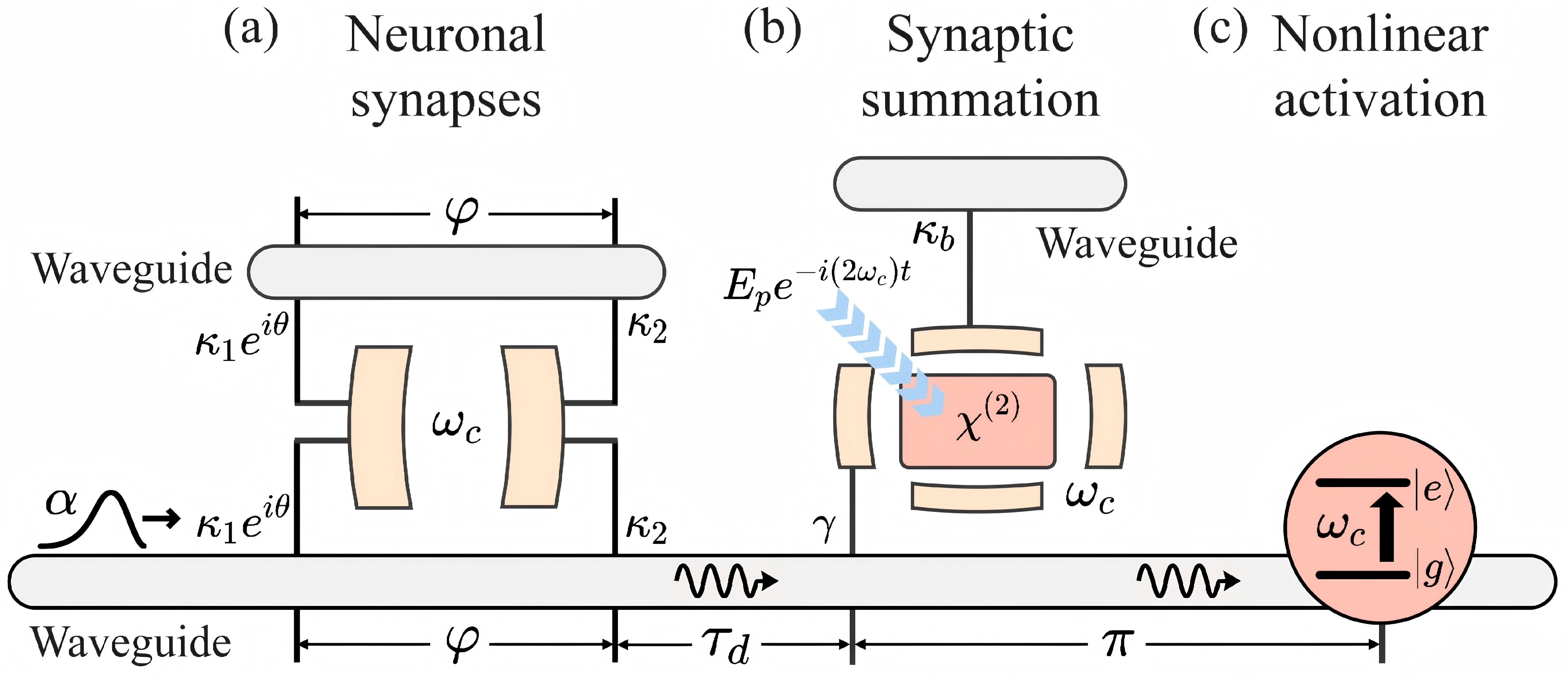
Figure 1: Physical implementation of a neuron in the WQED architecture. (a) Synaptic-weighting module based on giant-cavity interference. (b) Pump-assisted temporal integrator in the bad-cavity regime. (c) Nonlinear activation realized via a TLS.
- Synaptic Weighting: Adjusted via phase-controlled nonlocal interference in a giant cavity that is coupled at separate points to chiral waveguides. This enables dynamic, fast-tunable control over the real-valued weights, leveraging spatial phase without slow thermal modulation.
- Temporal Integration: Performed by a critical-gain cavity integrator that coherently accumulates sequential optical pulses (representing input values) and releases the sum as a composite pulse. This is achieved with active gain-compensation in the bad-cavity regime.
- Nonlinear Activation: Achieved using the transient Rabi response of a strongly driven TLS. The input pulse traverses the TLS, creating a strongly nonlinear transformation due to atom-field interaction and saturation dynamics. An alternative implementation using a multiwaveguide structure generates a tanh-like activation profile.
Nonlinear Optical Activation
The nonlinear activation provided by the TLS is physically intrinsic, relying on the quantum-optical properties of driven two-level systems. The input-output relation is governed by the Heisenberg-Langevin equations, ensuring a native and fast nonlinearity without electronic bottlenecks. The activation function reliably suppresses small inputs and exhibits quasi-linear response for large signal amplitudes. For completeness, the nonlinear response for both single-waveguide (saturable) and multiwaveguide (tanh-like) structures is shown:
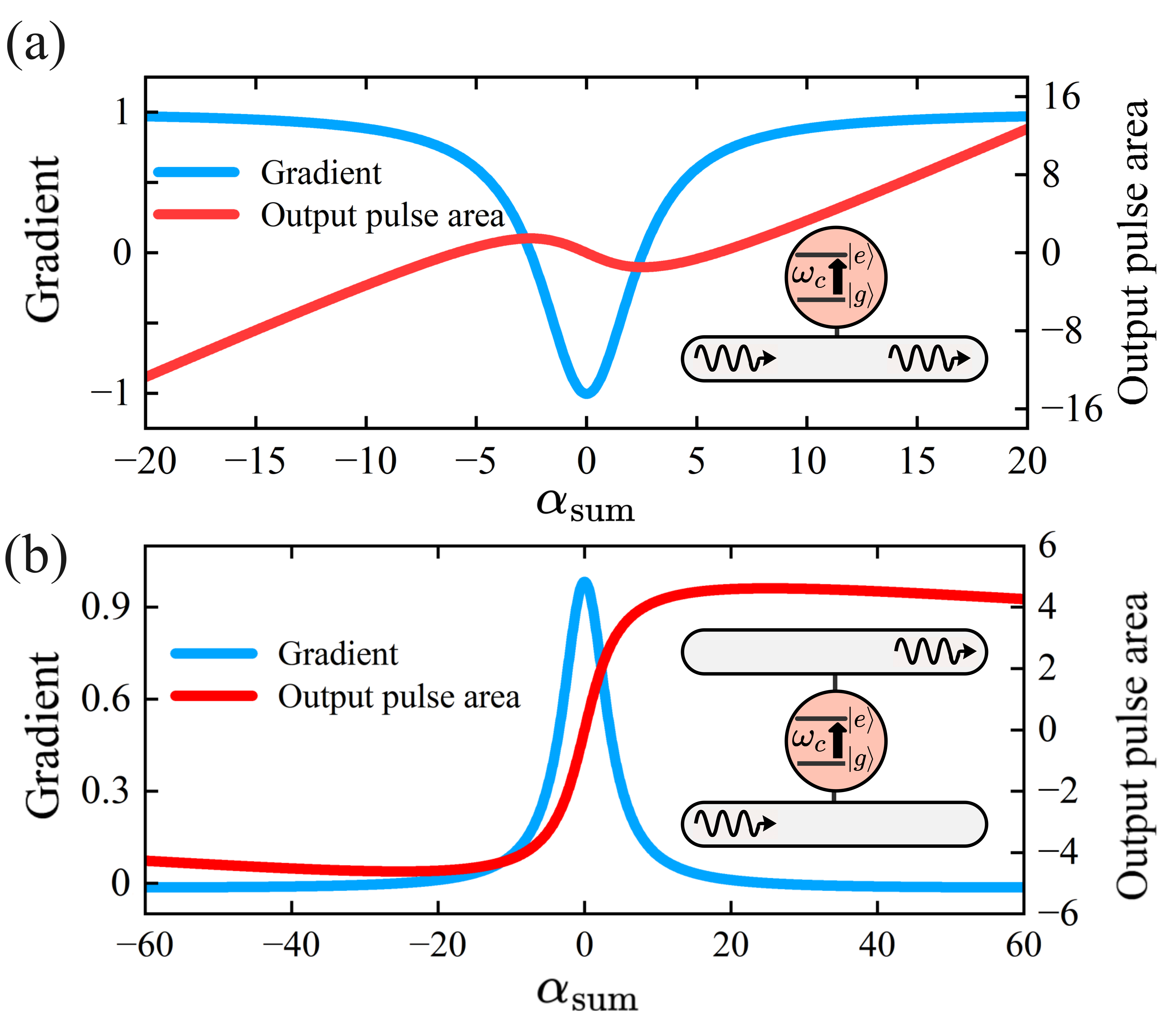
Figure 2: Nonlinear activation function response for single- and multiwaveguide-driven TLS, with corresponding activation gradients.
Combining these neurons into a feedforward network produces a quantum-optical neural network (QONN). High-dimensional classical inputs (e.g., image vectors) are encoded in a sequence of time-multiplexed coherent optical wavepackets injected into the input waveguide. Linear transformations are implemented via the phase-tuned giant-cavity modules, while sequential summation and nonlinearity are distributed through the physical layer.
The full network is benchmarked on standard classification tasks:
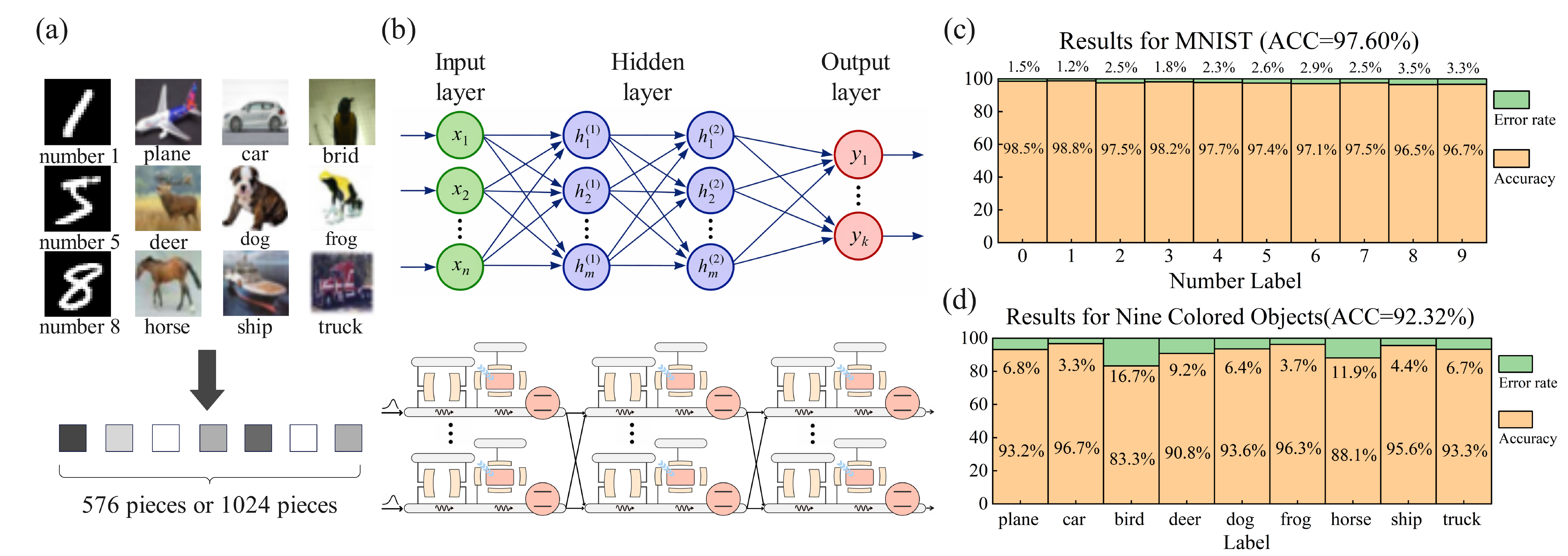
Figure 3: (a) Example training samples from MNIST and colored-object datasets; (b) QONN architecture with two hidden layers; (c) Test accuracy for MNIST classification; (d) Test accuracy for nine-object colored recognition.
- For the MNIST digit classification task, the QONN achieves 97.60% accuracy.
- On a nine-class colored object recognition task, the network achieves 92.32% accuracy.
These performances are realized with network sizes of 576–128–128–10 and 1024–256–256–9 for MNIST and colored-object datasets, respectively. Training is conducted via backpropagation, with forward passes executed physically in the simulated architecture, and parameter updates performed in software. Notably, even under substantial hardware variability, including 25% gain deviation and strong phase noise, the architecture maintains test accuracies above 94%.
Physical Feasibility, Robustness, and Practical Implications
The WQED-based QONN is directly compatible with contemporary superconducting circuit-QED platforms. The essential elements—giant-cavity coupling for weighting, parametric cavity integration, and TLS-based nonlinearity—map naturally to state-of-the-art superconducting microwave hardware, where phase tuning, strong nonlinearity, and high-Q resonators are experimentally accessible.
The approach leverages time-division encoding of high-dimensional vectors, reducing overall hardware complexity compared to parallel spatial encoding and enabling straightforward handling of negative weights via phase shifts. The use of the physical noise inherent in the integration process is argued to act as an effective regularizer, analogous to stochastic gradient descent in classical learning algorithms.
Critically, by eliminating the optoelectronic nonlinearity bottleneck, this design achieves both lower energy dissipation and reduced system latency, which is essential for ultrafast and scalable neuromorphic photonic processors.
Theoretical and Future Perspectives
This paper demonstrates that the universal linear and nonlinear operations underpinning neural computation can be implemented through native, transient quantum dynamics instead of steady-state photonics or electronics. The results make an assertive claim that "coherent transient photon dynamics can function as a native physical resource for neuromorphic computation," emphasizing new directions for foundational research in large-scale, high-dimensional, coherent optical networks.
Looking ahead, integration of this paradigm with quantum networking, noise-engineered learning strategies, and further scaling (in device number and bandwidth) appears tenable. The synthesis of physical stochasticity with coherent optical processing highlights a curiosity for future AI systems that intrinsically blend quantum noise and photonic speed for hybrid classical-quantum learning models.
Conclusion
The architecture proposed in "Optical Neural Networks from Coherent Transient Dynamics in Waveguide QED" substantiates the feasibility of a fully optical neural network paradigm, unifying synaptic weighting, temporal summation, and nonlinear activation within a transient quantum dynamical framework. The strong classification performance, tolerance to hardware noise, and direct mapping to current photonic and superconducting quantum hardware indicate viability for future ultrafast, energy-efficient neuromorphic processors that exploit the full quantum-optical primitives of light-matter interaction (2605.17752).