- The paper presents a matrix-weighted estimator that bypasses the need for eigenvalue lower bounds in multi-task linear regression.
- It achieves minimax optimality with robust transfer even under high-dimensional, singular designs and outlier task contamination.
- Empirical validations demonstrate improved prediction accuracy and safety, ensuring graceful degradation when tasks are unrelated.
Multi-task Linear Regression under Mild Spectral Assumptions: Adaptivity, Robustness, and Safety
Introduction and Motivation
The problem of multi-task learning (MTL) in linear models arises when one seeks to jointly estimate model parameters for multiple related tasks, exploiting task relatedness to achieve improved statistical efficiency compared to independent-task estimation. Conventional analyses and algorithms in MTL, particularly in transfer-robust settings where a minority of tasks may be unrelated outliers, have fundamentally relied on the assumption that the empirical second-moment matrix for each task has a uniformly lower-bounded spectrum—i.e., every task’s design is well-conditioned with eigenvalues ≳1. However, this lower-boundedness condition is often violated in realistic high-dimensional regimes where design matrices may be rank-deficient or exhibit rapidly decaying spectra. The work "Multi-task Linear Regression without Eigenvalue Lower Bounds: Adaptivity, Robustness and Safety" (2605.17126) systematically addresses this limitation by developing an estimator and theoretical framework that achieves robust, adaptive multi-task linear regression guarantees without any eigenvalue lower bounds.
Contaminated Task Model
The considered setup involves m regression tasks with shared or similar parameter vectors for a majority "inlier" fraction, while the remaining "outliers" can be arbitrarily unrelated. The inlier parameters are assumed to lie within an ℓ2-ball of radius δ, and the outlier fraction ε is unknown. The objective is to minimize per-task mean squared prediction error, either in-sample (empirical risk) or population (prediction risk), without prior knowledge of which tasks are inliers or the degree of relatedness.
Evasion of Lower-Boundedness of Covariate Spectrum
Prior robust multi-task learning methods, such as ARMUL [duan2023adaptive], rely on strong convexity (i.e., minimum eigenvalue lower bounds) to obtain high-probability MSE bounds that improve over independent-task learning (ITL) whenever δ is small. The present work provides a structural relaxation: instead of requiring every j to be well-conditioned, it introduces a relative balancedness assumption—quantified by a balancedness constant B—which posits only that each task’s empirical covariance is upper-bounded compared to the averaged inlier geometry. Notably, B remains finite even when individual j are singular or have rapidly decaying spectra, provided their principal directions have sufficient overlap.
Matrix-Weighted Regularization
A matrix-weighted norm penalty replaces the standard isotropic m0 regularization from prior work. The estimator solves:
m1
where m2 is the empirical loss for task m3, and the penalty geometry is tailored to m4. This construction aligns regularization with the observed design, avoiding over-penalization in weakly observed directions and obviating the need for a uniform lower eigenvalue bound.
Theoretical Guarantees
Adaptivity, Robustness, and Safety
Central contributions are captured by a simultaneous set of properties:
- Adaptivity: The estimator exploits inlier task similarity whenever moderate balancedness holds (m5 is not too large), achieving minimax-optimal task-average prediction risk (up to logarithmic and m6-dependent factors), with no prior knowledge of m7 or m8 required.
- Robustness: Statistical efficiency is retained even in the presence of an unknown fraction m9 of arbitrary outlier tasks.
- Safety: When ℓ20 is large or tasks are unrelated, the estimator provably degrades gracefully, matching the ITL rate with no negative transfer.
Finite-Sample Risk Bounds
The main risk bound (in-sample MSE for inlier task ℓ21) is:
ℓ22
with no explicit dependence on the minimum eigenvalue of ℓ23. The estimator’s worst-case prediction error across all tasks satisfies
ℓ24
matching the independent-task rate universally.
Population Risk and Sample Complexity
The transfer from empirical to population MSE is governed by a task-specific comparability constant ℓ25 (ratio of empirical to population covariance). When ℓ26 and the design is sufficiently concentrated, ℓ27 and the minimax transfer regime persists for population risk. High-probability analyses under general sub-exponential designs are included, with explicit sample complexity characterization.
Empirical Validation
Synthetic experiments verify that the estimator matches or outperforms baselines (ITL, DP, and ARMUL) in diverse regimes, including:
- Varying Inlier Radius ℓ28: When inliers are tightly clustered, substantial gains are obtained on both all-task and related-task splits.
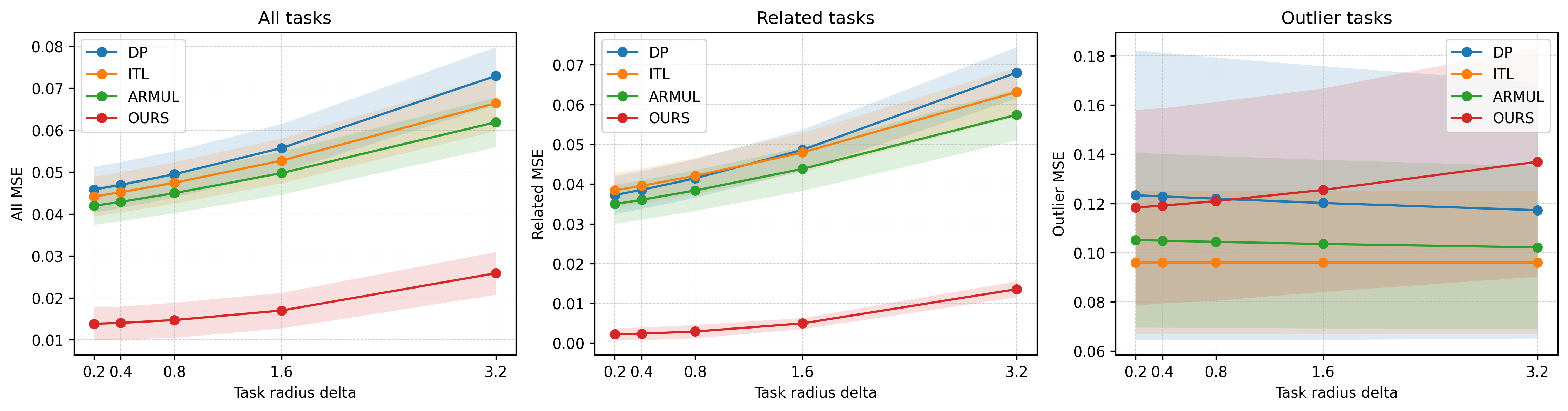
Figure 1: Population MSE across all, related, and outlier tasks as inlier radius ℓ29 is varied; matrix-weighted method consistently dominates on all-task and related-task MSE.
- Increasing Outlier Fraction δ0: The method retains sharp error increases only gracefully as contamination rises, preserving robustness.
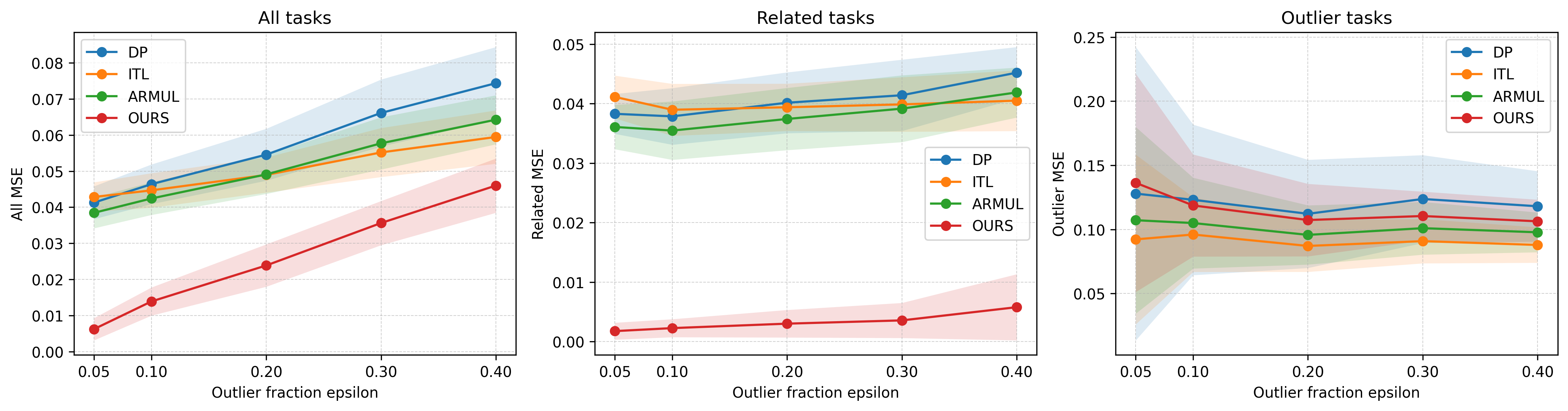
Figure 2: All-task, related-task, and outlier-task MSE as δ1 is swept; the estimator preserves performance on related tasks even under high contamination.
- Eigendecay δ2 Stress: For models with rapidly decaying spectra, the matrix-weighted estimator preserves strong transfer, unlike methods requiring lower bounds.
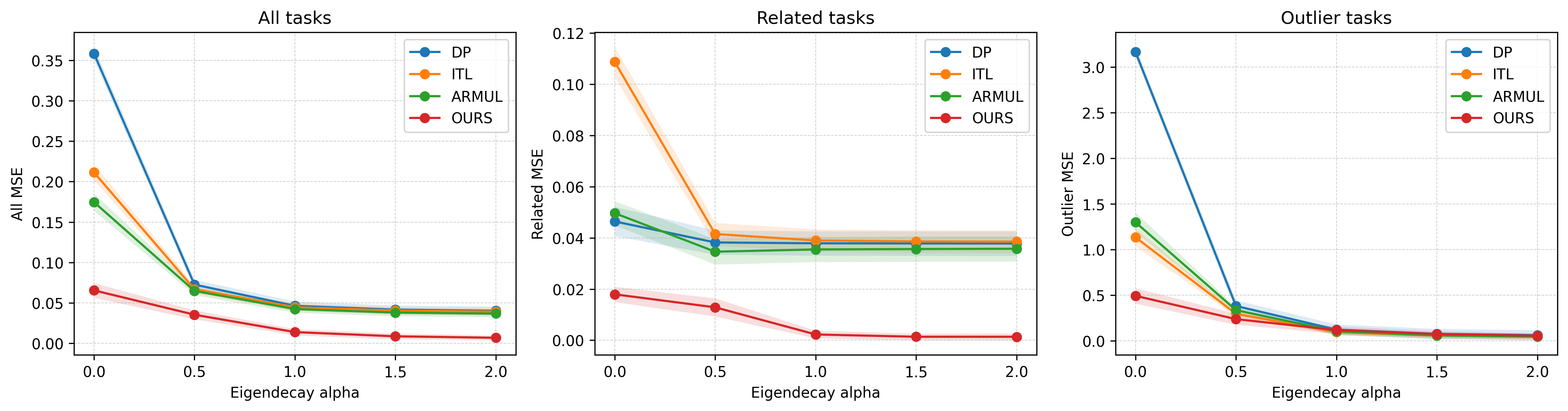
Figure 3: Effects of increasing eigendecay exponent δ3; performance gains persist for matrix-weighted method even in near-singular regimes.
- Large-Balancedness (δ4) Stress Test: When transfer geometry is unfavorable (δ5 large), the estimator tracks ITL risk without negative transfer.
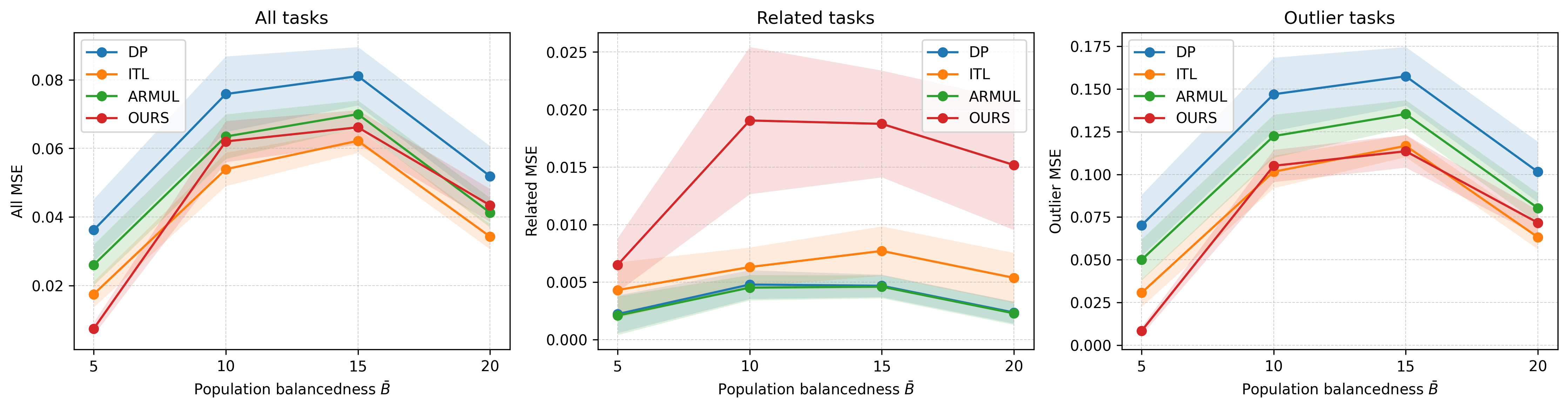
Figure 4: All-task, related-task, and outlier-task MSE as population balancedness δ6 increases; method never suffers catastrophic negative transfer, matching ITL in high-δ7 regimes.
On the UCI Human Activity Recognition dataset, the estimator achieves a mean classification error of 1.27%, outperforming ITL (4.67%), DP (7.61%), and ARMUL (5.24%).
Implications and Future Directions
Theoretical Impact
This work demonstrates that lower eigenvalue assumptions are not inherent to robust transfer in multi-task linear regression. The relative balancedness condition is both necessary and sufficient for nontrivial transfer, and the safety property removes risk of negative transfer altogether. The analysis accommodates both degenerate (singular) and nearly singular designs, broadening practical applicability and aligning theoretical guarantees with empirical realities in high dimensions.
Practical Applicability
The matrix-weighted approach is implementable using standard convex optimization routines, requiring only empirical covariances—no parametric knowledge of δ8 or task similarity parameters is needed. The empirical balancedness constant δ9 additionally serves as a diagnostic for the potential utility of transfer on new datasets.
Extensions and Open Problems
Future research directions include sharpening the dependence on ε0 and extending these geometric insights to infinite-dimensional models: RKHS regression, kernel and neural tangent regimes, and overparameterized neural networks. These developments are likely to influence adaptive meta-learning and multi-task reinforcement learning, where spectrum degeneracy and outlier contamination arise naturally.
Conclusion
"Multi-task Linear Regression without Eigenvalue Lower Bounds: Adaptivity, Robustness and Safety" (2605.17126) provides a theoretically complete and practically implementable solution to robust multi-task estimation under minimal spectral assumptions. It delivers sharp adaptivity and minimax optimality under mild balancedness, robust outlier handling, and provable safety in all settings, fundamentally altering the requirements for information transfer in high-dimensional multi-task regression.