- The paper introduces a revised QNM activation prescription with a newly identified bounce radius, clearly delineating the transition from prompt response to QNM-dominated ringdown.
- It employs both numerical time-domain solvers and analytic high-frequency asymptotics to achieve near-exact amplitude and phase agreement in waveform reconstruction.
- The study enhances gravitational waveform templates for GW astronomy, providing robust insights for black hole spectroscopy and tests of general relativity.
Dynamical Excitation of Quasinormal Modes: Propagation and Convergence in Schwarzschild
Introduction and Context
This paper conducts a comprehensive analysis of the dynamical excitation of quasinormal modes (QNMs) during the gravitational collapse scenario of a compact object plunging into a Schwarzschild black hole. Building on prior foundational work that utilized one-body BH perturbation theory for ringdown modeling, this investigation revisits the excitation of QNMs by dynamically evolving sources. It sharpens previous prescriptions for QNM propagation and offers a new, generalized framework aligned with recent developments in Green’s function spectral decomposition.
The significance of this work is rooted in its relevance for accurate waveform modeling for GW astronomy, enabling improved interpretations of high-fidelity merger signals observed by current ground-based interferometers and advancing the precision of BH spectroscopy. The paper systematically addresses the limitations in constant-amplitude QNM templates and underscores the necessity of incorporating the correct temporal dynamics and propagation causality into ringdown modeling.
High-Frequency Behavior and Propagation Prescription
A central result of the paper is a rigorous re-derivation of the QNM “causality condition” that determines when the QNM contribution to the Green’s function is active for a given observer. The previous formulation, which was based on a “curved light-cone” propagation with a minimal gauge, is shown to be overly restrictive. Through an in-depth analysis of the high-frequency asymptotics of Leaver’s QNM solutions, and leveraging both numerical and analytic tools, the authors establish that the convergence and domain of validity of the QNM expansion are instead governed by a modified condition:
tobs−r∗,obs≥t′+∣r∗′∣,
where r∗∈R is the standard tortoise coordinate. This sharpens the physical picture: for sources at r∗′>0, the QNM signal must scatter off a newly identified “bounce radius” at r∗=0 before propagating outwards, while for r∗′<0, propagation occurs directly on the light cone.
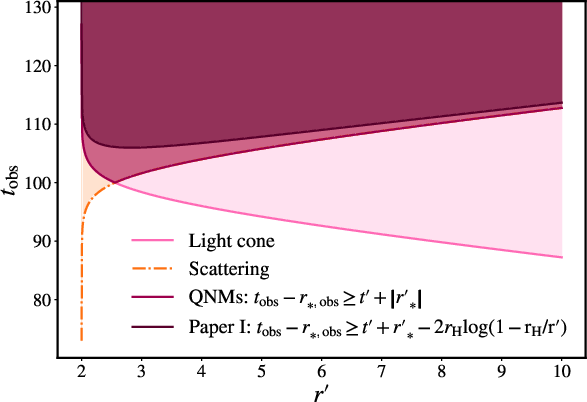
Figure 1: The temporal propagation structure: classic light-cone (pink), QNM propagation with a bounce at r∗=0 (light purple/orange), compared to the earlier minimal-gauge prescription (dark purple).
This revision is firmly supported by studying the large-n behavior of the near-horizon expansion coefficients in Leaver’s method. The transition at r∗=0 is not associated with the potential peak or photon sphere but rather emerges as an intrinsic, new radius characterizing QNM excitation.
Adopting the modified propagation prescription, the authors recompute the dynamical ringdown waveform excited by a plunging particle. The analysis is performed with state-of-the-art time-domain perturbation solvers, where numerical waveforms are computed at future null infinity and compared with QNM-reconstructed signals as a function of the observer’s retarded time.
The QNM signal rapidly converges to the numerical waveform shortly after the particle crosses the bounce radius r∗=0, with the immediate post-bounce times delivering near-exact amplitude and phase agreement for the oscillatory portion of the signal.
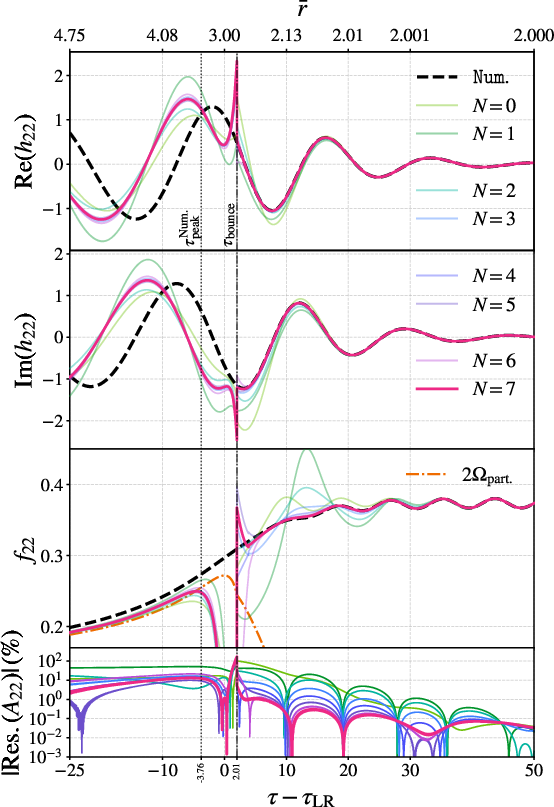
Figure 2: Numerical and QNM-propagated waveform, instantaneous frequency, and residuals through the plunge and ringdown; vertical lines mark the amplitude peak and bounce crossing.
Strong-norm residuals demonstrate that prior to the crossing of r∗=0, the QNM-propagated signal cannot match the numerical result due to the significant contribution from the prompt response—this is substantiated by the late activation of the QNM Green’s function sector. The convergence of the overtone sum is sharply improved post-bounce, with r∗∈R0 QNMs required for pre-bounce convergence, and rapid suppression of high overtones’ relevance after crossing. This confirms that physically meaningful overtone decomposition is unattainable before activation of the QNM sector, clarifying ongoing debates regarding overtone fitting methodology.
Collective Mode Dynamics and Phase Interference
A novel insight emerges on the behavior of relative phases among QNM overtones. Pre-bounce, the activation coefficients of successive overtones are nearly exactly out-of-phase (r∗∈R1), resulting in destructive interference and oscillatory cancellation in the overtone sum. Post-bounce, phases become increasingly aligned (r∗∈R2), with overtone contributions coherently adding and rapidly decaying with overtone number.
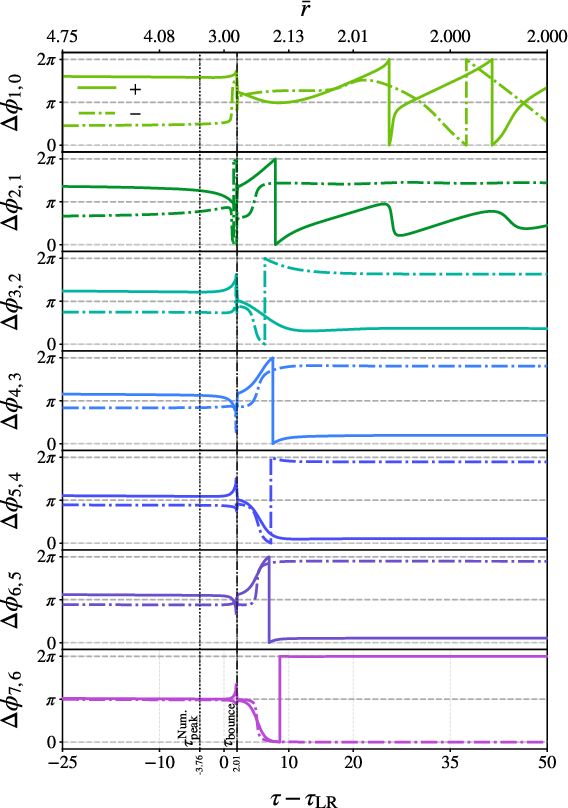
Figure 3: Time evolution of the relative phases between successive overtones as a function of observer retarded time; destructive interference transitions to constructive addition at the bounce crossing.
This clarifies previous empirical findings in nonlinear waveform fits for full numerical relativity. The underlying dynamics of overtone phase alignment, dictated by the bounce transition, provides a theoretical foundation for overtone amplitude evolution and associated signal cancellation phenomena.
Mode Coefficient Behavior and Secondary Effects
The detailed behavior of QNM activation and impulsive coefficients (as well as their geometric excitation factors) is tracked for both quasi-circular and radial plunges. The (non-)smooth behavior at r∗∈R3 and the rapid post-bounce decay are resolved, with the redshift terms previously identified shown to be unaffected by the propagation prescription, as their relevancy is limited to the late near-horizon regime.
The analysis is extended to radial plunge scenarios, demonstrating that tail contributions (power-law decays) are suppressed in quasi-circular orbits but dominate in radial infalls; this difference is evident in the residual analysis and the time derivative structure of the waveform.
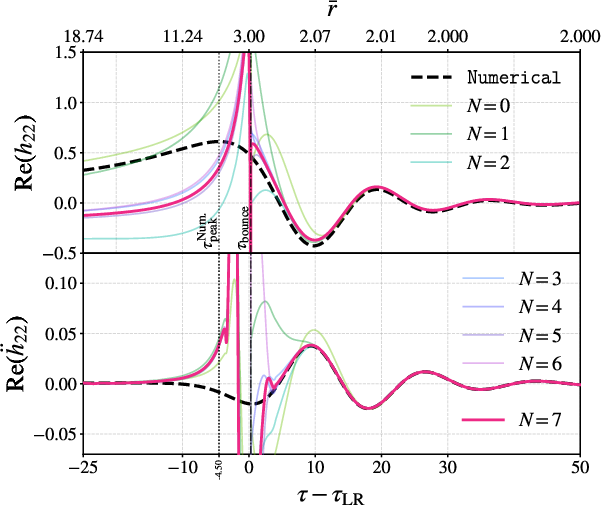
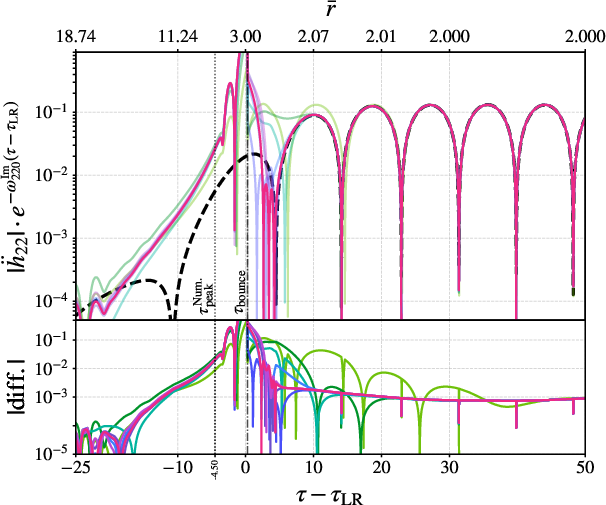
Figure 4: QNM and full-numerical waveform agreement in the case of a radial plunge, highlighting the relative magnitude of QNM and tail contributions.
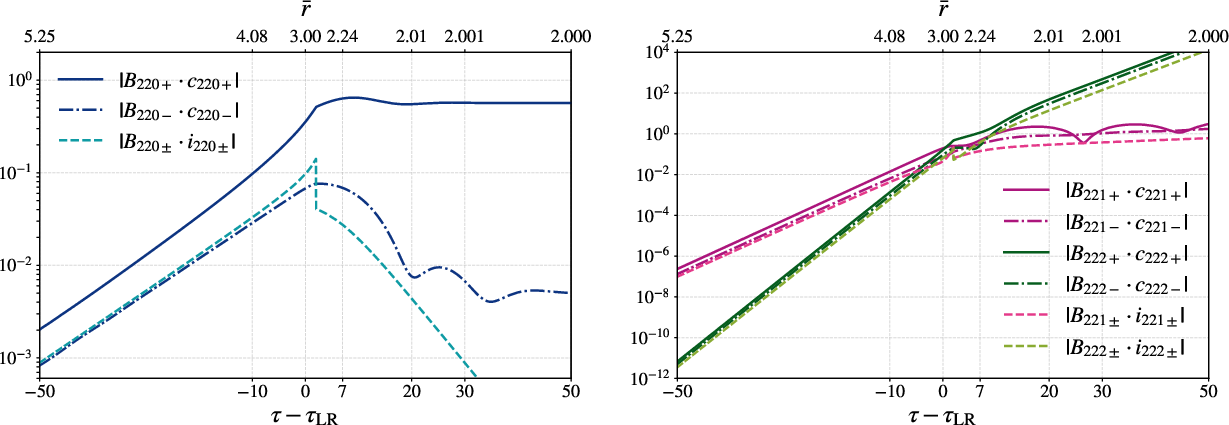
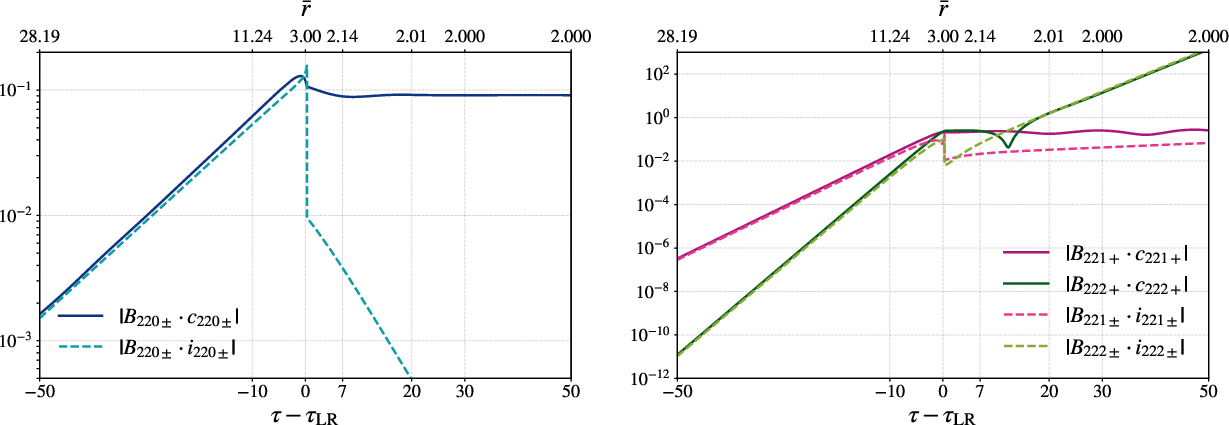
Figure 5: Absolute value of QNM activation coefficients and their time evolution for selected overtones, confirming the predicted scaling and the sharp dynamical transition at r∗∈R4.
Theoretical and Practical Implications
This work solidifies the theoretical foundation underlying first-principles derivation of the late-time waveforms for plunging compact objects in the Schwarzschild geometry. The revised prescription for QNM activation times not only ensures accurate and convergent overtone summation but also provides a general, prescription-independent framework consistent with independent treatments of the Green’s function in frequency and time domains (2605.16492).
On a practical level, these results provide a robust underpinning for the construction of improved gravitational waveform templates applicable to LIGO/Virgo/KAGRA observations. The explicit delineation of the post-bounce regime where QNM-only templates are valid is critical for robust waveform parameter estimation, ringdown tests of general relativity, and black hole spectroscopy.
Moreover, the identification and physical interpretation of the bounce radius as a transition between the prompt response and QNM-dominated regimes establish a new standard for the demarcation of signal portions relevant for testing the Kerr hypothesis and the no-hair theorem.
Conclusions
This study advances the understanding of the dynamical excitation and propagation of black hole QNMs by rigorously characterizing the domain of QNM activation and convergence in the time domain, introducing the concept of a bounce radius at r∗∈R5 intrinsic to Schwarzschild perturbations. The framework is numerically validated and demonstrated to yield nearly complete first-principles ringdown modeling almost immediately after the main signal peak. The precise delineation of QNM propagation domains, overtone phase dynamics, and the explicit convergence of the overtone sum will inform both theoretical explorations of black hole perturbation theory and practical waveform modeling for GW data analysis.
Future extensions to spinning backgrounds are anticipated to clarify additional subtleties in the physics of QNM excitation and to further inform tests of general relativity with observational data, especially regarding the interpretability and extraction of higher overtones in complex merger events.