- The paper presents a rigorous analysis of preconditioned Annealed Langevin Dynamics, establishing dimension-uniform error bounds for sampling multimodal Gaussian mixtures.
- It compares Euler–Maruyama and exponential integrator methods, showing that explicit discretization can lead to instability while the ELP scheme ensures robust performance.
- The work provides spectral preconditioning guidelines and trade-offs essential for high-dimensional Bayesian inference and generative modeling in infinite-dimensional settings.
Overview and Motivation
The paper "Dimension-Uniform Discretization Analysis of Preconditioned Annealed Langevin Dynamics for Multimodal Gaussian Mixtures" (2605.16473) systematically examines the discretization properties of preconditioned Annealed Langevin Dynamics (ALD) in the context of infinite-dimensional sampling problems, focusing particularly on multimodal Gaussian mixture targets. The central objective is to establish conditions under which diffusion-based samplers maintain stability and dimension-independent error bounds as the finite-dimensional approximations are refined towards the underlying function-space target. The analysis draws attention to the critical interplay between spectral preconditioning, annealing geometry, and discretization schemes, identifying scheme-dependent trade-offs that impact the sampler's robustness across high-dimensional regimes.
The paper sets the stage by modeling the infinite-dimensional target as a diagonal Gaussian mixture on a separable Hilbert space, enabling rigorous analysis via successive spectral truncations. Each mixture component is specified via basis expansions, with trace-class covariances and finite-energy means. Preconditioning is realized as a diagonal operator, affording spectral rescaling across basis directions. This structure makes explicit the refinement mechanism: increasing truncation dimension d incrementally incorporates higher-frequency coordinates, which are typically associated with rapidly decaying spectral quantities.
A principal insight is that preconditioning both shapes the diffusion geometry and introduces a trade-off: while it can accelerate exploration in stiff directions, it also amplifies errors in high-frequency coordinates. As a result, the choice of preconditioner must be calibrated not only against the target and continuous-time dynamics but also against discretization-induced errors.
The paper leverages the annealed Langevin framework, carrying out sampling along a path of intermediate distributions—each arising from convolution of the target mixture with a gradually vanishing Gaussian smoothing. The annealing path interpolates between an easily sampled initial law and the original multimodal target, mitigating the metastability and slow mixing that standard Langevin algorithms display in high dimensions.
The continuous-time analysis, building on [baldassari2026dimension], demonstrates that dimension-uniform KL control is achievable under spectral summability conditions linking the smoothing covariance, component covariances, and the preconditioner. Specifically, if
i∈I∑wij≥1∑γjσijλj2<∞,
then the KL divergence between the ALD terminal law and the target can be made arbitrarily small, uniformly in d. The result is idealized, assuming exact scores and initialization, but it provides a spectral design guideline for robust infinite-dimensional ALD.
Discretization Analysis: Euler--Maruyama Limitations
The core technical contribution addresses the disconnect between continuous-time robustness and discretization stability. The Euler--Maruyama (EM) scheme, wherein the stiff linear part of the annealed score is treated via an explicit forward Euler step, imposes a stringent stability constraint. In high frequencies, where the annealed covariance scales are small, the drift can become arbitrarily large, forcing aggressive high-frequency damping by the preconditioner:
j≥1supσjγj<∞.
This constraint, when combined with annealing-bias control, restricts the initial smoothed law to remain uniformly close to the target across dimensions—a severe practical limitation in multimodal setups where the annealed initialization is intentionally distant from the target to facilitate mixing.
The EM-induced instability is empirically apparent: as dimension increases, the scheme becomes unstable in high-frequency coordinates, with the KL error exhibiting rapid divergence.
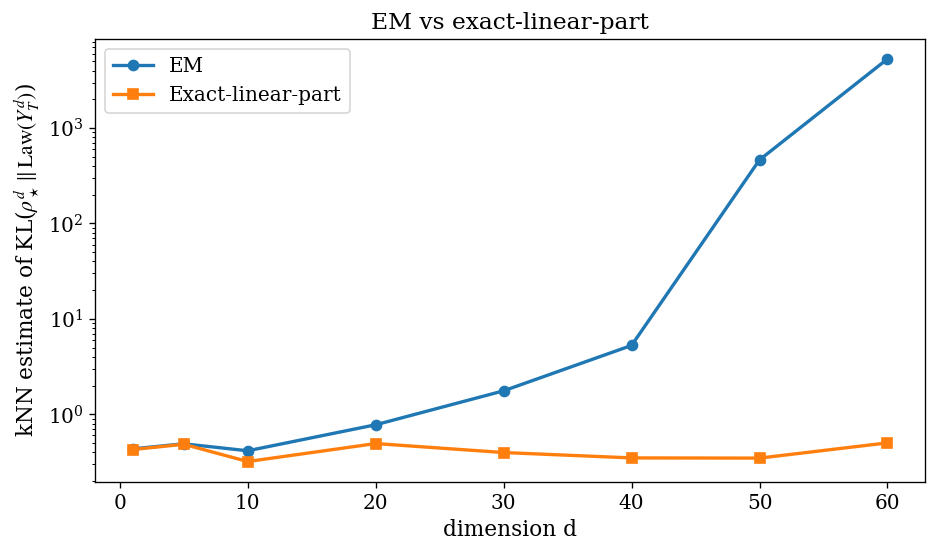
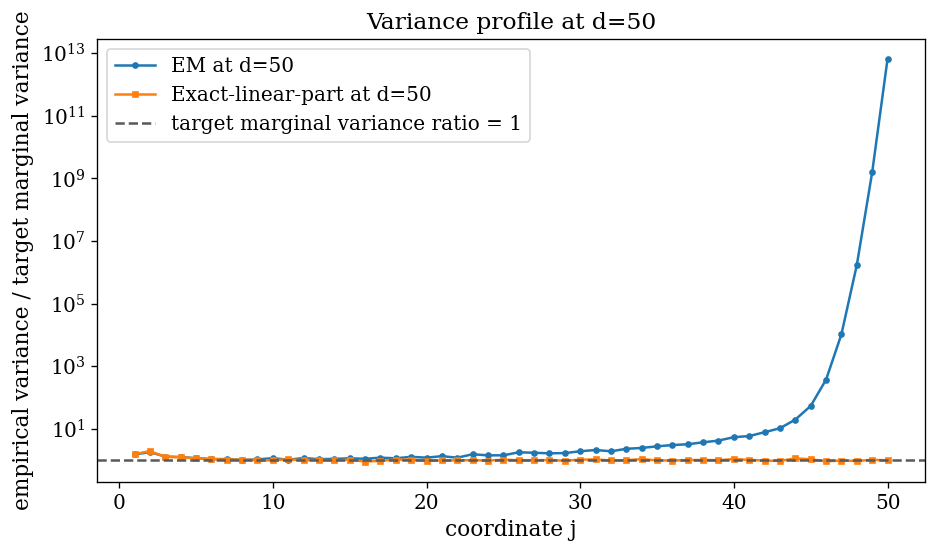
Figure 1: Left: empirical KL(ρ⋆d∥Law(YTd)) versus dimension d (log scale); EM diverges rapidly, ELP remains robust. Right: variance profile at d=50, normalized; EM exhibits high-frequency excess, ELP stays near target scale.
Scheme-Dependence and Exponential Integrator (ELP) Analysis
The paper establishes that the EM-induced restriction is not intrinsic to ALD, but rather an artifact of explicit discretization of stiff linear terms. It introduces an exponential-integrator scheme—the Exact-Linear-Part (ELP) discretization—which integrates the stiff linear drift exactly within each time-interval while freezing the nonlinear mixture correction.
The main theorem provides a dimension-uniform KL bound for ELP:
d≥1supKL(ρ⋆d∥Law(YTd))≤8T1j≥1∑γjσjλj2+Cdisc(1+T2)hmax
where hmax is the maximal time-step. The bound separates the annealing and discretization contributions and confirms that, under appropriate spectral summability conditions, ELP maintains stable, dimension-independent error guarantees regardless of the initial smoothing's proximity to the target.
Strongly, the authors construct explicit examples where KL(ρ⋆d∥ρ0d)→∞ as i∈I∑wij≥1∑γjσijλj2<∞,0 (initialization far from target), yet the ELP scheme delivers uniform KL control for all i∈I∑wij≥1∑γjσijλj2<∞,1. This is a bold, scheme-dependent contradiction to the restrictions observed with EM.
Spectral Regime and Preconditioner Design
The analysis details a practical design trade-off: the preconditioner i∈I∑wij≥1∑γjσijλj2<∞,2 must balance annealing acceleration and high-frequency damping. In power-law spectral regimes with common covariance tails, a balanced choice is i∈I∑wij≥1∑γjσijλj2<∞,3, leading to per-coordinate contributions i∈I∑wij≥1∑γjσijλj2<∞,4 and sufficient conditions i∈I∑wij≥1∑γjσijλj2<∞,5 for tail decay exponents. This framework enables explicit preconditioner design for function-space diffusion models, a problem of substantial interest in infinite-dimensional sampling and generative modeling.
Empirical Validation and Robustness
Numerical experiments corroborate the theory, with ELP consistently exhibiting dimension-robustness and stable convergence in high-dimensional settings—even when the initialization law diverges from the target. The KL error and variance profiles confirm the practical efficacy of the proposed discretization, and additional diagnostics (Figure 2, not shown) demonstrate estimator robustness across choices of i∈I∑wij≥1∑γjσijλj2<∞,6 in kNN-based KL estimation.
Implications and Potential Extensions
The results carry significant implications for the analysis and deployment of function-space samplers in Bayesian inverse problems, generative modeling, and MCMC methods for infinite-dimensional targets. The identification of scheme-dependent restrictions and the introduction of dimension-uniform discretization represents an advance in the theory of diffusion-based samplers, directly enabling robust application in high- and infinite-dimensional regimes.
Theoretical extensions can include relaxing the diagonal structure to general covariances, exploring Loewner lower-bounds for non-diagonal operators, and integrating learned or score-based generative models in the place of exact scores. Furthermore, the spectral trade-off framework invites automated preconditioner design via optimization of the annealing and discretization error contributions.
Conclusion
This paper develops a rigorous framework for dimension-uniform discretization of preconditioned ALD targeting multimodal Gaussian mixtures. By dissecting scheme-dependent trade-offs and demonstrating the superiority of exponential-integrator approaches over Euler--Maruyama in infinite-dimensional settings, the analysis offers explicit spectral guidelines and practical design strategies for robust diffusion-based sampling. The work is foundational for high-dimensional Bayesian inference, score-based generative modeling, and function-space MCMC, and sets a technical precedent for future research in spectral preconditioning and dimension-independent discretization.