- The paper presents a full time-domain PDE model that reduces the wolf-tone indicator (J_wolf) from over 0.95 to below 0.6 under optimized plucked excitation.
- It employs numerical finite difference schemes to solve coupled equations of string, bridge, and body dynamics with strategically tuned mass-spring-damper suppressors.
- Validation with real cello recordings confirms model predictions and highlights trade-offs between wolf-tone mitigation, sustain, and spectral fidelity.
Mathematical Modeling and Numerical Analysis of Wolf-Note Suppressors in Cellos
Introduction and Background
The paper "The Wolf and the Cello: Modelling and design of multiple resonance suppressors in large string instruments" (2605.16210) introduces a rigorous time-domain mathematical model for the coupled vibro-acoustic dynamics of large bowed string instruments, such as the cello, specifically focusing on the phenomenon and mitigation of the wolf note. The wolf note, characterized by amplitude modulation and tonal instability, arises due to strong interaction between a vibrating string and a low-damped resonance mode of the instrument's body, often resulting in compromised playability and tonal fidelity.
Previous works have typically approached the wolf note with modal decomposition, empirical tuning, or simplified oscillator models. In contrast, this research directly solves the full system of PDEs governing the string, bridge, body, and suppressors in time, bypassing modal expansion limitations and allowing straightforward extension to multidimensional and nonlinear models.
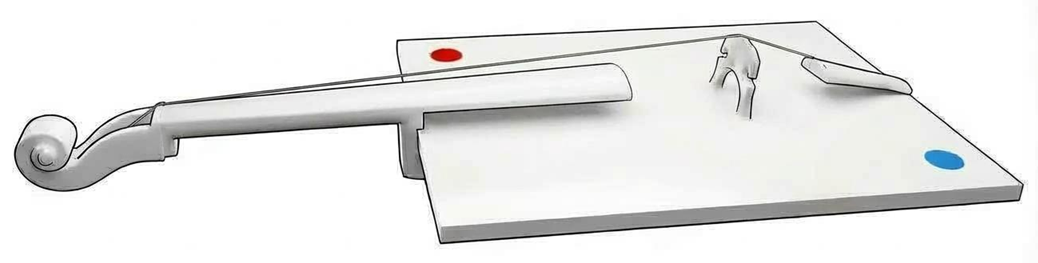
Figure 1: A schematic of the modeled system: string, bridge, body plate, and wolf suppressor, with audio signal registration (red) and suppressor location (blue).
Model Description
The dynamic system consists of a stiff string (second- and fourth-order terms for tension and bending), a two-dimensional stiff plate representing the body, a lumped-mass bridge with asymmetric feet stiffness, and one or more wolf suppressors modeled as mass-spring-damper elements with tunable location and parameters.
- Equations for each subsystem are numerically discretized via finite difference schemes.
- The bridge mediates coupling via elastic force at prescribed points, and wolf suppressors are elastically and viscously attached, each acting as a frequency-tuned local resonator.
- String excitation is modeled via pluck (impulse profile) and bowing (stick-slip frictional excitation).
The suppressor's natural frequency (fsu), mass (msu), and damping (ζsu) are key tunable parameters, with ideal spring constant selection ksu=msu(2πfwolf)2 to target the problematic resonance.
Three quantitative performance measures are introduced to evaluate wolf suppressor efficacy:
- Jwolf: Detects wolf-tone onset via spectral concentration analysis in the beat frequency range, based on Hilbert transform envelope filtering and energy ratio in target bands.
- Jsustain: Measures minimum signal attenuation across notes to avoid anti-resonance over-damping.
- Jfidelity: Assesses spectral deviation from the original (unsuppressed) instrument, using L1 metric over log-magnitude spectra.
A numerical grid allows exhaustive testing over suppressor spatial location and parameter landscapes; indicators are computed per note and globally over the chromatic range.
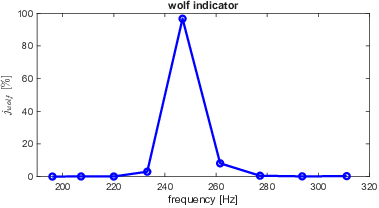
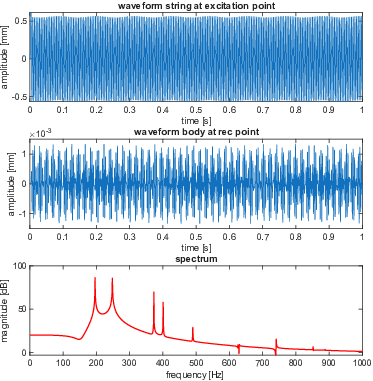
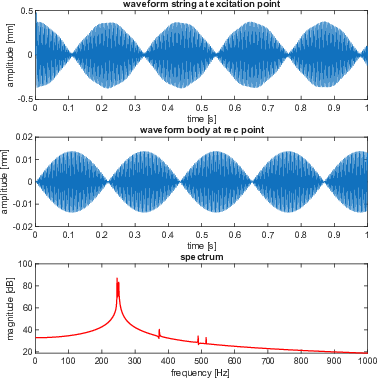
Figure 2: Map of jwolfi indicator for all tested frequencies, highlighting maximal wolf-tone energy at target resonance.
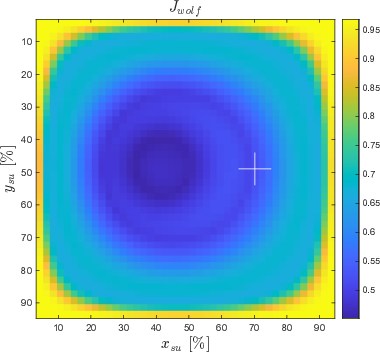
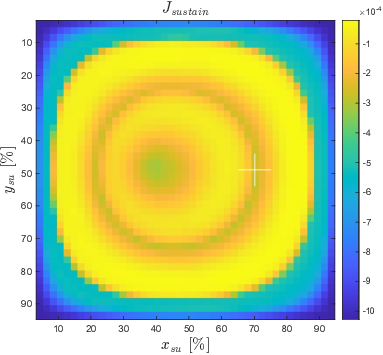
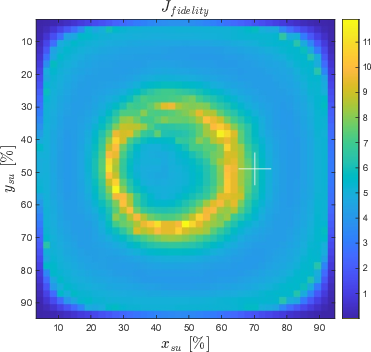
Figure 3: Global Jwolf indicator landscape for varying suppressor positions, revealing optimal placement zones for wolf-tone mitigation.
Numerical Results
Plucked Excitation
Without suppressors, wolf note manifestation is sharp at a single frequency (e.g., msu0 for msu1), corroborated by spectral double peaks and envelope waveform modulation.
Addition of a single suppressor exhibits strong sensitivity to location and parameters: correctly tuned and optimally placed, msu2 drops below msu3, with acceptable trade-offs in sustain and fidelity. Suboptimal placements exacerbate both wolf and attenuation artifacts.
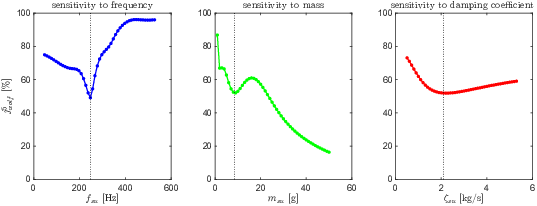
Figure 4: msu4 as a function of msu5, msu6, and msu7, revealing minima at optimal settings.
Bowed Excitation
Bowed excitation yields less regular modulation and increased complexity in suppressor optimization landscapes. The optimal suppressor position is non-centered, reflecting bridge asymmetry and spatial modal structure. When deployed, wolf suppression is effective, but with localized attenuation and spectral shifts.
Multiple suppressors (equal total mass) offer only marginal improvement in indicators, suggesting limited practical advantage unless optimal spatial deployment can be computationally guaranteed.
Real Cello Validation
The msu8 indicator robustly identifies wolf notes in real cello recordings (chromatic scale C3–C4), aligning with subjective perception and validating model predictions.

Figure 5: Waveform of real cello chromatic scale, analyzed for wolf-tone occurrence.
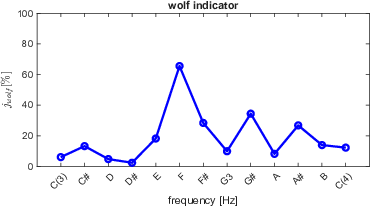
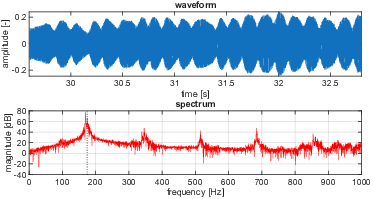
Figure 6: Indicator msu9 applied to real recording, with maximum corresponding to the wolf-affected note.
Implications and Future Directions
This modeling framework establishes a computationally tractable approach for precise suppressor design, leveraging unified time-domain PDE solvers. Practical implications include providing luthiers with algorithmic methods to optimize suppressor placement and parameters, thereby minimizing trial-and-error and mitigating unwanted side effects such as anti-resonance or spectral loss.
Extensions to nonlinear, three-dimensional body models and inclusion of air coupling are feasible and would allow for even greater fidelity in instrument simulation. Multi-objective optimization algorithms will be necessary to balance playability, sustain, and tonal integrity for individualized instrument calibration.
Conclusion
A comprehensive coupled string-bridge-body-suppressor model has been developed and numerically analyzed for the wolf note phenomenon in cellos. Novel quantitative indicators enable systematic evaluation of wolf-tone suppression, attenuation, and spectral fidelity. Results demonstrate high sensitivity to suppressor configuration, reveal trade-offs among performance metrics, and validate the approach against real instrument recordings. The methodology paves the way for advanced suppressor design and optimization, with future work envisaged in nonlinear dynamics and automated, multi-objective placement strategies.

