- The paper demonstrates that spectroscopic resolvability of nearly degenerate quasinormal modes near avoided crossings is fundamentally limited, even at high SNR.
- The paper applies Bayesian inference with 2DS, 2AC, and EP waveform models, revealing that amplitude recovery is highly sensitive to model choice.
- The paper shows that collective waveform signatures, such as linear-growth terms, enable effective detection of AC-induced non-Hermitian features in gravitational wave data.
Detectability of Avoided Crossings in Black Hole Ringdowns
Introduction
The study "Detectability of avoided crossings in black hole ringdowns" (2605.16199) addresses the practical challenge of identifying avoided crossing (AC) phenomena in black hole quasinormal mode (QNM) spectroscopy using gravitational wave (GW) data. In non-Hermitian systems, ACs arise when two QNM frequencies approach each other as system parameters are varied, resulting in characteristic amplitude enhancement and nearly opposite excitation phases, which can yield pronounced destructive interference. The paper presents an extensive Bayesian inference study to determine whether such closely spaced QNMs—and the distinctive features of ACs, such as effective double-pole behavior—can be observationally resolved.
Black Hole QNMs, Avoided Crossings, and Exceptional Points
Black hole perturbation theory yields QNM spectra, each mode characterized by complex frequency ω=2πf−i/τ where f and τ are the frequency and damping time respectively. ACs occur when two eigenfrequencies become nearly degenerate and exhibit repulsion in the complex plane, while exceptional points (EPs) represent a degeneracy not only of eigenfrequencies but also of their corresponding eigenfunctions.
Near an AC, QNM excitation and time-domain response can be effectively modeled by either: a simple superposition of two damped sinusoids (2DS), an AC-based destructive interference model (2AC), or a double-pole QNM model (EP). In the EP regime, interference may manifest as a linear-growth term te−iωt in the GW signal, distinct from standard damped exponentials.
Three waveform models are used in Bayesian inference analyses:
- 2DS model: Superposition of two damped sinusoids, directly parameterizing individual QNM amplitudes, frequencies, damping times, and phases.
- 2AC model: Includes the enhancement and destructive interference dictated by AC theory, tightly coupling the amplitudes and phases of two modes.
- EP model: Approximates the signal as a double-pole QNM, parameterizing both the standard damped component and a linear-growth term.
The Bayesian inference employs a time-domain likelihood incorporating realistic detector noise, and parameter estimation is performed on injected signals representing optimal observational conditions.
Frequency and Damping Time Resolvability
A primary question is whether the individual frequencies and damping times of two nearly degenerate QNMs associated with an AC are resolvable in GW data, even at high SNR.
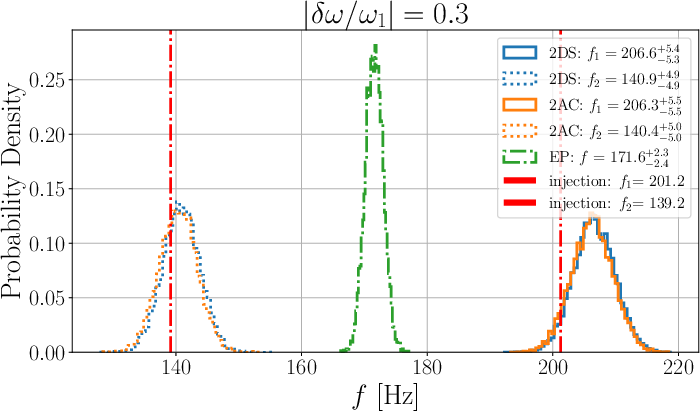
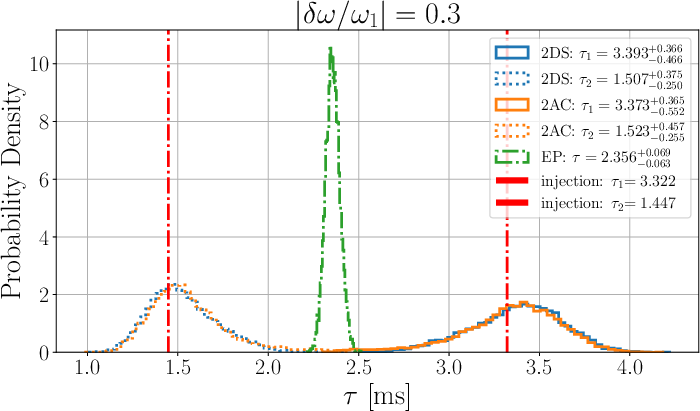
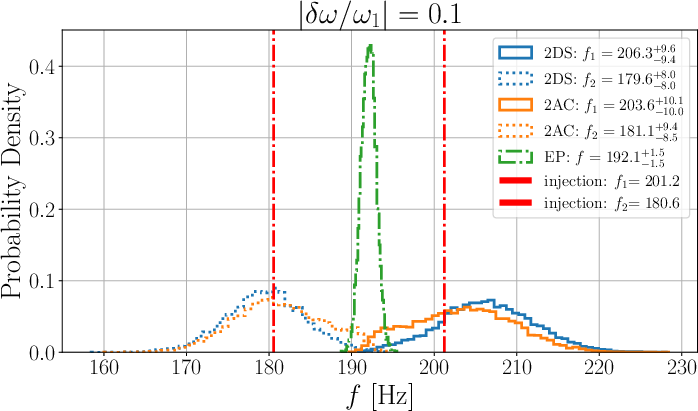
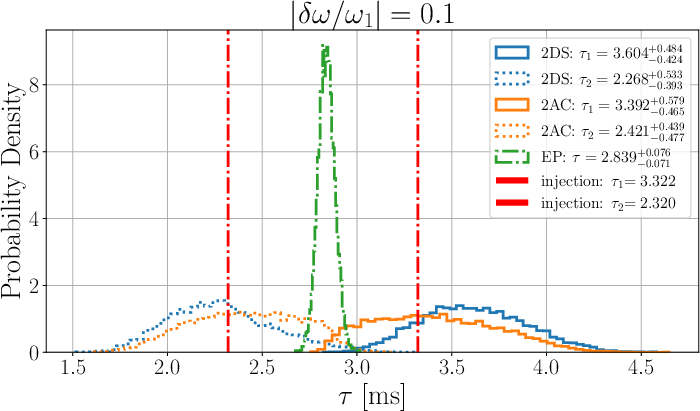
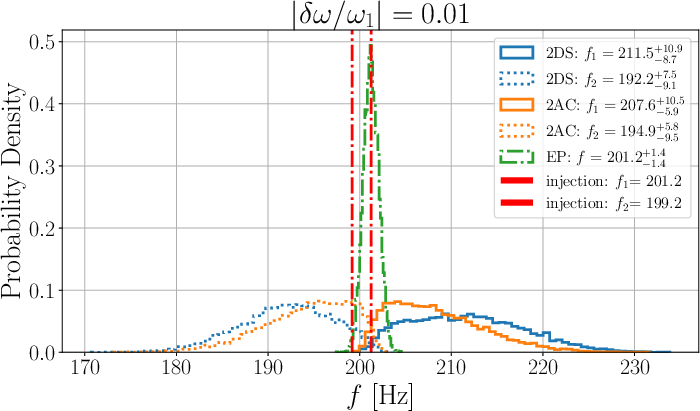
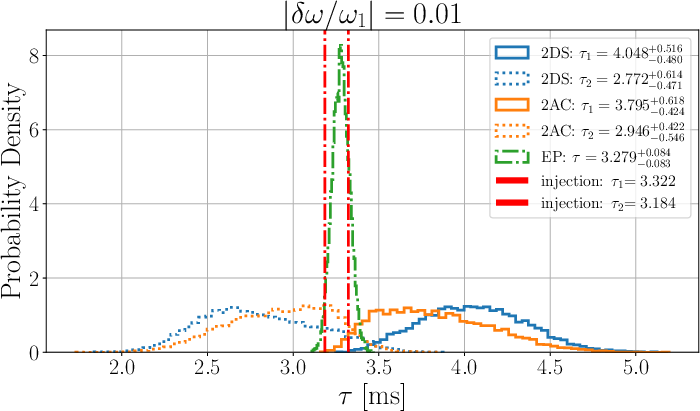
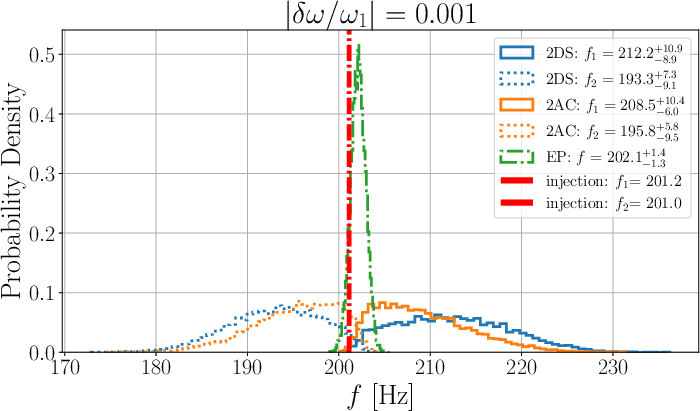
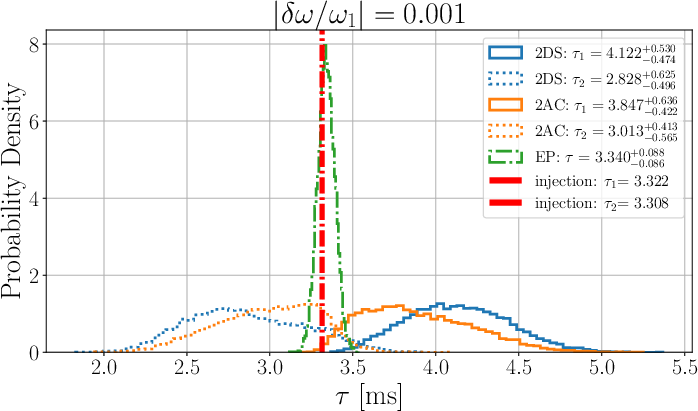
Figure 1: Posterior probability distributions for the frequencies and damping times for frequency-shifted (left) and damping-time-shifted (right) cases, as a function of fractional complex-frequency separation ∣δω/ω1∣.
Analysis shows that for ∣δω/ω1∣≳0.1, the 2DS and 2AC models yield comparable posterior uncertainties, but as the separation diminishes, frequency and damping time posteriors broaden and overlap, failing to recover the injected values reliably. The EP model recovers an effective, averaged complex frequency for small separations, breaking down for larger ones. Thus, even with optimistic assumptions, spectroscopic resolvability of individual QNM frequencies is demonstrably limited.
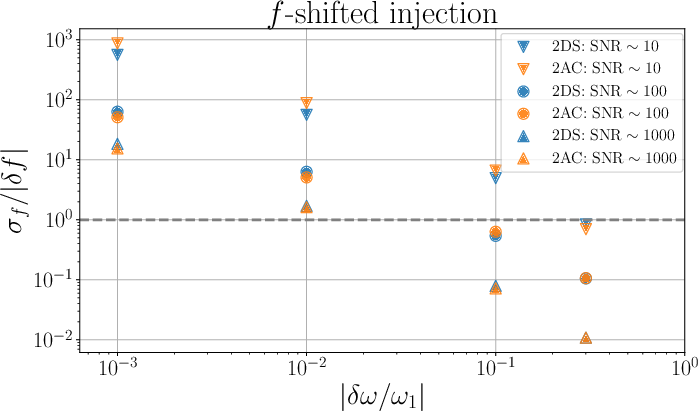
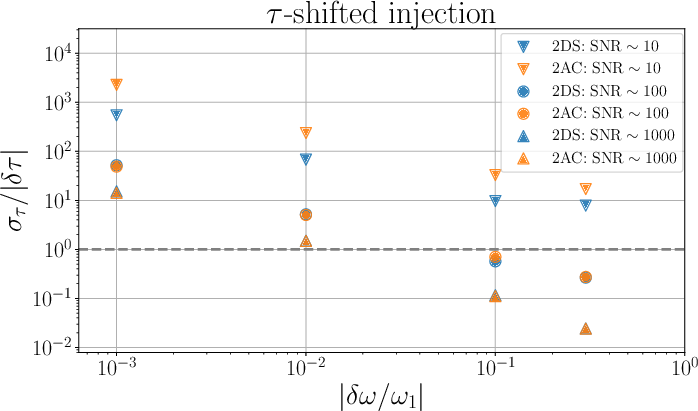
Figure 2: Resolvability criteria for frequencies (left) and damping times (right) versus fractional separation ∣δω/ω1∣, with shaded regions indicating when modes are unresolvable at a given SNR.
Fisher matrix analysis confirms that resolvability deteriorates quadratically with decreasing frequency separation and improves inversely with SNR.
Amplitude Parameter Inference
The inference of QNM amplitude parameters is highly sensitive to waveform model choice. In the 2DS model, amplitude posteriors for nearly degenerate modes are systematically underestimated, as the likelihood statistically favors parameter regions where destructive interference occurs with small amplitudes—finely tuned large-amplitude solutions are disfavored due to their small prior volume.
Conversely, the 2AC model retains robust amplitude recovery, since amplitude enhancement associated with ACs is modeled directly. The EP model reliably infers the amplitude of the linear-growth term only when the double-pole approximation holds.
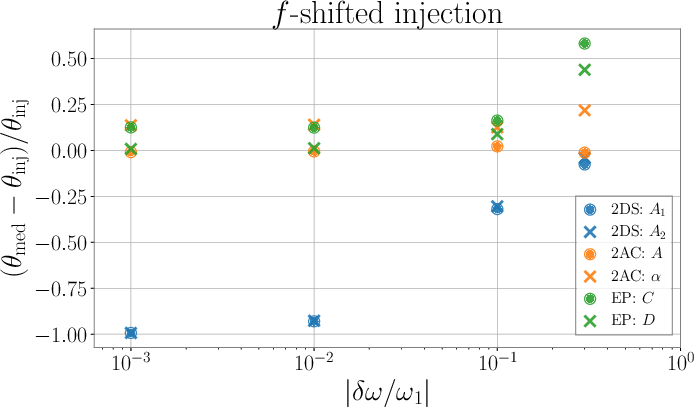
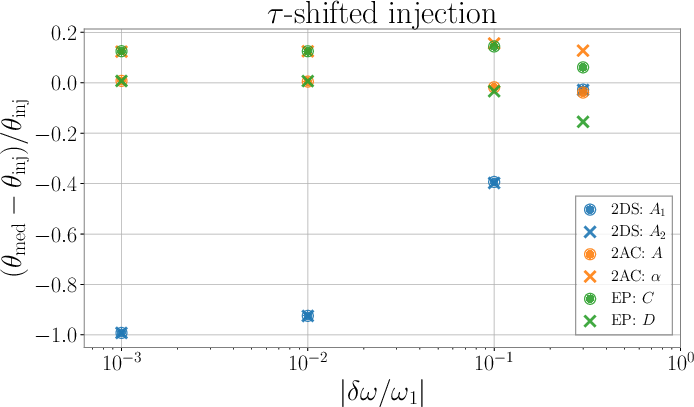
Figure 3: Fractional deviation of inferred amplitude parameters from the injected values for each waveform model, highlighting systematic bias in the 2DS model for small ∣δω/ω1∣.
Detailed posterior distributions further illustrate the marginalization effects that cause mode amplitudes to be underestimated in the 2DS parameterization as degeneracy increases.
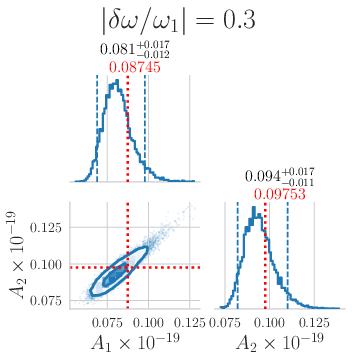
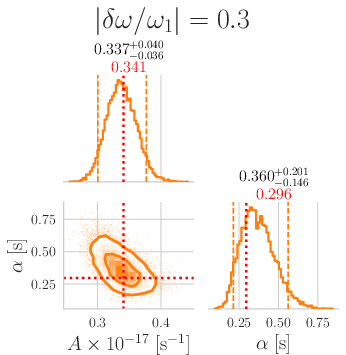
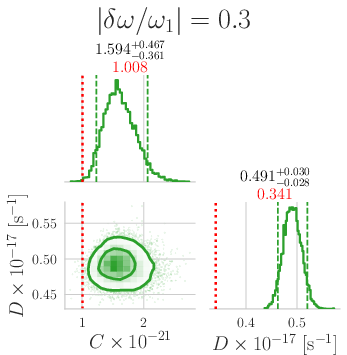
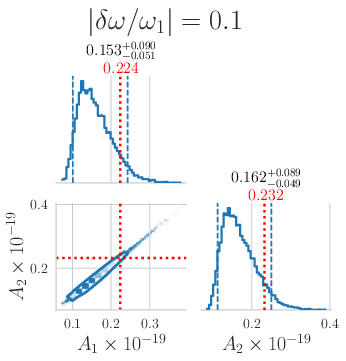
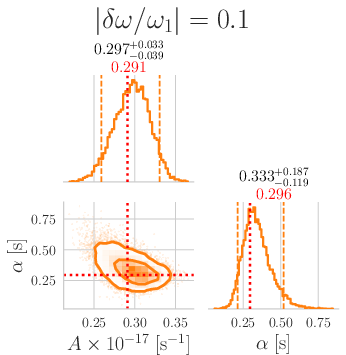
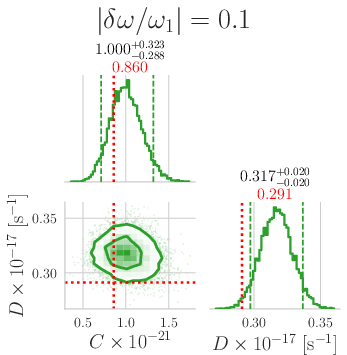
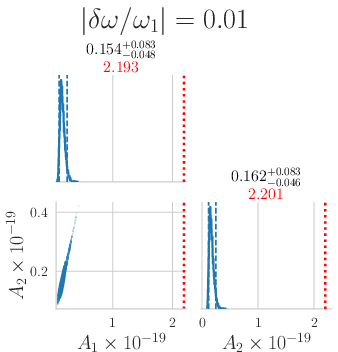
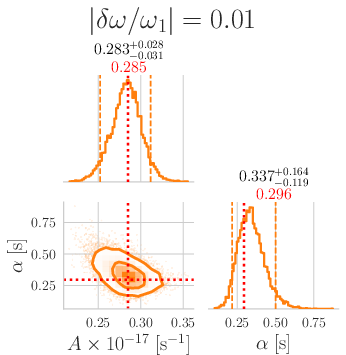
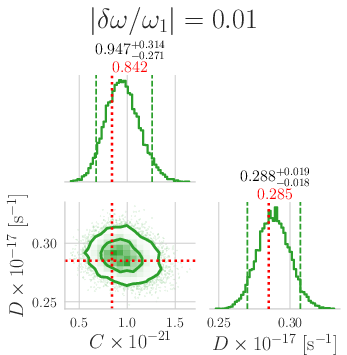
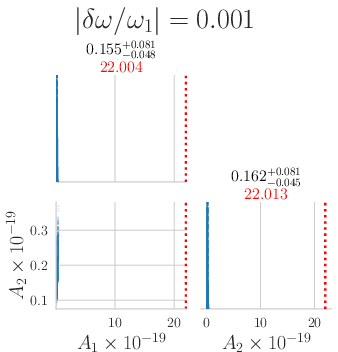
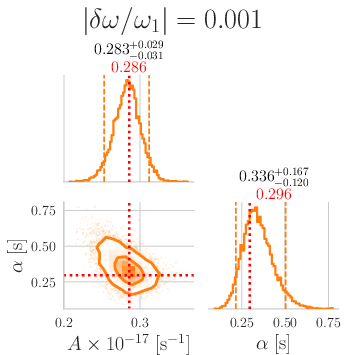
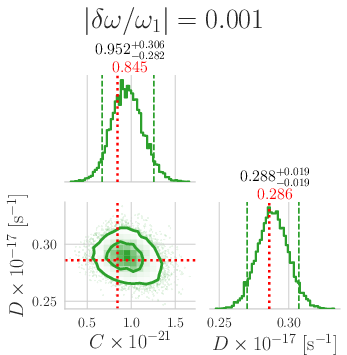
Figure 4: Posterior probability distributions of amplitude parameters for frequency-shifted injections; left, middle, right: 2DS, 2AC, EP models.
Realistic Application: ACs in Kerr Black Holes
Applying these methods to the AC between the (2,2,5) and (2,2,6) overtones of a Kerr black hole (f0), where only these modes are injected and lower overtones are assumed removed, the study finds:
- The individual complex frequencies remain unresolvable, even at high SNR.
- The EP model accurately recovers a nonzero linear-growth coefficient, confirming the presence of AC-induced effective double-pole behavior.
- The 2AC framework offers improved amplitude inference, and the collective waveform signature of ACs can in principle be observed if contamination from non-AC modes is negligible.
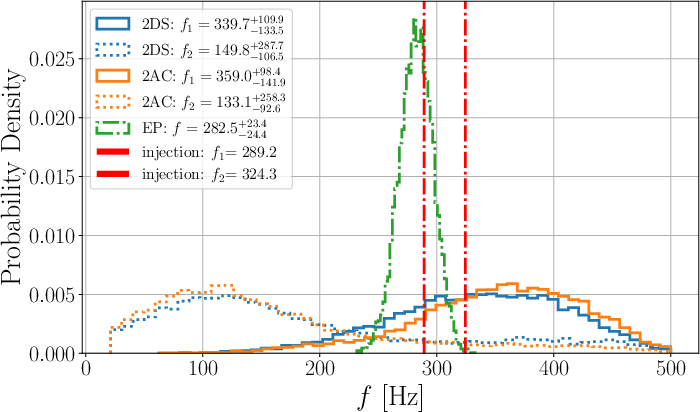
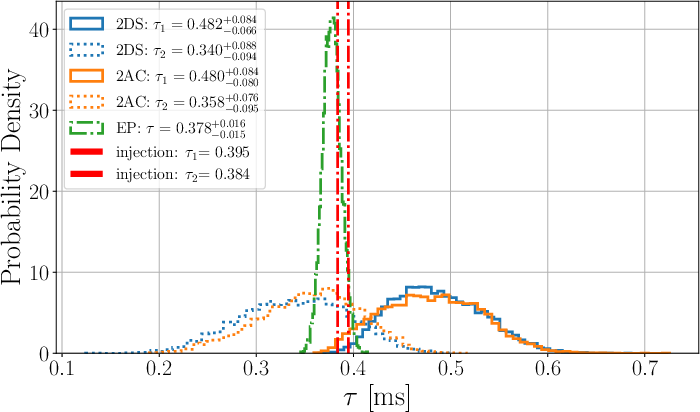
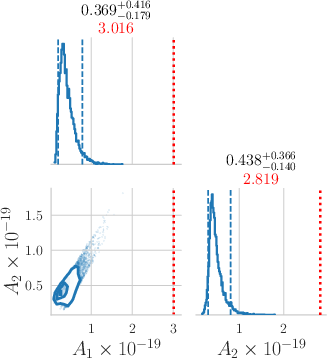
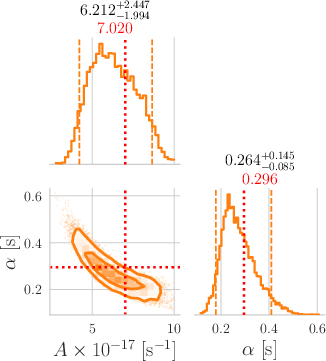
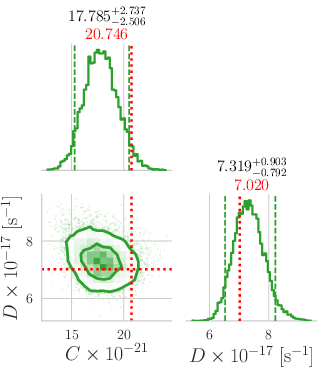
Figure 5: Posterior distributions for frequencies and damping times (top), and amplitude corner plots (bottom) for AC in Kerr BH analysis, showing effective recovery of collective amplitude with EP model.
Theoretical and Practical Implications
This study establishes several critical points:
- Spectroscopic resolvability of closely spaced QNMs near ACs is fundamentally limited, even in ideal data, due to quadratically degrading sensitivity with frequency separation and the adverse effects of destructive interference on amplitude inference.
- Collective AC waveform features can remain observable using AC-inspired or EP parameterizations, specifically if AC-related modes dominate the ringdown signal and other overtones are appropriately excised.
- Amplitude inference is waveform-model dependent, with standard 2DS parametrization yielding misleading results for nearly degenerate modes.
Practically, these results advocate for the development of AC-motivated and EP-based waveform templates in GW ringdown analysis. Theoretically, the work motivates further investigation into the role of non-Hermitian phenomena, such as exceptional points and avoided crossings, in GW spectroscopy, associated resonance instabilities, and their potential observational consequences [Yang:2025dbn, PanossoMacedo:2025xnf].
Speculation on Future Developments
Future GW detectors with enhanced sensitivity and longer post-merger observation time may improve frequency separation limits, but the quadratic scaling barrier will persist. Advanced multimode and AC-aware Bayesian analyses, combined with systematic ringdown mode removal and robust amplitude modeling, are essential for meaningful non-Hermitian spectral diagnostics. The theoretical insight provided by double-pole and EP models might play a pivotal role in extracting signatures of fundamental perturbation physics from GW data, extending into tests of GR and alternative theories.
Conclusion
The detectability of avoided crossings in black hole ringdown signals is constrained primarily by the inability to spectroscopically resolve individual QNMs as complex-frequency separation decreases. However, effective collective waveform signatures associated with ACs—especially the linear-growth term characteristic of double-pole excitation—can remain observable using suitably parameterized waveform models. Amplitude inference in standard models is subject to significant bias, but AC-aware and EP models enable more robust characterization of nearly degenerate mode interference. Overall, while individual QNM identification near ACs remains elusive, the distinctive non-Hermitian features of black hole perturbation spectra are within reach of current and forthcoming GW observational analyses.
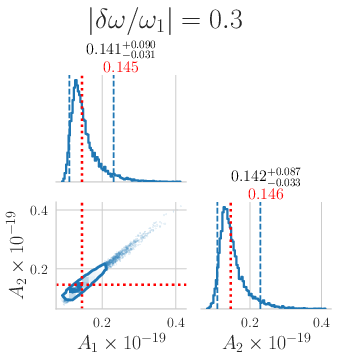
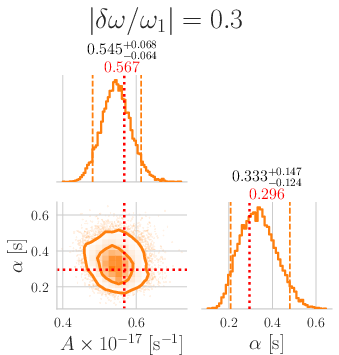
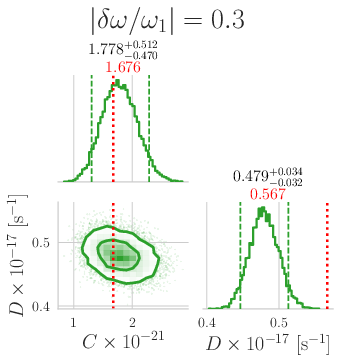
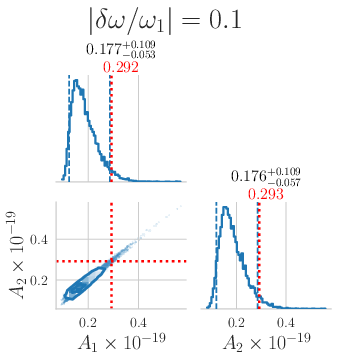
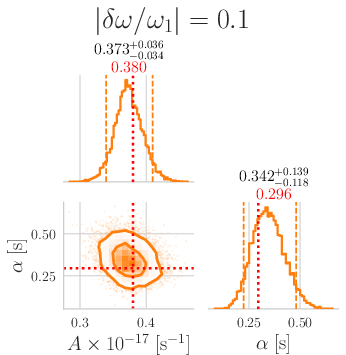
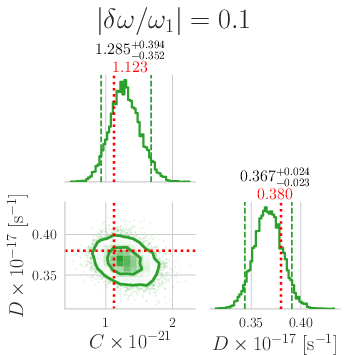
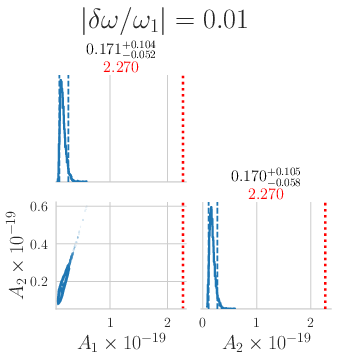
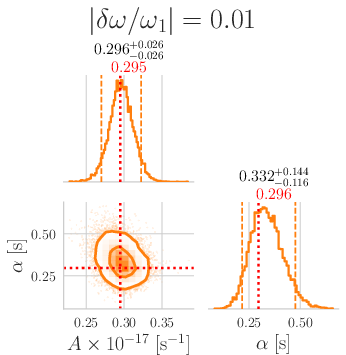
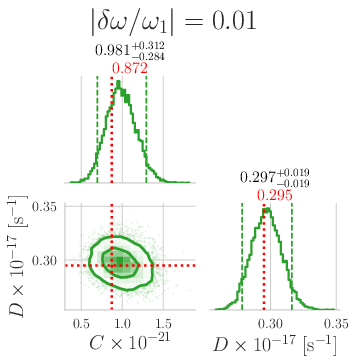
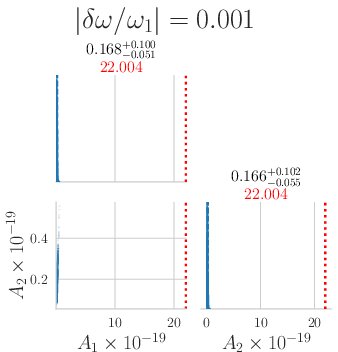
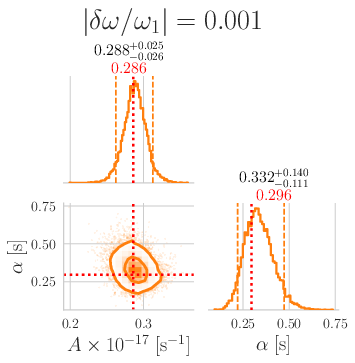
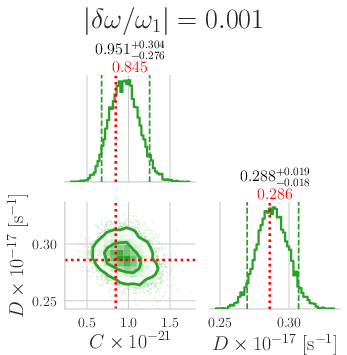
Figure 6: Posterior distributions of amplitude parameters for damping-time-shifted injections, illustrating systematic amplitude underestimation and superior recovery with AC-inspired parameterizations.

