- The paper shows that classical post-processing can extract the correct order from noisy quantum phase estimation outputs using specific statistical features.
- It quantifies recoverability through measures like autocorrelation peak and dominant verified mass fraction, with M1,frac emerging as the key predictor.
- The findings have practical implications for error mitigation and robust algorithm design in noisy intermediate-scale quantum (NISQ) devices.
Recoverability of Noisy Quantum Order Finding in Shor’s Algorithm
Introduction
Shor’s algorithm represents a primary demonstration of quantum computational advantage, with quantum order finding as its central subroutine. However, the transition from theoretical performance to practical realizations is hampered by the impact of quantum noise on real NISQ hardware. The study "When Noisy Quantum Order Finding Remains Recoverable for Shor's Algorithm" (2605.16074) directly addresses the question of when, and under what measurable conditions, classical post-processing can still extract the correct order from noisy phase-estimation outputs. Unlike analyses focused solely on noise mechanisms or hardware-level error rates, this work systematically quantifies recoverability as a function of statistical and algorithm-aware features of the observed output distributions, leveraging a dataset of quantum experiments executed across contemporary IBM hardware.
Problem Context and Methodology
Order finding relies on encoding the order information in the output distribution of a precision register, obtained via quantum phase estimation. In the noiseless regime, this distribution presents a pronounced comb-like structure aligned with the true order. On NISQ devices, the output is distorted, sometimes to the point of substantial ambiguity.
The paper formalizes the criterion of "recoverability": a noisy run is recoverable if standard continued-fraction-based post-processing (with modular verification) returns the correct order. To probe the behavior of recoverability under noise, the authors collect 680 quantum experiment distributions (across multiple N, a, register sizes, and QFT settings) and compute four distributional and post-processing-aware features: autocorrelation peak strength (Apeak), normalized entropy (Hnorm), dominant verified mass fraction (M1,frac), and verified margin fraction (Δver,frac).
Empirical Analysis of Feature Predictivity
The experimental results demonstrate that residual comb-like structure and the organization of probability mass over verified candidate denominators jointly determine recoverability.
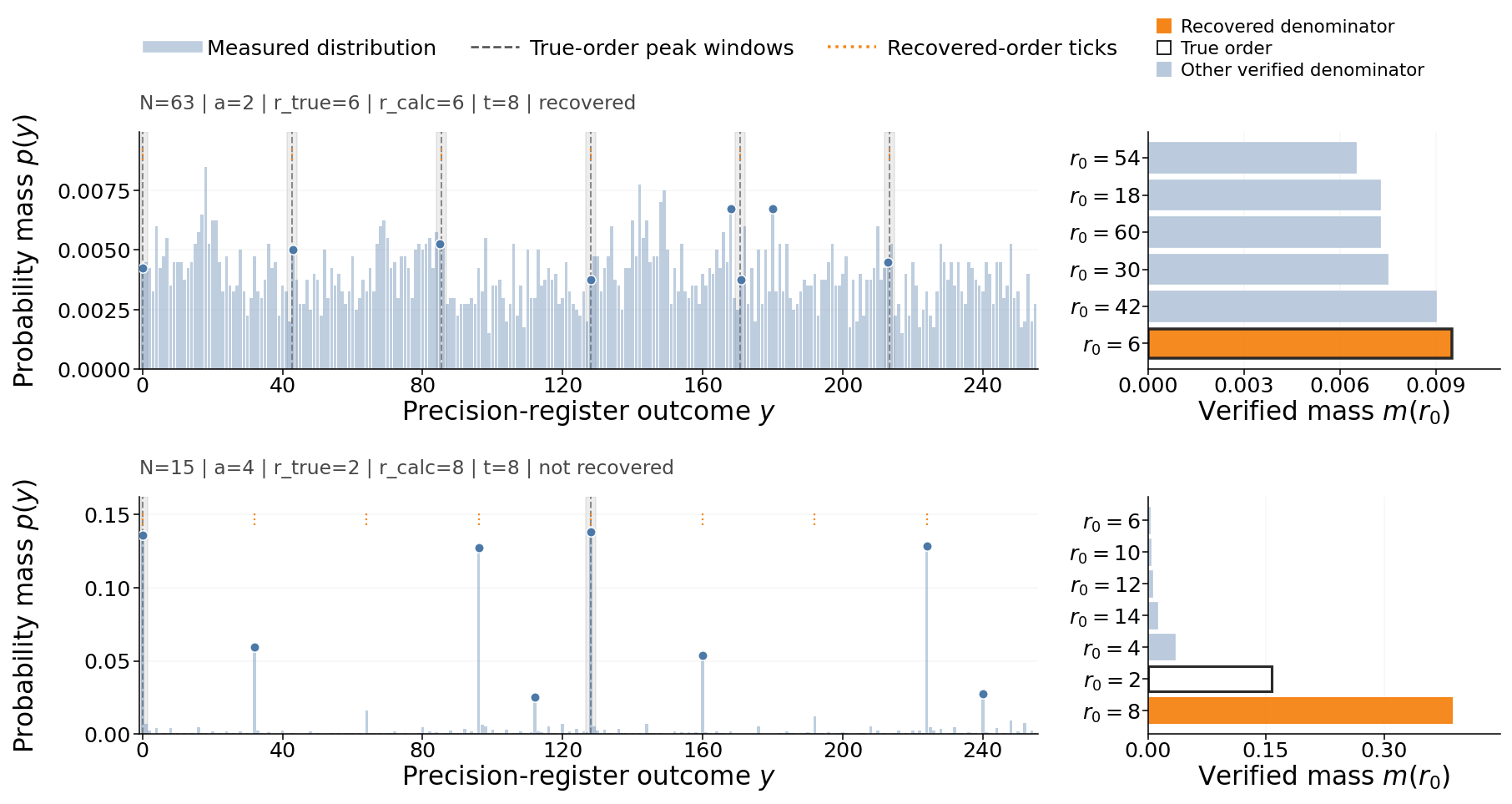
Figure 1: Examples illustrating that weak histogram structure can still yield correct recovery and, conversely, that strong peaks can be misleading if incorrect candidates are favored.
Marginal distributions and feature scatterplots reveal that while recoverable runs tend to cluster in regions of high Apeak and low Hnorm (indicative of non-flat, structured distributions), these features do not always decisively separate recoverable from non-recoverable cases.
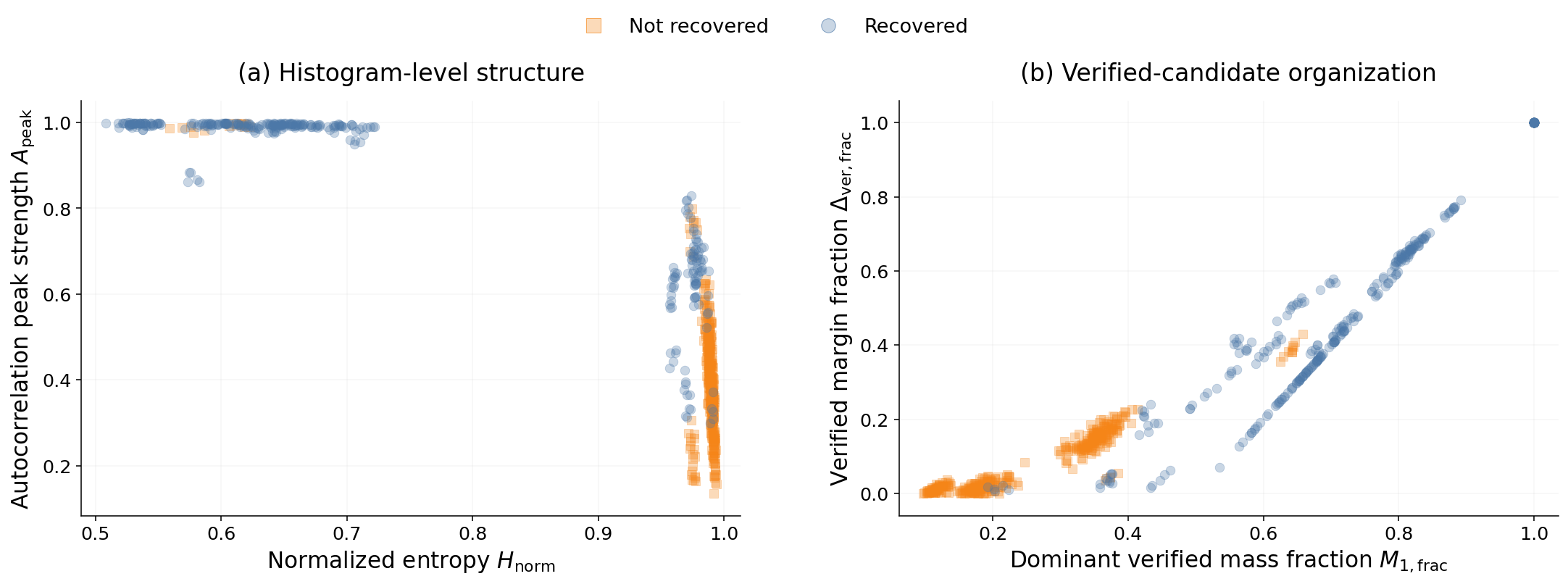
Figure 2: Relationship between normalized entropy, autocorrelation, and post-processing-aware features, colored by recoverability.
Crucially, the dominant verified mass fraction M1,frac—the probability mass assigned, after post-processing, to the leading (via modular verification) candidate denominator—shows the highest single-feature AUROC (0.981), outperforming generic statistical metrics.
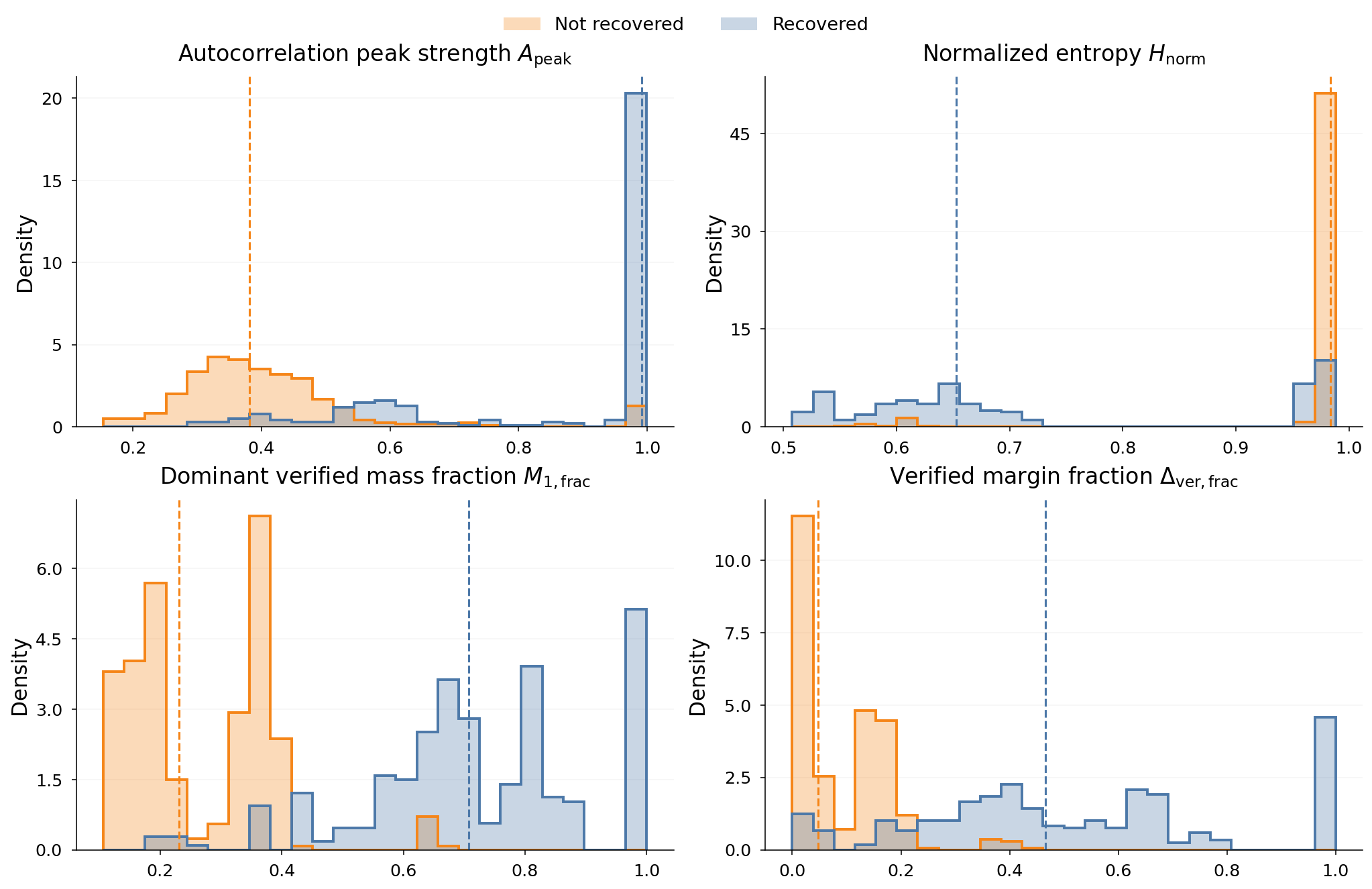
Figure 3: Feature distributions for recoverable and non-recoverable instances, showing greater separability for post-processing-aware metrics.
This finding is reinforced by tree-based multivariate analyses. The random forest classifier achieves near-perfect held-out AUROC with the four features, with permutation importance highlighting M1,frac as the primary controlling predictor and the other three features offering only incremental additional value.
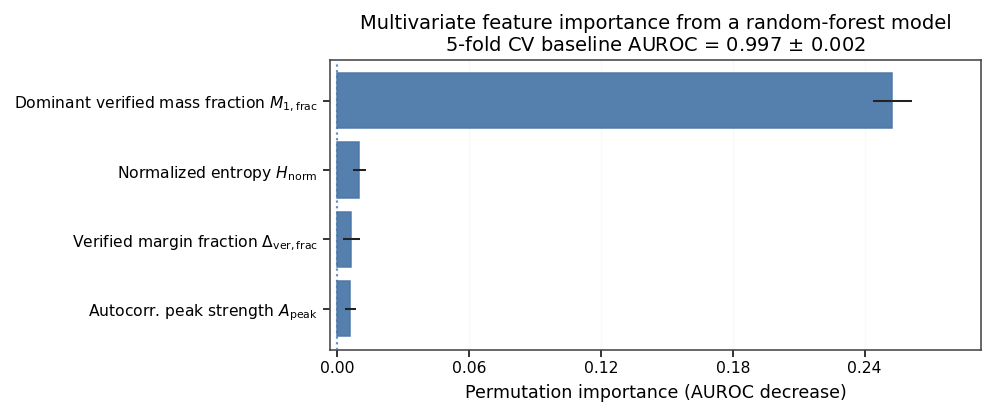
Figure 4: Permutation importance of the four features shows dominant contribution from a0.
The single decision tree reveals interpretable threshold rules: strong concentration of verified mass on a single candidate (a1) virtually guarantees recoverability, while a diffuse distribution signals probable failure.
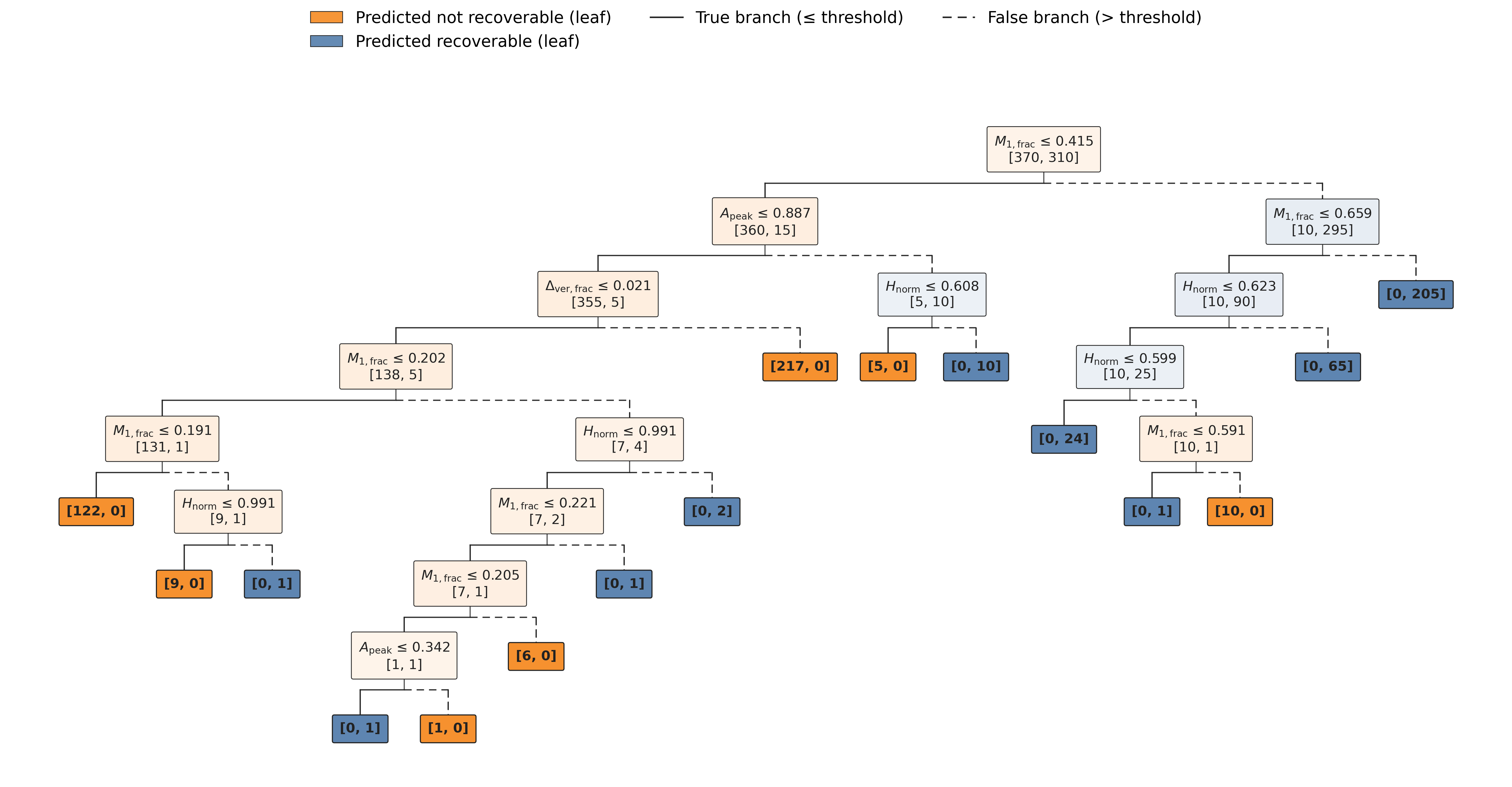
Figure 5: Decision tree model exposes explicit threshold splits in predicting recoverability outcomes.
Interpretation and Broader Implications
This analysis decouples mere visible peak structure from algorithmic recoverability, establishing that successful order recovery requires structural alignment between quantum noise effects and the structure of the post-processing step. Notably, instances exist where the output registers are highly distorted, yet classical decoding still singles out the correct order, and vice versa.
The underlying mechanism can be interpreted as a two-stage propagation of quantum noise: first, circuit-level errors can deposit probability mass into “competing” sectors associated with incorrect candidate orders; second, later-stage noise (QFT approximation, readout errors) broadens the support of each such comb. Recoverability is then a function of how classical post-processing aggregates this survival mass.
This result has direct practical and theoretical implications:
- Benchmarking and Error Mitigation: The precise quantification of post-processing-aware features (especially a2) enables targeted error mitigation strategies. Techniques could be developed to shift runs across interpretable recoverability thresholds, through denoising or post-selective reweighting.
- Algorithmic Robustness: The findings sharpen the understanding that successful practical quantum order finding relies not only on generic noise suppression but also on preserving the relative organization of verified probability mass after post-processing.
- Phase Estimation in NISQ Regimes: The presented methodology generalizes to other phase estimation tasks where the visibility of the ideal signal is not always an accurate predictor of algorithmic success or failure.
Speculation on Future Directions
Expanding the dataset to cover broader classes of modulus, work register size, and more diverse noise profiles would allow further assessment of the generality and universality of these recoverability predictors. Additionally, the development of mitigation protocols that explicitly optimize features such as a3 represents a concrete route to enhance reliability of quantum algorithms in noisy environments. Deeper integration of ML-based classifiers for predicting recoverability may also inform adaptive strategies for reruns or circuit recompilation on NISQ hardware.
Conclusion
This work establishes that algorithmic recoverability for quantum order finding under noise is fundamentally characterized not by the presence of histogram peaks alone, but by the aggregation of verified probability mass via classical post-processing. The dominant verified mass fraction emerges as a robust, interpretable, and actionable feature for predicting success. These insights enable improved benchmarking, diagnosis, and mitigation strategies for near-term quantum computations targeting order-finding and related Fourier-structure-based problems.
(2605.16074)