- The paper identifies a two-term scaling law for Tan’s contact, with leading N^(5/2) and subleading N^(3/2) contributions.
- It employs a saddle-point reduction and contour-integral method to derive closed-form expressions for the scaling functions A(τ) and B(τ) across degenerate and dilute regimes.
- The work resolves canonical versus grand-canonical discrepancies and offers precise predictions for experimental observations in 1D cold-atom systems.
Overview and Motivation
This work establishes a rigorous large-N scaling law for Tan's contact in a harmonically trapped Tonks–Girardeau (TG) gas at finite temperature, formulated in the canonical ensemble. The TG gas arises as the infinite repulsion limit of the 1D Lieb–Liniger model, mapping strongly interacting bosons onto noninteracting fermionic wavefunctions via the Girardeau transformation. The central observable, Tan's contact C, quantifies short-range pair correlations and governs the universal k−4 tail in the momentum distribution, connecting microscopic physics to thermodynamic identities and interaction energies. Previous treatments either relied on grand-canonical ensemble (GCE) approximations (notably via the local density approximation, LDA) or studied small particle numbers, thereby leaving the subleading finite-N corrections and canonical-vs-grand-canonical distinctions insufficiently resolved.
The principal technical achievement of this paper is a two-term scaling law for the canonical contact:
CN(τ)=A(τ)N5/2+B(τ)N3/2,
where τ=T/TF is the reduced temperature (TF being the Fermi temperature), A(τ) recovers the LDA/GCE result, and B(τ) is a novel universal function representing the ensemble correction—quantifying the difference between canonical and grand-canonical treatments at fixed mean particle number. Closed forms are derived for N0 and N1 in the deep degenerate and dilute regimes, and uniformly accurate Padé approximants are constructed for intermediate temperatures.
The TG gas in a harmonic potential is described by the Hamiltonian
N2
in harmonic oscillator units. In the N3 limit, bosonic eigenstates are mapped onto antisymmetrized fermionic Slater determinants, ensuring identical local observables (e.g. density, energy) but distinctive off-diagonal correlations.
Tan's contact is defined as the coefficient in the large-momentum tail of the momentum distribution:
N4
where N5 is the thermal one-body density matrix.
The canonical ensemble evaluation is built from a contour-integral representation of the partition function,
N6
with N7 the grand partition function, and the contact integrand utilizes a kernel functional averaged along this contour.
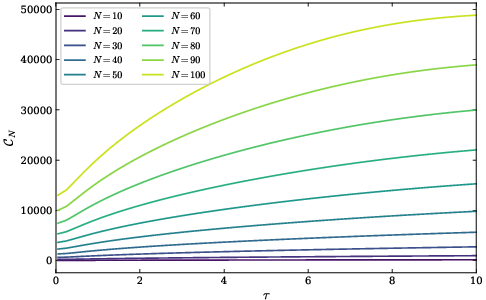
Figure 1: Canonical-ensemble contact as a function of reduced temperature N8, evaluated from the contour-integral representation for various particle numbers.
The large-N9 expansion employs a saddle-point reduction leading to phase-space integrals involving the self-consistent scaled chemical potential C0. In this limit, the Fermi occupation function becomes independent of C1 at leading order, parameterized by C2 and C3:
C4
The universal scaling law emerges as:
C5
where
C6
with C7, C8 denoting phase-space moments of C9.
Analytic Limits: Degenerate and Boltzmann Regimes
In the degenerate (k−40) regime, the leading coefficient k−41 admits a Sommerfeld expansion
k−42
while the subleading k−43 is linear in k−44 with boundary layer (Airy) corrections negligible for k−45:
k−46
In the high-temperature, dilute (k−47) regime, the coefficients reduce to
k−48
so the ratio k−49, which reflects the Poissonian particle-number statistics of the GCE, with the canonical contact below its grand-canonical counterpart by a universal finite-N0 correction.
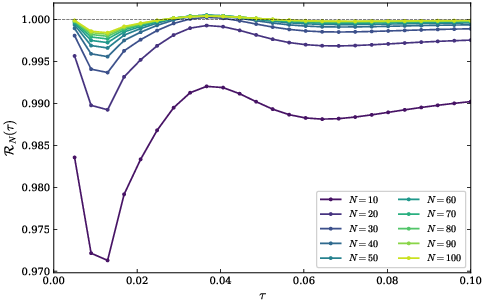
Figure 2: Low-N1 verification of the scaling law, illustrating convergence of the ratio N2 to unity with increasing N3 and demonstrating the accuracy of the analytic coefficients.
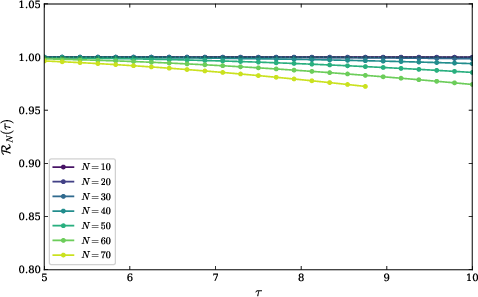
Figure 3: High-N4 verification, showing scaling collapse and confirming canonical corrections in the Boltzmann regime.
Universal Scaling Functions: Numerical Evaluation and Interpolation
For intermediate N5, no analytic simplification is available, and the universal functions N6, N7 are evaluated numerically via direct quadrature of their integral representations. Additionally, Padé approximants are constructed to interpolate between analytic regimes and provide uniformly accurate closed forms across the physical temperature window.
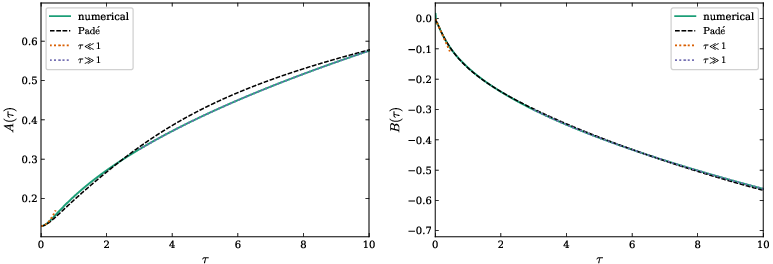
Figure 4: Universal scaling functions N8 and N9 computed numerically (solid blue), Padé approximants (black dashed), and analytic asymptotes (colored dotted lines), spanning CN(τ)=A(τ)N5/2+B(τ)N3/2,0.
Physical Origin of the Subleading Correction: Ensemble Correspondence
A detailed comparison of the canonical and grand-canonical treatments reveals that CN(τ)=A(τ)N5/2+B(τ)N3/2,1 quantifies the ensemble correction to the contact—i.e., the part arising due to the fixed-CN(τ)=A(τ)N5/2+B(τ)N3/2,2 constraint in the canonical ensemble and absent in GCE calculations. The explicit form of CN(τ)=A(τ)N5/2+B(τ)N3/2,3 is obtained from universal phase-space integrals of the Fermi function and the global particle-number cumulants of the GCE:
CN(τ)=A(τ)N5/2+B(τ)N3/2,4
with CN(τ)=A(τ)N5/2+B(τ)N3/2,5 built from local and global fluctuations. This correction becomes non-negligible at order CN(τ)=A(τ)N5/2+B(τ)N3/2,6 and is strictly negative.
Numerical Verification and Padé Approximants
The scaling law is verified numerically for CN(τ)=A(τ)N5/2+B(τ)N3/2,7 up to CN(τ)=A(τ)N5/2+B(τ)N3/2,8 across CN(τ)=A(τ)N5/2+B(τ)N3/2,9 using canonical contour-integration, confirming both the scaling exponents and the accuracy of the universal coefficients. Padé approximants for τ=T/TF0 and τ=T/TF1 enable efficient evaluation and interpolation for practical comparison with experiment.
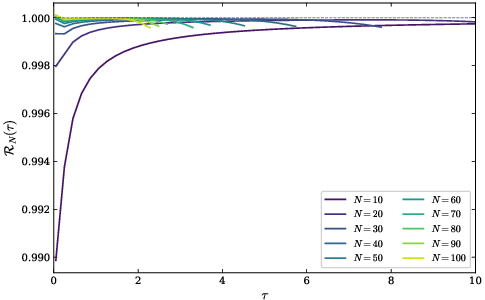
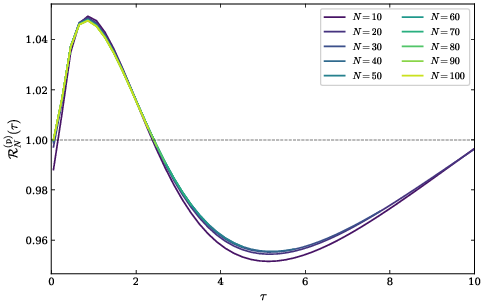
Figure 5: Full-τ=T/TF2 scaling verification: ratio τ=T/TF3 using numerical and Padé scaling functions, confirming the scaling law across the full temperature range.
Implications and Future Directions
The explicit canonical scaling law provides a quantitative prediction for Tan's contact in trapped TG gases at finite temperature. The identification of τ=T/TF4 as the ensemble correction resolves the canonical-vs-grand-canonical ambiguity and delineates the physical origin of subleading corrections. For practical settings, such as experiments measuring Tan's contact in 1D Bose gases [Huang et al 2025], these results provide stringent benchmarks across the degenerate to classical crossover.
The theoretical framework and contour-integral methodology are extensible to zero-temperature edge corrections (where non-commuting limits produce τ=T/TF5 scaling in strict τ=T/TF6), multi-component fermionic mixtures, and finite-coupling Lieb–Liniger gases, where canonical-vs-grand-canonical distinctions are expected to dictate subleading scaling terms. Further work will elucidate thermal suppression of edge corrections and extend the theory to more general settings.
Conclusion
This paper rigorously formulates and analytically derives the canonical large-τ=T/TF7 scaling law for Tan's contact in the harmonically trapped TG gas at finite temperature, establishing the universality of the leading coefficient and precisely quantifying the subleading ensemble correction. Closed-form expressions and efficient Padé interpolants bridge all physical regimes, and numerical verification affirms the scaling law's accuracy and practical relevance for quantitative comparison with modern cold-atom experiments.