- The paper demonstrates that chiral geometry induces orbital angular momentum textures and persistent currents without relying on atomic spin–orbit coupling.
- A three-orbital tight-binding helix model is developed using Slater–Koster parametrization to reveal momentum-dependent inter-orbital coherences that yield odd-in-momentum OAM components.
- The analysis distinguishes equilibrium OAM accumulation from nonequilibrium Edelstein responses, offering new routes for enhanced orbital-to-spin transduction in spintronics.
Orbital Angular Momentum Textures and Currents in a Discrete Helix: Equilibrium and Linear Response
Introduction and Motivation
The paper "Orbital Angular Momentum Textures and Currents in a Discrete Helix: Equilibrium and Linear Response" (2605.15981) addresses the microscopic origins of angular momentum selectivity in chiral conductors and specifically interrogates the mechanisms by which orbital angular momentum (OAM) textures and currents manifest in purely geometrically chiral systems, without the necessity of atomic spin–orbit coupling (SOC). This is particularly significant for interpreting the robust spin polarization observed in CISS (chirality-induced spin selectivity) phenomena, where SOC is often weak.
The authors construct a minimal three-orbital tight-binding model for a single helical chain, explicitly retaining the local orbital basis (pr,pϕ,pz) and parameterizing inter-orbital hopping via Slater–Koster rules in cylindrical coordinates. The model is designed to capture the essential symmetry-breaking features emergent from chirality and serves as a foundational context for analyzing nonequilibrium OAM responses (current, texture, Edelstein susceptibility) and their consequences for spin injection mechanisms.
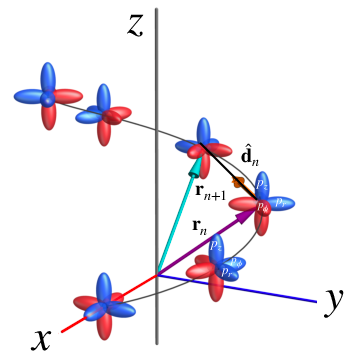
Figure 1: Helical chain model with local p orbitals and screw symmetry, illustrating nearest-neighbor geometry and orbital orientations relevant for OAM texture.
Three-Orbital Tight-Binding Helix: Model Construction and Band Structure
The tight-binding Hamiltonian is formulated with onsite energies for each orbital and nearest-neighbor hopping terms defined by geometric overlaps and Slater–Koster parameters, distinguishing σ and π bonding. The helical geometry enforces antisymmetric hopping in the (pz,pr) and (pr,pϕ) sectors, yielding both even and odd hybridization channels under momentum reversal.
By transforming to the Bloch basis, the Hamiltonian is decomposed into even and odd components in k, and the resulting 3×3 band structure is obtained by diagonalization. Notably, this construction allows the identification of distinct inter-orbital coherence channels that underpin different components of the OAM vector L=(⟨Lr⟩,⟨Lϕ⟩,⟨Lz⟩).
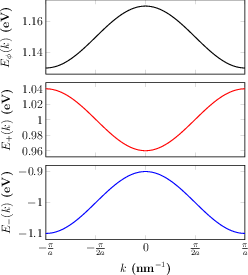
Figure 2: Band structure in the reduced trz-only model, imitating the momentum-selective hybridization between azimuthal and longitudinal orbitals.
Orbital Angular Momentum Textures: Momentum Dependence and Symmetry
The Bloch eigenstates inherently carry local OAM texture, which is analytically derived via inter-orbital coherences:
- p0 arises from (p1, p2) coherence, odd in p3.
- p4 arises from (p5, p6) coherence, odd in p7.
- p8 vanishes due to symmetry constraints; only the p9 amplitude is imaginary.
This model demonstrates that OAM texture emerges purely from helical geometry—chirality breaking inversion symmetry and introducing odd-in-momentum mixing—with the sign of the texture governed by structural handedness.
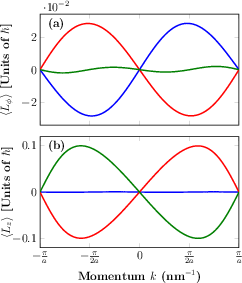
Figure 3: Exact OAM textures for all three bands; azimuthal and longitudinal components persist, radial vanishes.
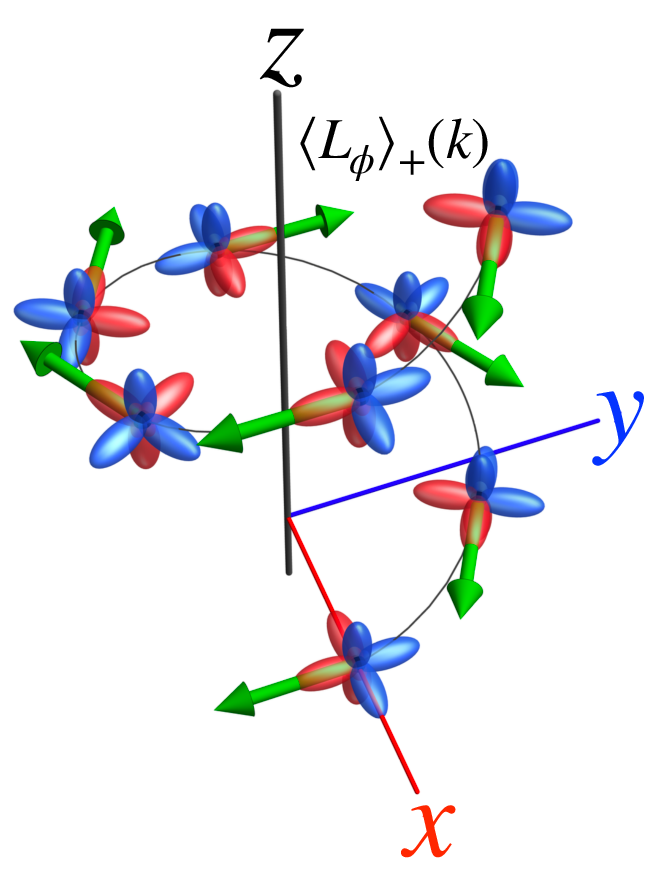
Figure 4: Analytical texture from the σ0-only model, showing the σ1-odd character of σ2.
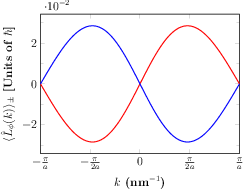
Figure 5: Reciprocal-space Azimuthal OAM Texture σ3 for hybridized bands, demonstrating sign inversion between σ4 and σ5.
Equilibrium OAM Currents and End Magnetization
In equilibrium, average OAM texture vanishes by parity (sum over σ6), but persistent-like OAM currents can exist due to the product of odd textures and odd band velocities. The discontinuity at the molecular ends produces a net accumulation of magnetic moment, with dominant orbital contributions expected along the molecular axis (σ7 direction). Theoretical estimates suggest measurable end point magnetization, relevant for interpreting experimental interactions between finite helices and magnetized substrates.
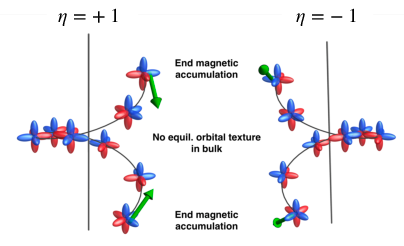
Figure 6: Accumulation of OAM and magnetic moment at helical chain terminations, with chirality-dependent axial (σ8) polarization.
Orbital Edelstein Response: Nonequilibrium Linear Susceptibility
Upon application of an external electric field, the OAM Edelstein susceptibility (σ9) quantifies the linear response of OAM accumulation. Only the odd-in-momentum texture components contribute, yielding a finite azimuthal and longitudinal Edelstein response in a single helix, while the projected linear orbital current conductivity vanishes due to parity (even π0 multiplying an odd texture). This result is sharply technical: the model predicts no longitudinal orbital current under linear response in a single helix, a claim that diverges from conventional spin Hall and orbital Hall paradigms.
Numerical evaluation exhibits sharp Van Hove singularities at band edges and significant sensitivity to temperature due to the ultranarrow kinetic bandwidths.
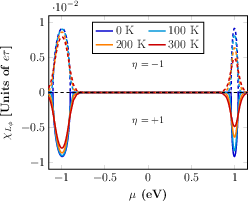
Figure 7: Temperature and chemical potential dependence of π1; quantifying thermal smearing and the unipolarity of orbital accumulation.
Orbital-to-Spin Transduction: Comparison with Conventional SOC
The spin Edelstein effect is conventionally limited by the relativistic SOC scale (π2). Here, orbital-to-spin conversion is modeled via a local SOC channel of the form π3, with coupling strength π4. The magnitude of induced spin polarization is proportional to geometrically generated orbital hybridization (π5) and π6, and can exceed that of the conventional route, even when atomic SOC is weak.
The sign of the induced spin polarization is chirality-dependent, inverting upon reversal of helical handedness. The model provides explicit formulas for effective spin splitting due to OAM texture and outlines scenarios under which bulk molecular conversion dominates over interfacial mechanisms.
Practical and Theoretical Implications
The conclusions provide a rigorous mechanistic foundation whereby chirality alone—without atomic SOC—can induce OAM textures and current-induced responses in low-dimensional systems. This has direct implications for spin injection and selectivity in chiral molecular and crystalline conductors. The analysis distinguishes equilibrium persistent OAM currents (yielding end magnetization) from the nonequilibrium Edelstein channel (yielding OAM textures).
The model's parity-driven prohibition of linear longitudinal OAM conductivity in single helices informs future theoretical and device architectures, suggesting double-helix systems or symmetry engineering as routes to restore conductivity. The orbital injection mechanism offers substantial advantages for spintronics, as OAM overlap scales (π7, π8) can be orders of magnitude larger than SOC, underpinning the observed strong spin signals in chiral systems.
Experimental extensions are suggested, including Kerr rotation and surface magnetization measurements in chiral crystals (e.g., Te, dichalcogenides, distorted perovskites), as well as careful racemic separation and interface studies to probe end magnetization and bulk versus surface transduction.
Conclusion
This paper establishes that orbital angular momentum emerges as a primary transport channel in chiral one-dimensional systems via geometrically enforced hybridization, even in the absence of atomic SOC. The minimal three-orbital tight-binding helix model reveals the centrality of odd-in-momentum inter-orbital mixing, parity-driven selection rules for linear response, and enhanced orbital-to-spin conversion efficiency. The findings sharpen theoretical understandings of CISS, clarify the limits of equilibrium and nonequilibrium OAM transport, and delineate practical paths forward in orbitronics and chiral spintronics. Future developments will likely explore more complex geometries to restore forbidden conductivity channels and probe orbital textures in a broader class of materials, catalyzing new designs for low-dissipation spintronic devices.