Hand-in-the-Loop: Improving Dexterous VLA via Seamless Interventional Correction
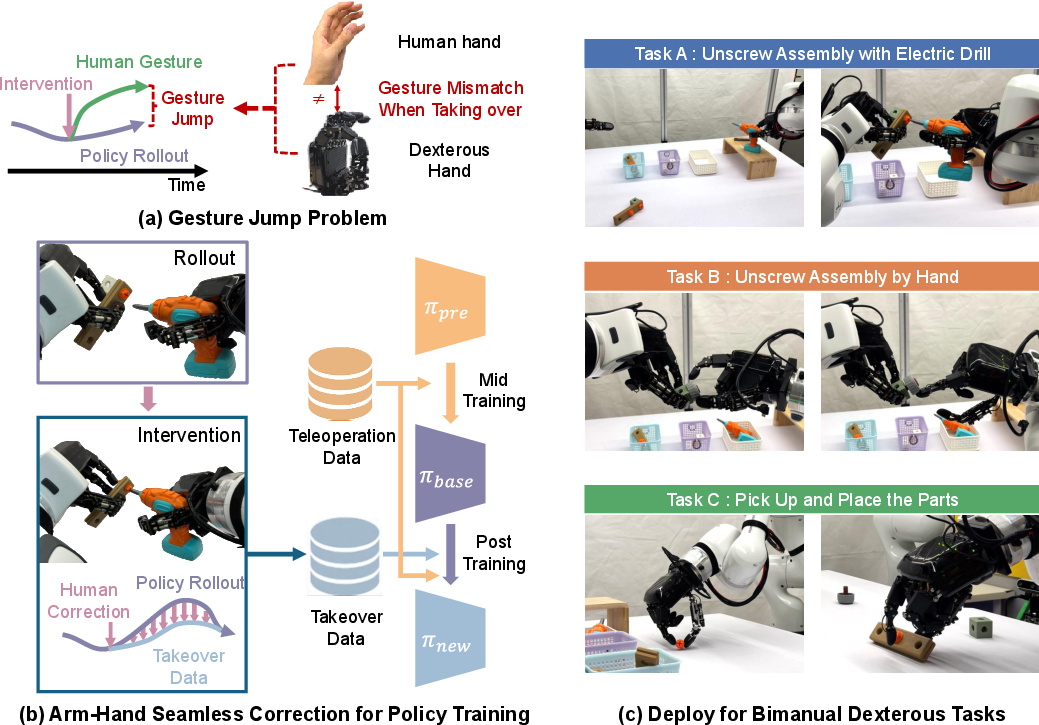
Abstract: Vision-Language-Action (VLA) models are prone to compounding errors in dexterous manipulation, where high-dimensional action spaces and contact-rich dynamics amplify small policy deviations over long horizons. While Interactive Imitation Learning (IIL) can refine policies through human takeover data, applying it to high-degree-of-freedom (DoF) robotic hands remains challenging due to a command mismatch between human teleoperation and policy execution at the takeover moment, which causes abrupt robot-hand configuration changes, or "gesture jumps". We present Hand-in-the-Loop (HandITL), a seamless human-in-the-loop intervention method that blends human corrective intent with autonomous policy execution to avoid gesture jumps during bimanual dexterous manipulation. Compared with direct teleoperation takeover, HandITL reduces takeover jitter by 99.8% and preserves robust post-takeover manipulation, reducing grasp failures by 87.5% and mean completion time by 19.1%. We validate HandITL on tasks requiring bimanual coordination, tool use, and fine-grained long-horizon manipulation. When used to collect intervention data for policy refinement, HandITL yields policies that outperform those trained with standard teleoperation data by 19% on average across three long-horizon dexterous tasks.
Paper Prompts
Sign up for free to create and run prompts on this paper using GPT-5.
Top Community Prompts
Explain it Like I'm 14
Overview
This paper is about teaching robot hands to do tricky things better by letting a human step in smoothly when the robot starts to mess up. The robots use “Vision-Language-Action” (VLA) models, which means they look at the world (vision), understand instructions (language), and then move (action). That works well for simple grippers, but it’s much harder for human-like robot hands with many moving fingers. Small mistakes can build up over time and cause failures, like dropping tools.
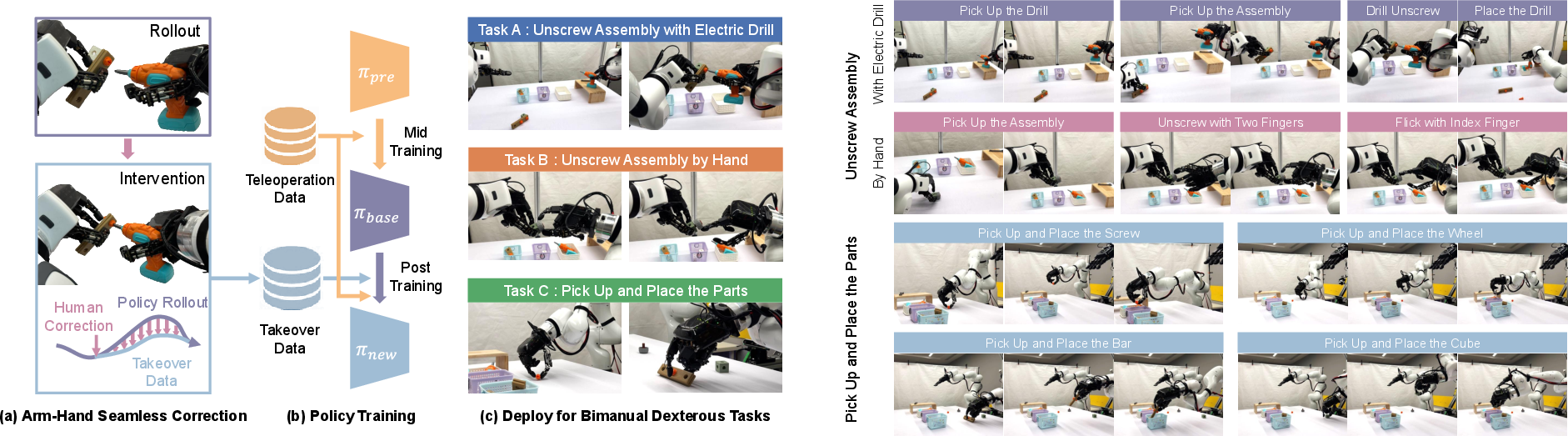
The authors introduce Hand-in-the-Loop (HandITL), a way for a person to gently guide or “nudge” the robot in the moment—without causing sudden, harmful jumps in the robot’s hand shape. Those jumps (they call them “gesture jumps”) can break a delicate grip. HandITL blends the human’s corrections with the robot’s ongoing actions, keeping movements smooth and safe.
Objectives and Questions
The paper focuses on four simple questions:
- Can we stop the “gesture jump” that happens when a human takes over control mid-task?
- After a human takes over, can the robot still keep a stable grip and finish precise tasks well?
- If we collect these real-time human corrections, can we use them to train the robot to do better next time than just using normal teleoperation demos?
- Can this approach handle long, complicated, two-handed tasks, like using a drill to unscrew parts?
Methods: How HandITL Works
Think of HandITL like power steering for robot hands: the robot drives itself, but a person can gently guide the wheel without yanking it.
- Robot setup: Two robotic arms each hold a human-like 21-joint hand (lots of moving parts). A person wears motion-tracking gloves and VR controllers to share control. Foot pedals switch modes quickly so the person can jump in at the right moment. Cameras give the robot a view of the scene.
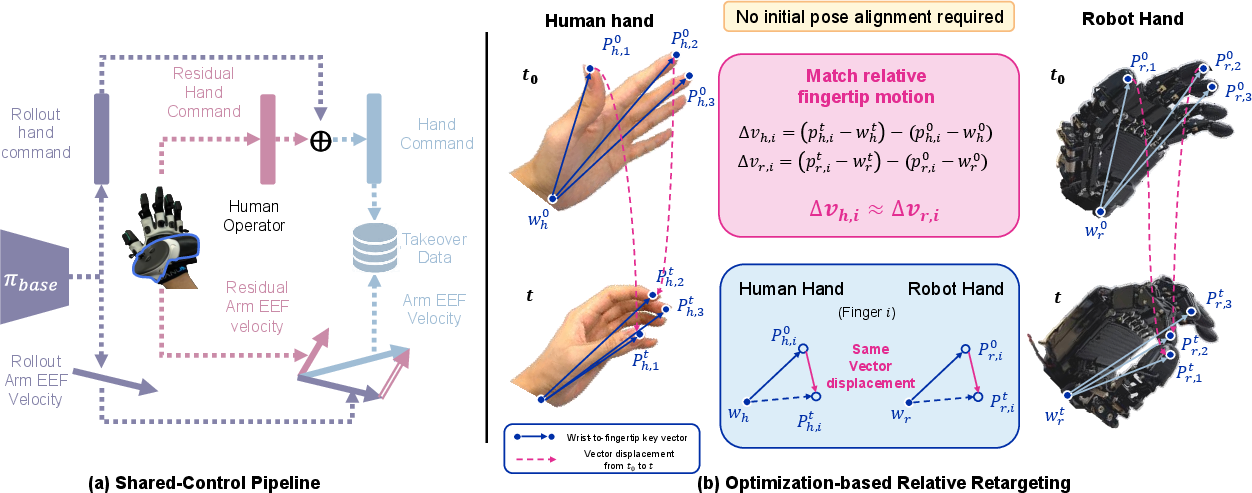
- Smooth hand corrections (relative retargeting):
- Problem: If the robot is holding something and a human suddenly takes over with a different hand shape, the robot “snaps” to the human pose. That can break the grip.
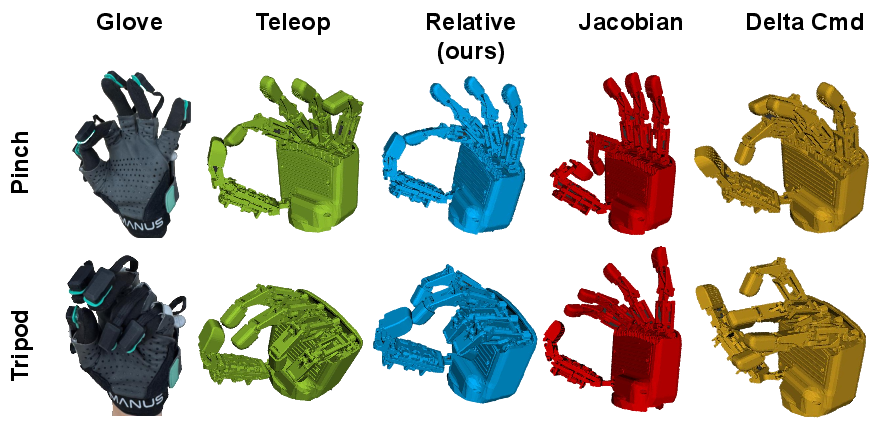
- Solution: Instead of copying the human’s absolute hand shape, HandITL follows the human’s small changes from the current moment. It’s like saying, “Start from exactly where the robot hand is now, then follow the human’s tiny adjustments.” This prevents sudden jumps.
- Safety and stability: The method also includes rules to keep fingers from colliding, encourages good pinch shapes (for reliable gripping), and avoids jittery motions so everything stays steady.
- Gentle arm corrections (shared control by velocity):
- For the arms, the human’s wrist motions are treated as small “nudges” added to what the robot already plans to do. If the human stops moving, the nudges fade out automatically. No need to “recenter” your hands—there’s no drift.
- Two ways to help:
- Full Takeover: The human’s corrections dominate when a big recovery is needed.
- Copilot: The robot stays in charge, and the human adds light, local corrections—like lane-keep assist in a car.
- Training with what really happens (on-policy data):
- They record full robot runs, including where the human stepped in. Those moments are especially valuable because they show how to fix the exact mistakes the robot makes in real life.
- Later, they fine-tune the robot’s policy on this “correction data,” so the robot learns to avoid or recover from those same problems next time.
Main Findings
Across tools, two-handed coordination, and precise, long tasks, HandITL made control smoother and results better. Key results include:
- Much smoother takeovers:
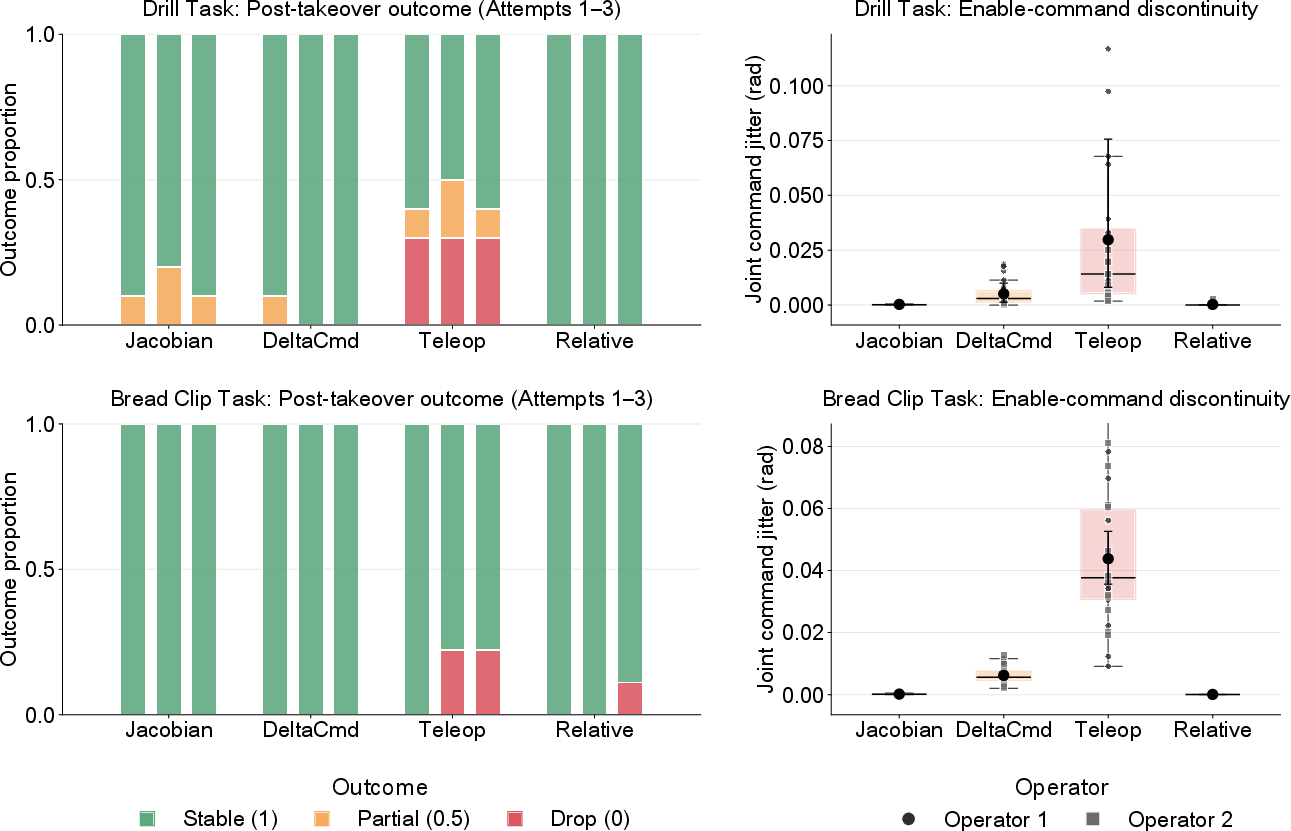
- HandITL cut takeover “jitter” (the sudden jump in hand commands) by about 99.8% compared to direct teleoperation switching. This helps keep grips stable instead of dropping objects.
- Better after-takeover performance:
- On a parts-picking task, it reduced grasp failures by 87.5% and made the task 19.1% faster on average than standard teleoperation.
- It kept precise grips more often (like maintaining a pinch) and avoided awkward finger positions that lead to drops.
- Stronger learning from interventions:
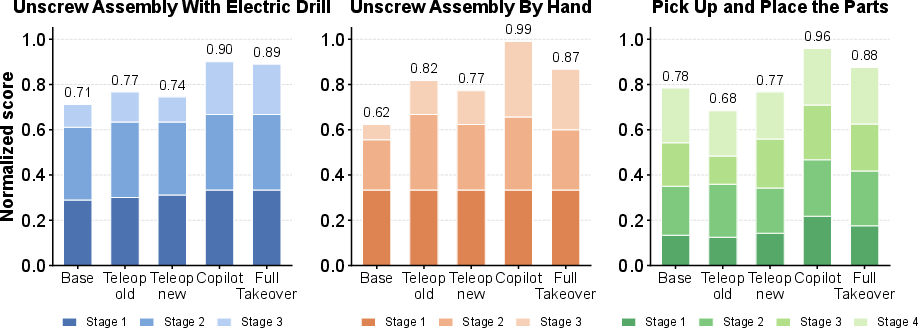
- When they used HandITL’s human-correction data to fine-tune the robot, the policies performed better than policies trained with the same amount of ordinary teleoperation data—by about 19% on average across three long, dexterous tasks.
- “Copilot” data (where the robot stays in charge and the human provides small nudges) worked best overall, likely because it stays closest to how the robot normally behaves.
Why this matters: Long tasks with lots of finger contact are where small errors snowball. HandITL helps catch and fix those errors in the moment and then teaches the robot how to avoid them in the future.
Implications and Impact
- More reliable robot hands in the real world: By preventing sudden hand-shape jumps, robots can keep stable grips on delicate or heavy objects, use tools more safely, and finish longer tasks without failing midway.
- Easier human-robot teamwork: People can smoothly help robots only when needed, like a driving assistant, without taking full control or causing disruptions.
- Better data for learning: Instead of just showing robots examples of “perfect” demos, we also teach them how to recover from their own mistakes. That makes training more efficient and improves real-world robustness.
- What’s next: The authors note two main limits. First, human corrections can be noisy, so smarter filtering and selection of the best corrections would help. Second, ultra-precise actions (like millimeter-perfect alignment) are still hard with vision alone. Adding touch/force sensing could take performance further.
In short, HandITL is a practical step toward robot hands that can handle complicated, real-life tasks—and learn faster—by letting humans guide them smoothly at just the right moments.
Knowledge Gaps
Knowledge Gaps, Limitations, and Open Questions
Below is a consolidated list of concrete gaps that remain unresolved and can guide future research.
- Lack of theoretical guarantees: No formal stability, safety, or passivity analysis for (i) optimization-based relative hand retargeting under contact constraints and (ii) velocity residual injection for arm shared control.
- Unclear sensitivity to latency and noise: End-to-end control latency (glove/VR tracking + optimization + control loop) is not quantified; robustness to tracking noise, dropouts, and communication delays remains untested.
- Hyperparameter transparency and ablation: The precise forms and schedules of gates and weights (e.g., βi(d), ωj(d), αj(d), γ, λreg, safety margins, Huber threshold δ, EMA parameters) are not fully specified or ablated for performance/robustness trade-offs.
- Compute and real-time feasibility: No reporting of per-step solve time, worst-case optimization latency, or CPU/GPU resource usage; scalability to higher control rates or more complex constraints is unknown.
- Contact safety metrics: Reductions in “command discontinuity” are reported, but no direct evaluation of contact force transients, object pose disturbance at takeover, or peak joint torque/velocity spikes.
- Generalization beyond tested grasps: The method emphasizes pinch and some power grasps; effectiveness for diverse grasp taxonomies (tripod, lateral pinch, spherical, hook) and in-hand regrasp strategies is not evaluated.
- Bimanual coordination under shared control: How residual arm corrections on two arms are coordinated to avoid interference or conflicting corrections is not analyzed; no cross-arm coupling strategy or metric for coordination quality.
- Automatic intervention triggering: Interventions rely on human pedals; no policy-driven confidence estimation, OOD detection, or automatic request-for-help mechanism is explored.
- Authority blending policies: Human authority weights (βa, βh) are static and hand-tuned; no study on adaptive, context-aware blending or learned arbitration between human and policy.
- Data selection for fine-tuning: Executed commands across entire rollouts (including autonomous segments) are used as labels; no segmentation, filtering, or weighting of high-quality corrective segments vs. suboptimal human actions.
- Robustness to suboptimal human input: No analysis of how erroneous or noisy human corrections affect policy learning or how to detect/prune harmful takeover data.
- Offline vs. online learning: Post-training is purely offline; safety-aware online adaptation or incremental fine-tuning during deployment (with safeguards) remains unexplored.
- Sample-efficiency characterization: Only a single 1-hour post-training budget is reported; no scaling study quantifies performance vs. added minutes of intervention or teleoperation data.
- Distribution-matching rationale: The claim that copilot data stays closer to policy rollouts is plausible but not empirically verified via state-action distribution metrics or representational drift analyses.
- Baseline coverage: No head-to-head comparisons on dexterous tasks with recent shared-control/IIL systems (e.g., CR-DAgger, RoboCopilot) to contextualize gains under matched settings.
- Fairness of teleoperation baselines: “Teleop_new” data is generic; targeted teleop data that specifically emulates policy-induced failure states is not evaluated as a stronger baseline.
- Operator factors: Only two operators are included; impacts of operator expertise, learning curves, fatigue, cognitive load, and inter-operator variability are not quantified.
- Cross-embodiment portability: The approach is validated on a specific setup (Bytedexter V2 hands, Franka arms, Manus gloves, Quest controllers); portability to other hands/arms/gloves and to different kinematics is untested.
- Calibration drift and anthropometrics: Sensitivity to miscalibration, hand-size mismatch, and long-session drift in human-to-robot frame alignment is not evaluated.
- Workspace and singularity handling: Residual twist injection behavior near kinematic limits or singularities, and recovery strategies for workspace resets, are not formally analyzed.
- Force/torque control integration: The arm controller uses task-space PD with feedforward terms; benefits of compliance control, impedance/admittance tuning, or passivity constraints under contact are not investigated.
- Perception limitations: Performance under occlusions, lighting changes, and dynamic clutter is not quantified; the system is vision-dominant with limited study of perception failure modes.
- Missing tactile/force sensing: Recognized by authors; no integration of tactile/force feedback for contact state estimation, slip detection, or precision alignment.
- Task diversity and generalization: Only three long-horizon tasks are evaluated; generalization to novel objects, textures, mass distributions, and unseen task compositions is unclear.
- Success metrics breadth: The main long-horizon metric is sub-goal completion; full task success rates, recovery quality metrics, and human effort metrics (number/duration of interventions) need broader reporting.
- User experience and ergonomics: No formal user study on comfort, intuitiveness, mental workload, or long-session fatigue with dual-pedal, glove + VR controller setup.
- Conflict resolution during copilot mode: No explicit arbitration or conflict resolution logic when human corrections significantly diverge from policy commands over sustained intervals.
- Safety under heavy or hazardous tools: The approach is not evaluated for safety with heavier tools/objects, sharp tools, or environments requiring strict safety constraints.
- Prompting and instruction robustness: Effects of different language prompts/instructions on the VLA policy under human-in-the-loop corrections are not studied.
- Policy internals under intervention: How human interventions alter the policy’s internal representations, attention, or action priors is not analyzed (e.g., via probing or representation similarity).
- Data and code availability: While a project page is referenced, reproducibility depends on access to implementation details (loss definitions, controller parameters); completeness of released assets is not stated.
Practical Applications
Immediate Applications
Below are deployable use cases that can be implemented with today’s hardware and software stack described in the paper (dual 7-DoF arms, high-DoF hands, VR controllers + gloves, multi-view RGB-D, VLA policy with the HandITL interface).
- Manufacturing (electronics/consumer goods) — “Copilot” screwdriving, fastening, and small-part assembly
- What: Use HandITL’s seamless takeover and shared-control modes to stabilize grasps, align parts, squeeze triggers, and correct small pose errors during fine assembly (e.g., unscrewing assemblies with an electric drill, precision part placement).
- Why now: The paper shows 99.8% reduction in takeover jitter, 87.5% fewer grasp failures, and 19.1% faster completions versus conventional teleoperation, directly translating to lower scrap and higher throughput on contact-rich steps.
- Potential tools/products/workflows: ROS2 “HandITL Copilot” node; foot-pedal takeover UI; workstation retrofit kit (RGB-D cameras, gloves, VR controllers); per-task skill playlists with operator-in-the-loop checkpoints; quality dashboards logging interventions.
- Dependencies/assumptions: Operator available for intermittent corrections; reliable calibration of gloves/VR; VLA policy already competent at base task; safety-rated cobot cell; low-latency control network.
- High-mix/low-volume rework and repair cells
- What: Deploy dexterous policies that handle variable fixtures and parts; operators nudge or fully take over only at failure-prone states (copilot or takeover mode) to avoid drops and recover from OOD states.
- Potential tools/products/workflows: Intervention-triggered “rework macros” that get added to the training set (HG-DAgger-style); shift-level continual fine-tunes to adapt to new SKUs.
- Dependencies/assumptions: Short on-site fine-tuning windows; data management pipeline for mixing intervention data with base datasets.
- Warehouse and e-commerce fulfillment — delicate handling and packaging
- What: Shared control for opening bags/boxes, peeling tape, inserting fragile items, or manipulating clips/tags; operator micro-corrections prevent damage and speed recovery from near-failure grasps.
- Potential tools/products/workflows: “Damage-avoidance copilot mode” for fragile SKUs; incident heatmaps tied to intervention frequency to prioritize policy updates.
- Dependencies/assumptions: Sufficient camera coverage; gloves/VR-compatible PPE; stable SKUs or fast policy refresh cycles.
- Laboratory automation — caps, clips, and tool use around liquids and small instruments
- What: Stabilize and correct fine manipulations (e.g., opening vial caps, managing bread clips, aligning pipette racks) during VLA rollouts, capturing high-value correction data for later fine-tuning.
- Potential tools/products/workflows: “On-policy correction capture” button integrated with LIMS; auto-segmentation of intervention segments for retraining.
- Dependencies/assumptions: Minimal splash/spill risks; protective enclosures; policy already near-solve baseline skills.
- Teleoperation vendors and integrators — retrofit to reduce “gesture jumps”
- What: Integrate optimization-based relative hand retargeting and velocity-based arm residuals into existing teleop stacks to eliminate abrupt configuration mismatches at handover.
- Potential tools/products/workflows: “Gesture-jump suppressor” plugin; calibration wizards; drop-in ROS2 package; SDK for glove/VR device adapters.
- Dependencies/assumptions: Access to low-level hand kinematics; compute headroom for per-step optimization; consistent hand frames across devices.
- Academic/industrial R&D — on-policy data pipelines that actually move the needle
- What: Replace pure-demo fine-tuning with HandITL intervention data to improve robustness to compounding errors in long-horizon tasks (paper reports ~19% average improvement).
- Potential tools/products/workflows: Intervention-aware dataloaders; copilot-first data collection protocols; evaluation harnesses scoring sub-goals and OOD recoveries.
- Dependencies/assumptions: Reproducible evaluation tasks; careful data mixing ratios; guardrails to filter noisy human corrections.
- Safety and compliance for cobots — human-oversight workflows
- What: Use copilot/takeover logs and reduced-discontinuity handover to meet human-oversight expectations and lower incident risk (fewer drops, fewer abrupt motions).
- Potential tools/products/workflows: Intervention audit trails; “request-human” prompts when OOD likelihood spikes; compliance reporting for ISO/TS 15066-aligned risk assessments.
- Dependencies/assumptions: Policy monitors to detect drift/OOD; secure storage of operator data; site-specific safety review.
Long-Term Applications
These use cases are plausible extensions that require further research, scaling, new sensing, or regulatory progress before broad deployment.
- Assistive home and eldercare robotics (healthcare)
- What: Shared-control support for dressing, feeding, medication bottle opening, plug insertion, and appliance operation; caregivers provide micro-corrections without full teleop.
- Potential tools/products/workflows: “Care Copilot” mode; caregiver-friendly handheld takeover triggers; teach-by-correction routines to personalize for a household.
- Dependencies/assumptions: Strong safety guarantees, tactile/force sensing for delicate human contact, robust perception in cluttered homes, caregiver training, regulatory acceptance.
- Surgical and interventional robotics (healthcare)
- What: Surgeon-in-the-loop blending with precise autonomy for tool manipulation and tissue handling, using relative retargeting to avoid handover discontinuities.
- Potential tools/products/workflows: Haptic-enabled HandITL variant; certified logging of interventions; sterile, ergonomic control interfaces.
- Dependencies/assumptions: Millimeter-level accuracy, rich multimodal sensing, rigorous validation, clinical trials, and regulatory approvals.
- Hazardous environment maintenance (energy, nuclear, offshore, space)
- What: Remote expert interventions during dexterous tasks like valve turning, connector manipulation, or sample collection where autonomy struggles.
- Potential tools/products/workflows: “Robot Ops Center” for on-call experts; low-bandwidth residual control protocols; fleetwide learning from aggregated intervention logs.
- Dependencies/assumptions: Robust comms with variable latency; radiation/temperature-hardened sensors; fail-safe autonomy fallback; site certification.
- Humanoid and general-purpose robot copilot for dexterous hands (robotics)
- What: Port HandITL to humanoids with anthropomorphic hands for household/industrial generalists; seamless human corrections during long-horizon chores or assembly.
- Potential tools/products/workflows: Humanoid HandITL SDK; whole-body shared-control blending; skill libraries with copilot-tuned subroutines.
- Dependencies/assumptions: Reliable whole-body balance during takeovers; broader task libraries; powerful onboard compute; standardized hand kinematics.
- Tactile- and force-aware HandITL for ultra-precise manipulation
- What: Fuse fingertip tactile, force/torque, and high-res vision to tackle millimeter-level alignment (the paper notes this as a limitation).
- Potential tools/products/workflows: Tactile-informed retargeting objectives; force-compliant residual control; self-calibrating sensor fusion pipelines.
- Dependencies/assumptions: Robust, affordable tactile skins; low-latency fusion; updated training objectives that exploit tactile labels.
- Continual, cross-site policy improvement via intervention aggregation (software/ML ops)
- What: Centralize on-policy corrections from many facilities; schedule periodic foundation-policy refreshes that preserve local skills while improving global robustness.
- Potential tools/products/workflows: Federated intervention learning; data governance and drift dashboards; automated segment selection and preference learning to denoise human data.
- Dependencies/assumptions: Privacy-preserving data sharing; compute budgets; MLOps for versioning, rollback, and validation across sites.
- Standardization and policy frameworks for human-in-the-loop dexterous AI
- What: Define certification criteria for seamless handover (e.g., command discontinuity thresholds), intervention logging standards, and human-oversight protocols aligned with high-risk AI regulations.
- Potential tools/products/workflows: Conformance test suites; benchmark tasks and metrics (grasp stability post-handover, OOD recovery scores); training curricula for operators.
- Dependencies/assumptions: Cross-industry working groups; public datasets; collaboration with standards bodies and regulators.
- Remote intervention marketplaces and service models (business/operations)
- What: Third-party “intervention-as-a-service” where expert operators provide on-demand shared control to many deployed robots during tricky episodes.
- Potential tools/products/workflows: SLA-backed remote ops centers; billing tied to intervention time; secure, audited control channels.
- Dependencies/assumptions: Strong security, standardized APIs for HandITL-like interfaces, clear liability frameworks, and reliable connectivity.
- Education and workforce upskilling
- What: Curricula and simulators that teach intervention strategies, copilot ergonomics, and data-efficient correction collection for dexterous robots.
- Potential tools/products/workflows: VR-based training twins; graded exercises on long-horizon, contact-rich tasks; competency certification.
- Dependencies/assumptions: High-fidelity simulation of dexterous contacts; portable training hardware; agreed competency standards.
Glossary
- Anthropomorphic hands: Multi-fingered robotic hands designed to resemble and function like human hands. "multi-fingered anthropomorphic hands"
- Bimanual: Involving coordinated use of two robot arms/hands simultaneously. "bimanual dexterous manipulation"
- Command discontinuity: An abrupt change in control commands that can destabilize a robot during a takeover. "reduces takeover-induced command discontinuity by up to two orders of magnitude"
- Compounding errors: Small policy mistakes that accumulate over time and lead to larger failures in long tasks. "VLA models are prone to compounding errors in dexterous manipulation"
- Contact-rich dynamics: Interaction regimes where persistent, complex contacts between robot and objects dominate behavior. "contact-rich dynamics amplify small policy deviations over long horizons"
- Copilot shared control: An intervention mode where the policy remains primary while the human injects local corrective inputs. "copilot shared control"
- Covariate shift: Mismatch between training and deployment state distributions that degrades performance. "reduce covariate shift through expert queries or interventions during rollouts"
- Dataset Aggregation (DAgger): An interactive imitation learning algorithm that aggregates expert labels on the learner’s visited states. "Dataset Aggregation (DAgger)"
- Delta-command retargeting: A takeover strategy applying only the change in teleoperation commands relative to takeover time. "Delta-command retargeting"
- Exponential Moving Average (EMA): A low-pass filter that smooths signals by exponentially weighting recent observations. "Exponential Moving Average (EMA)"
- Feedforward twist: A predicted spatial velocity (linear and angular) provided by the policy to aid tracking. "the VLA outputs the target pose and feedforward twist"
- Full takeover: An intervention mode where human commands dominate to perform substantial recovery. "full takeover"
- Global Shaping: A loss term that guides overall hand shape based on relative fingertip motion when the hand is open. "Global Shaping"
- HG-DAgger: A human-gated variant of DAgger where the human intervenes to provide corrective control during rollouts. "HG-DAgger-style process"
- High-degree-of-freedom (DoF): Refers to systems with many independently controllable joints or parameters. "high-degree-of-freedom (DoF)"
- Hinge penalty: A constraint term activated only when a safety limit is violated, penalizing further violations. "The hinge penalty activates only when"
- Jacobian-based mapping: Computing joint updates from desired fingertip displacements using the kinematic Jacobian. "Jacobian-based mapping"
- Kinematic safety: Constraints ensuring commanded motions remain within safe joint and linkage limits. "kinematic safety"
- On-policy correction data: Intervention data collected while the policy controls the robot, capturing failures it actually induces. "on-policy correction data"
- Out-of-distribution (OOD) states: States not represented in the training data where policies often fail. "out-of-distribution (OOD) states"
- Pinch grasping: Grasping mode using thumb-to-finger opposition to hold small objects precisely. "For pinch grasping, we define a nominal target opposition vector"
- Pose-based retargeting: Mapping human hand poses to robot hand configurations in absolute coordinates. "With conventional pose-based retargeting"
- Proprioception: Internal sensing of robot joint states and configurations used as part of observations. "including multi-view RGB-D images and proprioception"
- Receding-horizon: Executing the first action of a predicted sequence and replanning at each step. "in a receding-horizon manner"
- Relative retargeting: Mapping incremental human hand motions (not absolute poses) to robot commands to avoid jumps. "relative retargeting method"
- Residual twists: Small, transient spatial velocity inputs added on top of policy commands for fine corrections. "injects the operator's transient wrist motion as residual twists"
- Safety margin: A predefined minimum distance to avoid collisions between robot links/joints. "the safety margin"
- Shared autonomy: A control paradigm where human and autonomy collaboratively influence robot actions. "limited hand-arm coordination under shared autonomy"
- Shared-control interface: A system that blends human corrective inputs with autonomous policy commands. "shared-control interface"
- Structural Safety: A loss term penalizing configurations that bring robot links too close, enforcing collision avoidance. "Structural Safety"
- Sub-goal Completion Score: An evaluation metric summing the completion of ordered sub-stages within long tasks. "Sub-goal Completion Score"
- Task-space PD tracker: A controller regulating end-effector pose using proportional-derivative control in Cartesian space. "A task-space PD tracker"
- Teleoperation: Human control of a robot remotely, often via motion capture or specialized devices. "teleoperation"
- Temporal Regularization: A loss term discouraging rapid joint changes to reduce jitter in commanded motions. "Temporal Regularization"
- Thumb-to-fingertip opposition vectors: Geometric descriptors capturing thumb-finger relationships critical for precision pinches. "thumb-to-fingertip opposition vectors"
- Velocity-based shared control: Blending human wrist-velocity inputs with policy commands to enable smooth corrections. "velocity-based shared-control interface"
- Vision-Language-Action (VLA): Models that map visual and language inputs to robot actions for manipulation. "Vision-Language-Action (VLA) models"
- Wrist-to-fingertip vectors: Vectors from the wrist to fingertips used to represent global finger motion. "wrist-to-fingertip vectors"
Collections
Sign up for free to add this paper to one or more collections.

