- The paper introduces meschers which use per-vertex screen-space coordinates and per-edge depth offsets to maintain local geometric consistency without global integrability.
- It leverages discrete exterior calculus to enable standard operations such as smoothing, subdivision, and heat-based geodesic computation on impossible objects.
- The method accurately handles depth ordering and relighting, bridging computational geometry techniques with human perceptual phenomena.
Meschers: Geometry Processing of Impossible Objects
Introduction and Motivation
The paper "Meschers: Geometry Processing of Impossible Objects" (2605.14960) introduces a novel computational representation for impossible objects—geometric constructs that are locally consistent to the human visual system but globally incompatible with $3$D embedding. Traditional approaches to rendering such objects split into "cut representations" that divide geometry into locally valid pieces, or "bent representations" that deform surfaces to make globally impossible configurations appear plausible from certain views. These approaches compromise geometric processing: cuts disrupt local continuity needed for smoothing and subdivision, bends break normal consistency and relighting accuracy.
Meschers sidestep these limitations by storing screen-space vertex positions and relative depth offsets per edge, formalized via discrete exterior calculus (DEC). This enables locally valid normal and curvature calculations without forcing global $3$D integrability, facilitating geometry processing tasks such as subdivision, smoothing, intrinsic geodesic computation, and inverse rendering directly on geometry that remains perceptually impossible.
Mescher Representation and Mathematical Foundation
A mescher is defined as an oriented triangle mesh with per-vertex screen-space x, y coordinates and per-edge relative depth ζ (Figure 1). The ζ values are interpreted as discrete $1$-forms: local integrability is enforced by requiring that the oriented sum of ζ around each triangle is zero, matching the discrete Poincaré lemma constraint. This guarantees local embeddability: normals, triangle areas, and angles are well-defined per face. Global integrability is not necessary, allowing loops with nonzero total depth shift.
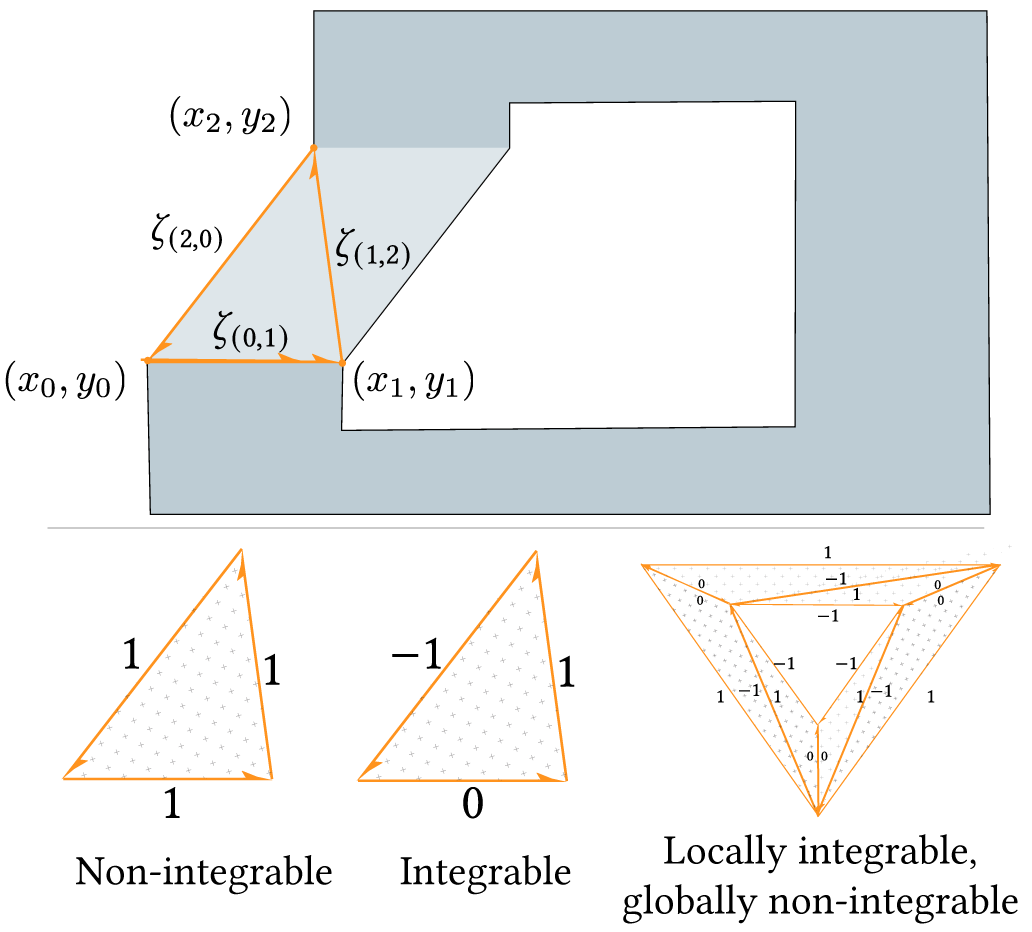
Figure 1: A mescher is defined by triangle meshes with vertices holding screen-space coordinates and edges storing directed relative depth offsets; local triangle consistency is enforced, global loops may remain inconsistent.
The DEC machinery, such as discrete exterior derivatives (d01 for vertices-to-edges, d12 for edges-to-faces), and discrete Hodge star matrices enables the construction of Laplacians and other operators fundamental to geometry processing. The $3$0 field itself admits a Hodge decomposition into exact (curl-free), divergence-free, and harmonic components. Mescher impossibility is characterized by a nonzero harmonic component; possible objects have $3$1.
Depth Ordering and Partial Ordering Structures
Meschers extend relative depth storage by allowing partial depth ordering among faces—a directed acyclic graph encoding additional cues (T-junctions, overlap) critical for perceptual depth assignment (Figure 2). This mechanism is essential for representing and rendering objects with disconnected patches where local depth consistency does not suffice to resolve global overlap relations.
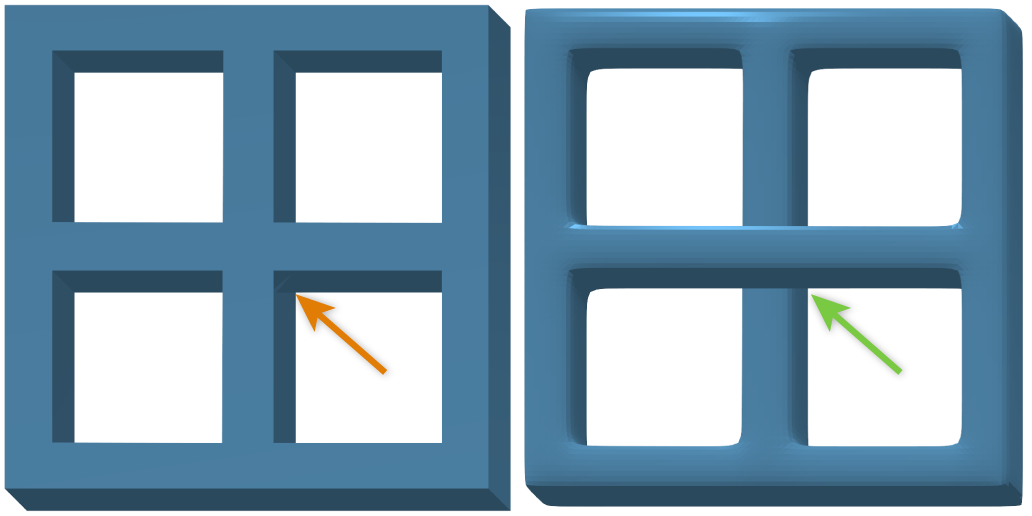
Figure 2: Adding a partial depth ordering enables rendering globally impossible configurations via acyclic ordering overlays.
Geometry Processing Operations
Rendering and Relighting
Rendering meschers involves flattening triangles in screen-space and computing normals from $3$2, making them compatible with directional and environment map illumination. Relighting can be achieved via standard shading models since local geometry remains consistent; meschers avoid artifacts of bent approaches where perturbed normals break shading continuity (Figure 3).
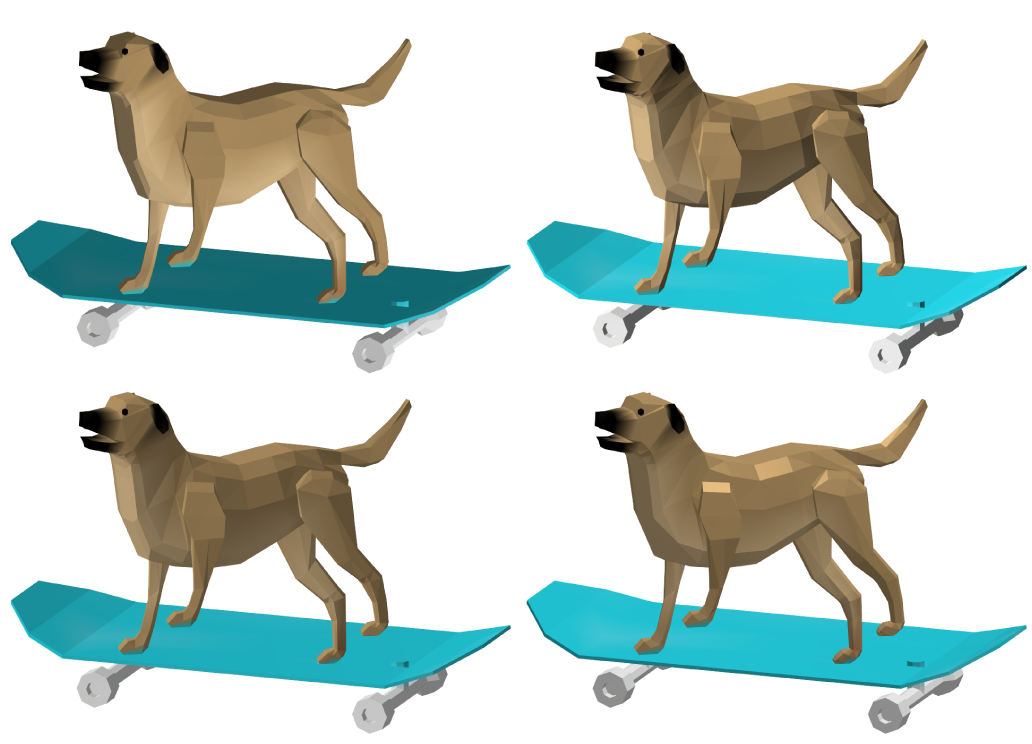
Figure 3: Meschers enable relighting impossible geometry; certain lighting increases perceptual strength of the illusion.
Subdivision and Smoothing
Subdivision is performed by inserting midpoints and creating new triangles, with $3$3 subdivided linearly under orthographic projection. Smoothing, as Laplacian smoothing, applies to both screen-space coordinates and to the curl-free part of $3$4. Harmonic components are invariant to smoothing, resulting in stylization or correction of modeling artifacts (Figure 4).

Figure 4: Laplacian smoothing stylizes or regularizes mescher geometry, independently affecting screen-space and depth.
Intrinsic Geodesics and Heat Diffusion
Geodesic computation (heat method) leverages mescher's intrinsic metric: heat diffusion is solved via DEC Laplacians, gradients are calculated locally, and shortest paths re-integrated using Poisson solves (Figure 5). This process is impossible in bent or cut approaches due to disrupted local geometry.
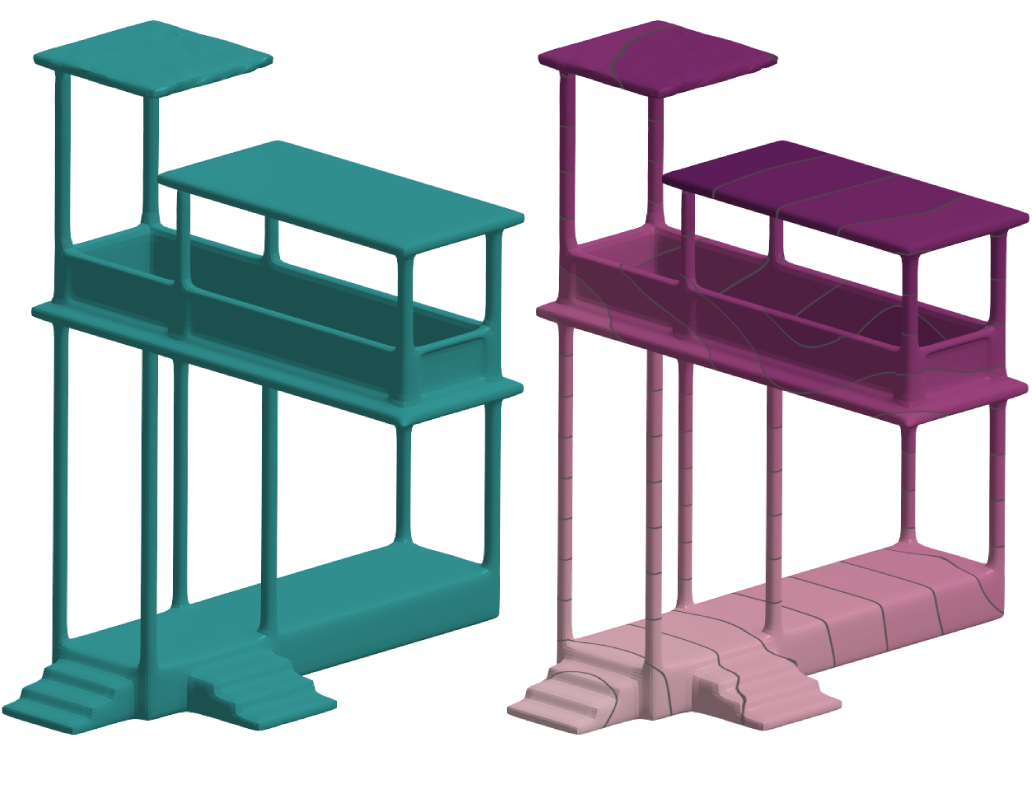
Figure 5: Mescher geodesics are computed intrinsically via the heat method, measuring paths from source regions.
Inverse Rendering
Meschers support gradient-based inverse rendering: screen-space coordinates and $3$5 are optimized to minimize the error between rendered and target images using differentiable rasterization (SoftRas) and Sobolev gradient descent. The pipeline can reconstruct impossible objects from images, confirming impossibility via nonzero harmonic content (Figure 6).
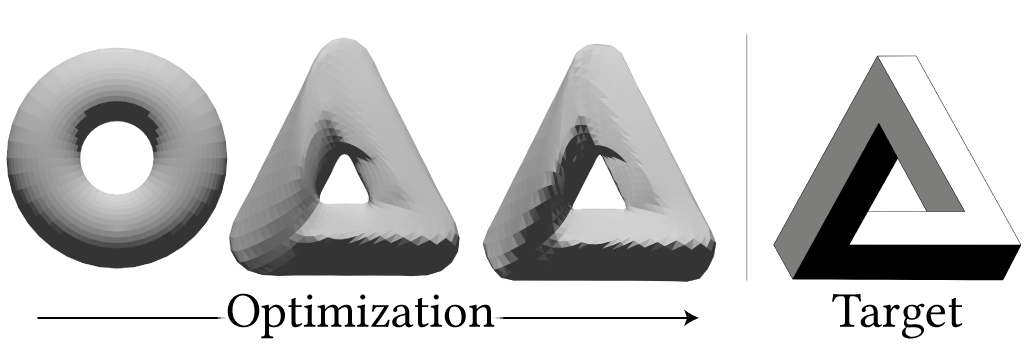
Figure 6: Gradient-based inverse rendering recovers mescher representations from images, including Penrose triangle.
Embedding and Conversion
Meschers generalize both cut and bent representations. By specifying cuts or removing harmonic components, one can recover traditional models, but meschers uniquely enable full geometry processing on impossible forms (Figure 7).
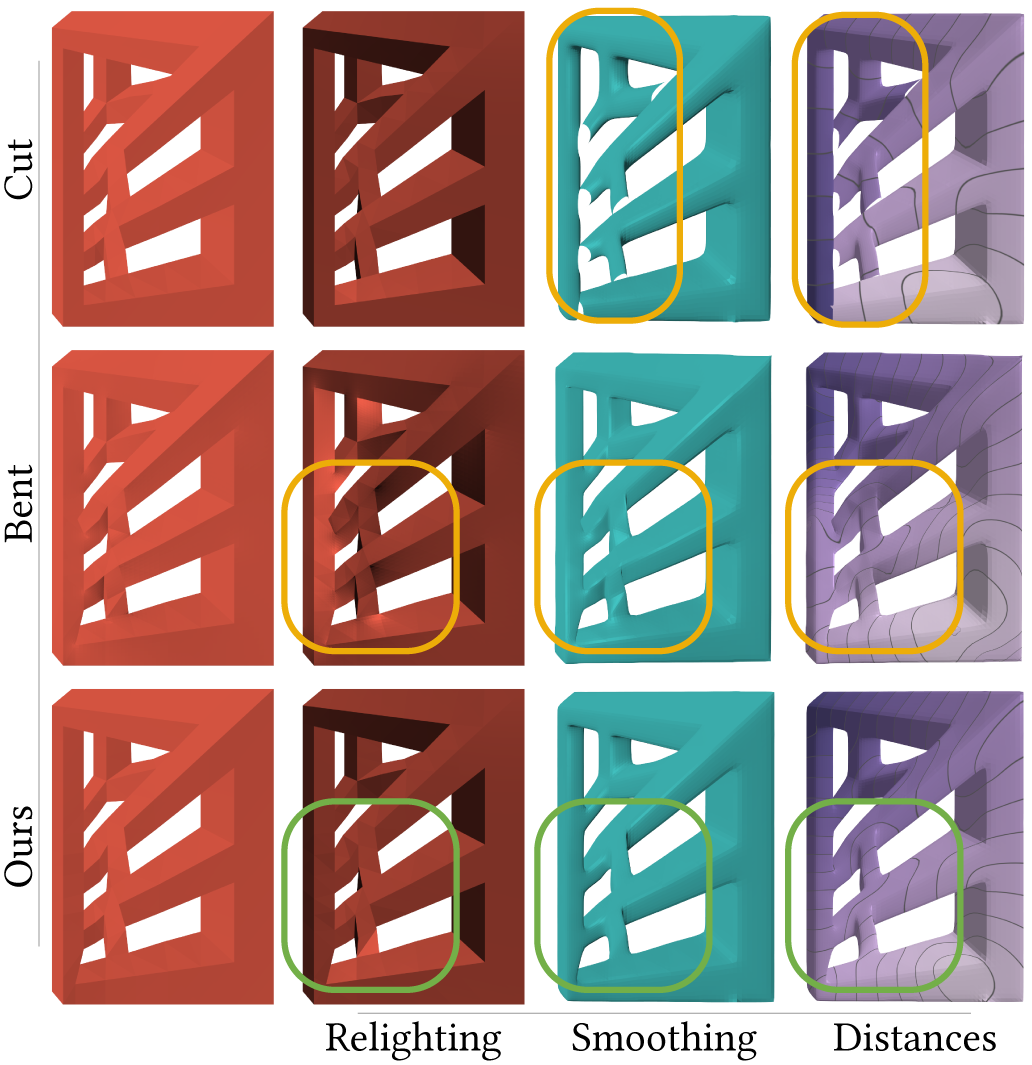
Figure 7: Comparison between meschers, cut, and bent approaches; only meschers support all geometry processing tasks without artifacts.
Data Processing and Shading
Meschers support a variety of shading techniques (flat, smooth), indistinguishable from traditional meshes for locally consistent geometry (Figure 8).
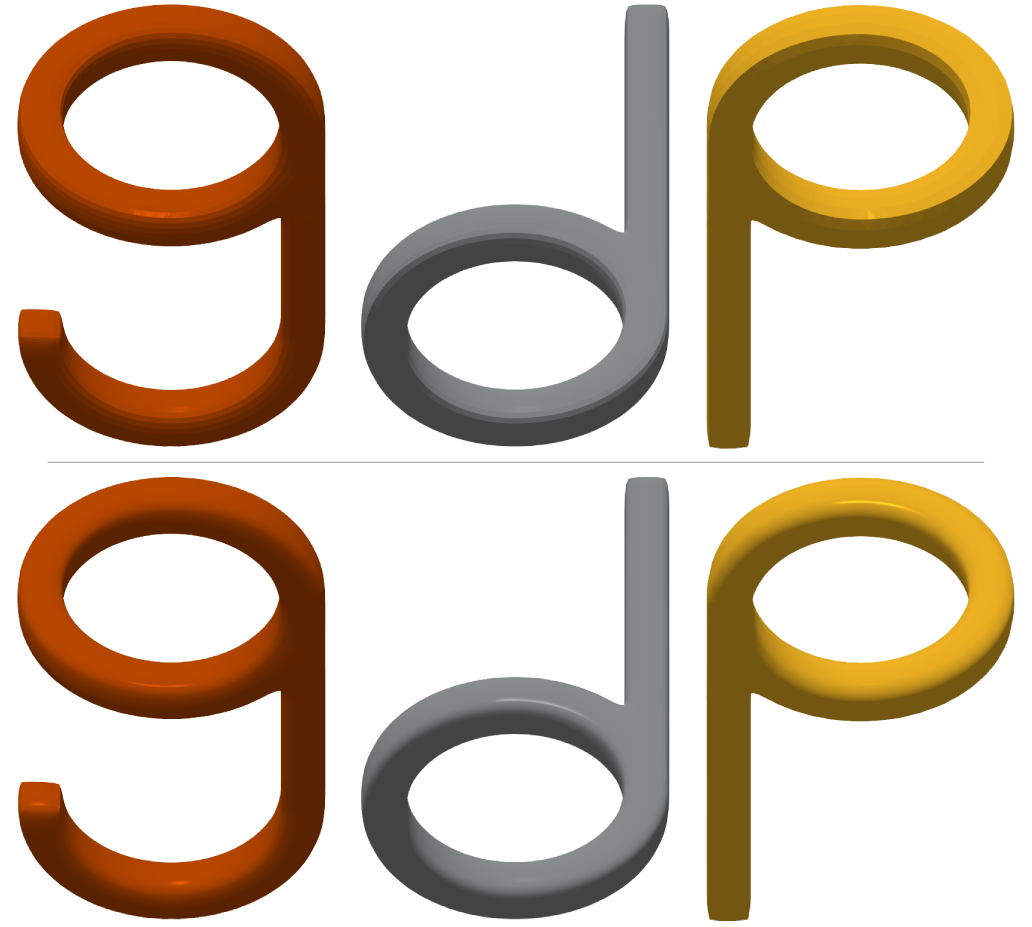
Figure 8: Meschers rendered with diverse shading techniques, leveraging local consistency for visual stylization.
Practical and Theoretical Implications
The mescher framework enables artists and graphics researchers to manipulate impossible objects using standard geometry processing tools: smoothing, subdivision, intrinsic measurements, and optimization. The theoretical foundation in DEC offers compatibility with existing mesh processing algorithms and lays groundwork for more perceptually-inspired computational geometry.
For vision science, meschers offer a bridge between computational models and human perceptual phenomena: shortest paths traced on meschers can be compared to human gaze trajectories, and the geometric representation aligns with the "2.5D sketch" model of Marr and related frameworks in vision research.
Practically, meschers can be integrated into modeling software, game engine pathfinding, and vision science experiments, allowing both user-driven and inverse rendering-based creation of impossible geometry. Pathological cases (non-orientable, highly ambiguous depth configurations) remain beyond current capability but point to valuable extensions (non-manifold DEC, implicit representations).
Future Directions
Future work includes modeling interfaces for direct mescher creation, robust inverse rendering pipelines, extension to non-orientable surfaces, experimentation with higher-order DEC discretizations for advanced rendering, and exploration of mescher-inspired implicit representations. Combining meschers with shadow and transparency computation from traditional models broadens their graphical utility.
From a vision science standpoint, meschers can further contribute to studying perceptually-driven models of vision and creativity, testing the correspondence between computed and human-perceived geodesics, and designing perceptually adaptive computer vision algorithms.
Conclusion
Meschers establish a perceptually-motivated, mathematically rigorous data structure for impossible objects, enabling comprehensive geometry processing and rendering tasks not previously accessible. By separating local and global integrability, meschers provide a platform for both graphics and vision science to further investigate and operationalize the interplay between perception and geometry.