- The paper demonstrates that nonminimal vector-tensor couplings lead to two distinct sectors, with one yielding standard Schwarzschild metrics and the other a monopole-like asymptotic structure.
- It applies Noether charge methods to reveal that Lorentz-violating parameters modify physical observables, with solar-system tests constraining these deviations relative to GR.
- Numerical analysis of neutron stars shows significant strong-field effects on mass, radius, and moment of inertia, highlighting potential observable departures from general relativity.
Black Holes and Neutron Stars in Massive Hellings-Nordtvedt Theory
Theoretical Framework and Motivation
The massive Hellings-Nordtvedt (HN) theory extends standard vector-tensor gravity by introducing a vector field Aμ nonminimally coupled to curvature through two independent terms: A2R and AμAνRμν. When augmented by a potential driving the vector field to a nonzero vacuum, this structure aligns with spontaneous Lorentz symmetry breaking and shares conceptual features with bumblebee gravity models. Previous investigations within the restricted AμAνRμν sector revealed black holes and neutron stars exhibiting monopole-like asymptotic geometry with a solid-angle deficit. The present work interrogates whether this monopole-like structure is inherent to the nonzero vector vacuum or contingent on the precise form of nonminimal coupling.
Asymptotic Structure and Sector Separation
A detailed examination of the field equations and asymptotic vacuum conditions reveals that generic nonzero values of both couplings are incompatible with the required vector vacuum at spatial infinity. The theory bifurcates into two allowed single-coupling sectors:
- A2R sector (γ2=0): Admits asymptotically flat Schwarzschild geometry, with the vector field nontrivial but metric remaining standard.
- AμAνRμν sector (γ1=0): Reproduces the previously established monopole-like asymptotics, characterized by a Lorentz-violating parameter and a solid-angle deficit.
Thus, spontaneous Lorentz breaking via the vector vacuum does not generically induce monopole-like asymptotics; it is a feature exclusive to the Ricci-tensor coupling.
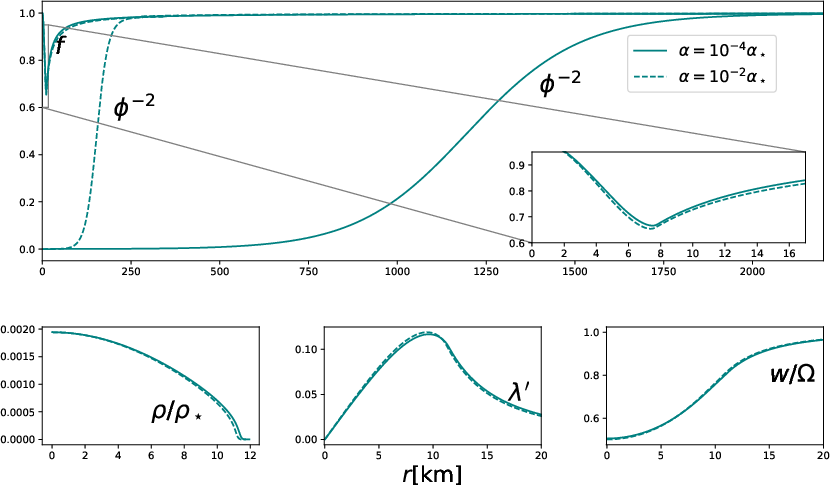
Figure 1: Numerical solutions of (f,ϕ−2,ρ,λ′,w/Ω) for neutron stars with SLy EOS in the A2R sector; strong-field deviations occur with weak-field-compliant A2R0.
Black Hole Solutions: Noether Mass and Weak-Field Constraints
Black holes in the A2R1 sector possess metrics identical to Schwarzschild when parametrized by the integration constant, but the Noether charge computed via Wald’s formalism yields a physical mass A2R2, explicitly correcting for the Lorentz-violating parameter A2R3. The physical observables are thus sensitive to the coupling strength, breaking apparent metric degeneracy with GR at the level of conserved charges.
Solar-System tests—perihelion advance, light deflection, and Shapiro delay—impose bounds A2R4, several orders of magnitude weaker than the monopole sector (A2R5). Notably, in the A2R6 sector, the Noether mass is essential for extracting observable constraints; the coupling enters weak-field geometry only via the mass redefinition.
Neutron Star Structure and Strong-Field Effects
Construction of slowly rotating neutron stars (SLy EOS) in the A2R7 sector demonstrates that even with A2R8, significant deviations from GR emerge in the strong-field regime. Numerical solutions indicate:
- Mass and Radius: At low central densities, both are reduced relative to GR. At high densities, they increase sharply, with the maximum mass occurring at lower A2R9 compared to GR and the monopole sector.
- Moment of Inertia: Behaves similarly—decreased for low-mass stars and enhanced for high-mass stars; sensitive to the interplay between mass, radius, and matter distribution.
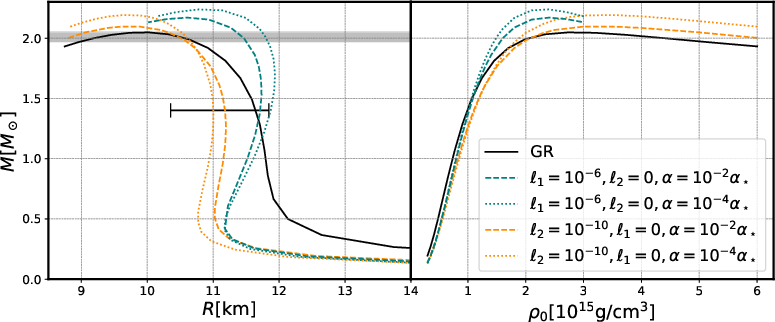
Figure 2: Mass-radius and mass-central density relations for SLy EOS; AμAνRμν0 and AμAνRμν1 sectors diverge notably at high densities.
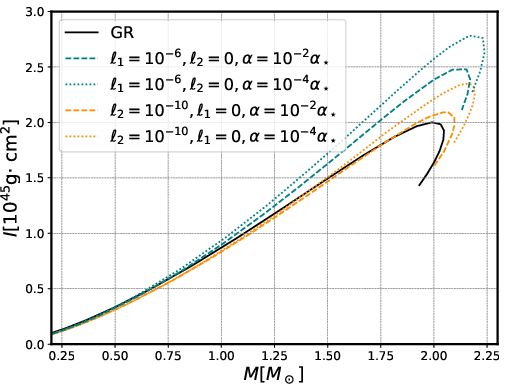
Figure 3: Moment of inertia versus mass for SLy EOS; deviations from GR and between sectors amplify for high-mass stars.
Observational constraints from pulsars and GW170817 are satisfied for representative choices of AμAνRμν2 and the potential parameter AμAνRμν3; deviations from GR in mass-radius and AμAνRμν4-AμAνRμν5 relations remain within allowed ranges but are future targets for refinement.
Implications and Prospects
Strong-field deviations are prominent in neutron-star observables, supporting the role of compact stars in probing nonminimal vector-tensor gravity, even when weak-field bounds are satisfied. The qualitative similarity to scalar-tensor theories with nonminimal coupling underscores the utility of the AμAνRμν6 sector as a viable framework for exploring spontaneous Lorentz breaking and vector vacua in the context of compact objects.
Future developments should address:
- Stability and well-posedness of solutions in both sectors, as dynamical pathologies have been reported for self-interacting vector fields in related models.
- Extension to additional neutron-star observables (quadrupole moment, tidal Love numbers), enabling tests of universal I-Love-Q relations and improved constraints on coupling strengths and potential forms.
- Embedding within broader theoretical contexts (e.g., Einstein-frame analyses), ensuring clarity in matter sector interactions and observational signatures.
Conclusion
The massive Hellings-Nordtvedt theory, with its sector separation governed by the asymptotic vector vacuum, delineates sharply between monopole-like and flat asymptotics. The AμAνRμν7 sector allows phenomenologically rich compact-object solutions, where weak-field constraints still permit substantial strong-field modifications. The formal distinction between metric and physical observables necessitates careful use of Noether charges for astrophysical predictions. Stability analyses and further nonlinear observable studies are crucial for theoretical viability and for leveraging neutron stars as empirical probes of Lorentz-violating modified gravity (2605.14711).

