- The paper demonstrates direct transcription of NV center spin information in the NIR telecom range using wavelength-resolved ODMR.
- Methodology includes mapping the 1042 nm zero-phonon line and verifying spin fidelity against conventional visible emissions.
- Implications include enabling quantum repeaters and photonic quantum memories without the need for active quantum frequency conversion.
Introduction
Diamond nitrogen-vacancy (NV) centers are a widely utilized solid-state quantum platform for quantum sensing, information processing, and photonic interfaces due to their stable, optically addressable spin states at ambient conditions. Conventional optically detected magnetic resonance (ODMR) and spin readout exploit visible fluorescence from triplet optical transitions, necessitating subsequent quantum frequency conversion for integration with telecommunication infrastructure. This work demonstrates, for the first time, direct transcription of NV center spin information into the near-infrared (NIR), including the telecom-relevant 1300–1600 nm range, by wavelength-resolved ODMR of the infrared singlet emission. This establishes an intrinsically telecom-compatible, conversion-free photonic interface.
Electronic Structure, ODMR, and the Role of Spin-Selective ISC
The NV− center comprises a substitutional nitrogen adjacent to a vacancy in the diamond lattice. Its electronic structure features a spin-triplet ground (3A2) and excited (3E) state, alongside a manifold of intermediate singlet states (1E and 1A1). Optical spin initialization and readout leverage spin-selective intersystem crossing (ISC): transitions from mS=±1 more efficiently populate the singlet manifold, leading to reduced visible fluorescence and enabling ODMR.
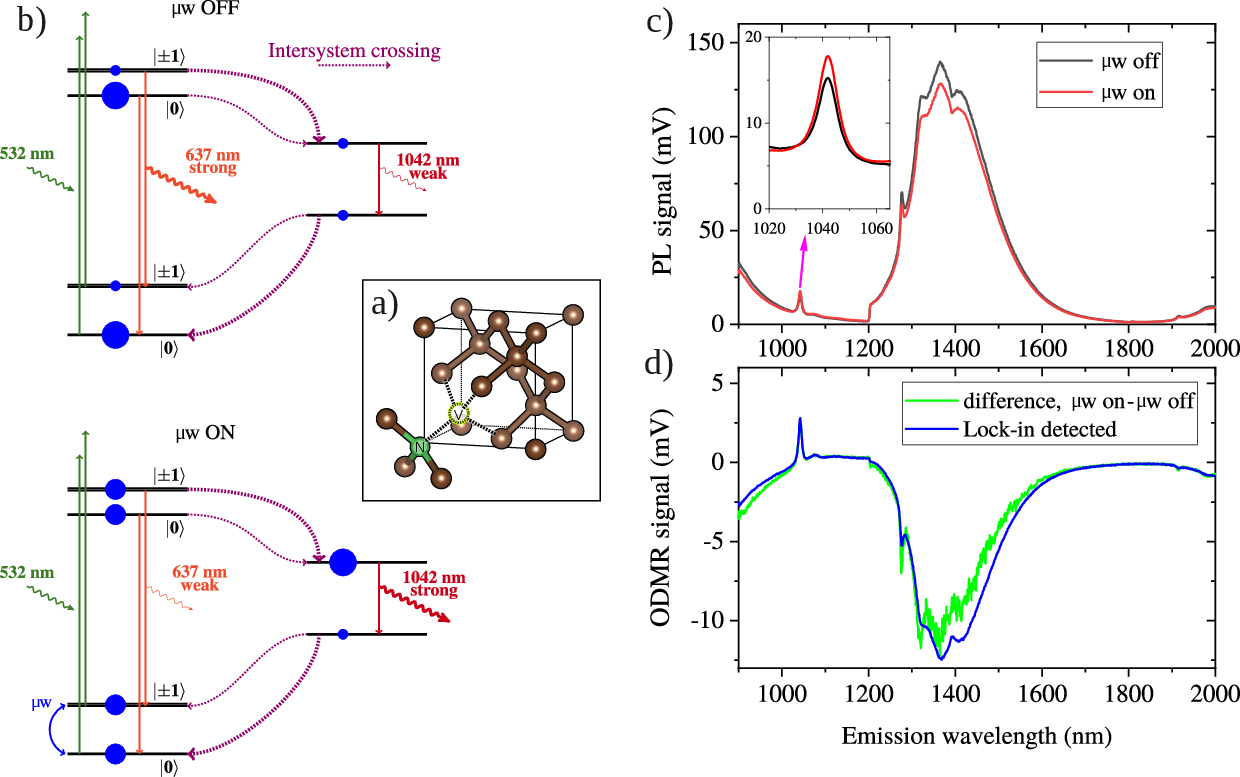
Figure 1: (a) NV center structure; (b) Jablonski diagram showing singlet NIR transitions; (c) NIR emission spectra with microwave manipulation; (d) ODMR signal derived via lock-in detection.
Traditionally, the singlet manifold, with a characteristic zero-phonon line (ZPL) at 1042 nm (1E→1A1), is considered a dark decay channel. However, its population is governed by the same spin-dependent ISC that mediates visible ODMR contrast. Thus, microwave-driven spin redistribution must modulate the 1042 nm emission; its spin-contrast is expected to mirror but be opposite in sign to the visible channel.
By employing wavelength-resolved ODMR using long-pass filters (600 nm and 1000 nm), the direct NIR photoluminescence response of ensemble NV centers was mapped under resonant microwave excitation. The 1042 nm singlet ZPL, filtered out from visible emission, emerges as the dominant spin-contrasted feature. Notably, this NIR ODMR contrast persists up to 1800 nm—unambiguously spanning the critical O, E, S, C, and L telecommunication bands.
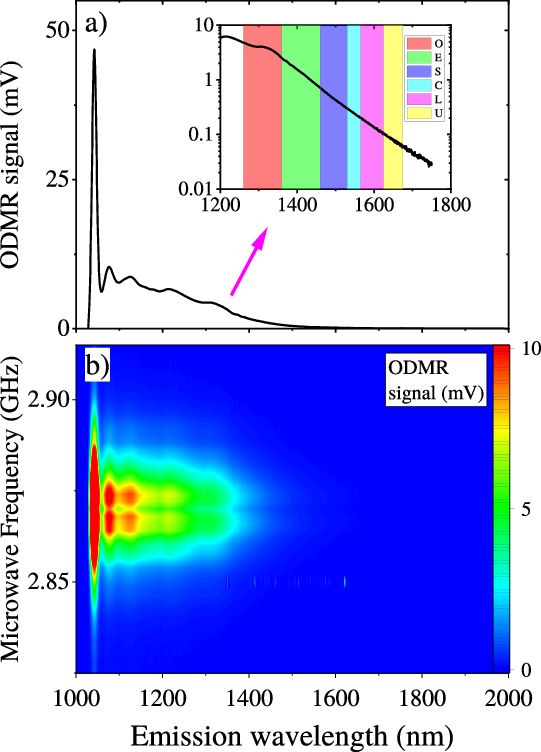
Figure 2: (a) ODMR spectra (filtered above 1000 nm) showing the 1042 nm ZPL and sidebands, with telecom bands indicated; (b) ODMR amplitude map versus MW frequency and emission wavelength—contrast visible up to the detection noise floor at 1800 nm.
The opposite sign of the visible and NIR ODMR signals reflects population transfer dynamics: microwave excitation depletes the optically polarized mS=0 state, enhancing the population transfer via singlet decay channels and thereby amplifying NIR emission.
Spin-State Fidelity and Field-Dependent ODMR Mapping
To assess whether the NIR channel encodes the same spin information as the conventional visible channel, field- and frequency-resolved ODMR measurements were conducted at both 680 nm (visible) and 1310 nm (NIR). The resonance positions and their magnetic field dependencies are identical across detection wavelengths, confirming that the infrared channel directly registers the same spin transitions as visible fluorescence.
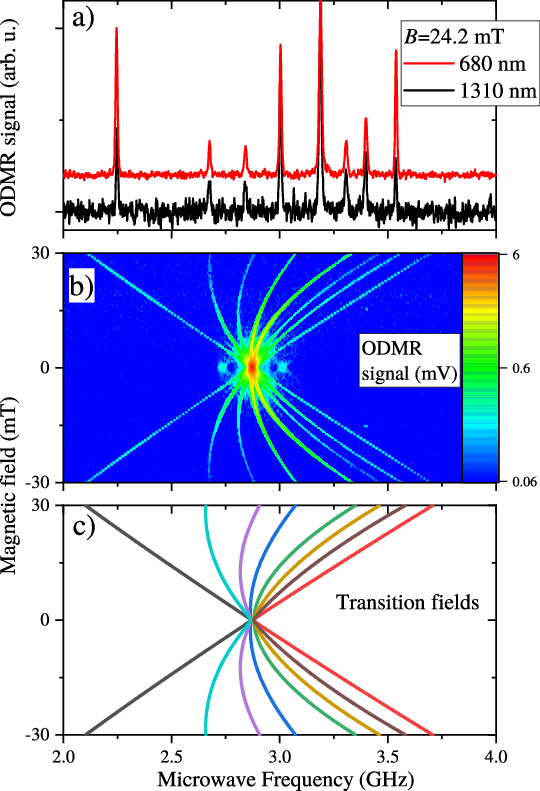
Figure 3: (a) ODMR comparison at 680 nm (VIS) and 1310 nm (NIR) at 24.2 mT; (b) field-dependent ODMR map at 1310 nm with logarithmic scaling; (c) calculated spin Hamiltonian energy dispersion for all crystallographic NV orientations.
Quantitative agreement between the measured resonance branches and those simulated using the ground-state spin Hamiltonian (including axial and transverse zero-field splittings, g-factor, and field orientation) confirms high-fidelity state transcription across the full NIR spectrum.
Instrumentation and Simultaneous Dual-Wavelength Detection
A home-built spectroscopic setup, sensitive from the visible to 2000 nm, was deployed. Key features include a 532 nm laser excitation, wavelength-resolved Czerny-Turner spectrograph with interchangeable PMT and InGaAs detectors, conductor-backed CPW for broadband MW irradiation, and field modulation/detection optimized for slow spin-lattice relaxation dynamics.
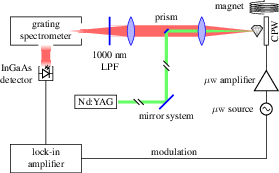
Figure 4: Schematic of the wavelength-resolved ODMR apparatus, highlighting dual VIS/NIR detection and MW integration.
Simultaneous measurement using a 600 nm long-pass filter shows direct, concurrent detection of the $1042$ nm NIR ODMR signal and a residual, negative-contrast visible signal due to second-order grating diffraction, confirming the intrinsic and opposite spin contrast in both photonic channels.
Implications and Prospects
This work shows, with direct experiment, that NV center spin information can be optically read out at NIR wavelengths spanning the complete telecom window, without frequency conversion or non-linear optics. This fundamentally reframes the singlet manifold from a loss-inducing decay channel to a robust, high-fidelity quantum-readout interface natively compatible with fiber photonics and CMOS architectures.
Practical implications are immediate for the construction of quantum repeaters, photonic quantum memories, and distributed quantum sensing with direct coupling to long-haul fiber links. The bypassing of active quantum frequency conversion—previously a major bottleneck for NV-based quantum networking—enables simpler device architectures, lower photon loss, and integration into standard telecom multiplexing infrastructure.
Future developments may include enhancement of NIR collection efficiency, on-chip multiplexed readout, single NV NIR detection, and the exploration of telecom-compatible color centers in alternate wide-bandgap materials. This capability is expected to accelerate the scaling of quantum internet technologies and networked quantum sensing platforms.
Conclusion
Wavelength-resolved ODMR experiments confirm direct, high-contrast NIR spin-state readout from the NV center's singlet transitions up to the 1800 nm telecom limit. The NIR emission maps faithfully onto the conventional visible ODMR features, demonstrating robust transcription of quantum information into telecom wavelengths with opposite optical contrast. This result obviates the need for active frequency conversion for NV-based quantum interfaces, enabling direct integration with existing telecommunication infrastructure and advancing the prospects of practical, scalable quantum networks.