- The paper establishes a multi-constraint perturbative bootstrap for heavy-light correlators, uniquely determining three-loop f-graph coefficients in N=4 SYM.
- It employs a novel f-graph expansion combined with OPE limits, cusp rules, and supersymmetric localization to capture both planar and non-planar contributions.
- The approach reveals key symmetry enhancements and refined OPE data, advancing analytic techniques for determinant-like operator sectors.
Bootstrapping Giant Graviton Correlators in N=4 SYM
Introduction and Scope
This work addresses the perturbative bootstrap for mixed heavy-light four-point functions in the large-N limit of N=4 super-Yang--Mills (SYM), specifically correlators of the form ⟨GGO2O2⟩ where G are giant graviton operators of dimension O(N) and O2 are half-BPS single-trace chiral primaries in the stress-tensor multiplet. The study targets a parameter regime inaccessible by standard planar methods due to the non-trivial topology and dimension of the heavy operators. The authors realize a three-loop solution by leveraging a multi-faceted bootstrap strategy, involving graphical f-graph bases, OPE limits, supersymmetric localization, and a ten-dimensional hidden symmetry.
Bootstrap Strategy and f-Graph Expansion
The correlator is analyzed via a loop integrand decomposition into a basis of labelled f-graphs, with distinguished points corresponding to giant gravitons. In contrast to correlators of single-trace operators, non-planar N0-graphs contribute already at leading order in N1, reflecting the breakdown of planarity in the presence of determinant-like operator insertions. The N2-graphs are constructed using chiral Lagrangian insertion techniques, with reduced N3 symmetry depending on the number of loops N4.
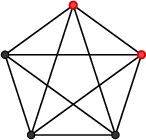
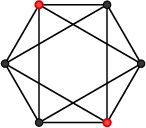
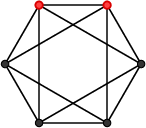
Figure 1: Labelled N5-graphs at one and two loops, with solid lines denoting propagators N6 and highlighted vertices indicating the giant graviton positions N7, N8.
At three loops, the systematics of the expansion introduce fifteen topologically distinct N9-graphs, including both planar and non-planar representatives, with explicit forms organized in terms of numerator monomials in N=40. The graphical complexity grows rapidly with loop order, underscoring the centrality of a robust constraint framework in coefficient determination.
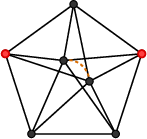
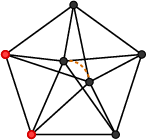
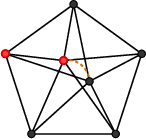
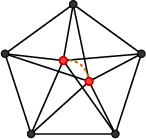
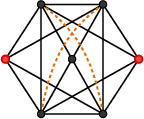
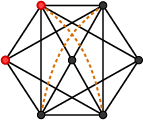
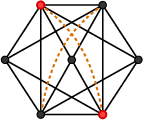
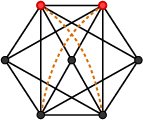
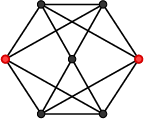
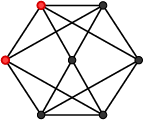
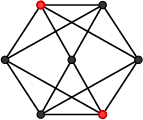
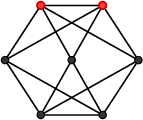
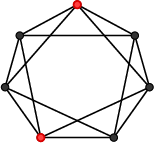
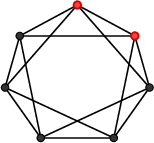
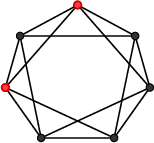
Figure 2: Three-loop labelled N=41-graphs, grouped by topology class; only the first row corresponds to planar cases, the rest are non-planar.
The N=42-graph coefficients are uniquely determined at three loops by an over-constrained system, comprised of:
- Cusp (double-triangle) rules: These arise from specific light-like OPE limits and implement relations between higher-loop and lower-loop integrands, constraining numerators via local behaviors near cusps.
- OPE (triangle) rules in various channels: Limits such as N=43 or N=44 enforce the dominance of specific operator exchanges (e.g., the Konishi multiplet or twist-two operators) and their anomalous dimensions.
- Integrated correlator constraints from localization: Supersymmetric localization furnishes explicit values for integrated correlators up to three loops, providing strong conditions via the periods of the contributing N=45-graphs.
- Harmonic-sum representability: Complete crossing-symmetric analytic continuation of twist-two OPE data is imposed, with structure constants and anomalous dimensions expressed as nested harmonic sums of appropriate weight.
- Ten-dimensional hidden symmetry: The correlators are required to be upliftable to a ten-dimensional form, effectively constraining non-planar contributions and demanding cancellation of mixed transcendental constants such as N=46 in integrated correlators (for generic chiral primary dimensions).
The systematic enumeration of fixed parameters (Table 1 in the paper) demonstrates that with these conditions, the system is uniquely solvable up to three loops; non-trivial consistency between separate minimal constraint sets further corroborates internal consistency.
Results: Giant Graviton Correlators up to Three Loops
Tree, One, and Two Loops
At tree level, the correlator reflects leading disconnected and connected contractions, with explicit N=47-dependence.
At one loop, only the box N=48-graph appears, with normalization entirely fixed by localization. At two loops, two N=49-graphs (planar and non-planar) enter, and coefficients are determined by localization and OPE constraints.
Three Loops
Fifteen ⟨GGO2O2⟩0-graphs contribute (four planar, the remainder non-planar), with the constraint system dictating all coefficients uniquely upon imposing hidden symmetry. Significantly, the required presence of non-planar ⟨GGO2O2⟩1-graphs is essential not only for matching the integrated correlators but also for achieving the correct asymptotic structure of OPE data, including cancellation of higher powers in ⟨GGO2O2⟩2 in the large-spin behavior for the determinant operator.
The resulting closed-form for the three-loop correlator features coefficients that interpolate between several key physical limits:
- For sphere giant gravitons (⟨GGO2O2⟩3), the result reduces (in the planar sector) to previous two-loop literature and provides the full three-loop correction, including all mixed and non-planar effects.
- At ⟨GGO2O2⟩4, corresponding to dual giant graviton operators, the planar contribution exhibits full ⟨GGO2O2⟩5 permutation symmetry.
- In the very-heavy operator limit (⟨GGO2O2⟩6), the dominant graphs are proportional to the powers of ⟨GGO2O2⟩7 anticipated from the effective large-charge description.
OPE Data and Large Spin Limit
Extraction of OPE coefficients for twist-two operators reveals highly non-trivial structure. The authors find that for general giant graviton parameter ⟨GGO2O2⟩8, the OPE coefficients grow as ⟨GGO2O2⟩9 at G0 loops for large spin G1. However, for the maximal determinant (G2) these high powers collapse to linear G3 scaling at all computed loop orders. This collapse is crucially dependent on the correct non-planar content and suggests enhanced underlying symmetry for maximal giants. Further, all OPE data can be compactly packaged in terms of harmonic sums, validating the applicability of modern bootstrap technology to non-minimal sectors of G4 SYM.
Theoretical and Practical Implications
From a theoretical perspective, these results extend the success of amplitude/correlator bootstrap strategies into heavy, non-planar BPS sectors, confirming both the viability of graphical G5-graph methods and the continued appearance of hidden higher-dimensional symmetries outside the single-trace planar regime. The explicit determination of correlators through three loops exposes new symmetry enhancement and operator-structure phenomena, sharpens the analytic understanding of OPE data in mixed heavy-light settings, and motivates further exploration of integrability and localization constraints beyond the planar limit.
Practically, the combination of graphical bootstrap rules and localization—supported by powerful harmonic sum and analytic technologies—makes higher-loop and more complex observables tractable, suggesting natural extensions to other correlation functions with determinant and sub-determinant operator insertions, and to finite-G6 corrections via further localization and OPE input. The observed polynomial dependence between G7-graph coefficients and giant graviton parameters potentially enables systematic ansätze for all-orders calculations if such patterns persist.
Outlook and Future Directions
Key open problems prompted by this analysis include:
- Formal derivation of the ten-dimensional symmetry and its manifestation for generic (dual) giant gravitons.
- Extension to generic chiral primary correlators and more complicated G8-symmetry configurations.
- Extraction and analysis of finite-G9 corrections, with implications for the interplay of determinant operators, non-planar dynamics, and defect interpretations.
- Computation of four-loop and higher periods for O(N)0-graph integrals, essential for matching to all-orders localization results.
- Investigation of the integrability of the bootstrap in the presence of large-charge or heavy BPS limits, with connections to semiclassical descriptions.
Conclusion
This study establishes a multi-constraint bootstrap for heavy-light correlators in O(N)1 SYM, grounded in O(N)2-graph integrand bases and tightly interlocked OPE, cusp, localization, and hidden symmetry conditions. All data to three loops is determined, matching known results and yielding new quantum corrections, with non-planar topologies shown to play an indispensable role. The results validate and significantly extend the perturbative bootstrap approach in the presence of operator insertions of dimension O(N)3, and provide a foundation for further exploration of heavy BPS operator sectors, their symmetries, and their role in holography.