- The paper shows that electronic Lévy glasses enhance spin Hall current conversion, reaching spin Hall angles up to 35% in graphene nanoribbons.
- It employs numerically exact tight-binding simulations and ensemble averaging over 10³ cluster configurations to contrast superdiffusive and diffusive transport regimes.
- The study reveals that tuning SOC strength and electrostatic potential enables low-power, high-efficiency spintronic device design through disorder engineering.
Spin Hall Effect in Electronic Lévy Glasses: Enhanced Spin Current Generation in the Superdiffusive Regime
Overview and Motivation
This paper systematically investigates the spin Hall effect (SHE) in electronic Lévy glasses, where graphene nanoribbons are proximity-coupled to randomly distributed spin-orbit clusters whose radii follow a power-law distribution. The study is motivated by the imperative need to improve charge-to-spin conversion efficiency and optimize spin transport in next-generation spintronic devices. Graphene's exceptional spin diffusion length is leveraged, while its weak intrinsic spin-orbit coupling (SOC) is mitigated via extrinsic and proximity-induced SOC mechanisms. The Lévy glass architecture—characterized by superdiffusive electronic transport—offers a controllable platform to tune transport regimes through Fermi energy, facilitating regime transitions between diffusive and superdiffusive behavior.
Methodological Framework
The device architecture consists of either armchair (AGNR) or zigzag (ZGNR) graphene nanoribbons, embedded with SOC clusters that emulate proximity coupling (Figure 1). The power-law distribution of cluster radii engenders a heavy-tailed disorder landscape, inducing superdiffusive electronic transport. Transport properties are analyzed via numerically exact tight-binding simulations using KWANT, leveraging the Landauer-Büttiker formalism for spin-resolved transport and calculation of spin Hall current and spin Hall angle (SHA). Ensemble averaging is performed across 103 cluster configurations to ensure statistical robustness.
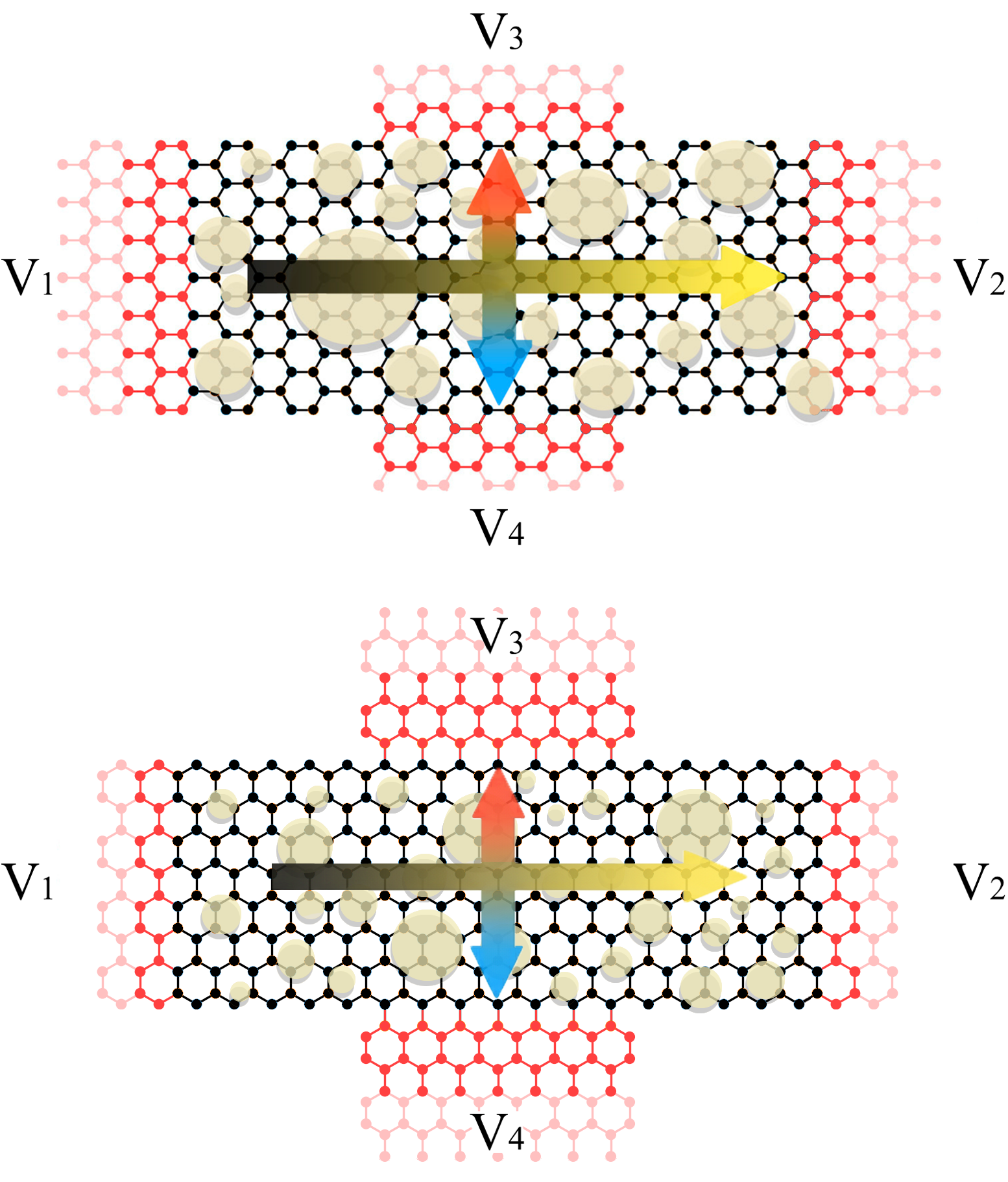
Figure 1: Schematic of AGNR and ZGNR graphene nanoribbons connected to four semi-infinite leads with randomly distributed proximity-induced SOC clusters.
Regime Differentiation and Spin Hall Response
Distinct transport regimes are identified: the superdiffusive regime (low Fermi energy, low resistivity, long spin diffusion length) and the diffusive regime (high Fermi energy, high resistivity, short spin diffusion length). The core result is the marked enhancement of spin Hall current and SHA in the superdiffusive regime compared to the diffusive case.
Numerical results explicitly demonstrate that in the superdiffusive regime, a substantially lower longitudinal charge current is efficiently converted into a large transverse spin Hall current. For strong SOC, the SHA reaches up to 35% (AGNR) and 25% (ZGNR), whereas in the diffusive regime the SHA saturates at 5%, consistent with reported values for diffusive graphene systems. The spin Hall current in superdiffusive transport can exceed that in the diffusive regime by approximately 70%.
Dependence on SOC Strength and Electrostatic Potential
Systematic parameter sweeps reveal that the efficiency of charge-to-spin conversion (SHA) increases with SOC strength up to a saturation point. In addition, the role of on-site electrostatic potential is scrutinized. Electrostatic potential impacts the spin Hall current differently across regimes: it enhances the current in the diffusive regime but does not substantially affect the SHA, while in the superdiffusive regime the SHA can be further improved, reaching values as high as 40% for AGNR.
Spin-Polarized Density of States and Device Efficiency
The spatial distribution of spin polarization is probed via spin-polarized density of states (SDOS), highlighting pronounced spin separation in the superdiffusive regime, especially near transverse terminals. This enhances spin current by reducing device magnetoresistivity.
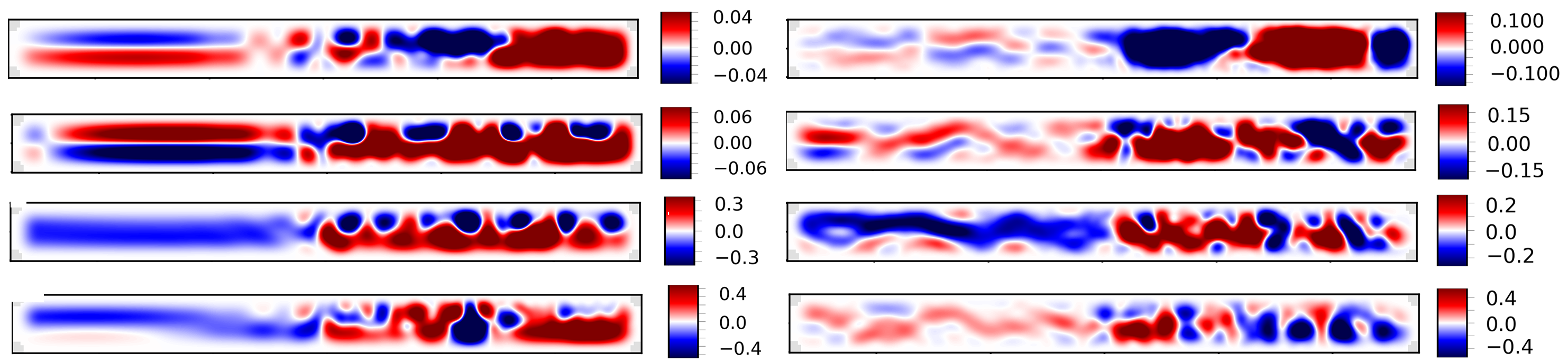
Figure 2: SDOS ⟨Sz⟩ for AGNR at increasing SOC strengths, illustrating superior spin separation in the superdiffusive regime compared to the diffusive regime.
Practical and Theoretical Implications
The results establish electronic Lévy glasses as a versatile architecture for optimizing spin transport via disorder engineering. There are clear implications for spintronic device design: the ability to achieve high SHA with minimal charge current enables low-power, high-efficiency spintronic applications. Further, the sensitivity of conversion efficiency to electrostatic potential expands the toolbox for external, device-level tuning. The results provide a route to robust, scalable spin Hall devices that exploit superdiffusive transport for superior performance.
Theoretically, the work advances understanding of transport in disordered systems with heavy-tailed distributions, underscoring the relevance of non-Boltzmann transport and superdiffusive dynamics in condensed matter. The findings connect physical disorder properties (distribution of cluster sizes) directly to macroscopic spin transport characteristics, offering a new paradigm for materials engineering.
Outlook
Experimental realization of electronic Lévy glasses is feasible by adapting methods involving quantum dot arrays and proximity-induced SOC via heavy metals and transition metal dichalcogenides. The precision of present bilayer growth techniques provides a path for fabricating devices with engineered cluster radii distributions. The study invites future exploration of disorder-driven phenomena in spintronics, including the interplay of strain, substrate effects, and temperature-dependent dynamics.
Conclusion
Through rigorous numerical and theoretical analysis, this paper demonstrates that electronic Lévy glasses, constructed from graphene nanoribbons with proximity-coupled SOC clusters, unlock the superdiffusive regime for enhanced spin Hall effect. Conversion efficiency is maximized—SHA reaches up to 35%—with significantly lower charge currents, presenting disorder engineering as a pivotal strategy for spintronic device optimization. These insights pave the way for the systematic design of highly efficient, robust spin Hall materials, broadening the scope of superdiffusive transport physics in real-world applications.

