- The paper introduces a local sparsification framework for stochastic matching that leverages LP-guided variance-optimal sampling for effective edge selection.
- The paper proves theoretical guarantees using heavy-light decomposition and shows that even a small local budget (e.g., k=5) can secure near-optimal matching efficiency.
- The paper demonstrates empirical success on real-world and adversarial benchmarks, outperforming traditional online matching algorithms with minimal communication.
Stochastic Matching via Local Sparsification: A Technical Analysis
This work presents a formalization and study of stochastic bipartite matching under local sparsification constraints, directly motivated by distributed and bandwidth-constrained systems (e.g., ride-hailing and resource allocation in cloud computing). The model interpolates between immediate, irrevocable online matching and offline centralized optimization. At arrival, each request ui can observe its neighbor set in the compatibility graph, but is constrained to select at most k edges (local budget) before forwarding this restricted list for a later global matching phase.
The key objective is preservation ratio: maximizing α=E[∣M(GS)∣]/E[∣M(G)∣], i.e., the expected efficiency of the sparsified instance with respect to the optimal offline matching with full information.
Local Sparsification and Edge Selection
The paper introduces the local sparsification paradigm with a two-stage process:
- Local pruning (decoupled, bandwidth-limited): Each request uses only the prior and its local realization to select size-k subset Si from its compatibility set.
- Global matching: The union GS=(U∪V,⋃Si) is provided to a central coordinator for optimal matching computation.
(GS) can be significantly sparser than G, depending on k, but is constructed with strict locality—each pruning decision leverages global statistics but not other arrivals’ realizations.
Fractional LP and Locally-Guided Sampling Mechanism
Critically, the sparsification is guided by fractional solutions to the Expected Instance Linear Program (LP): an offline relaxation that captures the optimal expected size by fractionally routing the stochastic demand using full knowledge of the prior distribution.
Local edge selection uses Variance-Optimal (VarOpt) sampling, parameterized by the LP variables:
- For each type/resource compatibility set, select exactly k edges using VarOpt sampling with weights k0 (fractional LP value).
- VarOpt provides tight negative association among selections, ensuring both exact sample size and preservation of expected mass with optimal variance properties.
- Heavier (large k1) edges are deterministically included as k2 grows, and lighter edges are handled probabilistically.
Theoretical Guarantees: Heavy-Light Decomposition
The efficacy of the local sparsifier depends on the spread of the LP solution:
- Define “heavy” edges as those with k3, “light” otherwise.
- If the LP solution is well-spread (most mass on light edges), the local sparsifier can preserve nearly all matching size with small k4.
The main theorem formalizes this:
- Theorem: For local budget k5 and a solution k6 with heavy mass k7 and light mass k8, the expected matching size satisfies
k9
- Corollary: If α=E[∣M(GS)∣]/E[∣M(G)∣]0 is α=E[∣M(GS)∣]/E[∣M(G)∣]1-well-spread (α=E[∣M(GS)∣]/E[∣M(G)∣]2), then α=E[∣M(GS)∣]/E[∣M(G)∣]3 suffices for α=E[∣M(GS)∣]/E[∣M(G)∣]4-approximation.
This implies that classical online stochastic matching barriers (e.g., α=E[∣M(GS)∣]/E[∣M(G)∣]5) can be fundamentally bypassed under local sparsification as soon as budgets allow selection of more than one edge.
Empirical Results
The authors validate their framework through empirical evaluations:
- NYC Ride-Hailing Dataset: Using real taxi events, the VarOpt Local Sparsifier (with small α=E[∣M(GS)∣]/E[∣M(G)∣]6, e.g., α=E[∣M(GS)∣]/E[∣M(G)∣]7) closely tracks the offline optimal matching and consistently outperforms pure random selection and classic online matching algorithms.
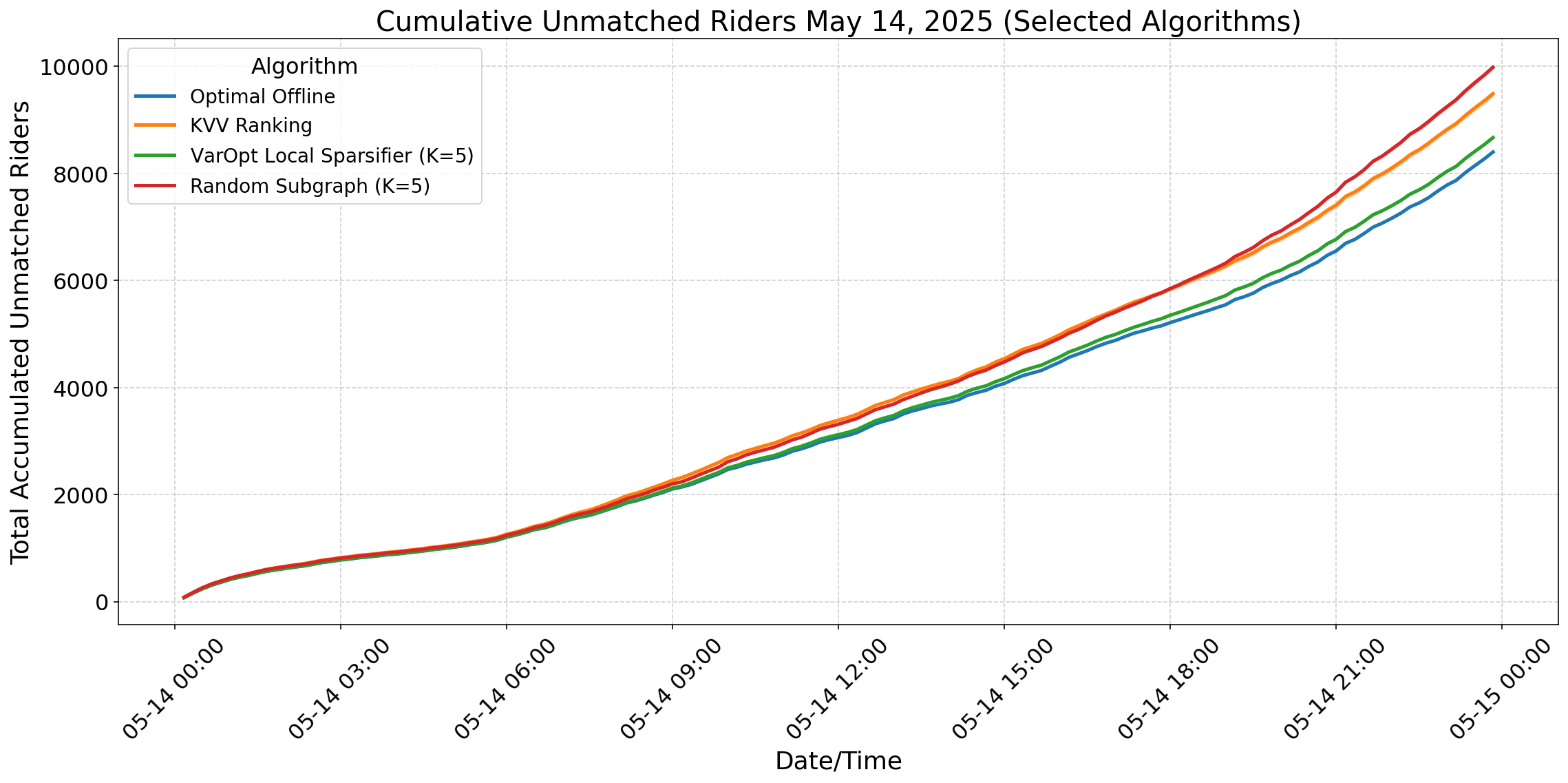
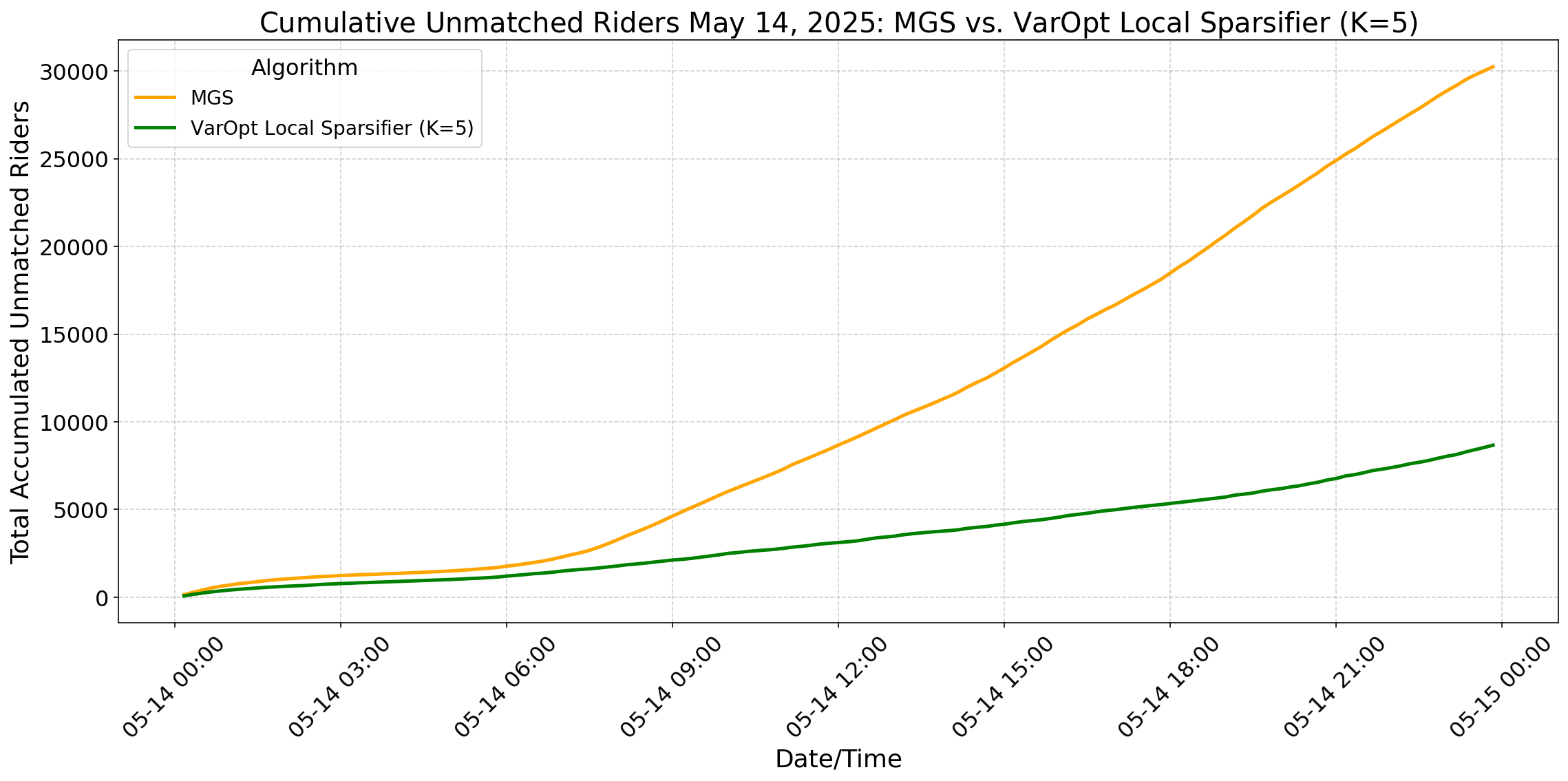
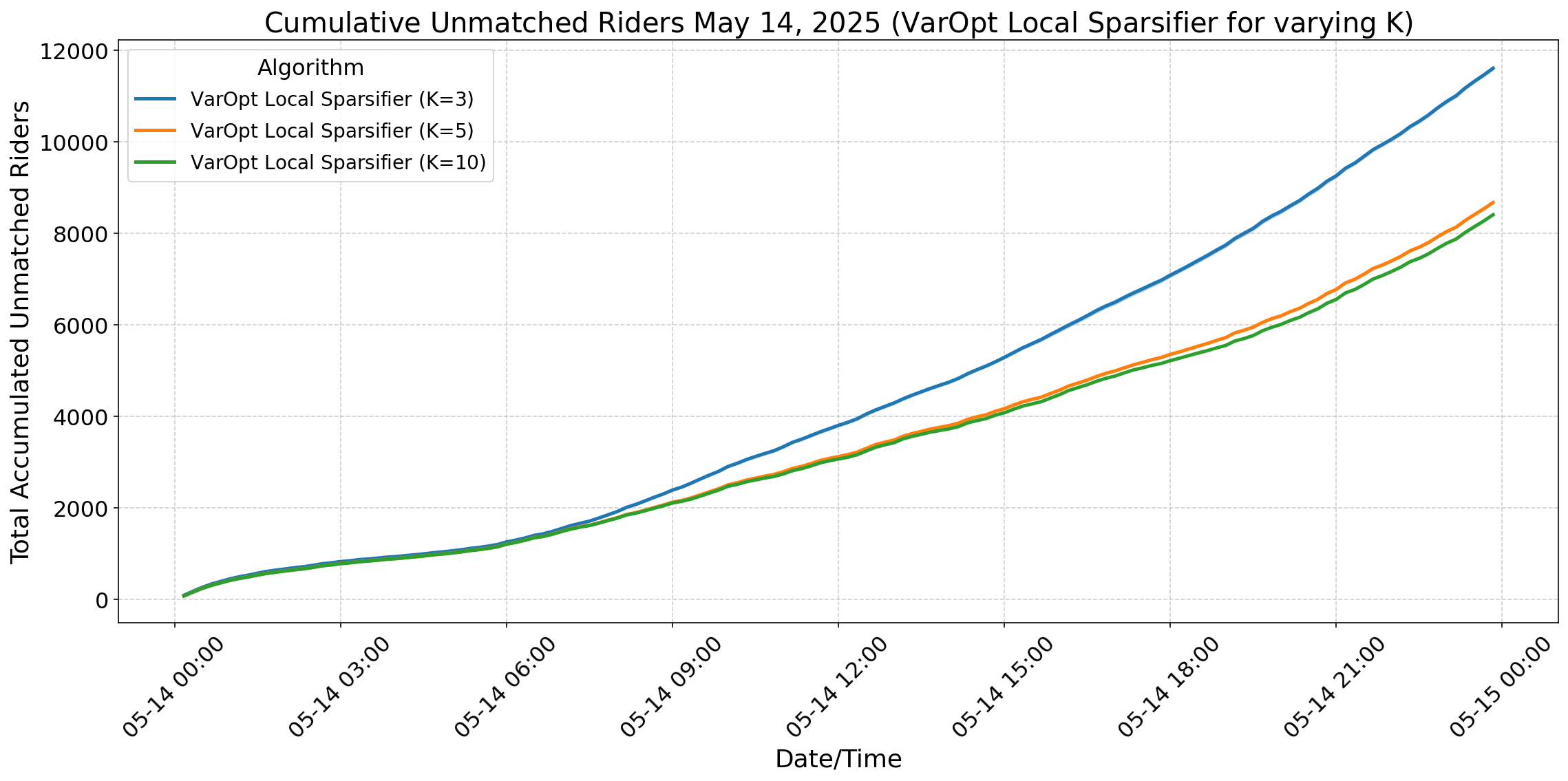
Figure 1: Baseline comparison of cumulative unmet demand. The VarOpt local sparsifier (α=E[∣M(GS)∣]/E[∣M(G)∣]8) outperforms uniform random selection and KVV baseline and tracks closely with the full-information optimal offline.
Ablation studies confirm diminishing returns past α=E[∣M(GS)∣]/E[∣M(G)∣]9, suggesting that strategic selection is substantially more impactful than choice set cardinality once k0 is moderately large.
- Synthetic Adversarial Benchmarks: On canonical hard instances (partitioned block graphs, KVV upper-triangular adversarial graphs, 0.901-efficiency lower bound graphs), VarOpt sparsification consistently surpasses classic online (KVV-Ranking) and random subgraph heuristics. In all domains, as k1 increases, the proposed strategy approaches optimal efficiency extremely rapidly—well before k2 approaches the size of compatibility sets.
Practical and Theoretical Implications
The framework explicitly separates the information-theoretic content of local versus global decision making in stochastic matching. It:
- Establishes that, in many practical regimes (e.g., dense, symmetric demand in real platforms), minimal local communication is required for near-optimal allocation, provided the global solution exhibits sufficient spread.
- Substantiates the “power of two choices” phenomenon for stochastic matching at the structural level, guaranteeing strong performance as soon as k3 is slightly greater than one.
- Demonstrates the robustness of LP-guided sparsification to adversarial construction, highlighting the importance of statistical edge weighting over naïve random selection.
Future directions include exploring whether any i.i.d. stochastic matching instance admits a deterministic local strategy yielding asymptotic optimality as k4, and tightening the gap between full-information matching and best achievable with strictly local sparsification, especially in unavoidably “heavy” instances.
Conclusion
This work introduces a rigorous, algorithmically efficient method for stochastic bipartite matching under strong locality and information constraints. The analysis leverages heavy-light decomposition of fractional LP solutions and variance-optimal sampling, yielding practical and tight theoretical guarantees on preservation ratios. Numerical results reinforce that with small budgets, the proposed local sparsifier effectively closes the performance gap to offline optimal, outperforming both classic online and agnostic subgraph selection strategies across both real-world and adversarial settings.