Phase Matching for a Generalized Grover's Algorithm
Published 13 May 2026 in quant-ph and math.OC | (2605.13758v1)
Abstract: We study the fully generalized Grover's algorithm to find the optimal phase changes for each step of the iteration to maximize gain in probability of observation of the target, and when phase matching is required. We find that classical Grover's algorithm and phase matching remains to be optimal till the target probability gets close 1. However, as the probability of observation approaches 1, the optimal phase changes differ from $π$ and no longer observe phase matching. We provide the optimization statement to find the optimal phase changes given the current amplitude vector and the size of the set. To analyze this formula, we approach it from a numerical and analytical perspective, with the analytical perspective focusing on special cases that simplify the optimization and allow for general statements about its behavior. Finally, we provide an example of a 5 qubit system and show that for the final iteration the optimal phase changes differ from traditional Grover's algorithm and do not observe phase matching, but lead to an increase in the probability of the target.
The paper demonstrates that conventional Grover phase matching (with π phases) is optimal except when the target probability nears unity, especially in small databases.
It employs both numerical and analytic methods to derive an explicit formula for the target-state probability after each generalized iteration.
Adaptive phase tuning, particularly in scenarios with nonstandard initializations, can slightly improve search efficiency, relevant for NISQ-era applications.
Phase Matching and Optimality in Generalized Grover’s Algorithm
Overview
The study "Phase Matching for a Generalized Grover's Algorithm" (2605.13758) addresses the generalization of Grover's quantum search algorithm by scrutinizing the phase rotations applied in each iteration. The work investigates the optimal selection of two phase parameters (ϕ,ψ), corresponding to the marked state and the ancillary state, and characterizes under which circumstances phase matching (ϕ=ψ) remains optimal as the algorithm progresses. Both numerical and analytic approaches are deployed to extract precise optimization criteria and to elucidate deviations from classical Grover's protocol in regimes of high success probability and small database size.
Problem Statement and Formal Framework
Grover’s algorithm offers a quadratic speedup for unstructured search, achieved via iterative application of a Grover operator composed of selective phase shifts and a diffusion operation. The generalization considered replaces the canonical π-phase rotations with arbitrary values ϕ and ψ for the target and auxiliary states, respectively. The initial system state is encoded as a two-level amplitude vector with possible nonzero relative phase, enabling analysis beyond symmetric or purely real state amplitudes.
The main technical contribution is an explicit formula for the target-state probability after a single generalized Grover iteration, where the update matrix is
This structure accommodates arbitrary initial superpositions and enables the explicit optimization of phase parameters at every iteration step.
Numerical Analysis of Phase Optimality
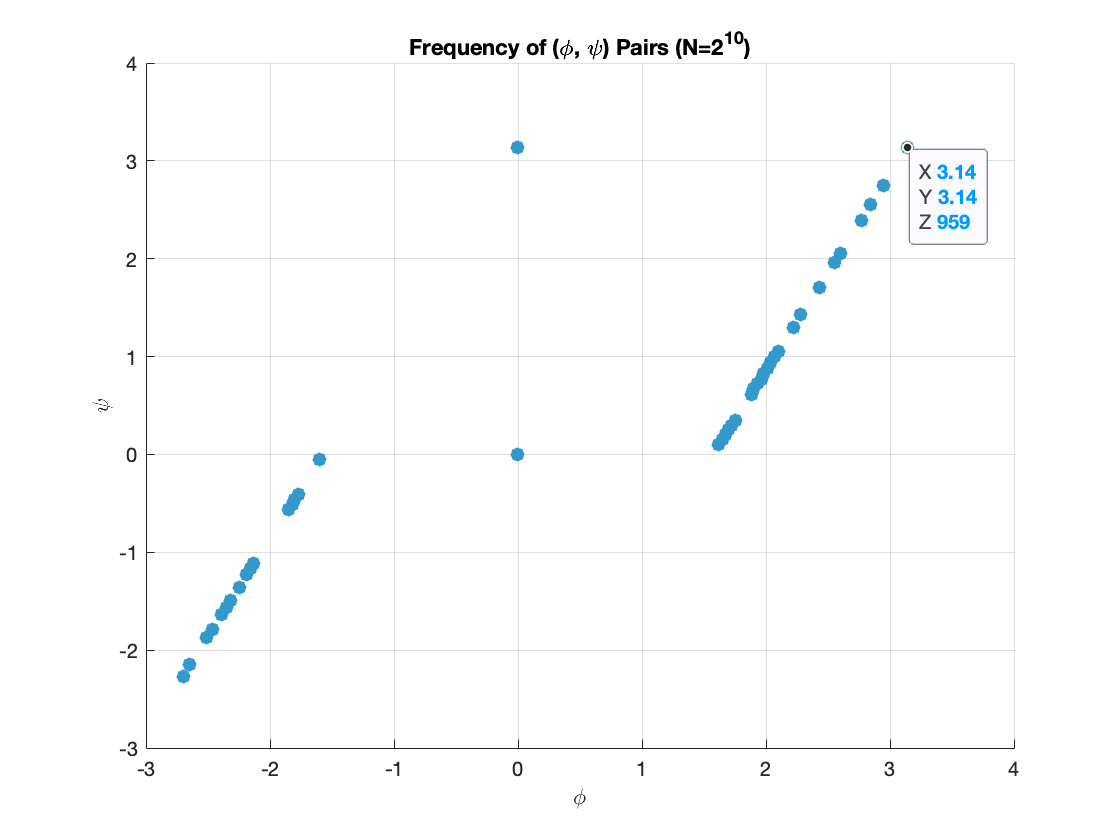
Numerical maximization of the post-iteration target probability as a function of (ϕ,ψ) reveals that classical Grover's protocol—phase matching with π—remains optimal for almost the entire process, except when the target probability closely approaches unity. This transition occurs earlier for smaller Hilbert space sizes.
For instance, with N=210, phase matching is optimal for all amplitudes corresponding to target probabilities up to ∼0.9962. Above this, the optimal phases diverge from ϕ=ψ0, and phase matching breaks down.
Figure 1: Optimal phase pairs ϕ=ψ1 for set size ϕ=ψ2—phase matching at ϕ=ψ3 holds up to very high target probability.
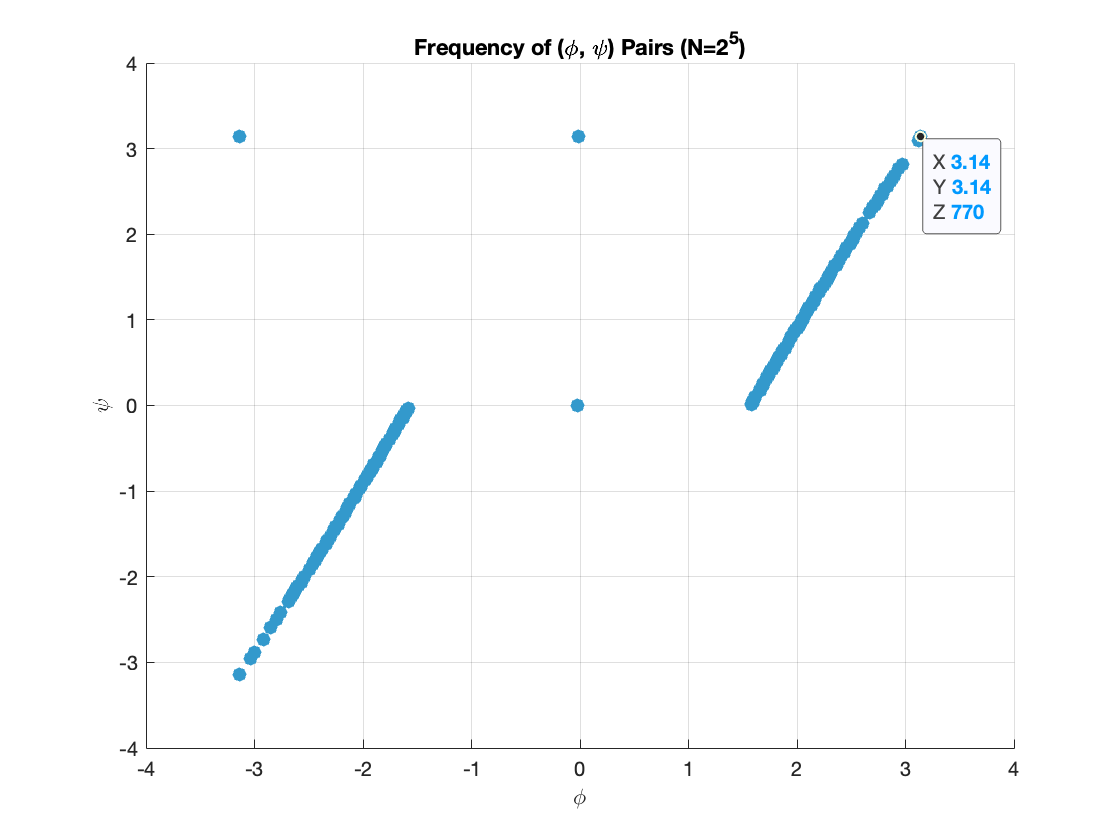
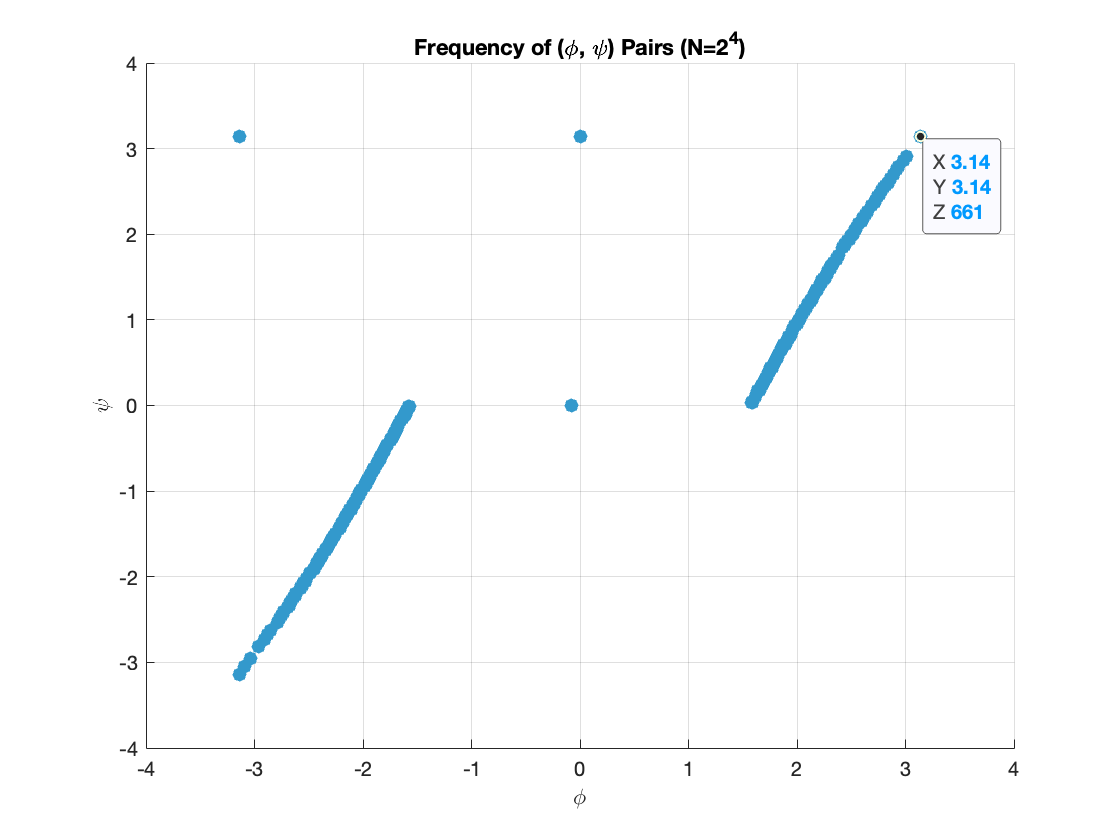
With progressively smaller ϕ=ψ4, the onset of phase mismatch occurs for lower target probabilities.
Figure 2: For ϕ=ψ5, phase matching remains optimal up to probabilities near ϕ=ψ6.
Figure 3: For ϕ=ψ7, the cutoff for phase matching is even lower, at target probabilities around ϕ=ψ8.
These results indicate that, while the advantage of adaptively optimizing the phases is modest for large ϕ=ψ9, there is measurable improvement in the success probability at the final iteration, especially for smaller search spaces.
Analytic Results and Theoretical Insights
The analytic investigation shows that, for large π0 and standard (Hadamard) initialization, the leading-order term in the target probability's optimization is maximized for classical Grover parameter settings: π1. This holds for both the first iteration and intermediate steps as long as the target amplitude is not already close to one (i.e., before the algorithm saturates).
Once the amplitude associated with the target state is high—typically at the last iteration—a transition arises where the optimal π2 are no longer matched and in general deviate from π3. This regime enables fine-tuning for exact success, a result that recovers and extends previous theoretical discoveries (see [Lo1], [LLZN]).
The analysis also establishes that when the initial amplitude vector is complex (i.e., with a nonzero relative phase π4), the optimal matching occurs between π5 and π6, not simply between π7 and π8. Thus, the algorithm can adapt to more general initializations, with practical consequences for hybrid or noisy settings, such as those encountered in NISQ devices.
Exemplary Case: Small System Improvements
For small π9, the generalized approach yields quantifiable, nontrivial improvements even with classical initialization. For ϕ0, the optimal choice of ϕ1 in the final step leads to a target probability of ϕ2, versus ϕ3 with strict phase matching. Such improvements, while numerically modest, demonstrate the theoretical possibility of a failure-free search in finite systems by adaptively selecting phase parameters.
Implications and Future Directions
Practically, the results reinforce the broad optimality of classical Grover's ϕ4-phase matching in large, symmetric, and real-amplitude search problems. The breakdown of phase matching at the high-probability regime and for small ϕ5 suggests that adaptive, iteration-dependent tuning of phase angles may yield small but potentially significant improvements in NISQ-era quantum search and exact scenario protocols.
The generalization also opens the way for optimized quantum search in nonstandard settings—e.g., with arbitrary initializations, noise-induced complex amplitudes, or restricted unitary transformations—by offering explicit maximization criteria and aligning with modern efforts in NISQ quantum algorithm engineering.
The authors indicate further research directions involving quantum walks and spatial search, promising close ties between optimal phase matching, interference engineering, and quantum stochastic processes.
Conclusion
This work establishes, both numerically and theoretically, that phase matching in generalized Grover's algorithm is optimal across most of the iterative process for standard initializations and sufficiently large search spaces. The optimality is lost only near-perfect target probabilities and for small system sizes, where adaptive phase selection produces exact or marginally improved search efficiency. The framework and optimization protocol provide a rigorous basis for customizing quantum search procedures in general state spaces, informing both theoretical investigations and experimental protocol design in practical quantum computation.
“Emergent Mind helps me see which AI papers have caught fire online.”
Philip
Creator, AI Explained on YouTube
Sign up for free to explore the frontiers of research
Discover trending papers, chat with arXiv, and track the latest research shaping the future of science and technology.Discover trending papers, chat with arXiv, and more.