- The paper introduces a novel semidefinite relaxation method that transforms nonconvex obstacle constraints into convex ones for real-time MPC on embedded platforms.
- It integrates PSD cone projections with ADMM and Riccati-based updates, achieving up to 73% shorter paths and enhanced safety compared to baselines.
- Empirical evaluations in static and dynamic benchmarks validate robust, agile performance in both planar and 3D scenarios with certifiable obstacle clearance.
TinySDP: Real-Time Semidefinite Optimization for Certifiable and Agile Edge Robotics
Semidefinite Relaxation in Embedded MPC
TinySDP confronts the longstanding challenge of real-time collision-free navigation under nonconvex geometric constraints on resource-constrained platforms. Standard embedded MPC solvers (e.g., TinyMPC, OSQP) exhibit limitations when obstacles induce nonconvexities, with prior mitigation techniques relying on conservative local convexifications, margin-tuned barrier functions, or computationally-intensive neural methods. TinySDP leverages semidefinite lifting via PSD cone relaxations of quadratic constraints—transforming nonconvex disk-based obstacle avoidance into structured convex constraints compatible with Riccati-based MPC. The approach retains efficient ADMM iterations through analytic PSD projections and exploits the Riccati structure for fast rollouts.
Algorithmic Architecture
The MPC problem is lifted to semidefinite form, introducing auxiliary moment variables for state and input, with linear lifted dynamics and costs. Obstacle avoidance is enforced by affine PSD relaxations per timestep on geometric subspaces (e.g., planar position). The ADMM-based solver alternates between Riccati primal sweeps, PSD cone projections (via small-matrix eigendecomposition), and dual updates. Crucially, the resulting lifted problem preserves embedded tractability, enabling runtime deployment on microcontrollers.
A posteriori certification is achieved via a rank-1 trace gap check: if the PSD-lifted moment block matches the rank-1 physical configuration closely and the lifted margin is positive, explicit geometric clearance from all obstacles is certified. This certificate is evaluated at each timestep, and a fallback policy prevents the application of uncertified controls.
Static and Dynamic Benchmark Evaluation
TinySDP's empirical evaluation spans static U-shaped cul-de-sac traps and dynamic moving-gap scenarios characterized by tight passages and moving obstacles. In the static benchmarks, TinySDP consistently reaches the goal, achieving path lengths up to 73% shorter than tuned TinyMPC baselines and up to 31% shorter than RPCBF, with order-of-magnitude improvements in goal precision and safety without requiring inflated margins. Notably, conventional barrier and linearization-based methods fail or require impractical safety margins far exceeding the physical robot's size.
In dynamic settings, TinySDP demonstrates robust anticipatory deviation, maintaining certification at every step as moving obstacles block the path. Path lengths are 30–43% shorter than RPCBF or high-margin TinyMPC baselines, with precise clearance and zero collisions. Baselines without sizable safety margins suffer early collisions and deadlocks.
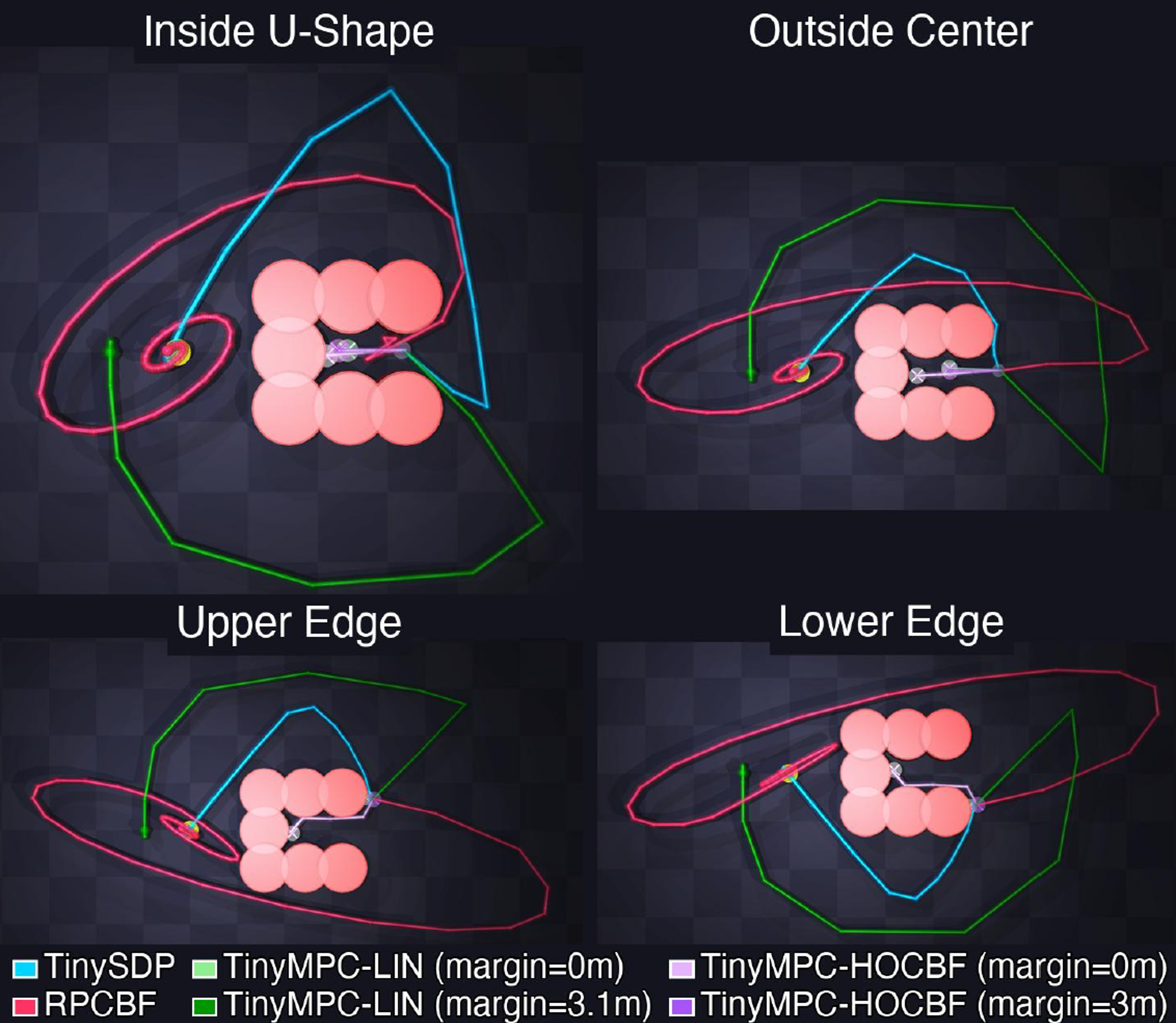
Figure 1: TinySDP’s trajectories in the static U-shaped benchmark demonstrate consistent navigation and superior path efficiency compared to baselines.
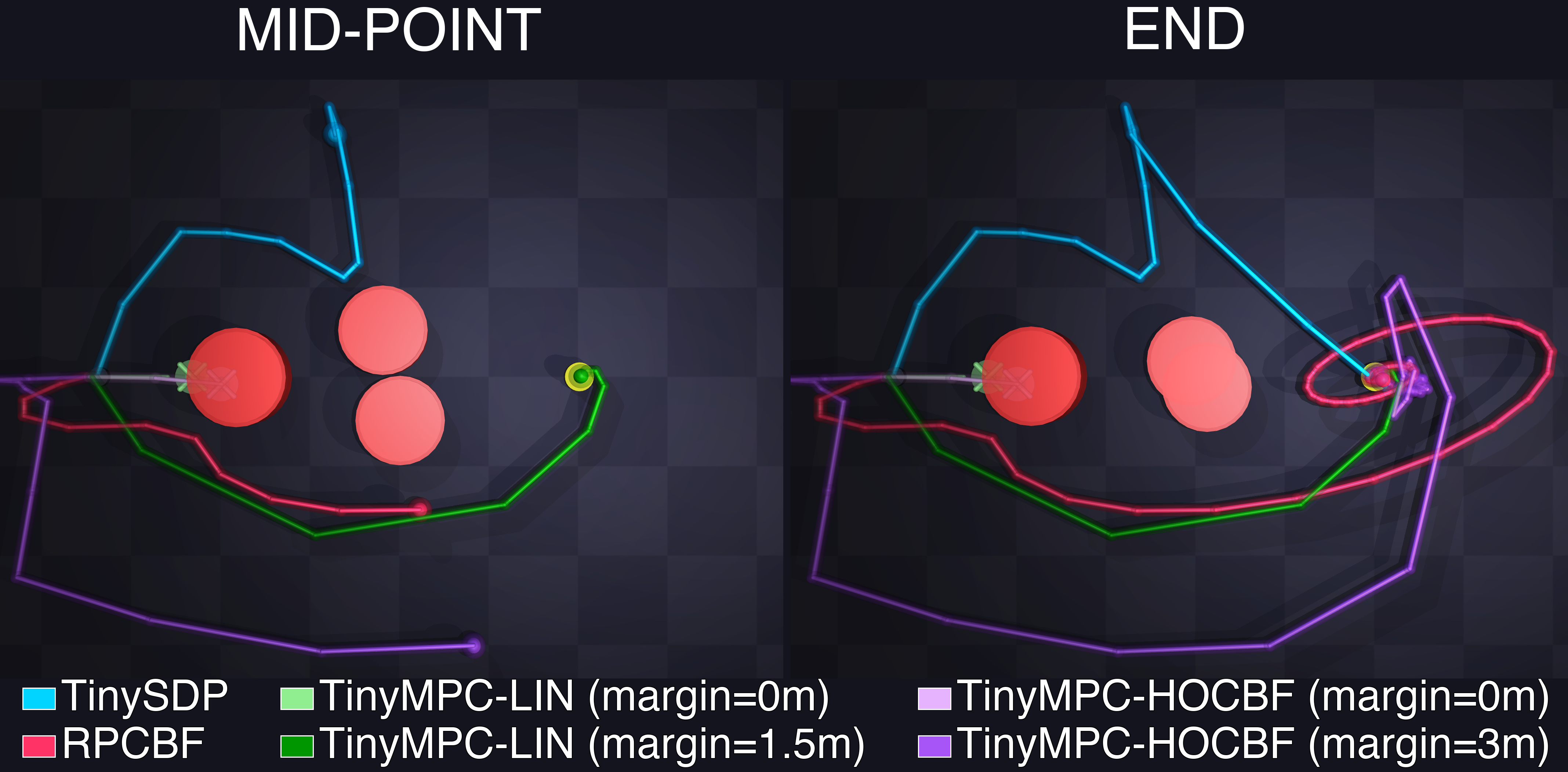
Figure 2: TinySDP anticipates moving obstacles in the dynamic benchmark, avoiding collisions with early deviation, unlike conservative or reactive baselines.
3D Extensions and Embedded Deployment
TinySDP is naturally extensible to higher-dimensional geometric subspaces (e.g., 3D motion), with the lifted PSD cone adapted for spherical obstacles. Simulated 3D scenarios illustrate nonplanar maneuvers and timing strategies, preserving clearance without manual margin inflation.
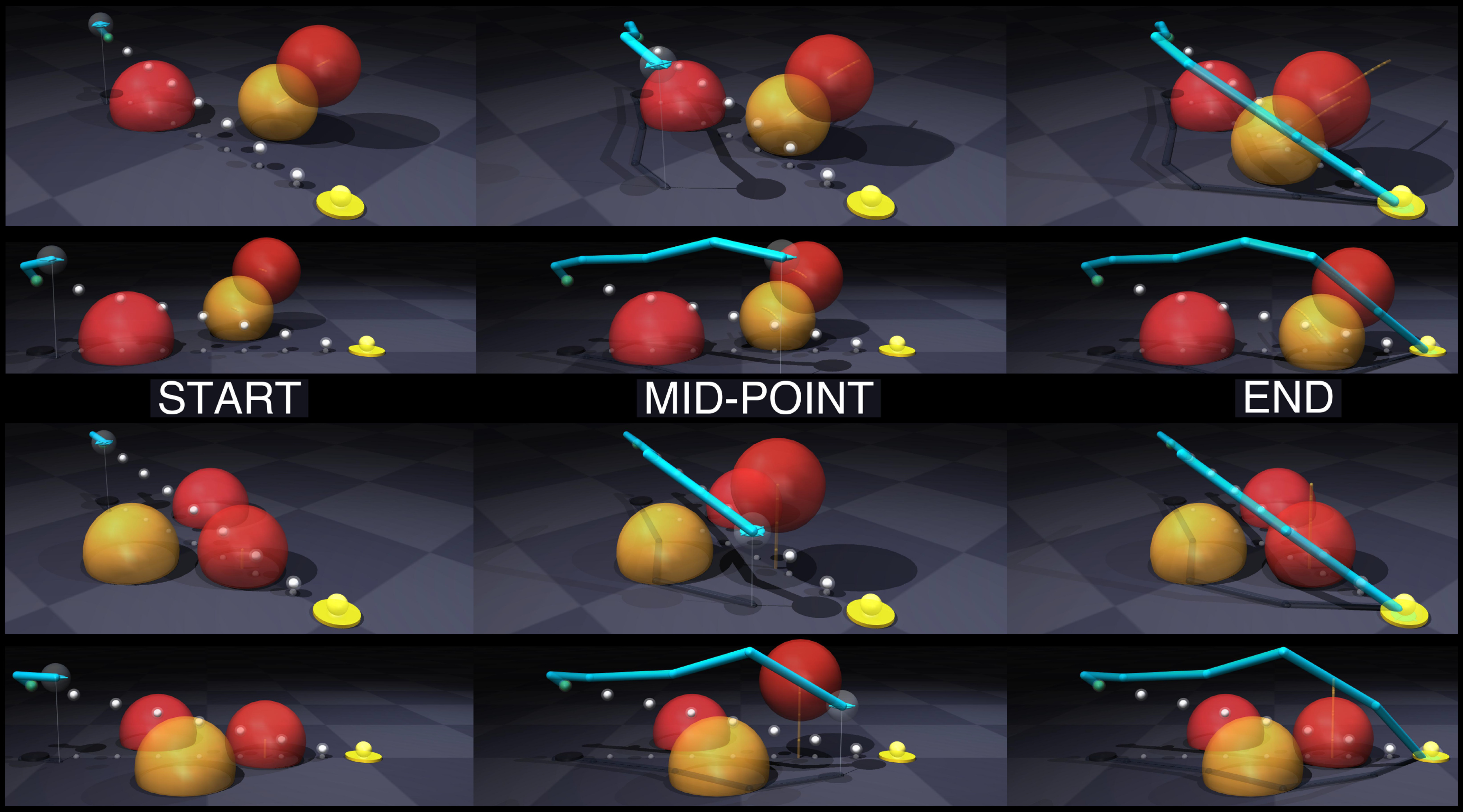
Figure 3: TinySDP in 3D dynamic scenarios, executing agile, nonplanar maneuvers around moving and oscillating spherical obstacles with positive clearance.
TinySDP is deployed on a Crazyflie quadrotor with a 168 MHz microcontroller and 192 KB SRAM, enforcing planar position PSD constraints. The full MPC solve is achieved at 25 Hz, with modest memory overhead and no practical bottleneck in the 3x3 matrix eigendecomposition. Real-world flight trials show anticipatory obstacle avoidance and maintained certification throughout, even under hardware disturbances.
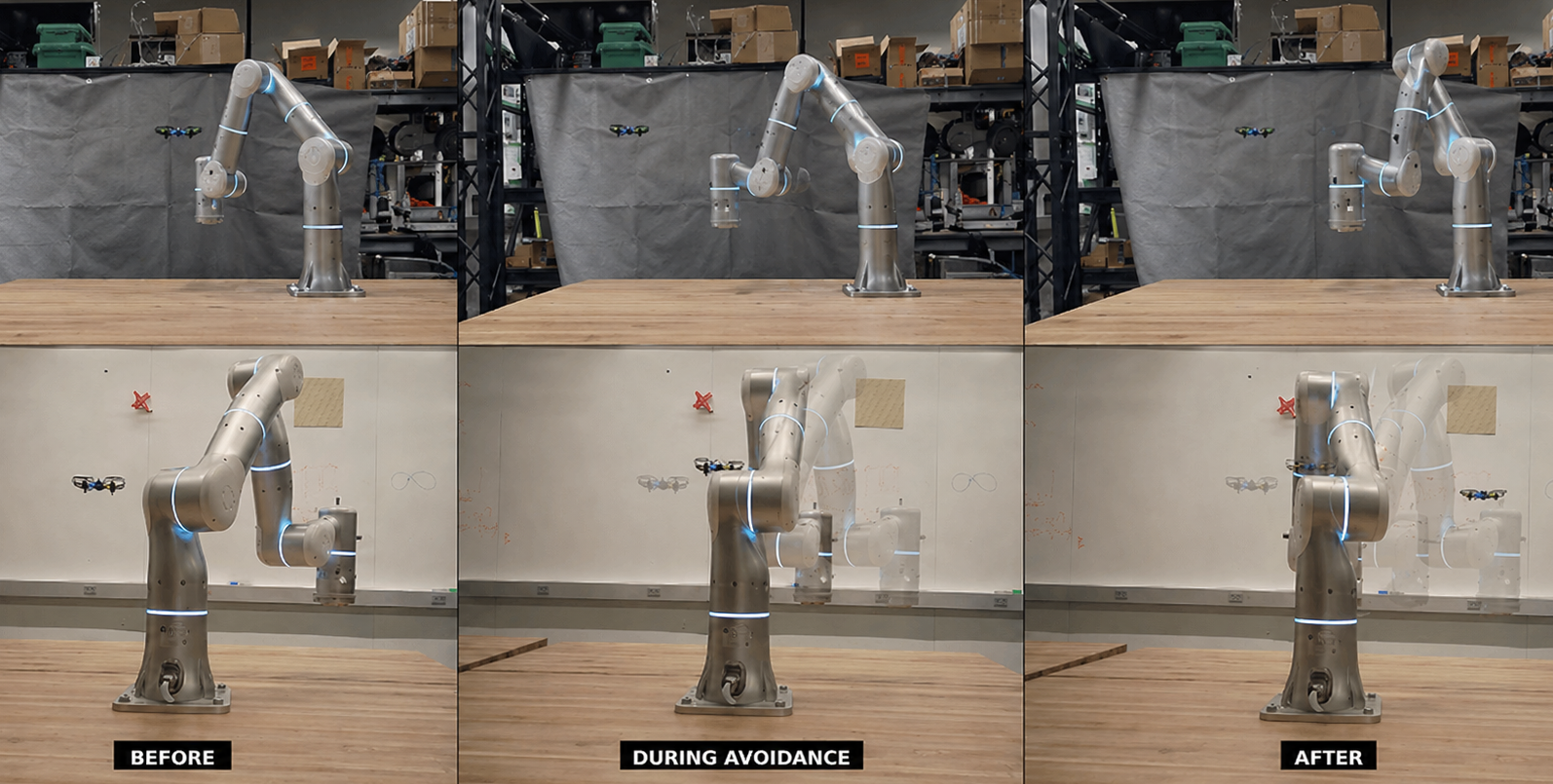
Figure 4: Crazyflie running TinySDP online to avoid a moving arm; before, during, and after the avoidance maneuver.
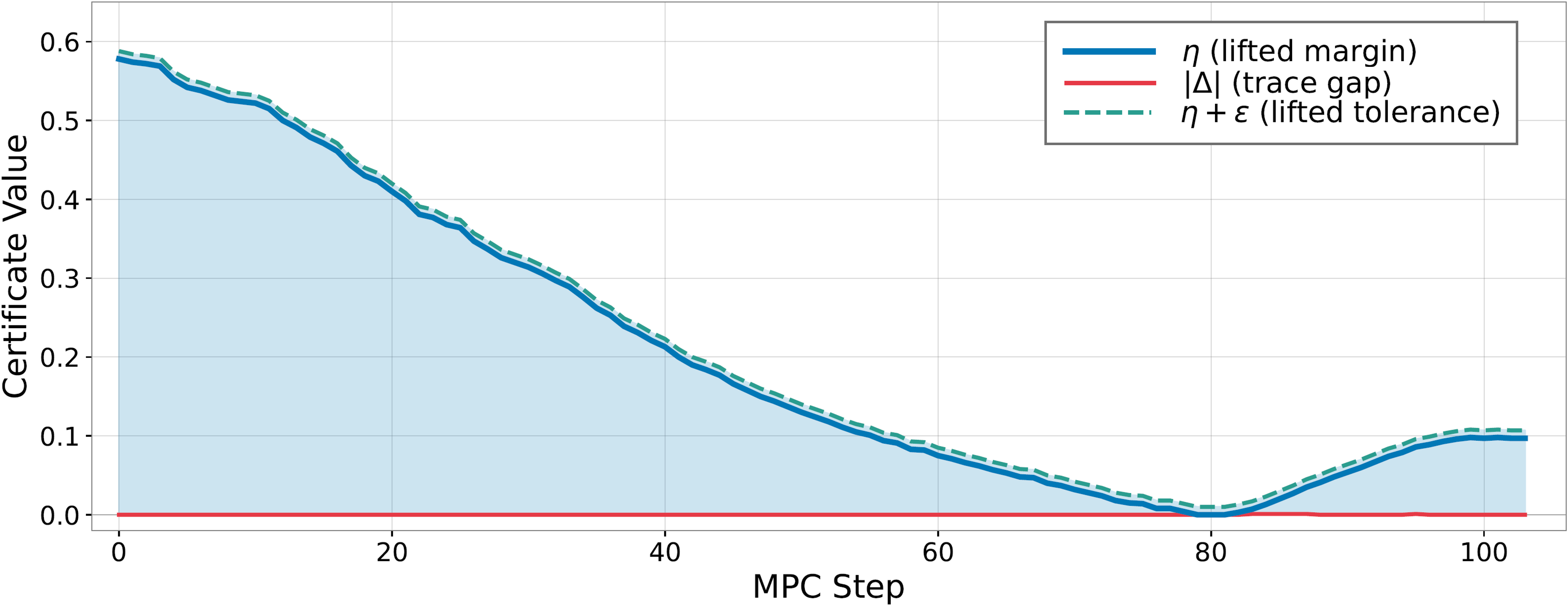
Figure 5: Evolution of the Rank-1 certificate during real-world flight; shaded regions confirm certifiable safety at all timesteps.
Implications, Limitations, and Future Directions
TinySDP empirically bridges the gap between offline SDP planning and real-time embedded control. By effectively lifting only task-relevant geometric variables, it circumvents the cubic scaling incurred by general SDP solvers. The per-timestep certification framework, though not a formal recursive feasibility guarantee, provides rigorous geometric safety checks with deployment-level robustness. Performance advantages are manifested in drastically reduced path conservatism, higher precision, and practical real-time feasibility.
Current limitations include the lack of a closed-loop theoretical guarantee, computational scaling with higher dimensionality, and reliance on a reactive fallback for extreme disturbance scenarios. Future developments should address horizon-wide certification and extend proactive safety guarantees via forward reachability, as well as richer obstacle representations beyond quadratic forms.
Conclusion
TinySDP provides a certifiable, structured semidefinite relaxation for obstacle avoidance in MPC on embedded platforms. Its integration of PSD-lifted constraints via Riccati–ADMM retains computational tractability and enables rigorous certification of collision-free navigation in both planar and 3D environments. The approach markedly outperforms margin-based, linearized, and barrier function baselines in path efficiency, precision, and practical deployment feasibility. The results indicate the opportunity for incorporating richer convex relaxations within real-time controllers, motivating research into low-compute SDP solvers and certified embedded MPC for advanced robotics.
Reference: TinySDP: Real Time Semidefinite Optimization for Certifiable and Agile Edge Robotics (2605.13748).