- The paper demonstrates a Floquet protocol that enables programmable nonreciprocal light-induced dipolar interactions with tunable beamsplitter and squeezing operations.
- The experimental setup uses optical tweezer arrays to achieve dynamic control over complex eigenfrequencies and realize negative-mass oscillator dynamics.
- The results offer a versatile toolbox for advanced quantum operations in non-Hermitian optomechanics, precisely managing both dissipative and conservative interactions.
Floquet Engineering of Nonreciprocal Light-Induced Dipolar Interactions in Optical Tweezer Arrays
Introduction
This paper introduces a comprehensive framework for time-dependent, Floquet-engineered light-induced dipolar interactions between optically trapped nanoparticles, focusing explicitly on the manipulation and control of mechanical degrees of freedom via programmable nonreciprocal optical forces. The study systematically demonstrates beamsplitter, single-mode, and two-mode squeezing operations, and realizes negative-mass oscillator dynamics by exploiting the inherent nonreciprocity of optical binding. The results enable continuous tuning of complex eigenfrequencies for subsystems and establish a versatile toolbox for quantum operations crucial in non-Hermitian many-body optomechanics.
The experimental system consists of optically trapped silica nanoparticles in independent tweezer potentials, allowing spatial and frequency detuning of the tweezers. Modulation of the optical frequencies induces Floquet dynamics, giving rise to time-dependent directional couplings g12(t) and g21(t) between nanoparticles, which can be rendered reciprocal (g12=g21), anti-reciprocal (g12=−g21), or a tunable combination, based on trap distance and optical phase.
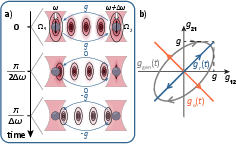
Figure 1: Time-dependent light-induced dipolar interactions with temporal modulation of reciprocal and nonreciprocal couplings.
Floquet engineering enables modulation-driven energy exchange and squeezing operations by matching the optical detuning Δω to mechanical detunings or sums, i.e., Δω≈ΔΩ or Δω≈2Ωˉ, leading to resonant beamsplitter (coherent energy exchange) and squeezing Hamiltonians.
Quantum Operations: Beamsplitter and Squeezing
Four distinct spectroscopic signatures—reciprocal/anti-reciprocal beamsplitter and squeezing—are observed by sweeping the optical detuning. When on-resonance (Δω≈ΔΩ or 2Ωˉ), the spectrogram exhibits avoided crossings or mode degeneracies, with extracted coupling rates g/2π ranging from 775 Hz to 953 Hz, all exceeding the damping rate g21(t)0 Hz, demonstrating strong light-mediated interactions.
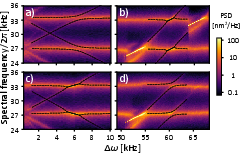
Figure 2: Spectrograms revealing reciprocal and anti-reciprocal beamsplitter and squeezing operations, mapped by joint particle motion.
Demonstration of coherent, quantum-beamsplitter energy exchange (analogous to Rabi oscillations) utilizes charged/neutral particles with instantaneous feedback cooling control, yielding oscillating variances and phase correlations that match theoretical predictions for both reciprocal and anti-reciprocal interactions.
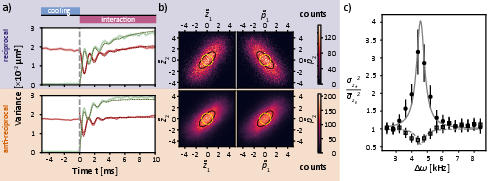
Figure 3: Programmable two-mode operations; coherent energy exchange and noise correlations for reciprocal and anti-reciprocal couplings.
Two-mode squeezing (TMS) shows correlated and anti-correlated quadratures for reciprocal interactions, and simultaneous correlations for both position and momentum in anti-reciprocal interactions, which is a hallmark of dissipative coupling and negative-mass oscillators. Measured squeezing gain achieves g21(t)1 and g21(t)2 dB below thermal noise, consistent with parametric drive theory.
Programmable Control of Complex Eigenfrequencies
By continuously scanning the inter-particle distance, the system realizes tunable combinations of beamsplitter and squeezing operations, resulting in joint control over the real and imaginary components of eigenfrequencies. Such manipulation enables the encirclement and investigation of exceptional points and non-Hermitian mode braiding.
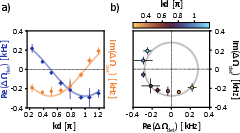
Figure 4: Tuning of complex eigenfrequencies as a function of interparticle distance; trajectories match theoretical circle in the complex plane.
Eigenmode reconstruction in the rotating frame, using Fourier demodulation, allows separation of dissipative and conservative dynamics, revealing programmable control over both normal mode frequencies and damping rates. No shift in stationary mechanical frequencies is observed upon modulation, unlike stationary interactions, providing protocol flexibility and clear quantum state readout.
Single-Mode Squeezing and Sideband Engineering
The Floquet protocol also extends to single-mode squeezing by setting g21(t)3, which parametrically drives one oscillator and modifies the variance along specific quadratures in phase space. Measurements include transition from linear to nonlinear regimes, with variance reduction limited by thermal noise and feedback stabilization protocols.
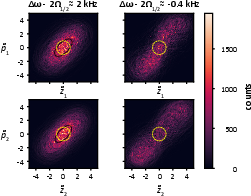
Figure 5: Single-mode squeezing phase spaces, showing reduction of variance relative to unmodified thermal states.
Sideband analysis confirms the resonant overlap conditions for light-induced Stokes and anti-Stokes scattering processes, which underlie the mechanisms for the beamsplitter and squeezing operations.
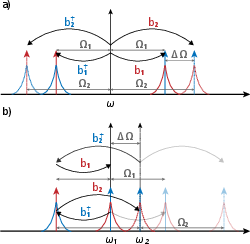
Figure 6: Reciprocal interaction sideband diagrams for non-degenerate frequencies; resonance at g21(t)4 gives beamsplitter Hamiltonian.
Measurement and Characterization of Nonreciprocity
Second-order cross-correlations and phase analysis quantify the degree of nonreciprocity, enabling precise determination of g21(t)5 and, thus, the nature of the interaction. Phase-locking histograms track the mechanical phase difference and confirm theoretical predictions of dissipative synchronization, with phase contrast increasing with interaction strength.
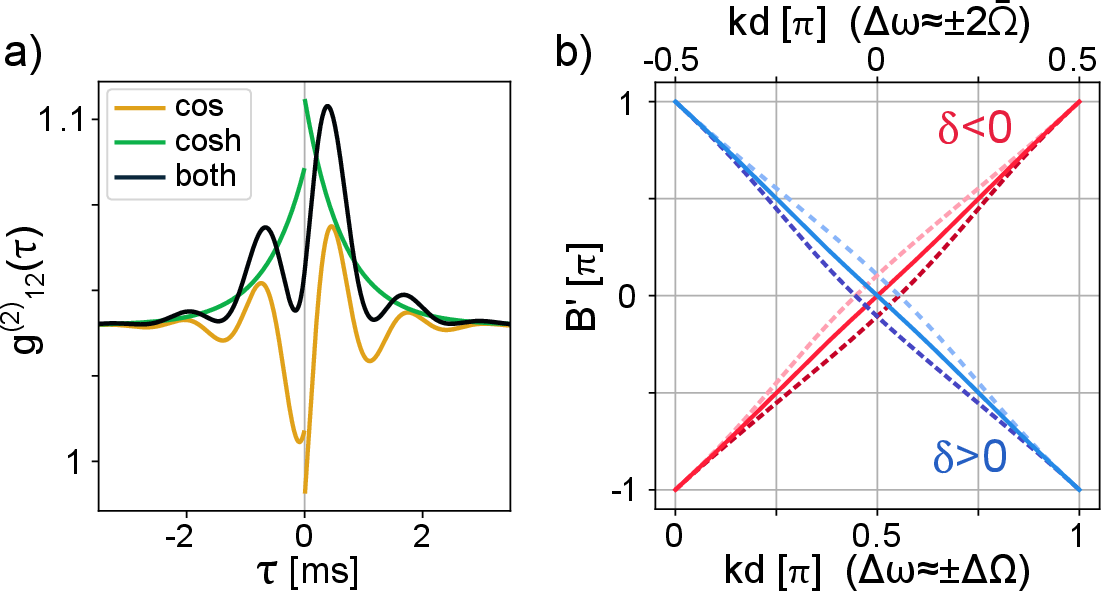
Figure 7: Second-order cross-correlation decomposition, showing phase-sensitive contributions and distance-dependent locking.
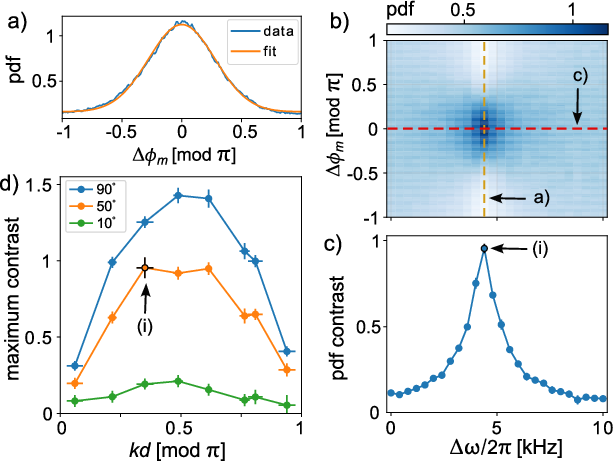
Figure 8: Histogram for mechanical phase difference, quantifying phase-locking under nonreciprocal drive.
Implications and Potential Extensions
The presented Floquet-engineered toolbox—modulatable beamsplitter and squeezing operations, negative-mass oscillator realization, and programmable nonreciprocity—offers a platform for advanced quantum control of optomechanical arrays. It is immediately applicable to hybrid systems (atoms, ions, nanoparticles), quantum sensing, and non-Hermitian many-body physics, supporting protocols such as quantum non-demolition measurements, stationary entanglement via reservoir engineering, and topological phase investigations.
The theoretical framework facilitates exploration of out-of-equilibrium dynamics, mode braiding, and heat transfer in nonreciprocal systems. The independence from cavity resonance and deterministic access to fundamental quantum optics operations (beamsplitter and TMS) via trap distance and optical frequency detuning constitutes a significant advancement in scalable optomechanical device engineering.
Conclusion
This paper establishes a formal framework for Floquet-driven, programmable nonreciprocal light-induced dipolar interactions in optical tweezer arrays. The realization of reciprocal and anti-reciprocal beamsplitter and squeezing operations, negative-mass oscillator dynamics, and continuous tuning of complex eigenfrequencies lays the foundation for future developments in quantum optomechanics, non-Hermitian physics, and hybrid quantum technologies. The experimental and theoretical results are robust, with coupling rates exceeding dissipation, strong squeezing, and programmable control protocols that offer novel opportunities for both fundamental and applied research in quantum science.