- The paper introduces DiffLNS, a hybrid framework combining discrete diffusion initialization with LNS2 repair to improve multi-agent path finding outcomes.
- It employs a diffusion-aware sparse social attention module to focus on imminent conflicts, reducing computation and enhancing plan repairability.
- Empirical results show robust scalability up to 312 agents, outperforming state-of-the-art methods by significant margins in congested environments.
Discrete Diffusion for Large-Scale Multi-Agent Path Finding with Sparse Social Attention
Problem Setting and Motivation
This work addresses the combinatorial challenge of Multi-Agent Path Finding (MAPF)—specifically the planning of globally consistent, collision-free joint trajectories for large agent teams in dense, congested environments. Recent advances in LNS-based methods (notably LNS2) have enabled scalable repair-based MAPF solving, where iterative local subset replanning (repair) is applied to improve a coarse, typically suboptimal initial solution. However, the initialization stage for MAPF-LNS2 remains a pronounced bottleneck, especially as the quality of the initial plans significantly influences the subsequent repair outcomes in highly coupled or congested regimes. This work identifies that suboptimal planning initialization in such settings induces compound conflicts which often render subsequent local repairs intractable or inefficient.
DiffLNS: Hybrid Discrete Diffusion and LNS2 Framework
The core contribution is the DiffLNS framework, which uses a discrete denoising diffusion probabilistic model (D3PM) as a learned initializer to generate structured, high-quality joint trajectories directly in the categorical action space, seamlessly integrated with downstream repair via LNS2. Rather than directly solving MAPF feasibility as a generative task, the discrete diffusion model acts as a warm-start mechanism, focusing optimization capacity on initialization quality—a paradigm shift in how deep generative models are brought to bear on large-scale MAPF.
This hybrid pipeline is succinctly depicted in Figure 1.
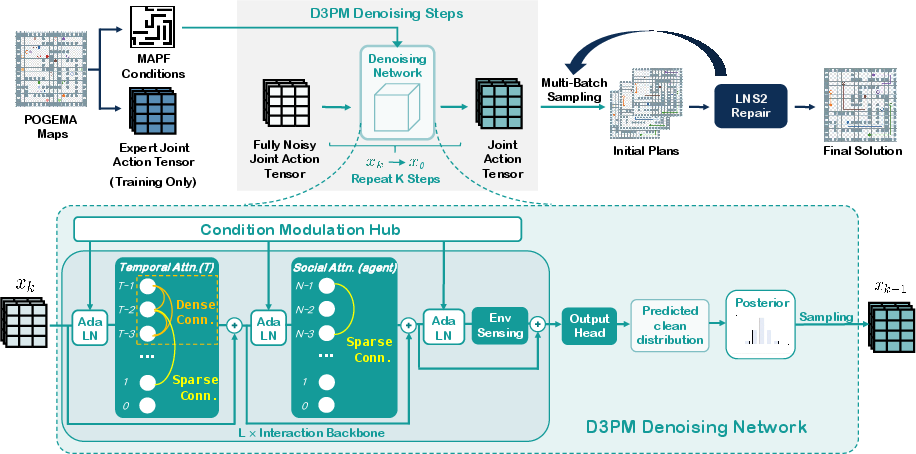
Figure 1: Overview of the DiffLNS hybrid framework, with structured discrete diffusion initialization and LNS2-based repair.
Diffusion-Aware Sparse Social Attention Mechanism
A critical architectural innovation is the introduction of a diffusion-aware sparse social attention module within the D3PM denoiser. Unlike dense all-to-all social attention, which is computationally intractable and misaligned with the locality of interaction relevance in MAPF, this module constructs dynamic local neighborhoods for each agent at every denoising step, based on proximity in the current inferred noisy joint trajectory. This mechanism Figure 2 restricts social context aggregation to agents likely to be in direct or imminent conflict, thereby improving both computational efficiency and the practical repairability of the initialized plans.
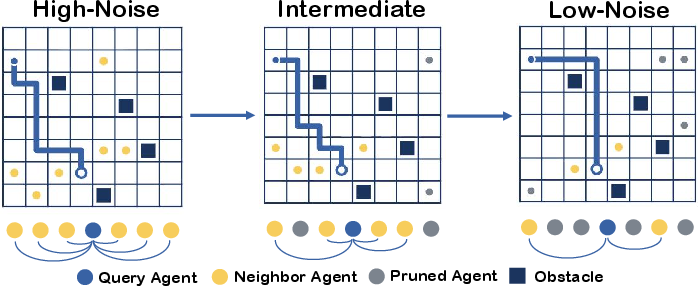
Figure 2: Agents attend to their dynamic local neighborhoods throughout denoising, focusing computation on imminent conflicts.
Empirical Results and Robustness
Extensive experiments are performed on the POGEMA suite with five diverse and structurally distinct environment families, each evaluated with high agent densities (up to 312 agents on 33×33 maps). Metrics include success rate (SR), sum of costs (SOC), and runtime, compared to SOTA classical (MAPF-LNS2, LaCAM3) and deep learning baselines (LNS2+RL, HMAGAT).
In 20 densely congested settings, DiffLNS achieves an average SR of 95.8%, outperforming the strongest baseline by 9.6 points, with consistent superiority as the system scales in agent count, despite being trained only on smaller instances of up to 96 agents. The framework exhibits robust empirical generalization to large-scale settings, with consistent improvements on hard maze and warehouse maps where classical methods rapidly degrade as density increases Figure 3.
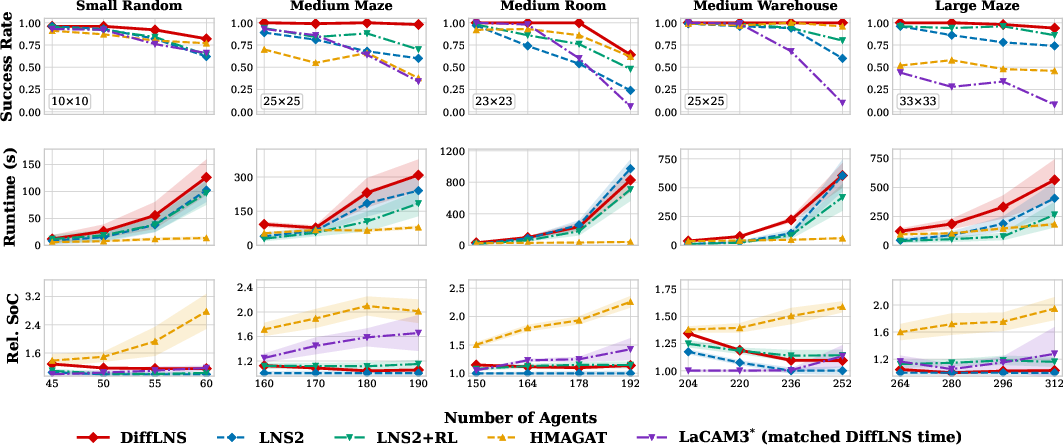
Figure 3: DiffLNS shows strong success rates across all benchmarks, with notable robustness in high-density scenarios.
A controlled initialization ablation shows that a single diffusion initialization, even without multi-candidate selection, yields more repairable starting points and higher downstream feasibility than prioritized-planning (PP+SIPPS) initializations in LNS2, even when the latter has fewer raw conflicts—a result supporting claims that global structure learned from expert demonstrations is more important than sheer conflict minimization Figure 4. Furthermore, iterative multi-sample repair with diverse candidate seeds outperforms even repeated prioritized initialization restarts under equivalent candidate budgets (Appendix, Figure "pp_multistart_comparison").
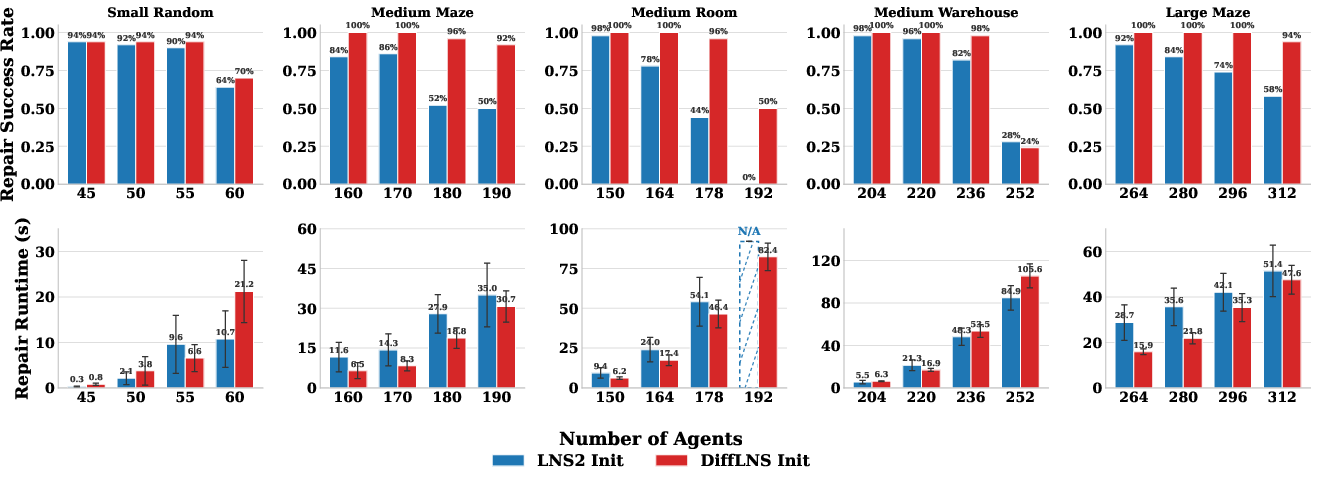
Figure 4: Diffusion initializations enhance repairability and accelerate valid solution discovery compared to classical PP+SIPPS-based initialization.
Ablation on the sparse social attention module demonstrates clear improvements in success rates and reduced candidate generation, compared to dense social attention, with the sparse module also achieving lower overall compute Figure 5.
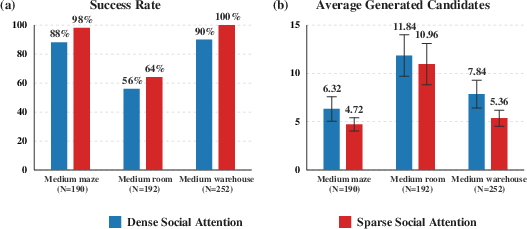
Figure 5: Sparse social attention enhances repair rates and reduces candidate search cost versus dense attention in congested maps.
Theoretical and Practical Implications
This work provides evidence that generative models, when carefully adapted to the structural requirements of combinatorial multi-agent planning (i.e., through discrete action space modeling and local interaction biases), offer scalable priors that serve as highly effective warm starts for classical search algorithms. The diffusion model supports permutation-equivariance in the agent dimension and generalizes outside its observed training cardinalities, demonstrating strong inductive generalization properties for structured, centralized plan synthesis.
Practically, DiffLNS is immediately relevant for real-time or large-scale robotics, autonomous warehousing, or any setting where planning under congestion must trade off between solution quality, feasibility, and compute. The generated seeds are amenable to massive parallelization in both initialization and repair, mitigating wall-clock penalties incurred by multi-sample generation.
The results further show that the choice of initialization is as important, if not more, than the inner-loop repair operator in challenging MAPF instances. By learning from expert demonstrations, the diffusion model captures multimodal joint plan distributions, breaking free from the deterministic or rigid structural limitations of prioritized or auto-regressive classical initialization.
Limitations and Future Directions
Current limitations include reduced impact on easier MAPF instances, inevitable reliance on downstream repair budget and solver implementation, and possible distribution shifts when scaling to larger map topologies or dramatically increasing agent counts. While agent-count generalization is empirically robust, further architectural or training regime adjustments are required for cross-map generalization. Integration with learned repair mechanisms beyond LNS2 (as suggested by LNS2+RL complementarity) is a natural avenue for combined learned initialization and repair.
Extensions to other combinatorial transport and decentralized planning domains are plausible, particularly where an expressive structured generative prior can transform the topology of search in classical solvers.
Conclusion
This work establishes discrete diffusion, enhanced with structured local social attention, as an effective and scalable warm-start mechanism for solving challenging, highly congested MAPF instances. DiffLNS's synergy of deep generative initialization and classical LNS2 repair achieves both strong feasibility and robust, scalable generalization, and fundamentally reframes initialization as a principal axis in multi-agent combinatorial search. The empirical findings and architectural advances provide a blueprint for further hybridization of generative modeling and combinatorial search in multi-agent planning and control.
Reference:
"Discrete Diffusion for Complex and Congested Multi-Agent Path Finding with Sparse Social Attention" (2605.13296)

