- The paper establishes a formal quantum-classical mapping of feedback-based optimization methods by translating quantum protocols into deterministic classical dynamics.
- The study demonstrates that while quantum algorithms (FALQON, iFALQON) achieve lower energy densities, classical algorithms (e.g., HOT-CACAO+) provide faster convergence and scalability in solving HUBO problems.
- The results reveal tradeoffs in control parameter designs, showing that homogeneous quantum control favors global search while classical inhomogeneous updates enable efficient, scalable combinatorial optimization.
Feedback-Based Quantum Optimization and Its Classical Counterpart: A Critical Analysis
Theoretical Foundation
The paper "Feedback-based quantum optimization and its classical counterpart: quantum advantage and the power of classical algorithms" (2605.13082) establishes a formal correspondence between quantum feedback-based optimization algorithms—specifically FALQON and its variants—and exact classical analogs. Optimizing the ground state of Ising-type spin models, commonly formulated as QUBO or HUBO, is functionally equated to combinatorial optimization tasks, with feedback-based Lyapunov control as the central paradigm for driving cost-function minimization. The quantum protocols rely on the feedback calculation of control parameters through measurements, whereas the classical counterparts exploit the canonical equations for spin dynamics, obviating the need for projective measurements and iterative feedback.
The quantum-classical transition is defined by mapping Pauli operators onto classical spin vectors and replacing quantum commutators with Poisson brackets. This transition enables the derivation of classical update rules that mirror the quantum reduction of energy density, providing a rigorous basis for comparing algorithmic performance at a fundamental level.
Algorithmic Landscape and Implementation
The paper articulates several optimization algorithms:
- Quantum Algorithms: FALQON (homogeneous, single parameter), iFALQON (inhomogeneous, per-spin parameters), and their feedback-driven protocol, engineered to guarantee monotonic Lyapunov reduction.
- Exact Classical Counterparts: CC-FALQON and CC-iFALQON, derived via quantum-classical correspondence, preserve feedback parameter semantics but operate deterministically on classical spins.
- Counterdiabatic Classical Algorithms: CACAO (first-order terms only), HOT-CACAO (higher-order counterdiabatic terms—second order and above), and HOT-CACAO+ (aggregated terms with maximal parameter expressivity).
Quantum algorithms require iterative measurement and feedback computation; classical algorithms execute direct updates, leveraging deterministic evolution with significant computational efficiency, especially in sparse/topologically restricted instances.
Benchmarks and Numerical Evidence
Quantum vs. Classical Quality and Convergence
Empirical evaluation using 2-SAT and 3-SAT instances (with clause density near phase transition) reveals several pivotal results:
- Quantum Advantage: FALQON consistently produces lower energy densities than its classical counterpart (CC-FALQON) in a subset of instances, indicating a qualitative quantum advantage in solution finding, albeit with slower convergence and larger computational overhead.
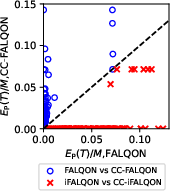
Figure 1: Energy density comparison between feedback-based quantum optimization algorithms and their classical counterparts on N=12 2-SAT instances.
- Inhomogeneous Driving: Contradictory performance emerges: iFALQON (\textit{quantum}) is inferior to CC-iFALQON (\textit{classical}), revealing that inhomogeneous control accelerates classical convergence but impedes quantum optimization. This nontrivial result is attributed to the locality/globality dichotomy in classical and quantum dynamics.
- Convergence Hierarchy: HOT-CACAO and HOT-CACAO+ exhibit superior convergence rates over CACAO and CC-iFALQON, while FALQON achieves lower final energies, underscoring a tradeoff between rapid descent and quantum correlation-driven solution quality.
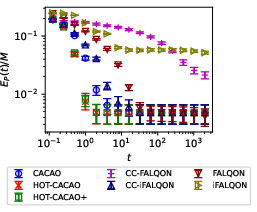
Figure 2: Energy density versus operation time for all quantum and classical algorithms; higher-order terms boost classical convergence while quantum methods reach marginally lower-energy solutions.
Scalability and HUBO Direct Solving
Classical algorithms are benchmarked on 3-SAT with N=104:
- Scalability: HOT-CACAO+ scales favorably, achieving lower or constant energy densities as system size increases (indicating only a ∼O(10−2) clause unsatisfaction rate for large N), while other methods plateau. Incorporating both higher-order counterdiabatic terms and the explicit problem Hamiltonian (HP) is essential for scalable high-quality solutions in large-scale HUBO.
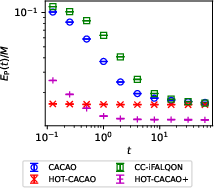
Figure 3: Convergence profiles for classical algorithms on N=104 3-SAT; HOT-CACAO+ consistently delivers the lowest final energies.
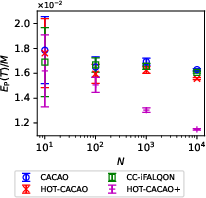
Figure 4: Energy density scaling with system size; HOT-CACAO+ improves solution quality for larger N.
Detailed Dynamical Analysis
Extensive exploration of the classical optimization dynamics is provided:
- Energy Relaxation: HOT-CACAO and HOT-CACAO+ show markedly faster trajectory convergence, with HOT-CACAO+. attaining the lowest energy endpoint.
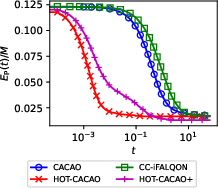
Figure 5: Energy density dynamics in large-scale 3-SAT; higher-order terms accelerate relaxation and enrich exploration.
- Control Strengths: Norms of control parameters (∥βY∥, ∥βX∥, ∥β∥) reveal that higher-order terms facilitate convergence in control norms themselves, facilitating more efficient descent to minima. HOT-CACAO+ features non-monotonic behavior, with peaks in N=1040, indicative of strategic exploration rather than purely greedy descent.
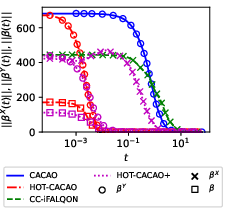
Figure 6: Time evolution of control strengths; HOT-CACAO+ achieves rapid control relaxation and more effective search.
Fundamental Contrasts: Quantum vs. Classical Dynamics
The paper advances a theoretical argument that quantum globality (Schrödinger dynamics) favors collective, correlated exploration under homogeneous control, while classical locality (canonical dynamics) benefits from independent, inhomogeneous driving. This insight is manifested in the observed contradiction: quantum dynamics are impaired by local parameter control (iFALQON) but classical dynamics are accelerated.
Additionally, classical algorithms can directly operate on higher-order polynomial optimization (HUBO) without order reduction—contrasting sharply with the auxiliary variable overhead in quantum and quantum-inspired QUBO solvers.
Conclusion
This study formalizes the classical counterparts to feedback-based quantum optimization algorithms and demonstrates both the quantum advantage of FALQON in solution quality and the computational efficiency and scalability of HOT-CACAO+ for large-scale HUBO. Strong numerical results substantiate the claim that higher-order and problem-Hamiltonian inclusion are critical for classical scalability, while quantum algorithms deliver marginally superior minima but suffer from overhead.
Classical algorithms, bypassing the measurement and iterative feedback intrinsic to quantum protocols, are substantially more efficient and viable for direct HUBO solving. Theoretical implications extend to future algorithmic design: leveraging locality/globality, higher-order interaction terms, and parameter expressivity will be pivotal for scalable combinatorial optimization.
Investigating systematic comparisons under fixed computational budgets and extending classical algorithms to broader optimization domains constitute important directions for subsequent research.

