- The paper provides a first-principles derivation identifying graviton Bremsstrahlung as a mechanism for gravity-induced decoherence.
- It employs the quantum Boltzmann equation in the Born–Markov regime to reveal decoherence rates scaling quadratically with the number of constituents.
- The results bridge microscopic quantum dynamics with macroscopic classical behavior, offering measurable predictions for future experiments.
Microscopic Gravity-Induced Decoherence: Graviton Bremsstrahlung in Collapse Models
Overview and Motivation
The article "Microscopic Origins of Collapse Models: Decoherence from Graviton Bremsstrahlung" (2605.12955) addresses the quantum measurement problem by constructing a fully quantum field-theoretic basis for gravity-induced decoherence and collapse, integrating quantum Boltzmann kinetic theory with explicit fermion–graviton interactions. Traditionally, collapse models like the Continuous Spontaneous Localization (CSL) and Díosi–Penrose (DP) frameworks have posited gravitational mechanisms for wavefunction collapse via phenomenological modifications to quantum dynamics. This work advances the theoretical underpinning of such models by establishing decoherence from first principles, identifying graviton emission (Bremsstrahlung) as the microscopic physical process effecting the loss of quantum coherence in matter superpositions.
Quantum Boltzmann Equation and Graviton Emission
The central theoretical tool in the paper is the quantum Boltzmann equation (QBE) for open quantum systems, offering a momentum-resolved master equation for the evolution of a reduced density matrix. The QBE is formulated in the Born–Markov regime, which is justified for weak gravitational interactions and negligible system–environment memory effects. The authors consider a spatially superposed spin-$1/2$ system (qubit) as the emitter of gravitational radiation.
Using canonical quantization in the weak-field limit, the graviton field is treated as a linear perturbation of Minkowski spacetime. The fermion–graviton interaction, responsible for Bremsstrahlung emission, enters the QBE as the dissipator (collision integral). The emitted graviton effectively records which-path information, leading to decoherence of the matter state.
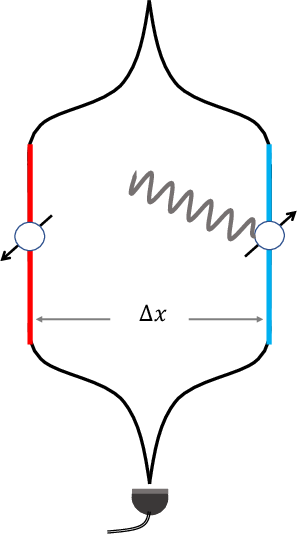
Figure 1: Graviton Bremsstrahlung process from a fermion in a spatial superposition state.
The evolution of the off-diagonal elements of the reduced density matrix ρ12(t), encoding the quantum coherence, follows a pure dephasing Lindblad equation,
ρ˙12(t)=−Γ(Δx)ρ12(t),
where the decoherence rate Γ(Δx) is a functional of the gravitational coupling, wavepacket separation, fermion mass, and graviton spectral density. In the limit of vanishing superposition spatial separation, Γ→0, and coherence is preserved; for macroscopic separations, Γ is maximized, yielding rapid decoherence.
Analytical Results and Scaling
The derived decoherence rate
Γ(Δx)=16mf2κ2V∫0∞2π2p2dpI~(g)(p)[G(Δx)−p∣Δx∣sin(p∣Δx∣)]
features a dependence on both the system's spatial extent and the spectral occupation of graviton modes I~(g)(p). The analysis demonstrates that while for an electron or atom this rate is minuscule (characteristic decoherence times exceed experimental scales), for composite systems the rate exhibits coherent quadratic enhancement in the number of constituents N, i.e., ΓN∼N2Γ1.
For large ρ12(t)0, corresponding to macroscopic objects, graviton-induced decoherence rates become significant, dynamically selecting localized pointer states and suppressing coherent spatial superpositions. This theoretical framework provides a rigorous physical realization of the amplification mechanism central to collapse models, quantitatively capturing the transition from quantum to classical dynamics.
(Figure 2)
Figure 2: Contour plot of the gravitationally induced decoherence time ρ12(t)1 as a function of total mass ρ12(t)2 and number of constituents ρ12(t)3, showing the rapid loss of coherence for large composite systems.
Numerical estimates based on plausible graviton backgrounds and typical wavepacket localizations yield
- ρ12(t)4,
- ρ12(t)5 for ρ12(t)6,
- ρ12(t)7--ρ12(t)8 for ρ12(t)9.
This hierarchy confirms that single-particle graviton decoherence is negligible, while many-body cooperative effects dominate in the classical limit.
Theoretical and Experimental Implications
The field-theoretic derivation exposes the inadequacy of phenomenological modifications that neglect the microscopic structure of matter–gravity couplings. Notably, the quadratic mass scaling emerges naturally from coherent superpositions of graviton emission amplitudes, bridging the gap between quantum field theory and the macroscopic suppression of interference central to DP/CSL models.
The direct mapping of this formalism onto all key CSL/DP features, including norm-preserving evolution and quadratic amplification, provides a strong theoretical benchmark for collapse phenomenology. It also suggests a principled route for parameter constraints via non-interferometric probes, such as spontaneous heating and decay in Bose–Einstein condensates, and noise measurements in gravitational-wave detectors.
These results sharpen the theoretical basis for experimental tests of gravity-induced decoherence. In the transition regime (large molecules, nanoparticles), upcoming precision matter-wave and optomechanical experiments may approach sensitivity where graviton-induced decoherence could, in principle, be probed or constrained.
Future Directions
The field-theoretic QBE framework adopted here sets the stage for several future developments:
- Extension to structured and dynamical graviton backgrounds: Incorporating cosmological or instrument-induced backgrounds could refine predictions for laboratory scenarios.
- Generalization to non-Markovian and strong-coupling regimes: Exploring the limits of the Markovian QBE could reveal corrections relevant in high-curvature or high-density environments.
- Multibody and non-Gaussian wavepackets: Going beyond the simple spatial superposition state, analyzing complex many-body wavefunctions will be crucial for understanding decoherence in condensed matter, astrophysics, and quantum gravity contexts.
- Comparison with non-gravitational environmental decoherence mechanisms: Disentangling graviton-induced decoherence from electromagnetic or phononic backgrounds is essential for any conclusive experimental observation.
Conclusion
This work establishes a rigorous, first-principles field-theoretic mechanism for gravity-induced decoherence by explicitly computing the effect of graviton Bremsstrahlung on spatial superpositions of matter. The resulting decoherence dynamics reproduce and refine the core features of phenomenological collapse models, providing an internally consistent amplification mechanism and connecting the microscopic description of quantum matter to emergent classicality. This theoretical advance has significant implications for experimental searches for quantum-to-classical transition mechanisms rooted in gravity and sets a robust agenda for the foundational study of quantum mechanics and quantum gravity.